A new dynamic
The rules of the traditional career ladder appear to be being rewritten, and it is the AI-fluent workforce that is the catalyst. As the first AI-native cohort enters work, businesses should expect shifts not only in technology adoption, but in how teams are managed.
For decades, the pattern was always the same. Experience flowed downwards, and senior colleagues trained juniors. The introduction of AI however, means knowledge now needs to flow upwards as well.
Intuit QuickBooks surveyed 1,000 18–24-year-old accountancy students and early-career finance professionals in Australia. Almost all respondents (92%) feel prepared to succeed in their first AI-enabled workplace. Nearly the same proportion (93%) believes they will be better equipped to use AI tools than future managers or senior colleagues. Only 15% believe they should wait for senior managers to lead the way.
It could be easy to chalk these figures up to the overconfidence of would-be Gen Z workers, many of whom are yet to experience life at the coalface. But this would be an oversimplification, and more than half of this sample have already hit the job market. The future workplace isn’t one where junior staff seek to seize control from their more seasoned counterparts. However, there may be a need to review and adapt management structures, particularly those that are wrapped around junior staff.
The AI-native workforce is here
Meet the AI generation. For this cohort, AI isn’t a sandpit for testing and experimentation. AI is their everyday reality and work without these tools is inconceivable. The majority (89%) think they would be slower without AI tools, 93% say AI will be a vital partner in career growth, and 83% believe AI will become an essential skill for accountants in every role.
Universities are already seeking to adapt to the widespread use of AI in assignments. According to 2026 HEPI research, 94% of UK undergraduates use generative AI to help with assessed work. Australian students are moving just as fast: the 2025 Australian Digital Inclusion Index, from RMIT, Swinburne and Telstra, found 79% of Australian students have recently used generative AI, the highest adoption rate of any group surveyed. And in Intuit QuickBooks’ research, 75% of early-career accountancy and finance respondents use AI daily or multiple times a day to learn, work and problem-solve. Most graduates are entering work with habits already formed.
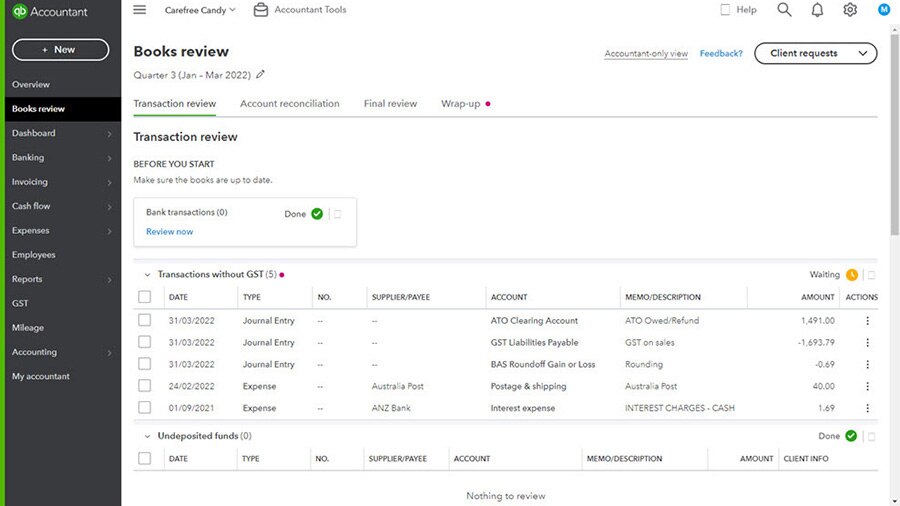
Those habits will inevitably shape what they expect from the workplace. For a generation accustomed to using AI to learn, solve problems and work more efficiently, access to intelligent tools will increasingly be an expectation rather than a perk. That means firms need to consider not only how they adopt AI, but how they embed it into the everyday workflows of their people. Intuit is doing exactly that through Intuit Intelligence, integrating AI directly into financial workflows to help tackle routine work, surface insights and support better business decisions.
Mind the capability gap
There are two camps starting to establish themselves, and a potential capability gap in the middle. On one side, there are the more experienced colleagues who hold deeper professional judgement, business context and regulatory knowledge. On the other, there are the junior colleagues who hold stronger fluency in everyday AI use.
This spread of skills can be both a blessing and a curse. In one scenario, the team could become polarised, with each camp dissatisfied about how the other carries out its daily tasks. In the ideal scenario, the business leadership prevents a generational contest from deepening, acknowledges the capability gap that is present, and sets out to close that gap, pairing AI fluency with experience.
An organisation that is positioned to flourish recognises that knowledge can and should flow both ways. AI will increasingly become an important tool for the entire workforce. The goal should be one unified workforce that spans generations, where everyone feels empowered and equipped to succeed in the era of AI.
AI is accelerating early careers
As well as being a tool for efficiency and innovation, AI is also a career accelerator, a fact that hasn’t been lost on new entrants to accountancy. The Intuit QuickBooks study found that 92% believe AI will help them advance faster.
It also shows that newcomers are equally ambitious and ready to quickly progress and take on more responsibility. Traditionally, businesses have rewarded time served, technical grounding and exposure to more complex work over several years. That will not disappear, but AI could compress parts of the journey.
By taking on more of the routine, repetitive work that has traditionally occupied the early years of an accounting career, AI has the potential to give junior professionals earlier exposure to higher-value work and more opportunities to build the judgement, commercial understanding and analytical skills that underpin progression.
That shift is also changing how AI tools are being developed. Rather than simply answering questions, they are increasingly able to carry out tasks on a user’s behalf. Intuit Intelligence, for example, allows users to set up personalised automations for recurring tasks using plain language, reducing time spent on repetitive processes and freeing up capacity for analysis and decision making.
Elsewhere in the data, 34% expect stronger technical and data skills to matter more. The next generation of accountants expect rapid career progression but are cognisant of the capabilities needed to get them there. Having already used AI to support their academic work, they will expect to use it to further their careers.