Choose your... Country Language
A person sitting at a table with a laptop.
Starting a business

The Philippines: Asia’s #17 Startup Hub

When launching a new business, choosing the right location is one of the most important decisions. It affects everything—from access to skilled talent and reliable internet to the local business climate and the success of the small businesses that came before.

As a trusted authority in small business and startup accounting, Intuit QuickBooks set out to identify the most promising places in Asia for new ventures. The Asia Startup Index evaluates 17 factors that collectively define a strong startup ecosystem, including infrastructure, funding opportunities, cost considerations, business environment, and workforce skills. 

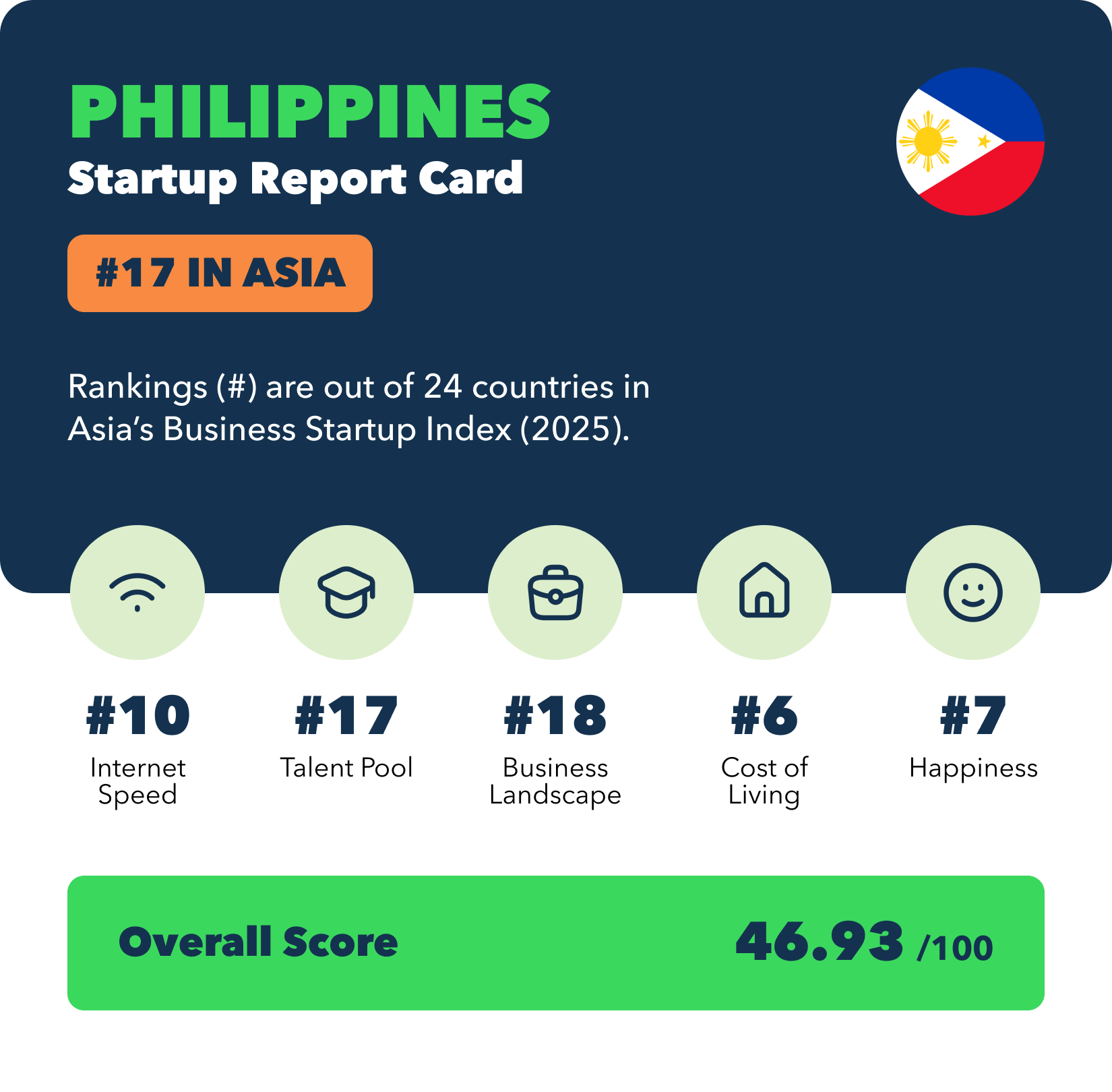
This article focuses on the Philippines, which ranked 17th overall in the Index. We’ll explore the country’s performance across these categories and unpack what the findings mean for entrepreneurs considering their options in this part of the world.

The Philippines: Key Insights

The Philippines ranked #17 overall, standing out for its strong economic growth, youthful workforce, and low operating costs. For entrepreneurs, this country offers a number of advantages that are appealing for certain types of businesses.

Key Findings: 

  • The Philippines ranked 17th overall with a total score of 48.48/100.
  • Predicted GDP Growth in 2026 (5.5%, 6th place): The Philippines is among the fastest-growing economies in Asia, with steady expansion driven by services, remittances, and a rising digital sector.
  • Internet Speed (60.0/100, 10th place): The Philippines recorded an average broadband speed of 108.4 Mbps, placing it slightly below the Asia average but still within the regional top 10.
  • Workforce Advanced Education (71.2%, 10th place): The Philippines continues to move up the ranks with a workforce eager to pursue further education and training.
  • Weekly Rent ($71 USD, 6th place): Affordable rental costs make it easier for startups to keep overheads low, particularly when setting up offices in urban hubs.
  • Happiness (6.1/10, 6th place): A relatively high happiness score reflects strong community spirit and quality of life—factors that contribute to a supportive environment for entrepreneurs and employees alike.
A person holding a piece of paper in their hand.

The Best Countries in Asia to Start a Business

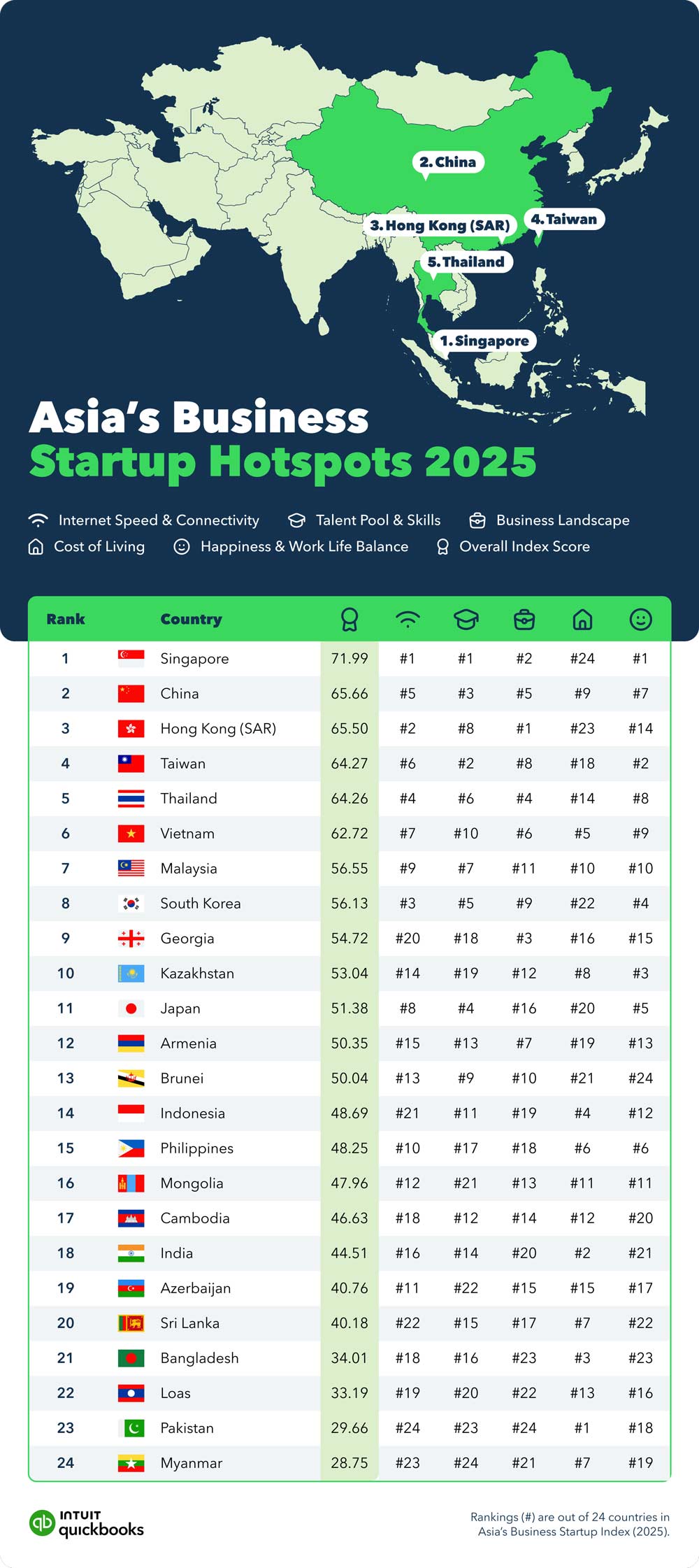
The Asia Startup Index Study highlights the region’s most promising environments for entrepreneurs, ranking 24 countries on a range of factors. At the very top, Singapore claims the number one position, reflecting its strong digital infrastructure, educated workforce, and competitive business landscape. Other high performers include China, Hong Kong (SAR) and Thailand—each offering their own unique advantages for founders looking to establish or expand their ventures.

Within this competitive landscape, the Philippines has carved out its place, ranking 17th overall. Its performance is shaped by a combination of robust economic growth, a youthful workforce, and comparatively low operating costs, which make it an appealing option for certain types of businesses. With predicted GDP growth of 5.5% in 2026 (among the highest in the region), the country is showing resilience and momentum that entrepreneurs can tap into. Affordable rental costs and above-average internet speeds further contribute to its attractiveness as a launchpad for startups.

For founders exploring opportunities across Asia, the Philippines demonstrates how a developing economy can offer both value and potential. 

The Philippines’ Rank for Startup Factors

For this study, Intuit QuickBooks conducted an analysis of 17 key indicators that can contribute to the success of startup businesses in that country. These indicators were then grouped into five categories:

1. Internet Speed: Fast and reliable internet connectivity makes a huge difference when starting a business, especially when you’re relying on remote collaboration. This study measured the average broadband speed (Mbps) across 24 countries in Asia.  

2. Talent Pool: Three indicators were measured as part of this category:

  • AI readiness: A country’s preparedness for AI adoption gives startups an edge by making advanced tools and technologies easier to access and integrate.
  • Workforce Advanced Education (%): A highly educated workforce gives startups access to skilled talent—driving innovation, efficiency, and faster growth.
  • Average monthly net salary (USD): Higher wages indicate stronger purchasing power and talent attractiveness.

3. Business Landscape: We measured a number of factors that reveal how smooth (or challenging) it is to run a company day-to-day. These factors included:

  • FDI net inflows (% GDP): More foreign investment suggests an open, attractive economy.
  • Business density (new firms per 1 000): More new firms signal a dynamic start‑up scene.
  • Predicted GDP growth 2026 (%): Faster growth suggests expanding markets.
  • Private credit (% GDP): Higher credit depth indicates a well‑developed banking sector.
  • Time to start business (days): Fewer days mean less bureaucratic delay.
  • Cost to start business (% GNI): Lower costs ease entry.
  • Corporate tax rate (%): Lower taxes reduce ongoing liabilities.
  • Prime lending rate (%): Lower interest rates improve access to finance.
  • Inflation rate (%): Low inflation preserves purchasing power and reduces uncertainty.
  • Unemployment rate (%): Lower unemployment implies a strong labour market.

4. Cost of Living: High costs shorten the runway for early-stage startup ventures, while affordable markets give founders more breathing room to experiment and scale. For this category, we considered the following:

  • Weekly rent (USD): Lower rents reduce start‑up operating costs.
  • Cost of living index: Lower living costs stretch founders’ runway and wages.

5. Quality of Life: A happier workforce is more engaged and productive, and founders thrive when they can balance personal wellbeing with professional success. 

Next, we’ll reveal how the Philippines scored within these categories, and explain in greater detail how these metrics affect startup businesses.

The Philippines’ Internet Speed & Connectivity: #10 in Asia

The Philippines ranked 10th out of 24 countries in our study for internet speed, with an average broadband speed of 108.4 Mbps. This places the country below the regional average, highlighting ongoing challenges in connectivity.

For comparison, Singapore leads Asia with 393.2 Mbps, followed by Hong Kong at 323.9 Mbps and South Korea at 278.7 Mbps, while Pakistan sits at the lower end with 16.2 Mbps.

Strong internet connectivity is essential for modern businesses, enabling cloud collaboration, e-commerce, and customer engagement. While the Philippines’ broadband speed remains below the regional average, continued investments in fiber networks and mobile infrastructure are helping to close the gap—creating a more reliable digital foundation for the country’s growing startup ecosystem.

The Philippines’ Talent Pool & Skills: #17 in Asia

The Philippines ranked #17 in Asia with an overall talent score of 34.23/100.

Key insights:

  • AI readiness: 58.5/100 preparedness for AI adoption. 
  • Workforce with advanced education: 71.2% of workers in the Philippines are tertiary educated.
  • Average monthly income: $391 USD, making it the 6th cheapest country in this study (regional average: $1,056 USD).

The country offers a mix of skilled talent, AI preparedness, and cost-effective wages, providing a foundation for startups to scale efficiently.

Here’s what the data revealed:

AI Readiness: 58.5/100

In terms of AI readiness, the Philippines scored 58.5/100, above the regional average of 56.23/100. This reflects moderate preparedness to adopt AI technologies, including workforce skills, digital infrastructure, and supportive policies.

Workforce with Advanced Education: 71.2%

A well-educated workforce supports innovation and business growth. With 71.2% of workers holding tertiary qualifications, the Philippines ranks well in terms of human capital benefiting startups.

Average Monthly Income: USD $391

Average monthly income in the Philippines is relatively low, at $391 USD, ranking the country 15th in the study and below the regional average of $1,056 USD. This enables startups to access skilled talent cost-effectively, though lower wages may limit local purchasing power and market demand.

Overall, the Philippines’ combination of AI readiness and a well-educated workforce provides a foundation for businesses to grow, innovate, and scale—particularly for startups looking to leverage talent in a cost-effective environment.

The Philippines’ Business Landscape: #18 in Asia

For this category, the Philippines ranked #18 in Asia with an overall score of 42.37/100. 

Key insights:

  • Predicted GDP growth 2026: 5.5% (within the top 5 in Asia)
  • Prime lending rate: 7.1% (#9 in Asia)
  • Inflation rate: 3.2% (Regional average: 4.44%)
  • Unemployment rate: 2.2% (#4 in Asia)

While the Philippines ranks mid-range overall, several indicators highlight its strong potential as a destination for entrepreneurs. High projected GDP growth and low inflation point to a resilient and expanding economy. Combined with a young, active workforce, these trends position the Philippines as one of Asia’s most promising emerging startup markets.

Foreign Direct Investment (FDI) Inflows

FDI inflows measure international investor confidence and capital availability.

The regional average is 4.2%, placing the Philippines slightly below that level. It remains significantly higher than many developed Asian economies such as Japan (0.4%) and South Korea (1.1%). This reflects a healthy mix of foreign participation without overdependence on external capital.

The Philippines continues to attract steady foreign investment, though inflows remain below leading economies like Hong Kong and Singapore. Ongoing efforts to improve regulatory transparency and simplify business registration are expected to strengthen investor participation over time.

Business Density

Business density—measured as the number of new firms per 1,000 people—reflects the entrepreneurial activity within a country.

While the Philippines’ new-business formation rate (0.3 per 1,000 people) remains below the regional average, it’s notably higher than several large emerging markets—including India (0.2) and Pakistan (0.2)—and on par with Indonesia, one of Southeast Asia’s leading economies.

Predicted GDP Growth 2026: 5.5%

The Philippines is projected to grow by 5.5% in 2026, ranking 5th in Asia, behind India, Mongolia, Georgia, and Vietnam.

This strong forecast signals rising consumer demand, expanding domestic markets, and an increasingly dynamic business environment—offering startups room to scale.

Private Credit

Access to private credit is essential for startup growth.

At 49.8% of GDP, the Philippines’ private credit depth outpaces most emerging Asian economies, including Indonesia, Bangladesh, and Turkey, indicating a relatively mature and expanding banking sector.

Time to Start a Business

Ease of business registration is a key factor in entrepreneurial growth.

In the Philippines, starting a business takes around 33 days—making it the fourth longest timeframe among countries in the study, behind Iran (72.5 days), Cambodia (99 days) and Laos (173 days). This is well above the regional average of 19.6 days.

While the government has introduced reforms to simplify the process, registration remains slower than in leading economies such as Singapore and Hong Kong. Ongoing efforts to digitize systems and cut bureaucratic steps are gradually improving efficiency. Each reduction in registration time represents progress towards a more accessible and competitive business environment, where entrepreneurs can move from idea to operation with fewer delays.

Cost to Start a Business

At a fraction of the cost seen in more developed economies, the cost to start a business in the Philippines remains relatively low.

At 23.3% of GNI, the cost to start a business in the Philippines is higher than the regional average but still considerably lower than in many developing and emerging markets such as Cambodia (53.4%), Lebanon (42.3%), and Iraq (34.2%). This places the Philippines in a mid-tier cost bracket, suggesting meaningful progress toward affordability while highlighting further opportunities for reform.

Corporate Tax Rate

At 25%, the Philippines’ corporate tax rate aligns with major Asian economies such as China and India, remaining well below markets like Japan (30.6%) and Sri Lanka (30%). While slightly above the regional average, it reflects a balanced fiscal approach that maintains competitiveness while supporting infrastructure and public investment.

Reforms under the Corporate Recovery and Tax Incentives for Enterprises (CREATE) Act have gradually reduced rates, making the environment more competitive and appealing for both local and foreign investors.

Lending Rate: 7.1%

The prime lending rate in the Philippines stands at 7.1%, ranking #9 in Asia.

While borrowing costs are higher than some regional peers, the steady rate supports predictable financial planning for startups seeking loans to expand or invest in new projects.

Inflation Rate: 3.2%

Inflation remains well-controlled at 3.2%, less than half the regional average of 4.44%.

This stability reduces uncertainty for founders and investors, helping businesses plan confidently and manage costs with greater predictability.

Unemployment Rate: 2.2%

The Philippines has one of the lowest unemployment rates in Asia, at 2.2%, ranking #4 overall.

A young and active workforce provides startups with access to motivated talent, supporting innovation and steady economic momentum.


The Philippines’ Cost of Living for Startups: #6 in Asia

The Philippines is an affordable place to live, with an overall score of 26.40/100 in the Cost of Living category (6th place). 

Key insights:

  • Weekly rent (USD): The Philippines’ average weekly rent is just USD $71, making it the 6th most affordable in the study.
  • Cost of living index: The cost of living in the Philippines is relatively low. It scored 29.5/100 in our study, putting it in 9th place. For context, the regional average was 36.93/100.

Here’s exactly what the data revealed:

Average Weekly Rent: USD $71

The Philippines average weekly rent is just USD $71, placing it the 6th cheapest in the study. 

Affordable housing costs make it easier for founders and employees to manage living expenses while focusing on business growth.

Cost of Living Index: 29.5/100

The country scored 29.5/100 on the cost of living index, ranking 9th in Asia and well below the regional average of 36.93/100. By comparison, Singapore had the highest cost of living at 85.3/100, underscoring just how accessible day-to-day expenses are in the Philippines.

For startups, these lower costs provide a tangible advantage—greater flexibility to allocate resources to innovation, operations, and expansion instead of high overheads.

The Philippines’ Quality of Life: #3 in Asia

The Philippines ranked #3 in Asia for quality of life, with a score of 75/100 for the category. 

The happiness index score was 6.1/10, well above the regional average of 5.40/10. In comparison, Singapore scored the highest at 6.5/10, while Sri Lanka ranked lowest with 3.9/10.

For startups, this creates an encouraging environment in which founders and employees can thrive. A happier population often translates into a healthier workplace culture, stronger community support, and higher employee satisfaction—factors that can make a real difference when building and sustaining a business. The Philippines’ ranking suggests that entrepreneurs here don’t have to sacrifice work-life balance in pursuit of growth, making it a compelling choice for those seeking both opportunity and quality of life.

Why the Philippines is a Startup Hub

The Philippines is emerging as a strong contender in Asia’s startup landscape, ranking 17th overall in our study. With one of the fastest-growing economies in the region (5.5% GDP growth predicted for 2026), affordable living costs, and a workforce eager to up-skill, the country offers a promising foundation for new businesses. Its above-average internet speed, competitive rental prices, and supportive social environment further enhance its appeal for entrepreneurs looking to balance growth opportunities with quality of life.

Ready to launch your business in the Philippines? Discover how Intuit QuickBooks Online can help simplify accounting, cash flow, and compliance for your startup.

If you’re curious to see how the Philippines compares with other leading hubs across Asia, you can explore the reports for Malaysia, Singapore, and Hong Kong. You can also visit our startup guides to learn more about starting a business in the Philippines.

In short, the Philippines combines rapid growth with cost efficiency and an improving business environment—making it an increasingly attractive launchpad for ambitious entrepreneurs across Asia.

What the Experts Say

Many factors can affect a country’s business startup worthiness. For additional insight, we asked Michael Aguirre, Founding and Senior Partner of UHY M.L. Aguirre & Co., for his thoughts.

A person in a suit and tie smiles.

“The Philippines offers a compelling environment for entrepreneurs,” says Michael Aguirre, Founding and Senior Partner at UHY M.L. Aguirre & Co. “With a strong GDP growth forecast of 5.5%, low inflation at 3.2%, and an unemployment rate of just 2.2%, the country presents a stable and cost-effective business landscape. While internet speeds remain below the regional average, ongoing improvements in digital infrastructure and AI readiness are clear signs of progress. Affordable operating costs—like weekly rents averaging just $71—combined with a young, skilled workforce will continue to attract both local and international startups in the years ahead.”

Methodology 

The aim of this study was to help founders compare the ease and appeal of launching a business across Asia. Rather than focusing on just one aspect (like tax rates or venture capital), Intuit QuickBooks pulled together a broad basket of 17 indicators. These cover:

  • Infrastructure: How fast and reliable your internet connection is (average broadband speed).
  • Capital access: How much foreign investment a country attracts and how deep its banking sector is (FDI inflows and private credit as a share of GDP).
  • Costs: Rent, cost of living, net salaries, corporate tax and lending rates, and the cost of starting a company.
  • Business environment: How long it takes to register a company, how easy the process is, and expected economic growth.
  • Talent and fundamentals: Workforce with advanced education, unemployment and inflation rates, happiness scores, and a government AI‑readiness rating.

We chose these factors because a healthy start‑up ecosystem needs both affordable overheads and access to talent, capital, and stable economic conditions.

How we standardized data indicators for comparison

Each indicator (Mbps, dollars, percent of GDP, number of days) was measured differently. To put them on the same footing we turned every value into a percentile score. Think of a percentile as a “score out of 100” showing how a country ranks against its peers: the higher the percentile, the better. For indicators where bigger numbers are good (like faster internet or more FDI), higher values got higher percentiles. For indicators where smaller numbers are preferable (like lower rent or taxes), we flipped the values so that a smaller cost results in a higher percentile. This way, “better” always translates into a higher score.

Treating all metrics equally

Rather than arbitrarily deciding that, say, broadband speed is twice as important as inflation, we simply averaged the percentile scores. Each of the 17 indicators counts the same towards the final score. If data for a country were missing (for example, Taiwan’s FDI figure or a recent lending rate for Laos), we averaged only the available metrics. This avoids penalizing countries for gaps in international data, but it also means scores for those countries are based on fewer inputs and should be interpreted cautiously.

Where does the data come from?

Most numbers come from recognized international sources such as the World Bank, IMF, Oxford Insights, UN Happiness Report, the Speedtest Global Index, and national statistics. For living costs and rents, we used Numbeo, which aggregates user‑submitted prices; this provides broad coverage but may not match official statistics. We always used the most recent year available (usually 2023–2024, 2024-2025) but note that for some indicators (like prime lending rates in Japan or Laos) the latest official data are a few years old. Corporate tax rates are headline statutory rates; actual liabilities can differ depending on incentives or sectors.

Reading the results

The final index produces a score between 0 and 100. A higher score means a country offers faster internet, more investment, lower operating costs, better talent supply and a more favorable regulatory climate, on average. Singapore leads the ranking thanks to world‑class digital and financial infrastructure, fast incorporation and abundant skilled workers. Malaysia is mid‑table, benefiting from low costs and a healthy banking sector but still facing some red tape. The Philippines falls lower due to slower digital speeds and longer start‑up times, despite its strong growth and young workforce.

Caveats to keep in mind

  • Data gaps: Not every country reports every metric. Missing values are omitted from that country’s average, which can boost or dampen the overall score.
  • Data freshness: Some metrics, particularly lending rates, use the most recent available figure even if it dates back a few years.
  • Crowd‑sourced data: Numbeo figures on rent and living costs are based on user submissions and may be less precise than official statistics.
  • Tax and regulatory complexity: Headline corporate tax rates and ease‑of‑doing‑business scores don’t capture all sector‑specific incentives or bureaucratic nuances.
  • Outliers: For visual comparisons, we trimmed obvious outliers (e.g., extreme FDI and inflation values) to make charts easier to read. The index calculation still uses the full dataset.

Related Articles