

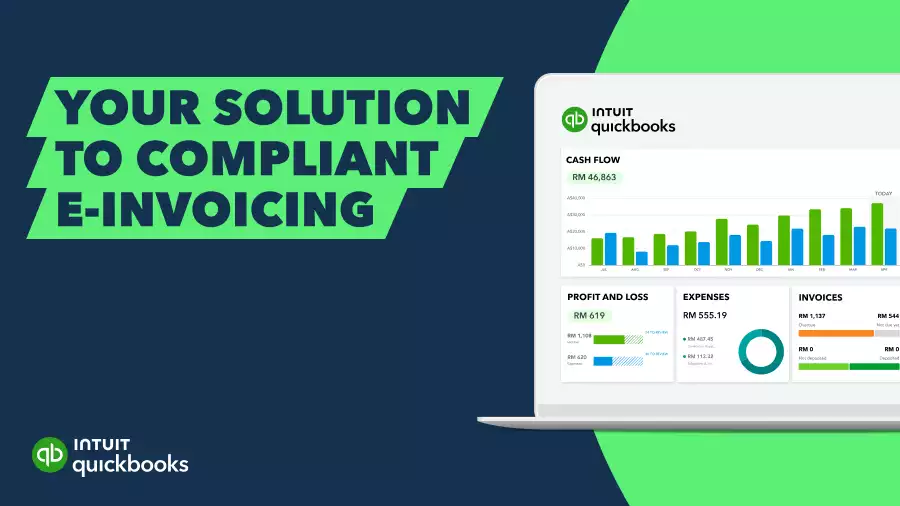
Introducing simple e-invoicing!
Fully LHDN compliant on all
QuickBooks plans.
Introducing simple e-invoicing!
Fully LHDN compliant, integrated
with QuickBooks online Accountant.
FINAL DAYS
70% off
for 3 months
FINAL DAYSStart fresh this new year with QuickBooks Online
DON'T MISS OUT
Buy now and get 70% off for 3 months Claim offer
DON'T MISS OUT
Claim offer
SALE
Buy now and
save up to 50% off today
See plans + pricing
Choose your... Country Language
Image Alt Text
Invoicing

An Accountants Edge: How QuickBooks e-Invoicing is Helping Me Future-Proof My Clients

The accounting landscape in Malaysia is shifting. Fast.

Since March 2023, the Inland Revenue Board of Malaysia (IRBM) has been progressively implementing mandatory e-invoicing across the nation marking a new era of digital financial operations. This significant change not only impacts how we as practitioners help clients adapt to these regulations but it also how our clients run their businesses.

The journey began with Phase 1 on 1 August 2024, targeting businesses with a turnover exceeding RM 100 million, followed by Phase 2 on 1 January 2025 for companies exceeding RM 25 million. These "early adopters" are now submitting their e-invoices to the IRBM.

Phase 3 of Malaysia's e-invoicing rollout is rapidly approaching, commencing on 1 July 2025. This vital phase will encompass businesses with an annual turnover between RM 5 million and RM 25 million, and means that businesses in this bracket should be actively preparing for the July deadline. Looking ahead, Phases 4 and 5 will be rolled out on 1 January 2026 and 1 July 2026 respectively, bringing all businesses (except exempted ones) into the e-invoicing fold.

I see a significant opportunity for accountants to not only support our clients as compliance officers but also as strategic partners in helping prepare our clients for these changes.

I’ve already started this journey with QuickBooks’ new in-product e-invoicing feature, and I’d like to share what we’ve learnt and how we’re preparing our clients.


Why QuickBooks for e-Invoicing

At InTune Outsourcing, we’ve long been using QuickBooks for our client accounting needs well before e-invoicing was announced.

When the new feature rolled out, it became immediately clear—this was a feature not only to help clients stay compliant with Malaysian tax mandates but would also streamline their operations.

Here’s what stood out:

  • Seamless LHDN validation: Every e-invoice can be submitted for validation by LHDN directly from QuickBooks. Once submitted from QuickBooks, every e-invoice is automatically validated by the LHDN. 
  • One dashboard, full visibility: Clients can track the e-invoice statuses—submitted, approved, rejected—in one simple dashboard.
  • The consolidated e-invoicing feature will help our customers with high invoice volumes by allowing them to combine and send all of the outstanding invoices for the month in a single invoice to the LHDN for validation. 

It’s rare for a tool to feel like it helps accountants and our clients. But this one does.

How we’re preparing our clients

My clients are worried about e-invoicing, they’re afraid of non-compliance, and they rely on me and my team for answers. 

Here are my top tips:

  • Group your clients based on turnover and map to the mandatory implementation date.
  • Look from the perspective of Processes, People & Technology (PPT):
  • Processes
  • Get your clients registered on IRBM MyInvois Portal and appoint their representatives. 
  • Review operational processes and workflow to assess if adjustments are required to comply with e-invoicing.
  • Additional policies, like staff claims policy, needs to be added to comply with e-invoicing. Another example would be the cut off dates for retail customers to request for e-invoice.
  • Update the customers and suppliers information with e-invoice details.
  • People
  • Ensure that all staff from various departments understand the fundamentals of e-invoicing and the impact on their work and company. This can be done through trainings.
  • Technology
  • Ensure that clients have key details to hand when completing the set-up process in QuickBooks including TIN, BRN, SST ID (if applicable), MSIC Code, and Business Activity Description.
  • Assist with the Digital Certificate (if required).

In fact, as a practice, we think this change brings several value-added advisory opportunities:

  • Training and change management: Many businesses will require training for their accounting, sales, procurement, and human resources teams, on the new e-invoicing processes and software. Accounting firms can develop and deliver these training programs.
  • Tax implications and strategy: While e-invoicing streamlines compliance, there might be nuanced tax implications, especially for complex transactions or cross-border trade. Again accounting firms can provide specialised tax guidance and advise on tax strategies within the e-invoicing framework.
  • Automation and digitalisation of workflow: Accounting firms can take this opportunity to enrol businesses who are still operating manually to automate and digitise their operational workflow by moving to QuickBooks Online.

Advice to my fellow Accountants: Don’t Wait

If you’re reading this and still relying on spreadsheets, external validation tools, or manually uploading files to the MyInvois Portal—I understand, change takes time.

But waiting until July isn’t the answer.

Start now.

Start with a few clients. Explore the feature. If you’re an existing QuickBooks customer, speak to the QuickBooks team. Build an understanding of the feature is—especially for firms like ours who handle multiple SME clients across industries.

I’ve spoken to fellow ProAdvisors, and there’s a shared sentiment:

“The QuickBooks Online e-invoicing features are simple and easy to use.”

This is particularly helpful for businesses like retailers with a high volume of transactions. 

There is also self-billed e-invoicing, which allows customers to record and submit transactions that do not follow standard e-invoicing workflows.

Educate yourself with these resources

If you want to see how QuickBooks e-Invoicing works in action, I highly recommend checking out these educational resources:

If you’re an existing QuickBooks customer, get in touch with your support team. They understand accountants and can help you onboard your clients.

A final thought

We talk a lot about “adding value” as accountants. This is one of those rare opportunities where tech, timing, and trust intersect, and give us a clear path to do just that.

With QuickBooks' e-Invoicing, it's not just helping our clients stay ahead of Malaysian tax mandates, it’s also surprisingly easy for them to generate, submit, and track their e-invoices—helping our clients to focus on running their businesses

QuickBooks has given us the tools. The next move is ours.