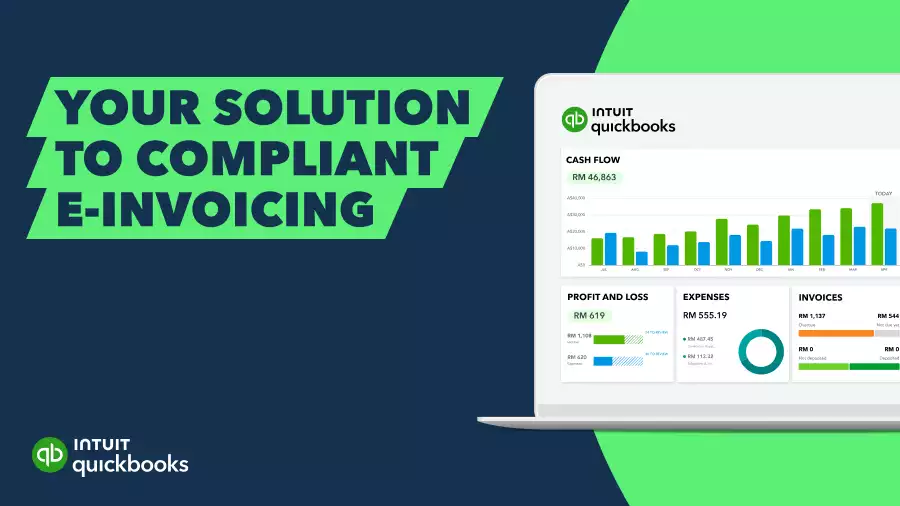
Many businesses in Malaysia will soon be required to send individual digital e-invoices to customers in the format outlined by the Inland Revenue Board of Malaysia (LHDN). This national initiative requires businesses to adopt electronic invoicing and report transactions.

Choose your...

Invoicing
QuickBooks Launches LHDN Compliant e-Invoicing Solution for Malaysian Businesses
Key Takeaways:
- QuickBooks has launched an LHDN‑compliant e‑invoicing solution for Malaysian businesses to help them meet new mandatory digital invoicing requirements set by the Inland Revenue Board of Malaysia (LHDN).
- The e‑invoicing feature automates the entire process from invoice creation to direct submission to Malaysian tax authorities, reducing manual work and compliance risk.
- Businesses can validate invoices before sending, combine multiple invoices into a consolidated submission, and use self‑billed e‑invoicing for non‑standard workflows.
- The feature also shows e‑invoice status and details (such as e‑invoice ID and a QR code) directly within QuickBooks dashboards, aiding transparency and tracking.
- For accountants and finance teams, this solution simplifies compliance with Malaysian e‑invoicing mandates and streamlines operations.
What is e-invoicing?
e-Invoicing enables the automated digital exchange of billing documents between a supplier and a buyer. Essential for compliance with local laws, it ensures transparency and the streamlining of invoice handling.
You can learn more about the e-invoicing mandated timelines and what it means for your business here.
Why is e-invoicing important in Malaysia?
The Malaysian government is championing e-invoicing as part of its national digital economy strategy to achieve several objectives:
- Combat tax evasion: Ensure all business transactions are accurately reported to tax authorities.
- Enhance efficiency: Decrease reliance on time-consuming manual invoicing methods.
- Minimise operational costs: Streamline invoicing and payment processes to reduce overheads.
How are we helping our customers with their e-invoicing
The new e-invoicing feature in QuickBooks Online streamlines e-invoicing for customers by automating the entire process, from creation to direct submission to the LHDN. This is achieved through our partnership with Sovos and ensures compliance with the Malaysian tax authority (LHDN) e-invoicing requirements.

Our e-invoicing solution not only supports Malaysian businesses in meeting the Government’s compliance requirements—it also contributes to the Government’s broader goal of improving tax transparency and digital efficiency.
Customers are able to validate invoices before sending them to end-users for payment.

With the consolidated e-invoicing feature, customers can combine and send all of the outstanding invoices for the month in a single invoice to the IRBM for validation.

This is particularly helpful for businesses like retailers with a high volume of transactions.
There is also self-billed e-invoicing, which allows customers to record and submit transactions that do not follow standard e-invoicing workflows.
QuickBooks e-invoicing streamlines Malaysian tax obligations and e-invoice processes for our clients, giving them back valuable time to grow their businesses.
Bringing transparency to your e-invoicing
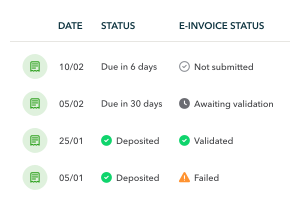
Our solution allows customers to monitor the LHDN status of e-invoices right from their QuickBooks dashboard.
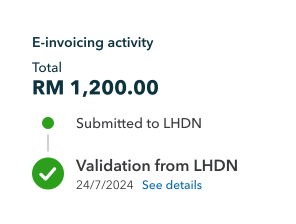
And easily see e-invoicing status activity for a particular invoice.
On the invoice, customers can also find details including the e-invoice ID and scan a QR code to verify the invoice on the IRBM website if needed.
For accountants, our solution will not only help clients stay compliant with Malaysian tax mandates but also streamline their operations.
What’s next?
You can get a head start by learning more in our e-invoicing help hub. Here you’ll find details on how to set up e-invoicing in QuickBooks online and other useful articles.
Interested in QuickBooks and this solution? You’ll find more information here along with ways to get in touch with our team.
Sales: 1800 818 232 (toll free)

