Income statement
An income statement shows a company’s revenues and expenses for a period of time. It provides information relating to returns on investments, risks, financial flexibility, and operation capabilities. The income statement formula generates an income statement. Most companies produce a multi-step income statement, which documents how a firm produces net income.
How does a multi-step income statement differ?
In a multi-step income statement, you first find your gross profit and then your operating income for a period of time.
Assume, for example, that you’re a small furniture manufacturer, and that you’re creating a multi-step income statement for May. Most of your business activity will flow through gross profit.
Your material, labour, and overhead costs post to the cost of goods sold account. In May, you sold R1,200,000 in furniture, and your cost of goods sold (material and labour costs) totalled R900,000. So you made a R300,000 gross profit.
But you also incurred expense line items—advertising costs, sales commissions, and home office costs—to operate your business in May. Let’s say those expenses totalled R170,000 for the month. You can subtract your R300,000 profit from your R170,000 expenses to find your R130,000 operating income for May.
Operating income vs. non-operating income
You can generate operating income from day-to-day business activities. In May, furniture sales produced R130,000 in operating income. Your company also earned non-operating income, including R2,000 in interest income and R4,000 from an equipment sale. So your net income for May now totals R136,000.
Your business must produce a majority of its net income from operating income activities because operating income is sustainable. Non-operating income is inconsistent and unpredictable. No company can rely on it to produce annual profits.
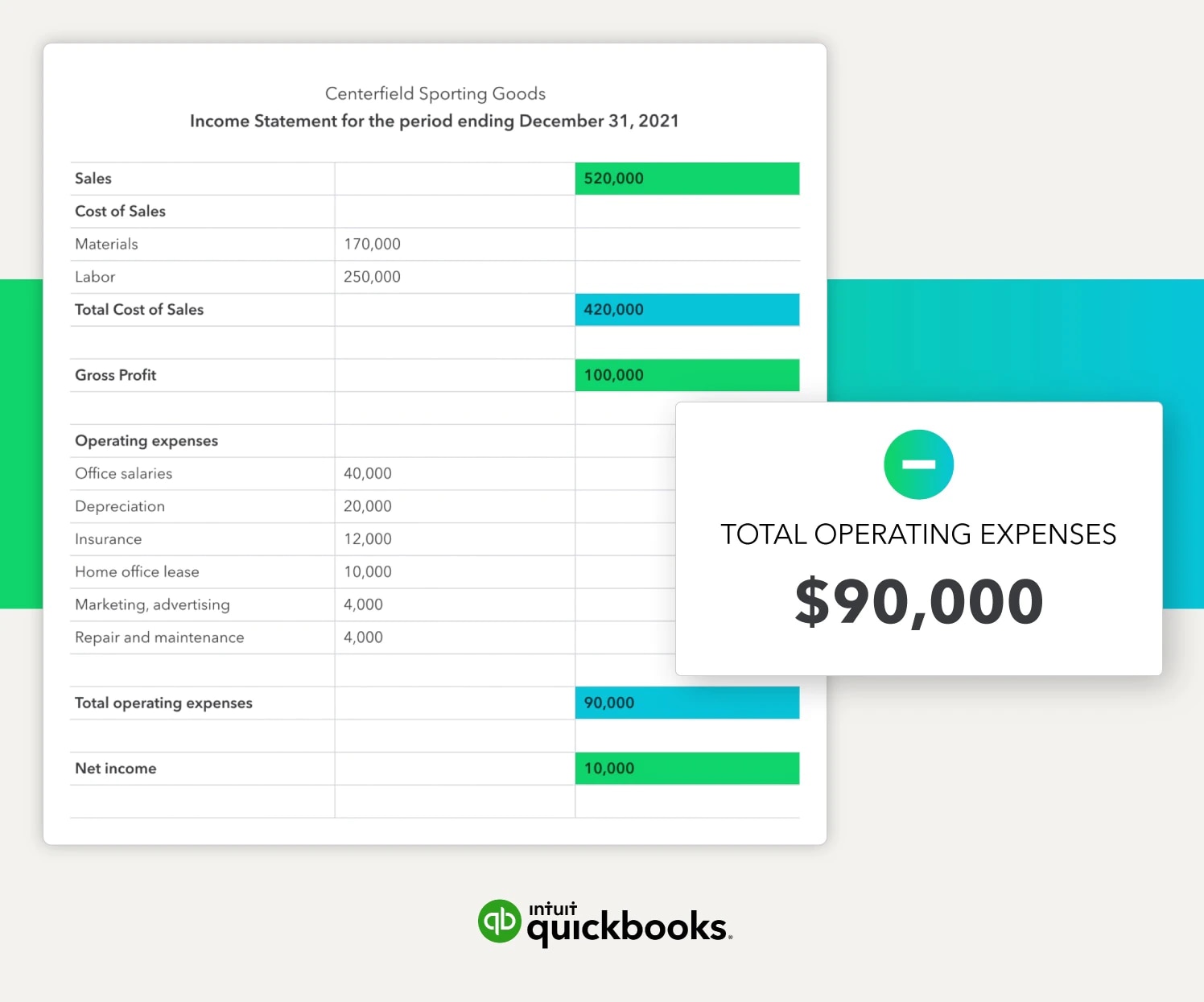
Review the Centerfield company’s income statement for the period ending December 31, 2021. Sales totalled R520,000, and the cost of sales totalled R420,000. So their gross profit was R100,000. And Centerfield had operating expenses of R90,000. That gave them R10,000 in operating income for the period. Since the company did not generate any non-operating income, its operating income was its net income balance.