SALE

Get 70% off QuickBooks for 6 months

See plans and pricing
QuickBooks Blog
Need help choosing a plan?
Created with Sketch. 1800 917 771 Schedule a call
Need help?
We're here for you.
Schedule call
Created with Sketch.
Image Alt Text
taxes

Key BAS Due Dates 2026-27: A Guide to Lodging Your BAS on Time

If you’re registered for GST, you’ll need to lodge a Business Activity Statement (BAS) and report your GST and other tax obligations to the ATO monthly, quarterly or annually.

BAS can feel intimidating without the right systems in place. Getting it lodged on time is a common source of stress, which leads many business owners to ask: ‘When is my BAS due?’

This guide covers every BAS due date for the 2026-27 financial year, the changes small businesses need to know about this year, and how accounting software - including the new QuickBooks GST AI Agent - can help you lodge accurately and on time.

What is BAS?

A Business Activity Statement (BAS) is the report you submit to the Australian Taxation Office (ATO) if your business is registered for Goods and Services Tax (GST). It’s how you report and pay GST, and it can also include PAYG withholding, PAYG instalments and other obligations.

Beyond compliance, a regular BAS rhythm helps you keep tabs on cash flow and GST turnover - useful metrics for running your business day to day.


What’s changed for BAS in 2026

The due dates themselves haven’t moved, but the cost of missing them has. Here’s what’s new or newly important this financial year:

•   Late lodgement penalties are higher. The Commonwealth penalty unit rose to $364 on 1 July 2026 (up from $330). For a small business, a late BAS can now attract up to $1,820 in Failure to Lodge penalties.

•   ATO interest is no longer tax‑deductible. General interest charge (GIC) incurred on or after 1 July 2025 can’t be claimed as a deduction. Paying late now costs you the full interest amount, with no offset at tax time.

•   Chronic late lodgers are being moved to monthly BAS. In 2025 the ATO shifted 3,500 businesses with poor compliance histories from quarterly to monthly GST reporting for a minimum of 12 months - and has confirmed it will keep doing so. If you’re used to one BAS a quarter, that’s three times the admin.

•   Payday Super has started. From 1 July 2026, employers must pay super guarantee within 7 days of each payday, rather than quarterly. If you used to pay super alongside your quarterly BAS, that routine no longer works - super is now a payroll‑cycle task, not a BAS‑cycle one.

•   Login changes. myGovID is now called myID. Your existing login still works, but the app and branding have changed.

Why BAS due dates matter

Meeting your BAS deadlines keeps you on the right side of the ATO and protects your business financially. If you don’t lodge or pay on time you can face interest, penalties and - increasingly - closer ATO scrutiny.

  • Avoid penalties and interest: Late BAS lodgements can attract Failure to Lodge penalties, and late payments accrue daily compounding interest that you can no longer deduct.
  • Protect your reporting cycle: A pattern of late lodgement or payment is exactly what the ATO uses to move businesses onto monthly reporting.
  • Build a good compliance history: A clean record makes it easier to negotiate payment plans or lodgement deferrals when you genuinely need them.
  • Keep cash flow in check: Regular BAS lodgement keeps you close to your numbers, so GST bills don’t arrive as a surprise.

Key BAS due dates for 2026-27

How often you lodge BAS depends on your GST turnover and, in some cases, your compliance history. The ATO assigns your cycle when you register for GST and will tell you if it changes.

Quarterly reporting

The default for most small businesses. If your GST turnover is under $20 million and the ATO hasn’t told you to report monthly, you lodge four times a year.

The ATO’s standard quarterly dates are the 28th of the month after each quarter ends. If a due date falls on a weekend or public holiday, you have until the next business day. If you lodge online you may also qualify for an extra two weeks on quarters 1, 3 and 4 - the concession is applied automatically and shows on your activity statement.

Quarter Period Standard due date Online lodgers (2‑week concession)
Q1 1 Jul - 30 Sep 2026 28 October 2026 11 November 2026
Q2 1 Oct - 31 Dec 2026 28 February 2027 (a Sunday - next
business day is Monday 1 March 2027)
No extra time - Q2 already includes
a one‑month extension
Q3 1 Jan - 31 Mar 2027 28 April 2027 12 May 2027
Q4 1 Apr - 30 Jun 2027 28 July 2027 11 August 2027

Check the date printed on your BAS. The two‑week concession doesn’t apply to monthly lodgers or to quarterly instalment notices (BAS R, S and T), and registered tax or BAS agents often have different lodgement dates again. The due date on your activity statement in ATO online services is the one that counts.
 

Monthly reporting

Required if your GST turnover is $20 million or more. Businesses under $20 million can also choose monthly reporting - some prefer smaller, more frequent payments for cash flow - and the ATO may direct you to report monthly if you’re not meeting your GST obligations.

Monthly BAS is due on the 21st of the following month - your July 2026 BAS is due 21 August 2026, and so on. Where the 21st lands on a weekend, the deadline rolls to the next business day. In 2026-27 that affects November 2026 (due Mon 23 Nov), February 2027 (Mon 22 Feb), March 2027 (Mon 22 Mar) and August 2027 (Mon 23 Aug). Monthly lodgers don’t receive the two‑week online concession.

Annual GST return

If you’re voluntarily registered for GST and your turnover is under $75,000 ($150,000 for not‑for‑profits), you can elect to report and pay GST annually. Some quarterly lodgers also pay ATO‑calculated GST instalments each quarter and reconcile with an annual GST return.

If you report GST annually, your return for 2025-26 is due 31 October 2026. Because that’s a Saturday, you have until Monday 2 November 2026. If you aren’t required to lodge an income tax return, the due date is 28 February 2027 instead.

Source: ATO - Due dates for lodging and paying your BAS.


How to track your BAS due dates

Staying on top of ATO deadlines can be tricky if you’re running a paper‑based or spreadsheet system. You have to reconcile your accounts, manually transfer figures into the BAS form and remember to lodge by the due date - time‑consuming and easy to get wrong.

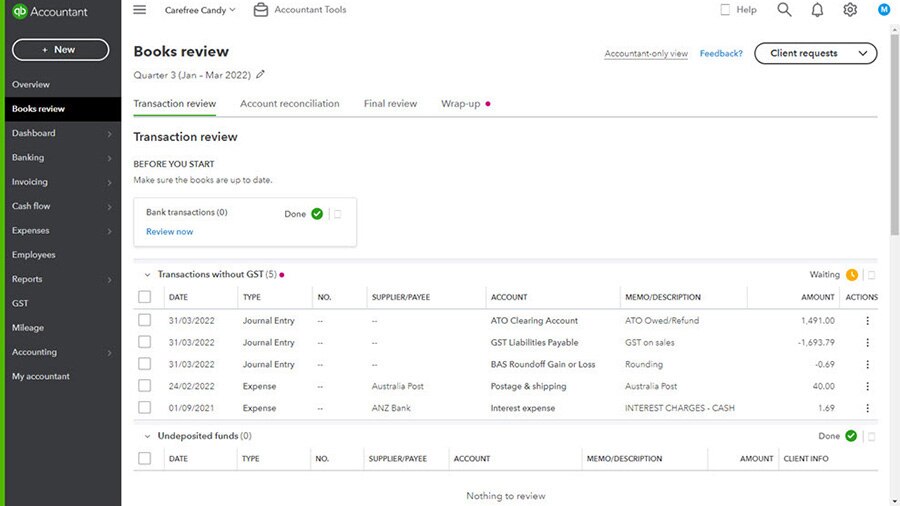
Accounting software simplifies the whole cycle. QuickBooks Online tracks GST on every transaction, generates your BAS figures, reminds you when a lodgement is coming up and lets you lodge directly with the ATO.

Now there’s an extra safety net before you press lodge. The QuickBooks GST AI Agent (BETA^), available on all QuickBooks Online plans, automatically reviews your GST data ahead of lodgement. It compares the income on your Profit & Loss with the net sales on your GST report, flags transactions with missing or incorrect GST codes or items wrongly excluded from the BAS, explains the cause in plain English (for example, a sale marked GST‑free that created a $50 difference) and recommends the fix. You review and approve every correction - the Agent never lodges on your behalf.

The flags appear in the pre‑file check when you prepare your BAS and as actionable tasks in your Business Feed, so the errors that usually surface after lodgement - and trigger ATO queries - get caught beforehand. If you work with an accountant or bookkeeper, it also means cleaner books land on their desk, which might save you billable hours.


What happens if you miss a BAS due date?

The ATO uses a mix of penalties and interest to encourage on‑time lodgement and payment. Here’s what can happen - and what’s changed.

Failure to Lodge (FTL) on time penalty

If you don’t lodge by the due date the ATO may apply a Failure to Lodge penalty. For individuals and small withholders (withholding under $25,000 a year) it’s calculated as:

  • 1 penalty unit - currently $364 - for each 28‑day period (or part of one) the BAS is overdue
  • Capped at 5 penalty units, so up to $1,820 per late BAS

Medium withholders pay double and large withholders five times that amount. Penalties apply per statement, so several missed lodgements can add up quickly - and penalties are never tax‑deductible.

Some reassurance: the ATO says it generally doesn’t penalise isolated late lodgements and will warn you by phone or in writing before applying an FTL penalty. It also generally won’t issue an FTL penalty where a late BAS results in a refund or nil amount. And if you gave your registered agent everything they needed on time and they lodged late, ‘safe harbour’ provisions may mean you aren’t liable.

Interest charges

If your BAS includes an amount to pay and you pay late, the ATO charges general interest charge (GIC), calculated daily and compounding on the outstanding balance. The rate is reviewed quarterly. Since 1 July 2025, GIC is no longer tax‑deductible, so the true cost of paying late has gone up.

Being moved to monthly reporting

Repeatedly lodging or paying late is one of the behaviours the ATO looks at when deciding to move a business from quarterly to monthly GST reporting for at least 12 months. Monthly reporting isn’t a penalty as such (for example, some businesses find it helps cash flow), but it does mean 12 BAS lodgements a year instead of four.

Impact on compliance history

Late lodgement affects your compliance record, which the ATO weighs when deciding whether to grant deferrals, remit penalties or approve payment plans in future.

Risk of further action

Continued non‑lodgement or non‑payment can lead to debt recovery action, including garnishee notices and director penalty notices for company directors. If you can’t lodge or pay on time, contact the ATO before the due date - engaging early is treated very differently from going quiet.

How to lodge your BAS on time

The good news: there are several convenient ways to lodge, most of them online.

  • ATO online services (via myGov and myID): Ideal for sole traders who manage their own tax and BAS.
  • Online services for business: Best for companies, partnerships and trusts. You’ll need an ABN and a Digital ID such as myID to log in.
  • Business software (like QuickBooks): Prepare, check and lodge your BAS in one place, with GST tracking, P&L and the GST AI Agent’s pre‑lodgement check.
  • Registered tax or BAS agent: A professional can lodge for you, offer advice and may have access to later lodgement dates.

You can also set reminders for key dates in the ATO app.

Reconcile before you lodge

Whichever method you choose, reconcile your accounts first. That means:

  • Making sure income and expenses are recorded accurately and in the right period
  • Checking the GST code on purchases and sales - GST‑free, input‑taxed and out‑of‑scope items are the most common mistakes
  • Verifying your payroll figures for PAYG withholding, and confirming super has been paid under the new Payday Super rules (if you have employees)

The QuickBooks GST AI Agent is designed to run the P&L‑to‑GST‑report comparison for you, points to the specific transactions causing a difference and proposes how to fix them before you lodge.

Frequently Asked Questions about BAS

Ready to take the guesswork out of your next BAS? Explore the GST AI Agent in QuickBooks and lodge with confidence.


**Feature availability varies by product. While available in all QuickBooks supported languages, the AI agent’s output will be English only at launch. We recommend you review all outputs carefully. This information is intended to outline our general product direction, but represents no obligation and should not be relied on in making a purchasing decision. Additional terms, conditions and fees may apply. Product offers, features, and functionality are subject to change without notice.

^[Beta] has limited availability and is subject to change. Features may be more broadly available soon.

This article provides general information only and does not constitute tax advice. Due dates and figures were checked against ato.gov.au in September 2026; always confirm the date shown on your own activity statement or speak to a registered tax or BAS agent.


Related Articles