

You asked, we listened: What's improved in QuickBooks Online in 2026, with more on the way
Simple, smart accounting software - no commitment, cancel anytime


GROWING BUSINESS


Accountancy, one of the oldest recorded professions in human history*, is undertaking a generational transformation. As technology reshapes accountants’ capabilities and how they work, a new wave of talent is entering the profession with high aspirations and a distinctly entrepreneurial mindset.
This shift couldn’t come at a more critical time and could serve as a much-needed saviour for a profession that has been grappling with a skills shortage in recent years. Data from the Financial Reporting Council has shown that accounting student numbers in the UK and Republic of Ireland reduced by 3.5% in 2022 to around 155,000** - a concerning trend when placed against the backdrop of an aging profession and a growing demand for accountancy services.
A discussion on the workforce of tomorrow, the pathways into accounting, and the future of the accounting industry. Hear from our guest speakers; Accountancy Lecturer James Wright FCCA, Practice Founder Grace Hardy MAAT, and Head of Talent Development at Moore Kingston Smith, Cecilia Van Eeden CA.
Today nearly half (45%) of accountancy firms report a shortage of skilled workers***. Traditional benefits like job security and competitive pay continue to attract people into the profession, however, they no longer seem to be the sole draw. As the profession evolves, by incorporating new digital tools, flexible working models, and fostering a growing spirit of entrepreneurship, it signals a revitalisation. Together, these elements reflect a profession not just adapting, but actively reshaping itself to attract a new generation of accountants.
Intuit’s latest ‘Changing Face of Accountancy’ report, which draws on new research from 500 accountancy students, reveals a new generation that is embracing opportunity. These students are tackling long-standing challenges and barriers head on whilst simultaneously redefining what it means to be an accountant in a tech-enabled, globally connected world.
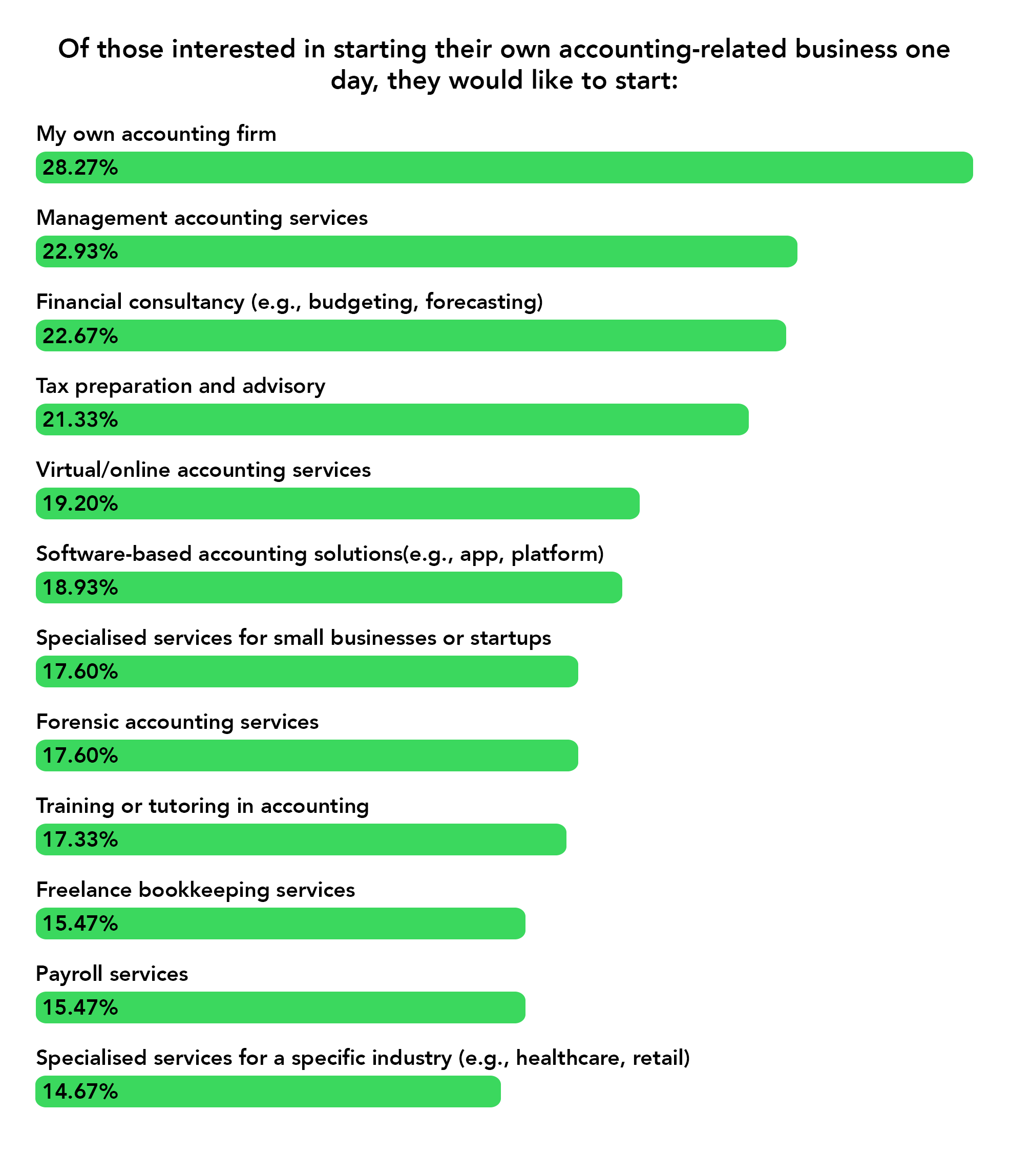
Among the next wave of accountants, entrepreneurial ambition is on the rise. In fact, 75% of accounting students stated that they’re driven by a desire to start their own accountancy-related business; a significant shift from the profession’s traditionally linear career path.
This entrepreneurial shift is being driven by students from a wide range of backgrounds — notably, 73% of female students and 71% of international students say they aspire to start their own accountancy-related businesses. These figures point to a generation with more varied experiences, values and career ambitions than ever before. Rather than following traditional career ladders, today’s aspiring accountants are reimagining the profession on their own terms — bringing new perspectives to what success in accountancy can look like.
This mindset shift reflects a broader transformation in how young professionals view the industry. For many, accountancy is no longer just about stability or structure — it’s a platform for innovation, independence, and impact. With digital tools removing traditional barriers to entry and empowering small business creation, this generation is well-positioned to redefine the role of the accountant in the modern economy.
“Now a critically in demand occupation, the accounting professional of tomorrow is part entrepreneur, part strategist, part tech leader. The industry has, however, seen a drop in new trainees and job candidates recently, and the average age of accounting professionals has increased to 45. We believe the future belongs to those who embrace the new, multifaceted role of the accountant, and the new crop of dynamic students who are ready to change the game.” Leigh Thomas, Vice President EMEA at Intuit.
The ambition of today’s accountancy students is being matched by training that’s evolving to meet the moment. Nearly 60% of respondents say their education is actively preparing them to think entrepreneurially — equipping them not just with technical skills, but with the confidence and mindset to launch businesses, lead teams, or even explore careers beyond the profession. Far from being outdated or rigid, the training is becoming a launchpad for a new generation of accountants to carve out dynamic, self-directed paths.
Josh Hickland-May, a data analyst who has just completed his Accountancy degree, commented: “Studying Accountancy has opened the door for a much broader range of career paths than I first expected – personally, my long-term aspiration is to become a finance director or CFO. I really enjoy the analytical side, and this is the route I plan to go down. There are so many potential specialisms once you have studied accountancy.”
This shift is not only redefining career paths — it’s also expanding what it means to be an accountant in the modern world. Today’s students aren’t just preparing to manage books; they’re being trained to think strategically, solve complex problems, and lead on innovation. As the profession evolves, these developing skills are setting the foundation for a more agile, entrepreneurial workforce — one that’s ready to respond to change, seize opportunity, and shape the future of accountancy.
Alongside the mindset shift taking hold among future accountants, technology is fundamentally reshaping their day-to-day role. The skills needed to succeed are rapidly changing, with new software easing traditional pressures and unlocking higher value work.
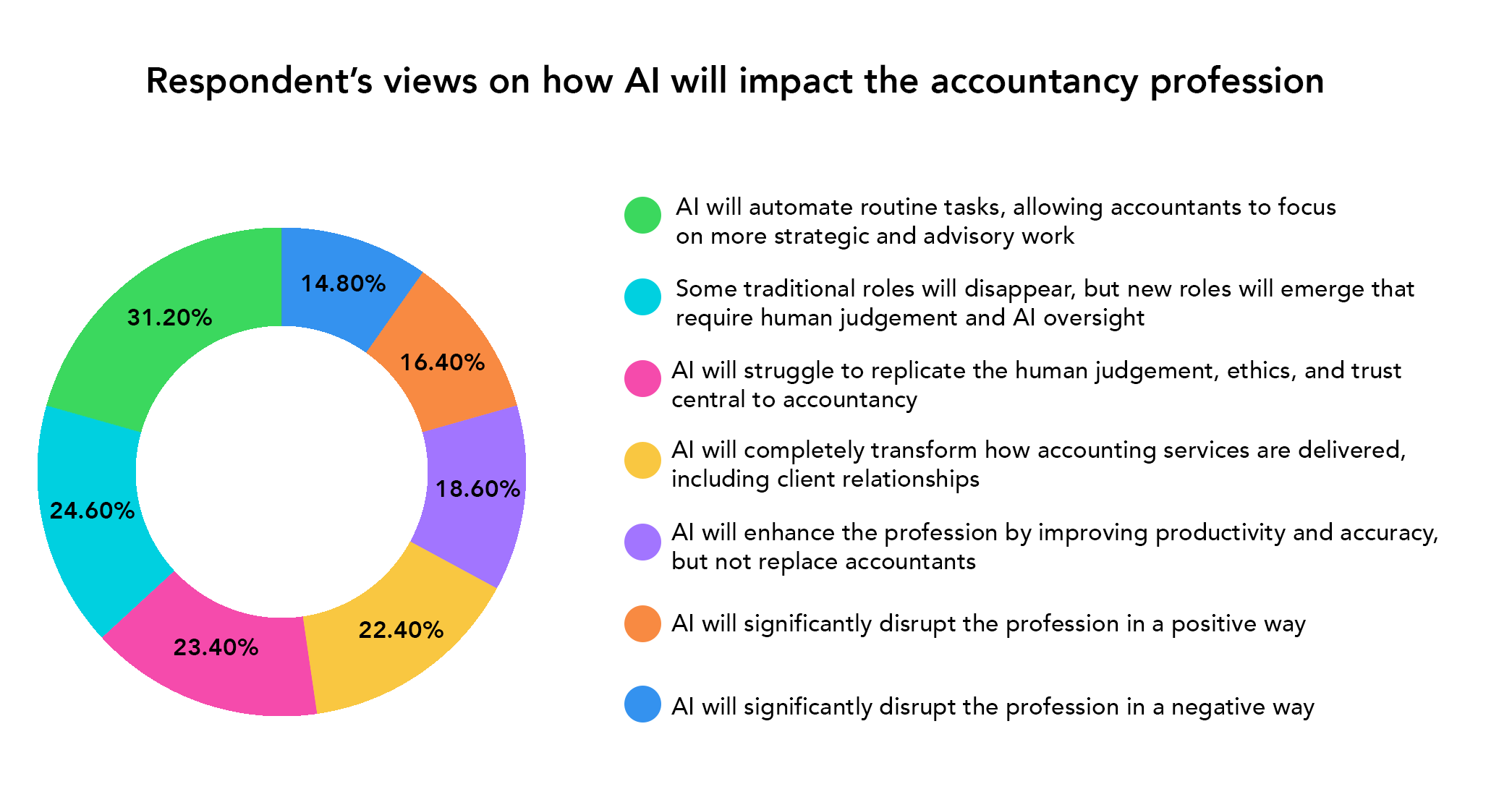
31% of accounting students believe AI will automate routine tasks - such as data entry whilst freeing them up to work on more strategic advisory work. For students with entrepreneurial ambitions, this shift is particularly powerful. With more time to dedicate to clients, growth strategies, or even launching a business, AI becomes a tool for elevation, not replacement.
Crucially, students who embrace this new reality will flourish. Nearly two-thirds (64%) of students stated their training left them feeling ready to use the latest tools. Rather than fearing automation, this generation views technology as a partner — one that enhances human intelligence, broadens service offerings, and sharpens competitive edge.
When asked to name the top three ways that the accounting profession will evolve over the next decade, 30% expect accountants to play a bigger role in business decision-making, and 22% believe strategic advisory will become a core part of the job.
As digital tools become more embedded in practice, the next generation of accountants will be freed to do what they do best — think critically, add value, and help clients navigate an increasingly complex business world.
Connor Godley, who is about to start his first full-time accounting role, commented: “Initially, it was my interest in maths that drew me to accountancy — I wanted a practical career, and accountancy seemed like the obvious choice. But after doing a university placement and working part-time at an accounting firm, my perspective shifted. I realised it’s not just about calculations; it’s really about helping businesses perform better, and the real value lies in advising people. That’s what I enjoy most now – working with and supporting others.”
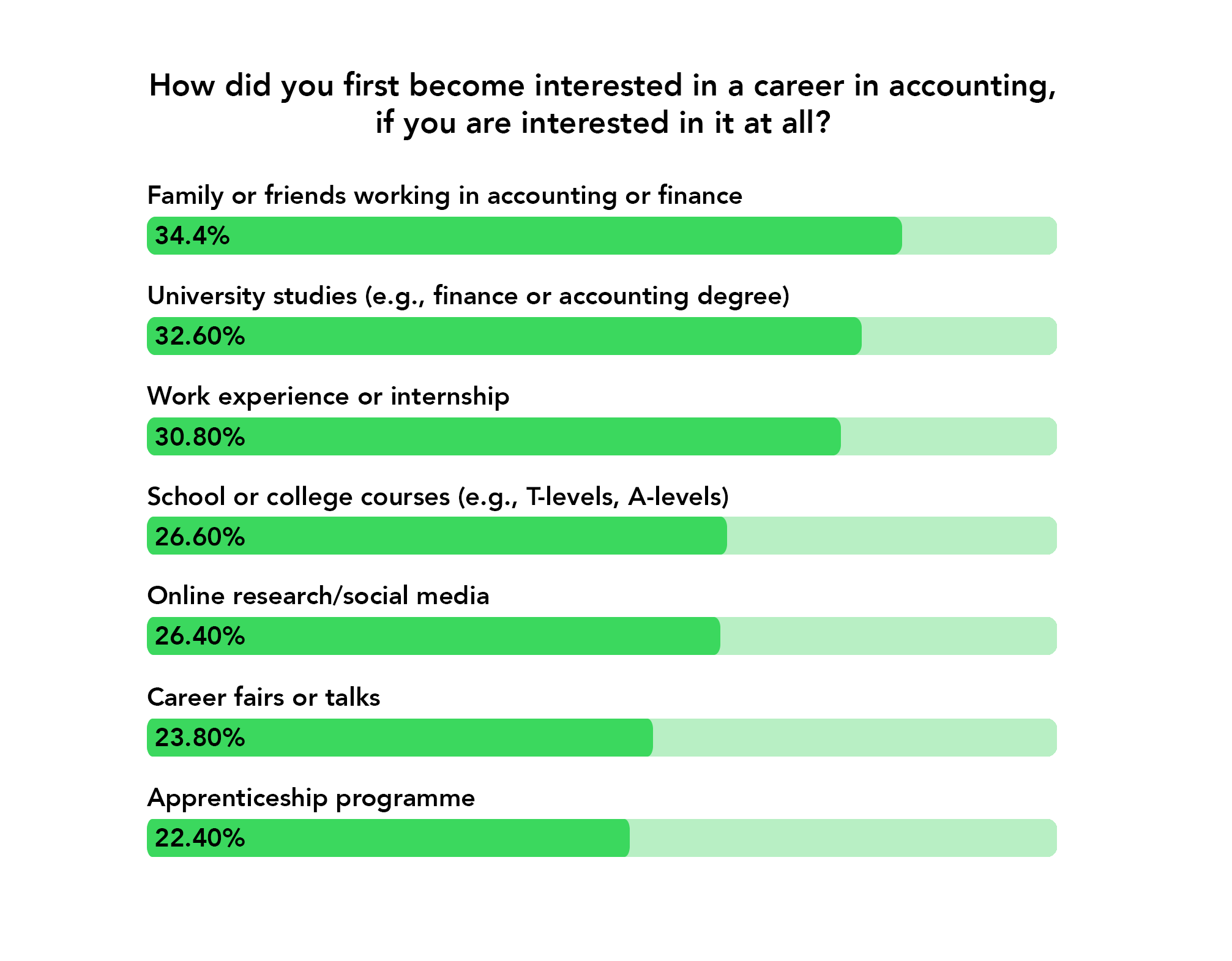
Whilst technology is rapidly changing the day-to-day realities of accounting, more traditional factors - like career stability and familiarity still play a pivotal role in attracting new talent. Over a third (34.3%) of students said they were influenced by family or friends already working within a similar field, while 32.6% first became interested through their university studies.
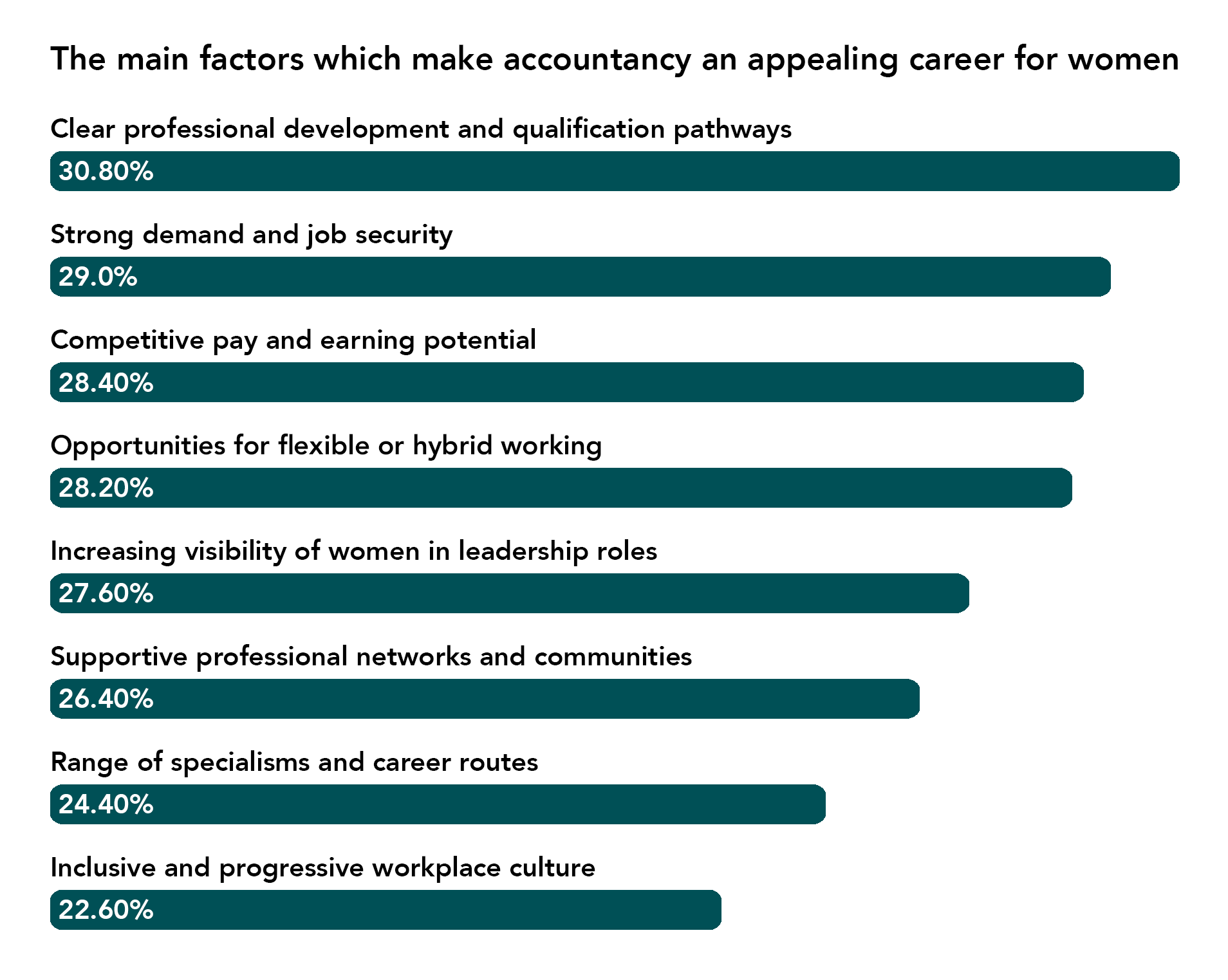
Yet the industry’s appeal is evolving. Today’s accountancy career offers more than just steady work — it promises flexibility, financial security, and room for growth. These qualities are proving particularly compelling for women entering the profession.
Thushana Balanchandran, a final-year Accountancy student looking to pursue a career in accountancy while also considering a future as a business owner, commented: “Coming from a low-income background, one of my fears is not having enough money to live on. Accountancy as a career path offers me the job security I need, enabling me to work my way up and develop a broad range of skills while also giving me the option of starting my own business in the future.”
Nearly 30% of female respondents cited job security as a major reason for pursuing a career in accountancy, with that number rising to 49% among 16–19 year old women. Flexibility is a powerful motivator too. Hybrid working arrangements were valued by 28% of all female students - a figure that climbs to 47% among women aged 45+ and 42% among those aged 35–44. In offering career paths that can adapt to individual needs such as a healthier work-life balance, the profession is positioning itself as a strong choice for women seeking balance, ambition and long term growth.
Grace Hardy MAAT, Founder of Hardy Accounting commented: “Accountancy gets labeled as male, pale and stale — but for people my age, that’s not the vibe at all. What attracted me to the profession is the emerging tech being used, the career prospects and the opportunity to build my own business from the ground up at only 21 years old.”
Still, challenges persist. Nearly 28% of respondents identified an underrepresentation in high-prestige or client-facing roles as a barrier and the same proportion pointed to the gender pay gap at senior levels. Even flexibility — one of the industry’s key selling points - was seen as an area for improvement by 31% of students, indicating that experience can vary significantly depending on workplace culture and career stage.
Progress however is underway. More women are becoming visible in leadership roles and professional networks offer increased support, accountancy must continue to evolve - creating pathways for all professionals to thrive and lead.
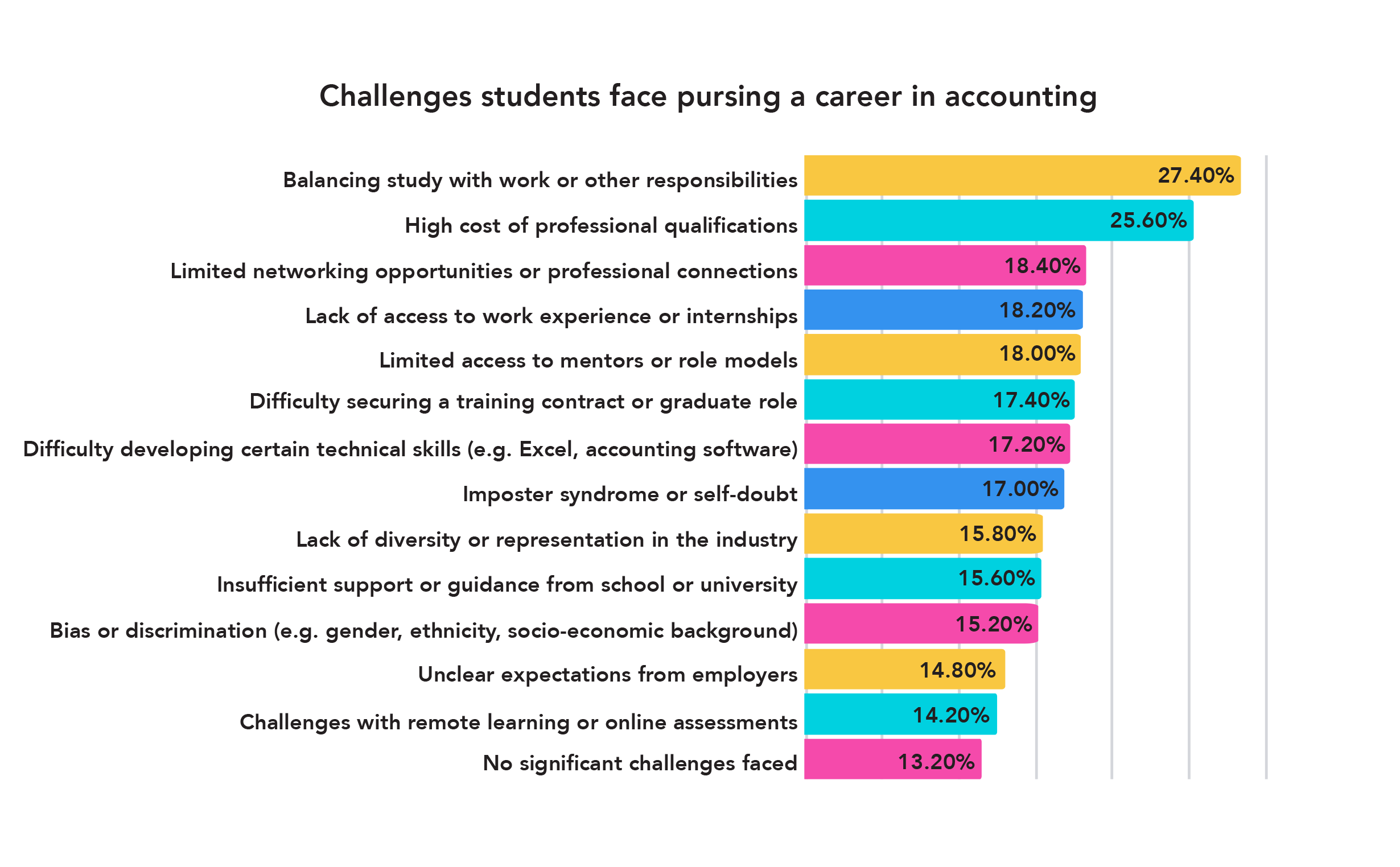
Despite the clear enthusiasm and entrepreneurial energy among aspiring accountants, traditional barriers to entry still exist. One of the most cited challenges highlighted by 27% of respondents, is balancing study with other responsibilities. The cost of professional qualifications, named by 26% of respondents, compounds this pressure. Many students may have to work long hours to fund their studies as a result, which could leave them stretched thin at a critical time in their development.
Other common hurdles include limited networking opportunities (18%) and limited access to mentors or work experience (18%). These gaps don’t just slow down progress — they contribute directly to the profession’s ongoing skills shortage. Without more structured support, the industry risks losing out on talented individuals who are ready and willing to lead, but lack the means to break into the industry.
Chrisbrown Christopher, a mature student pursuing accountancy as a second career, commented: “As AI continues to transform the accounting profession, it's creating new opportunities that didn’t exist before. Rather than wait for traditional employment in the sector, once I’m qualified, I’ve chosen to build my own business, and I believe that AI will shape the next wave of accounting businesses over the next few years.”
Additonally, 16% of students cited a lack of diversity or representation as a barrier for those looking to enter the industry. To seize the many opportunities now available, accountancy must first find ways to welcome students from all backgrounds, remove these roadblocks and equip the next generation with the tools and training to shape the industry's future.
Accountancy and Finance Senior Lecturer and YouTuber with over 36,000 subscribers, James Wright FCCA said: “As the accounting sector grows increasingly appealing to both students and career-changers, it's time for the profession to acknowledge and address the barriers to entry. Embracing diversity of thought and experience is key to driving innovation and effective problem-solving—crucial elements for the industry to truly thrive.”
The appetite for change is clearly there. What’s needed now is action — through better financial support, stronger mentorship, and a more inclusive professional culture that enables every aspiring accountant to succeed.
Whilst barriers to entry still exist, the future of accountancy is undeniably shifting. A new generation of professionals are entering the field with bold ambitions, entrepreneurial attitude and a desire to reshape the profession from within.
These students have a clear sense of purpose and possibility. They understand the challenges ahead: from financial pressures and outdated perceptions to underrepresentation and a need for greater flexibility. But they also see where the profession is going — and how they can help lead the way.
Keira Lake, an AAT Level 2 student and finance assistant at Dorchester Town Council, commented: “Since starting my AAT studies, I’ve had some amazing experiences meeting a hugely diverse range of people, from all walks of life. From a personal point of view, this is something I really welcome – as the industry evolves, it’s absolutely essential that we embrace diverse voices and as wide a range of perspectives as possible. This, to me, is the future of accountancy."
Empowered by modern training, armed with digital tools and motivated by values of innovation, inclusivity and autonomy, the next wave of accountants is redefining what success looks like. No longer confined to spreadsheets and tax returns, they’re stepping into advisory roles, becoming entrepreneurs and helping businesses navigate complexity whilst driving growth. Ultimately building a more inclusive profession.
If the industry can continue to evolve — removing barriers, embracing technology, and amplifying diverse voices — then the future of accountancy won’t just be brighter. It will be bolder, more human, and more impactful than ever before.
SMBs can find an accountant or bookkeeper with Intuit’s regional directory of QuickBooks-certified ProAdvisors.
** Financial Reporting Council
*** AdvanceTrack
Disclaimer
This content is for information purposes only and should not be considered legal, accounting or tax advice, or a substitute for obtaining professional advice specific to your business. Additional information and exceptions may apply. Applicable laws may vary by region, state or locality. No assurance is given that the information is comprehensive in its coverage or that it is suitable in dealing with a customer’s particular situation. Intuit does not have any responsibility for updating or revising any information presented herein. Accordingly, the information provided should not be relied upon as a substitute for independent research. Intuit does not warrant that the material contained herein will continue to be accurate nor that it is completely free of errors when published. Readers should verify statements before relying on them.
We may occasionally provide third-party links as a convenience and for informational purposes only. Intuit does not endorse or approve the views or opinions of any corporation or organisation or individual herein. Intuit accepts no responsibility for the accuracy, or legality, of third-party content.
Share:
Subscribe to get our latest insights, promotions, and product releases straight to your inbox.
9.00am - 5.30pm Monday - Friday

