

Journeys by Design gains multi-year financial visibility with QuickBooks Advanced
Simple, smart accounting software - no commitment, cancel anytime


MAKING TAX DIGITAL


If you’re a self-employed taxi driver, you might need to start thinking about Making Tax Digital for Income Tax in 2026. If you’re not already familiar, Making Tax Digital (MTD) is a government plan to bring tax records online. Currently, MTD for VAT impacts all VAT-registered businesses, but soon MTD for IT will roll out to self-employed individuals and landlords with over £50,000 of qualifying income in the tax year 2024 to 2025.
Want to learn more? We’re here to steer you in the right direction. In this article, we’ll explore what MTD for IT means for you and what the impact could be. You’ll also discover how to prepare for MTD for IT, as well as the consequences of not following the MTD for IT rules.
If you think Making Tax Digital for Income Tax might affect you as a taxi driver, then read on—we’ll take a closer look at what the tax year 2026/27 could bring.
Making Tax Digital (MTD) aims to move tax records from paper and spreadsheets to MTD compatible software that links directly to HMRC.
MTD for IT will be compulsory from the 6 April, 2026 for self-employed individuals and landlords who have over £50,000 of qualifying income for the tax year 2024 to 2025.
The transition to MTD for IT means individuals will need to use MTD for IT compatible software if they don’t already use one.
As a taxi driver, you might need to make some changes to how you manage your Income Tax under Making Tax Digital for Income Tax. The important thing to note is that, as of April 2026, it will only impact individuals with qualifying income of more than £50,000 for the tax year 2024 to 2025. However, even if you’re below this threshold, MTD will take effect for lower-income brackets in 2027, so it’s worth brushing up on the details.
The reason for these changes is that the government wants to simplify the record-keeping process and reduce the chance of administrative errors.
Many taxi drivers operate as self-employed taxpayers, even when they work for a platform like Uber. MTD for IT only applies to taxpayers who file Income Tax returns, therefore employees and limited companies may not need to follow HMRC for IT rules. MTD for IT is only required from April 2026 if the following applies:
You’re a sole trader or a landlord
You get income from your self-employment or rental income
Your qualifying income (your total yearly income from self-employment and property) is over £50,000 for the tax year 2024 to 2025.
If all the above apply to you, then you’ll need to transition your tax keeping from paper or spreadsheets to MTD for IT compatible software . These tools typically operate as a digital record-keeping service, usually within an accounting software. Under MTD for IT rules, you will be required to make quarterly updates to HMRC providing them with a snapshot of your business’s income and expenses for that quarter.
Whether you’re preparing for April 2026 or simply want to move over to digital tax submissions as before the MTD deadlines, we’ve laid out the steps you’ll need to make the transition.
First off, you’ll need to sign up for Self Assessment if you haven’t already. You can do this on the gov.uk website. During the sign-up process, you’ll be required to tell HMRC about your sole trader income. This includes:
The start date of your business (if it’s within two years)
The tax year you’ll start using MTD
Your business name (the name you use on invoices) and address
The nature of your trade and business.
You may also need to provide additional proof of your identity for Self Assessment, which might mean matching a photo of your face with your ID via a mobile phone app. Alternatively, you could be asked questions based on the information they already have on you, such as a passport or driving licence.
Before signing up to MTD for IT, you’ll need to check if it's relevant to you. Start by working out your qualifying income. If you meet the £50,000 threshold, you’ll need to sign up and get ready for MTD for IT by 6 April 2026. Users below this threshold may be able to sign up voluntarily.
HMRC doesn’t provide MTD compatible software directly, so you’ll need to find something that works with Making Tax Digital for Income Tax. Your software(s) must be able to create, store, and manage records of your self-employed earnings and expenses. You’ll also need it to send quarterly updates to HMRC and submit a final tax return by 31st January the following year.
You should use your MTD for IT software to create digital records and make submissions to HMRC. You’ll need to record self-employment income and expenses—including records of the amount, the date related to the income or expense, and the category type. If you have more than one sole trader business, or if you earn money from property, you’ll need to create separate records for each of these businesses.
Once a quarter (every three months), your software will need to add up your digital records and create totals for your income and expenses. These should then be sent to HMRC from your HMRC compliant MTD for IT software.
Keep digital records, submit quarterly updates to HMRC, and finalise your Income Tax at the end of your accounting period with Intuit QuickBooks.
Explore plans & pricing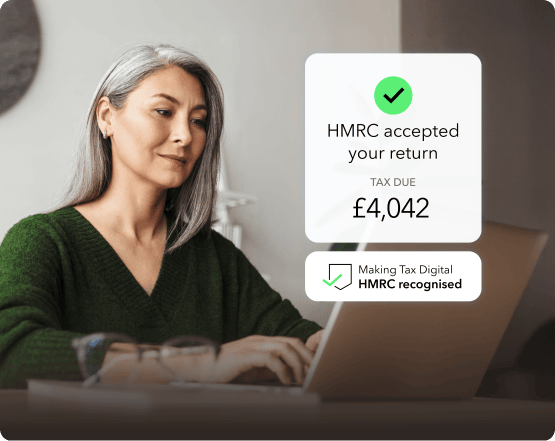
While the shift to Making Tax Digital for Income Tax may seem like extra work, it could introduce a number of benefits for taxi drivers. We know that time spent filing tax returns is time that could be spent working and earning, so whether you want to save time on admin or cut down on reporting errors, MTD can work for you in the long run. Here are some of the benefits of Making Tax Digital:
More frequent updates to HMRC for accurate tax bills
Digitally integrated, meaning no more paper trail
More detailed transaction records
No more manual spreadsheets
Time saved for other areas
Fewer errors to correct
Despite the benefits of Making Tax Digital for Income Tax, the transition to MTD for IT will mean making some changes to how you keep records and manage your Income Tax, especially at the start. It’s best to read up on the new system beforehand, to prevent any hiccups or snags when first getting to grips with it.
There’s also a cost involved in MTD for IT compatible software. You’ll need software that can work with HMRC, and it’s up to you to find one.
Not sure where to look? Don’t panic: QuickBooks offers affordable accounting software to help you transition to Making Tax Digital. Learn more about our pricing options.
If you’re unable to follow the Making Tax Digital for Income Tax rules, there could be some consequences:
For the first tax year of MTD (April 2026 to April 2027) there won’t be any penalties. However, from the following tax year on late submissions result in penalties. You’ll receive one penalty point for each late quarterly submission. If you reach two penalty points in a 24-month period, you’ll incur a £200 fine. You’ll also receive an additional £200 fine for each late submission after that.
If you have one penalty point but then don’t receive any more for two years, the point will be removed.
If you need to renew your Private Hire Vehicle (PHV) license, any outstanding tax issues could create delays. While the rules differ between local authorities, unpaid or unfiled taxes could impact your PHV license and your ability to stay working.
Not only will you be fined if you miss payments, but you’ll also have to pay interest on top of what you owe. As of 9 January 2026, the interest rates for late repayments are 7.75%.
For now, it depends on how much qualifying income you earn. VAT-registered businesses are already using MTD for VAT, but by 6 April, 2026 self-employed individuals with over £50,000 of qualifying income from their sole trade or property business in the year 2024 to 2025 will need to follow MTD for IT rules.
Qualifying income is the total income you earn from your self-employment and property (if that applies to you). If your sole source of income is from what you earn as a self-employed taxi driver, then that (before you deduct expenses) would be your qualifying income.
You can claim several expenses for tax relief as a taxi driver. These expenses must be wholly and exclusively for the purpose of your business. Any expenses which are personal in nature are not allowed. Typically, these include the general upkeep of your car, but could include the cost of:
Cleaning your taxi
Licence and registration costs
The interest on loans you took out to purchase the vehicle
Breakdown cover
MOTs
A portion of these expenses may be disallowed if you use your taxi for personal use.
The information on this website is provided free of charge and is intended to be helpful to a wide range of businesses. Because of its general nature the information cannot be taken as comprehensive and they do not constitute and should never be used as a substitute for legal, accounting, tax or professional advice. We cannot guarantee that the information applies to the individual circumstances of your business. Despite our best efforts it is possible that some information may be out of date. Any reliance you place on information found on this site or linked to on other websites will be at your own risk.
Share:
Subscribe to get our latest insights, promotions, and product releases straight to your inbox.
9.00am - 5.30pm Monday - Thursday
9.00am - 4.30pm Friday

