

Journeys by Design gains multi-year financial visibility with QuickBooks Advanced
Simple, smart accounting software - no commitment, cancel anytime


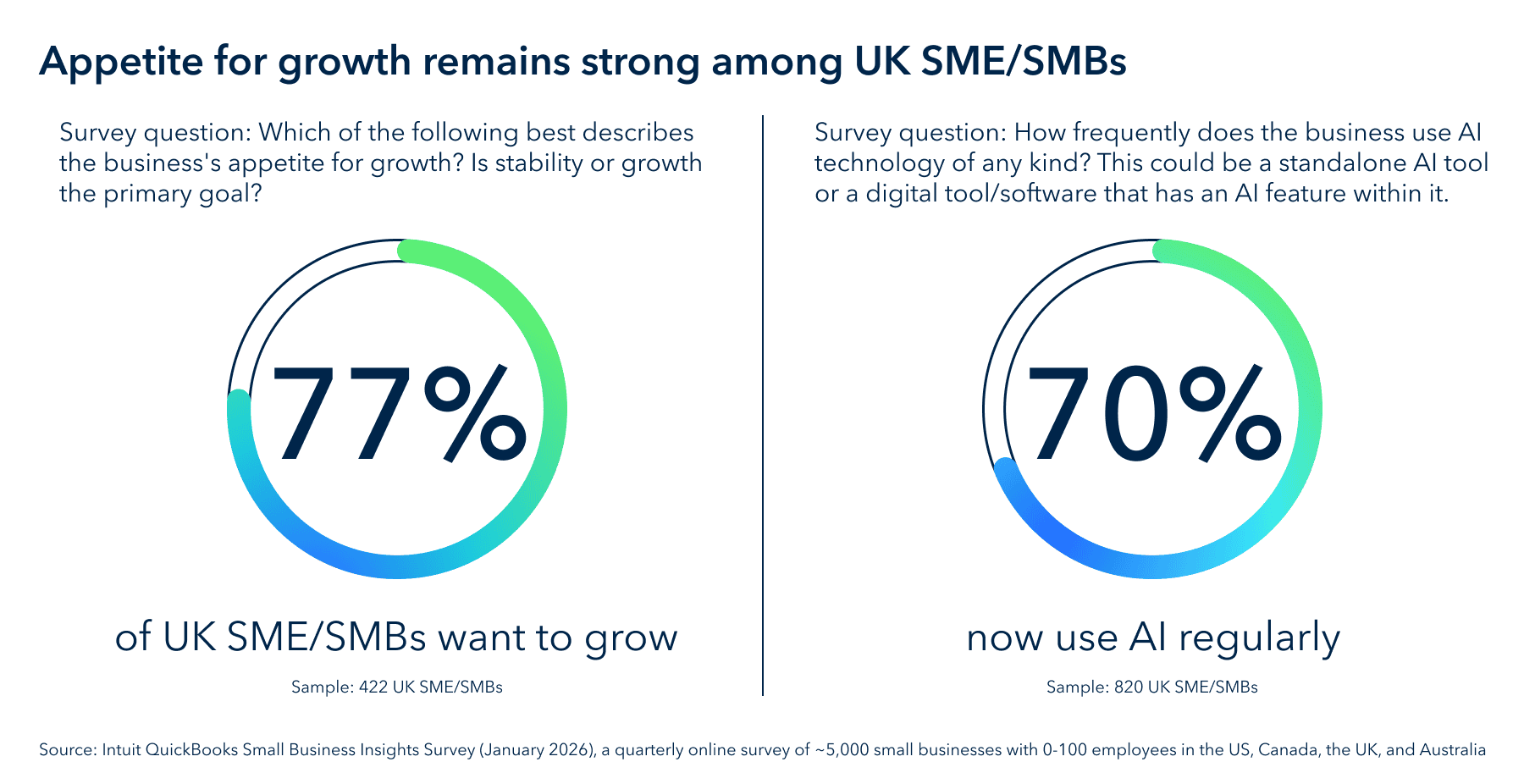
Appetite for growth remains strong among UK SMEs. Data from the January 2026 Small Business Insights survey reveals 77% of owners want to grow, either steadily or quickly. This ambition coincides with accelerating AI adoption: 70% of SMEs now use AI regularly, the highest level recorded since last spring
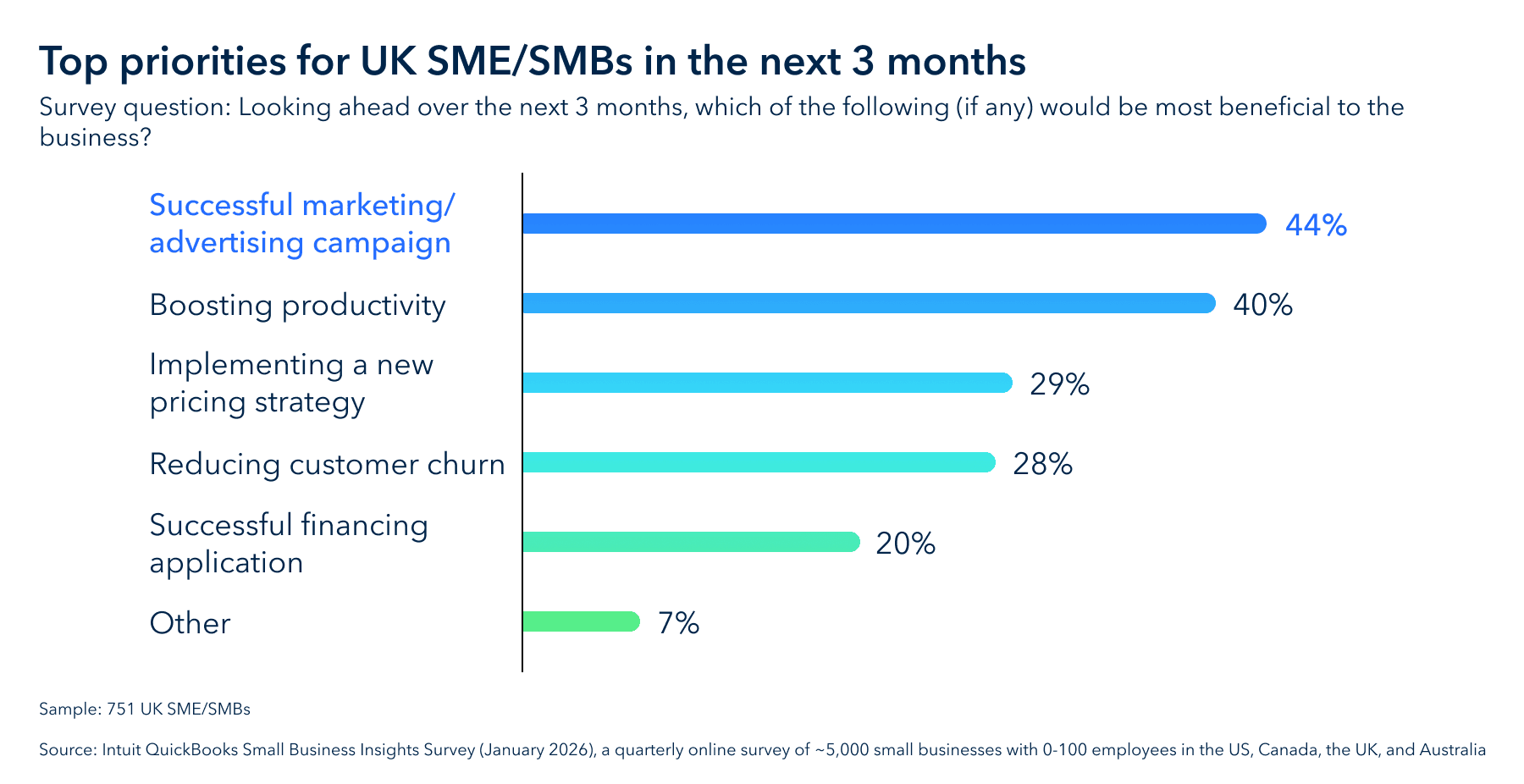
Many leaders (44%) say a winning marketing or advertising campaign would make the biggest difference in the next three months, outpacing productivity gains and new pricing strategies. Their plans reflect that urgency, with 25% gearing up to invest in new sales or marketing campaigns over the same period.
Core channels: Websites (29%) and social media (28%) rank among the most useful digital tools.
AI in marketing and sales: Almost 2 in 5 owners use AI for marketing weekly; 17% use it for sales.
Customer retention: 17% plan to invest in customer service to reduce churn; 36% already use AI for customer support weekly.
Bank transfers remain the dominant payment method (80%). But small businesses are using multiple options to keep money moving, including cards (56%), online platforms (50%) and mobile card readers (16%). Nearly 1 in 4 owners value these payment platforms as high-impact technology for their operations.
Despite these options, late payments affect a majority:
The payment gap: While 41% of owners want immediate payment (53% within 30 days), 61% report having invoices more than 30 days overdue.
Payment delays: 3 in 5 businesses are currently owed money from unpaid invoices.
AI intervention: Owners (20%) are using AI to predict late payments and automate invoice tracking weekly.
Inflation and rising costs remain the top external challenge for UK SMEs (52%), and 1 in 2 expect operating costs to rise further over the next three months.
Cash flow strain: 51% say cash flow is currently a problem.
Credit reliance: 2 in 5 report increased reliance on credit cards over the past year.
Funding hurdles: While 1 in 5 say a successful financing application would help most in the next three months, nearly 3 in 10 don’t expect to obtain the financing they need over the next year.
UK small businesses are caught in a paradox: many want to hire, but the workforce is shrinking. While nearly 2 in 5 (38%) plan to increase staff this quarter, the Intuit QuickBooks Small Business Index shows a decline in small business employment, continuing a downward trend since October 2025.
Hiring challenges: 34% say finding new talent is a challenge or getting harder.
Retention challenges: 32% report similar difficulties keeping existing employees.
Payment delays to vendors, contractors, and suppliers: Operational friction is stalling liquidity across the SME ecosystem. While 40% of UK SMEs face external challenges forcing delays (e.g., economic volatility), a nearly equal 38% admit to internal bottlenecks slowing payments to contractors and suppliers.
HR solutions: Facing these challenges, 27% of owners identify HR and payroll software as one of their most useful digital tools.
UK SMEs are using a hybrid approach to finances, combining professional accounting advice with a mix of legacy systems and modern software.
Financial management runs on multiple inputs: Most small businesses (70%) work with a qualified accountant, 62% use accounting software, and 59% still use spreadsheets.
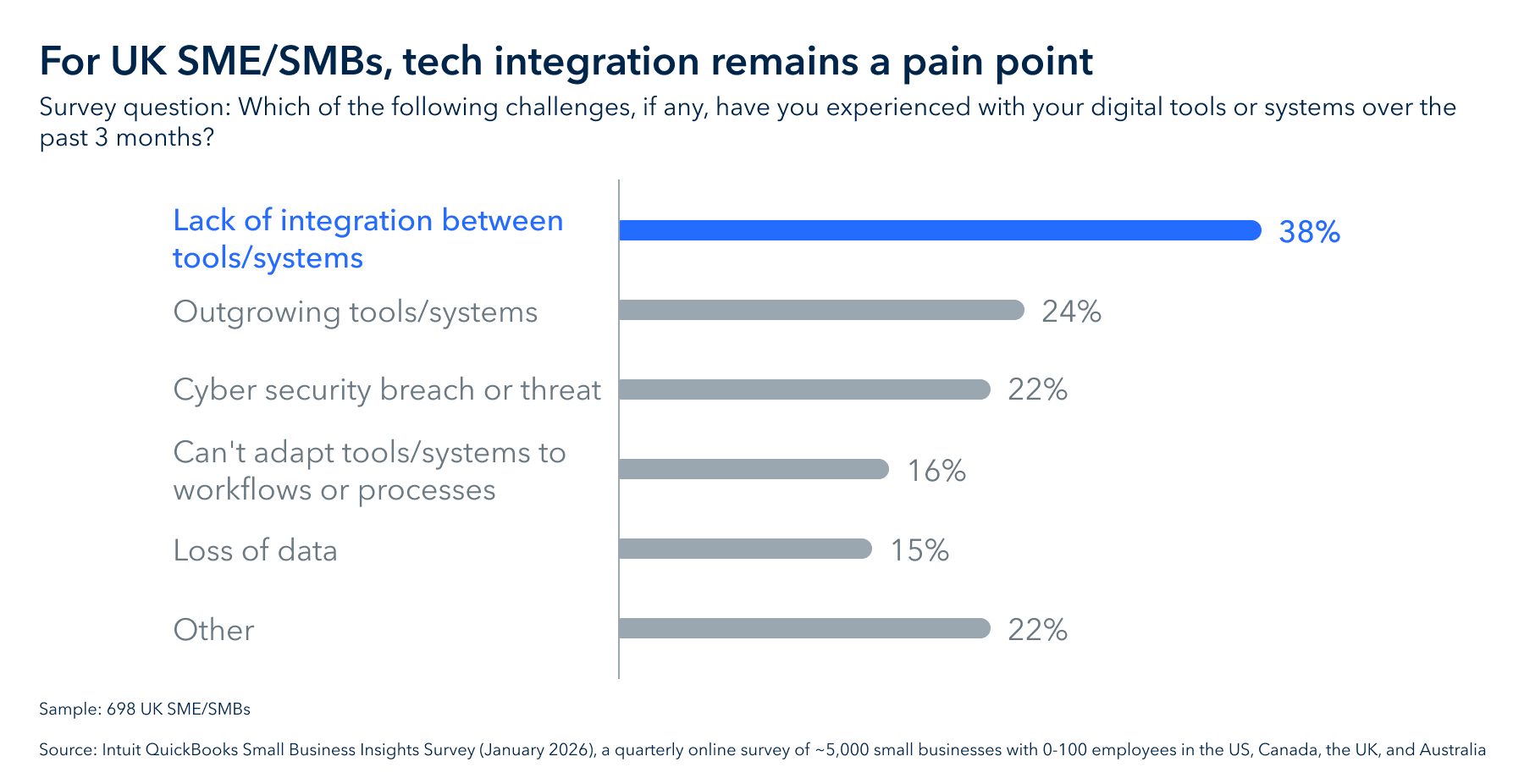
Integration remains a pain point: Fragmentation persists across various digital systems. Nearly 2 in 5 owners report a lack of tech integration is creating inefficiencies.
Internal roadblocks: SMEs point to blockers in forecasting and visibility, including accurately predicting costs or profit margins when creating estimates (19%), juggling too many apps (17%), and lacking insight into key performance indicators (16%).
Even with integration difficulties, financial management platforms stand out for their impact: 41% of owners say they’re among their most useful technologies.
AI has shifted into routine work for UK SMEs, helping owners save time, cut costs, and keep on top of weekly pressure points.
ROI from most useful digital tools: 64% report improved efficiency; 63% report significant time savings; and 38% say they’ve lowered operating costs.
Productivity impact: 77% of AI users say it has boosted productivity.
Admin as the #1 priority: 43% of SMEs are using AI for admin and scheduling, making it the top automated task.
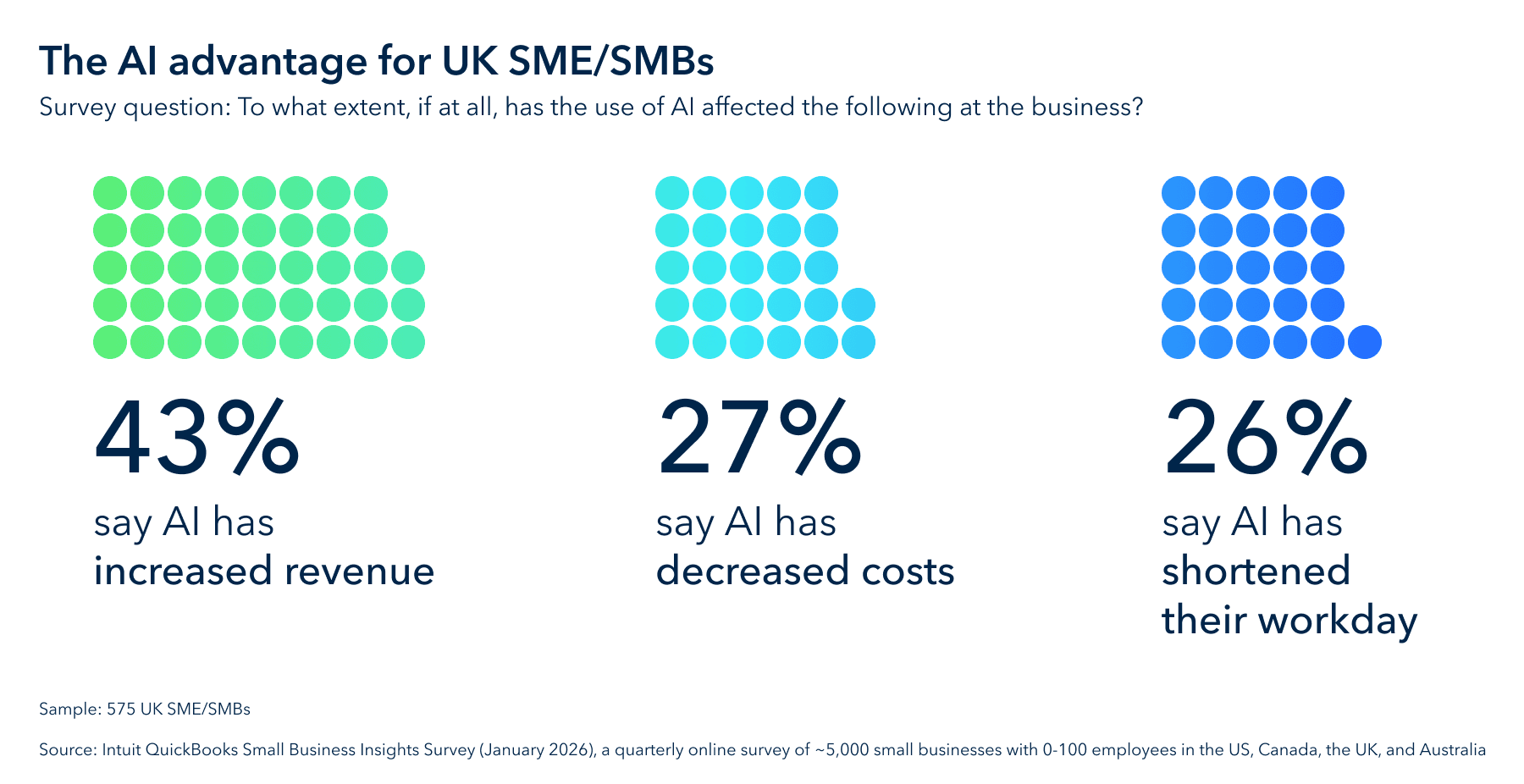
Driving business outcomes: 43% say AI has increased revenue; 27% report decreased costs; 26% say it has shortened their workday.
AI is becoming business-critical: 14% of AI users now describe AI as a core component of operations.
Get all the data from the Small Business Insights survey, updated every three months.
This content is for information purposes only, is provided free of charge and it is intended to be helpful to a wide range of businesses. Because of its general nature the information cannot be taken as comprehensive and they do not constitute and should never be used as a substitute for legal, accounting, or tax advice. Additional information and exceptions may apply. No assurance is given that the information provided is comprehensive, accurate or free of errors. Intuit does not have any responsibility for updating or revising any information presented herein. Any reliance you place on information found on this site or linked to on other websites will be at your own risk. You should consider seeking the advice of independent advisers and always check your decisions against your normal business methods and best practice in your field of business.
Share:
Subscribe to get our latest insights, promotions, and product releases straight to your inbox.
9.00am - 5.30pm Monday - Thursday
9.00am - 4.30pm Friday

