Second consecutive quarter of small business jobs growth in Q1/2024

Second consecutive quarter of small business jobs growth in Q1/2024

Small businesses create 25,700 jobs in first 3 months of 2024

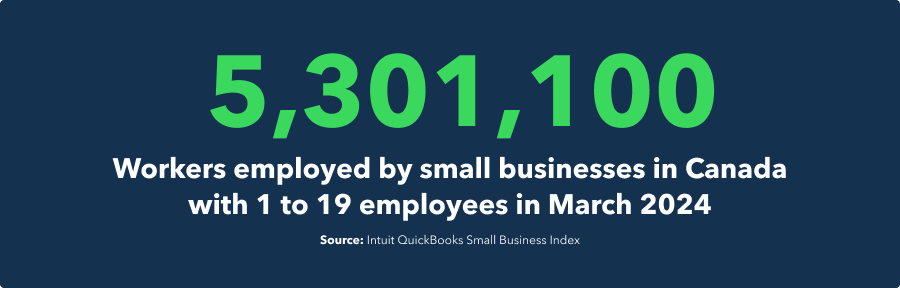
Small businesses in Canada with 1-19 employees have enjoyed two consecutive quarters of employment growth, according to the latest release from the Intuit QuickBooks Small Business Index. In the first quarter of 2024, small business employment grew by 0.49%, adding 25,700 jobs. This follows higher growth of 1.19% in the final quarter of 2023, when small businesses added 62,200 jobs. These businesses currently employ 5,301,100 people.


Jump to: Sectors | Regions | Analysis by Professor Ufuk Akcigit

quote image
"Optimism is growing around the Canadian economy's prospects of avoiding a recession."
Professor Ufuk Akcigit
5,301,100 workers employed by small businesses in Canada

Small businesses created a third of Canada’s jobs in Q1/2024

Canada’s smallest employers played an outsize role in jobs growth in the first three months of 2024. With overall employment up by 75,800 in Q1/2024, according to Statistics Canada’s latest Labour Force Survey, the Index projection indicates roughly a third of all jobs created in Canada from January to March were at small businesses with 1-19 employees. This contrasts with the US, where small businesses continue to lag behind larger businesses. 


When comparing current employment with jobs numbers 12 months ago, however, the picture is less positive for Canada’s small businesses. From March 2023 to March 2024, small business employment declined by 0.04% (2,200 jobs). This was primarily due to a weak Q2 and Q3 of 2023 which saw several months of sharply declining employment (find out why in the Intuit QuickBooks Small Business Index Annual Report) before the recent rebound, which has almost recouped those losses.

Construction sector adds the most small business jobs

Construction led the way in Q1/2024, with small business employment up by 24,900 in the sector (NAICS 23). This was likely driven by the increase in residential construction permits issued at the end of 2023. According to Statistics Canada, from December to January the value of residential construction permits rose by 13% — from $5.8 billion to $6.5 billion — primarily due to demand for multiple-dwelling buildings. This data, like the Intuit QuickBooks Small Business Index, is seasonally adjusted.


Small businesses in the wholesale and retail sector (NAICS 41-42; 44-45) had a tougher start to 2024, with employment down by 22,100 in the first quarter. National sales data for the sector is mixed. According to Statistics Canada, wholesale sales were up by 0.1% in January (the latest data available, seasonally adjusted), while retail sales were down by 0.3% — with motor vehicle and parts dealers seeing the largest declines. Retail has a much larger share of small business jobs than wholesale, so it’s likely small business retailers are driving the recent decline in employment in this sector.

Growing sectors


  • The construction sector (NAICS 23) created 24,900 small business jobs in Q1/2024 — an increase of 4.49% compared to the previous quarter. Year-over-year growth was also up, at 1.88%, with 10,600 more people employed at small businesses in March 2024 vs March 2023. Current employment: 567,200 jobs. 


  • Transport and warehousing (NAICS 48-49) was another growth sector in the first three months of 2024, adding 11,100 small business jobs. This 5.84% quarterly increase contributed to notable annual growth of 12.54% in March 2024 vs March 2023, with the sector employing 23,100 more people than 12 months previously. This was among the fastest rates of growth, year-over-year, of any sector for small businesses in Canada. Current employment: 195,800 jobs.


  • Professional services (NAICS 54) also saw rapid year-over-year growth in March 2024, at 10.34%, adding 44,700 jobs since March 2023 — a strong recovery after two previous years of annual declines. Quarterly, the sector added 9,200 jobs from the end of December to the end of March, an increase of 2.05%. Current employment: 454,900 jobs.

Declining sectors


  • The wholesale and retail sector (NAICS 41-42; 44-45) lost the most small business jobs in Q1/2024 — 22,100 in total — with a quarterly decline of 2.27%. Year-over-year, employment declined by 25,000 jobs from March 2023 to March 2024 (annual decline of 2.57%), leaving 959,200 people employed at small businesses. As noted above, it’s likely small business retailers are primarily driving this downward trend.  


  • The accommodation and food services sector (NAICS 72) had a relatively strong end to 2023 but in Q1/2024, small business employment declined by 4,800 jobs (-0.98%). Year-over-year, jobs numbers are down by 4,200 (-0.85%), with small businesses employing 490,400 people in March 2024.

Prairies powering small business jobs growth

Out of the five Canadian regions covered by the Index, three ended the first quarter of 2024 with more jobs at small businesses than at the end of 2023: Prairie Provinces, British Columbia, and the Atlantic region. The other two, Ontario and Quebec, ended the quarter with fewer small business jobs. 


On an annual basis, employment is up in four out of five regions, with British Columbia, Prairie Provinces, Ontario, Quebec, and the Atlantic region all adding small business jobs from March 2023 to March 2024. Only Ontario had declining employment on both a quarterly and annual basis.

Growing regions 


  • Prairie Provinces (Manitoba, Saskatchewan, Alberta) added 28,100 small business jobs in Q1/2024 (2.55% quarterly growth), with annual growth of 27,200 jobs (2.47%). These increases are likely the result of local economic influences because the region doesn’t have higher concentrations of small business jobs in sectors that are growing nationally, based on analysis of the Index’s data insights. Recent GDP forecasts similarly predict stronger growth in the Prairie Provinces than in other regions of Canada. Current employment: 1,113,000 jobs at small businesses.


  • British Columbia added 5,600 small business jobs in Q1/2024 (0.68% quarterly growth), with annual growth of 8,300 (1.00%). Current employment: 826,000 jobs.


  • The Atlantic region (Newfoundland and Labrador, Prince Edward Island, Nova Scotia, New Brunswick) added 3,700 small business jobs in Q1/2024 (0.92% quarterly growth), with annual growth of 4,000 (0.99%). Current employment: 408,000 jobs.


Falling employment in Ontario, mixed picture in Quebec


  • Ontario lost 14,300 small business jobs in Q1/2024 (quarterly decline of 0.77%), contributing to the 75,800 jobs lost from March 2023 to March 2024 (annual decline of 4.02%). Some of this decline can be attributed to job losses at small businesses in the wholesale and retail sector (noted above), where employment is down by 2.57% year-over-year. Current employment: 1,846,100 jobs.


  • Quebec lost 1,000 small business jobs in Q1/2024 (quarterly decline of 0.09%), but on a more positive note, added 11,700 jobs from March 2023 to March 2024 (annual growth of 1.08%). Current employment: 1,086,000 jobs.

Expert analysis

Ufuk Akcigit, the Arnold C. Harberger Professor of Economics at the University of Chicago, explores the trends in more detail.


“Optimism is growing around the Canadian economy's prospects of avoiding a recession, a sentiment that mirrors the situation in the US. In February, the annual CPI inflation rate in Canada dropped slightly to 2.8% from January's 2.9%. 


“Despite this, the Bank of Canada has decided to maintain its interest rate at the elevated level of 5% for another month. The start of 2024 has been marked by a notable increase in business insolvencies. The Canada Emergency Business Account (CEBA) program extended $60,000 loans to each of nearly 900,000 businesses to support them through the pandemic. Businesses were offered forgiveness of up to $20,000 on the loan if they repaid two-thirds of it by January 18. Failing that, the loan would convert to a three-year term loan with a 5% annual interest rate. In January, there was a surge in business insolvencies, more than doubling the figure from the same period a year earlier and even exceeding pre-pandemic levels for the month, according to data from the Office of the Superintendent of Bankruptcy. As businesses grappled with inflation rates higher than long-term averages, steep interest rates, and diminished consumer spending, the CEBA deadline served as a major challenge for many.


“This scenario is echoed in the annual change in small business employment during Q1/2024. According to the Intuit QuickBooks Small Business Index, there has been a marginal yearly employment decrease of -0.04% — though quarterly growth of 0.49% shows a glimmer of resilience. This is good news, but it should be seen in the longer-term context of persisting macroeconomic challenges, which continue to weigh heavily on small enterprises; evident in the long-term decline in small businesses’ overall share of employment from 32.4% in Q1/2015 to 30.2% in Q1/2024.


“In Ontario, a recent Equifax report shows rising mortgage delinquency rates. Over the past year, the rate soared by 135%, surpassing the national average of 52% more than twofold. Notably, this economic strain reflects the performance of small businesses in Ontario during Q1/2024, where we see quarterly employment down by 0.77% and by a substantial 4.02% annually. Conversely, the Prairies region had a robust start to 2024, boasting quarterly growth of 2.55% and yearly growth of 2.47%.


“Analyzing sectoral performance reveals notable trends. The accommodation and food services sector suffered the steepest quarterly decline at 0.98%, and a yearly decline of 0.85%. Meanwhile, the healthcare and social assistance sector faced the most significant annual decline of 3.18%. In contrast, the transport and warehousing sector emerged as a standout with impressive quarterly growth at 5.84% and remarkable yearly growth of 12.54%.


“Q1/2024 serves as yet another illustration of the increased susceptibility of small businesses to broader economic conditions illustrated by rising business insolvencies and mortgage delinquency rates. Despite the quarterly growth in small business employment, the small decline year-over-year signals the acute sensitivity of small enterprises to financial climates. Particularly for those heavily reliant on external financing, the scarcity or increased cost of credit poses significant hurdles. This dissonance underscores the distinct challenges faced by small businesses and emphasizes the imperative for tailored economic analyses and targeted policy interventions.”

Your privacy

We collect data when you use our website to improve its performance. Doing so also helps us provide a secure, personalized experience. Select 'Accept cookies' to agree or 'Cookies settings' to choose which cookies we use. You can change your preferences anytime by clicking the 'Manage cookies' link in the footer.

Choose your cookie preferences

Some cookies are needed to make our website work and can't be turned off. But we need your consent to use others that are not essential. You can make your choices below and update them at any time using the 'Manage Cookies' link. To find out more, visit our Cookies Policy.

These cookies are necessary for the site to function. They also help us keep your data safe.
These cookies allow us to enhance your experience and remember your preferences, region or country, language, and accessibility options.
These cookies tell us how customers use our website. We study and organize this data to help us optimise our content and provide you with personalised experiences.
These cookies help us provide you with relevant communications and ads in our products and on other sites.

Looking for something else?

Get QuickBooks

Smart features made for your business. We've got you covered.

Firm of the Future

Expert advice and resources for today’s accounting professionals.

QuickBooks Support

Get help with QuickBooks. Find articles, video tutorials, and more.
