A woman holding 2 boxes and typing on a laptop
Midsize business

Quick ratio guide: Formulas with examples


Key Takeaways

  • The quick ratio (or acid test ratio) is a liquidity ratio that can help companies determine their ability to convert liquid assets into cash to pay off short-term liabilities.

  • The quick ratio is best used with other liquidity ratios, such as the current ratio, to measure a company’s financial health. 

  • Selling off unnecessary assets may be an effective way to improve a company’s liquidity.


  • When conducting financial analysis, quick ratio calculations can help chief financial officers (CFOs) and finance teams determine their company’s liquidity and ability to meet short-term financial obligations. With prevalent economic uncertainty in the foreseeable future, 36% of Canadian businesses say one of their biggest challenges is financial strain, according to a Canadian Federation of Independent Business survey.

    By evaluating the quick ratio, analysts, investors, and key stakeholders can obtain valuable insight into a mid-sized company’s financial stability and cash flow management. Financial liquidity allows businesses to maintain positive relationships with lenders and suppliers.

    In this article, we’ll explore how the quick ratio works, explain what makes a good quick ratio, evaluate the advantages and disadvantages, provide industry examples, and offer strategies on improving liquidity.

    Overview of the quick ratio

    Quick ratio, also known as the acid test ratio, is a liquidity ratio that helps assess a company's ability to use its quick assets and cash to pay down its short-term financial obligations, but excludes inventory. Finance managers use the quick ratio as a valuable metric in discovering their organization’s capability to convert the most liquid assets into cash or cash equivalents to cover their near-term financial liabilities.

    Selling off assets may come in handy if a business finds itself needing to cover emergency expenses. However, it’s important to note that this formula solely looks at liquid assets and excludes inventory.

    The core components

    The quick ratio includes two parts: quick assets and current liabilities.

    Essentially, quick assets are the assets that a business anticipates to convert into cash within 90 days. Current liabilities are obligations that a company needs to pay off within one year.

    The main components of the quick ratio are:

    • Quick assets: 
    • Cash and cash equivalents
    • Marketable securities
    • Accounts receivable (A/R)
    • Current liabilities:  
    • Accounts payable (A/P)
    • Accrued expenses
    • Wages and salaries payable
    • Taxes payable
    • Short-term debt

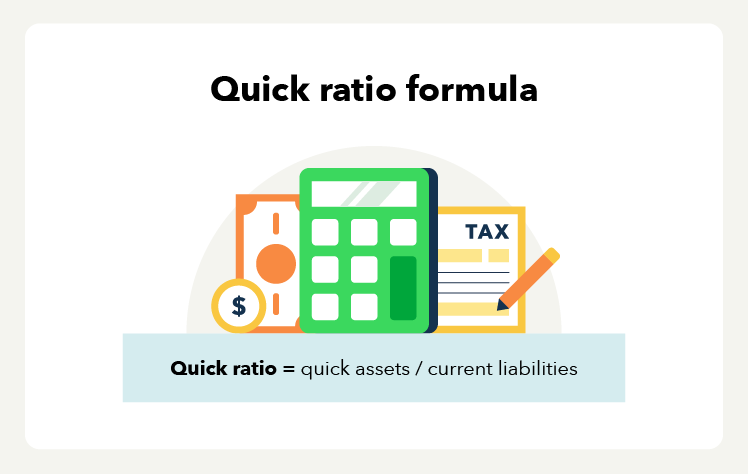
    Quick ratio formulas

    The quick ratio formula is: quick ratio = quick assets / current liabilities.

    The quick ratio can be calculated using numerous methods. Here’s a breakdown of how the quick ratio formula works. 

    The most simplified formula is: 

    Quick ratio = Quick assets / Current liabilities

    However, since quick assets comprise the assets mentioned above, the detailed formula can be illustrated as:

    Quick ratio = Cash & cash equivalents + Marketable securities + Accounts receivable / Current liabilities

    If a company can't extract all of the above data from the balance sheet, an alternative way to calculate the total amount of quick assets can be determined with this formula:

    Quick ratio = Current assets - Inventory - Prepaid expenses / Current liabilities

    The current liabilities can be found on the balance sheet. 

    Typically, the higher the ratio, the better a business is able to pay off its current liabilities. A business with a quick ratio of 1.0 indicates that for every $1.00 of quick assets, it has $1.00 in current liabilities. 

    A person in a pink dress is looking at a laptop.

    Let's grow your business together

    Get flexible solutions and real-time data to do everything from managing your money to paying your team. All in QuickBooks Online Advanced.

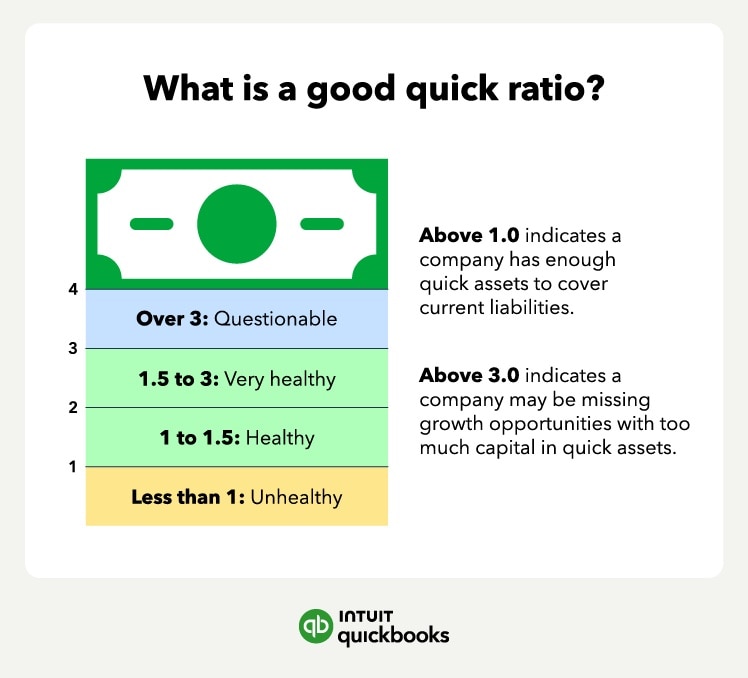
    What is a good quick ratio? 

    Each industry will have a varying ratio. For most industries, a ratio between 1.0 and 1.5 illustrates that the company has sufficient assets to cover its current obligations. 

    As a guideline, a higher quick ratio signifies better liquidity.

    In contrast, a lower quick ratio implies that a business has inadequate liquid assets to cover its short-term obligations. 

    Here’s the quick ratio range: 

    • Less than 1: Unhealthy 
    • 1 to 1.5: Healthy
    • 1.5 to 3: Very healthy
    • Over 3: Questionable

    The quick ratio will vary by industry. It’s not uncommon for certain industries to have high ratios, while other industries produce low ratios. Here are a few examples of where they land on the scale:

    • High quick ratios: Biotechnology, medical devices, asset management, diagnostics & research
    • Low quick ratios: Utilities, retail, grocery stores, airlines, car dealerships

    Similarly, here are several examples of industries that have varying current ratios:

    • High current ratios: Biotechnology, medical devices, semiconductors, asset management
    • Low current ratios: Airlines, lodging, utilities, resorts & casinos, restaurants

    Quick ratio examples

    Let's explore two contrasting scenarios: the first example has a high quick ratio and the second has a low quick ratio.

    High quick ratio example

    Quick assets from the example balance sheet are: 

    • Cash: $25,000
    • Cash equivalents: $6,500
    • Marketable securities: $15,700
    • Accounts receivable: $10,300
    • Total quick assets: $57,500

    The current liabilities are: 

    • Accounts payable: $22,900
    • Prepaid expenses: $1,600
    • Short-term loans: $17,000
    • Taxes payable: $2,600
    • Total current liabilities: $44,100

    Quick ratio: $57,500 / $44,100 = $1.30

    Here we see that the company has $1.30 in quick assets for every $1.00 in current liabilities. This signifies that it is able to cover near-term liabilities.

    [H3] Low quick ratio example

    Quick assets from the example balance sheet are: 

    • Cash: $13,000
    • Cash equivalents: $5,000
    • Marketable securities: $11,300
    • Accounts receivable: $14,600
    • Total quick assets: $43,900

    The current liabilities are: 

    • Accounts payable: $21,800
    • Prepaid expenses: $7,300
    • Short-term loans: $20,000
    • Taxes payable: $4,500
    • Total current liabilities: $53,600

    Quick ratio: $43,900 / $53,600 = $0.82

    In this example, the company has $0.82 in quick assets for every $1.00 in current liabilities. This indicates that the company may struggle to pay off its short-term obligations. 

    The elements that make up a good quick ratio.

    The importance of the quick ratio 

    The quick ratio is a proven formula that helps mid-sized companies manage cash flow. Looking internally, business owners can make adjustments to their cash flow to ensure they’re prepared for any unexpected financial challenges. Measuring liquidity levels can empower finance teams to make educated decisions, such as planning the optimal time to purchase new equipment or managing operating expenses.

    From an external perspective, lenders use this formula to assess how reliable a business will be in repaying loans. The quick ratio can also be a helpful measure for investors when comparing against competitors or determining a company’s ability to stay afloat during financial hardship. 

    Pros and cons

    Before utilizing the quick ratio, finance teams should understand the potential benefits and drawbacks: 

    Advantages:

    • It's a reliable way of measuring a mid-sized company’s short-term liquidity.
    • All data needed to perform the calculation are available in the balance sheet.
    • It can uncover early red flags for potential cash flow problems. 
    • It's more straightforward to calculate compared to the current ratio.
    • It's helpful in comparing liquidity with other companies or industry averages.

    Disadvantages:

    • It provides a narrow viewpoint, as it excludes some current assets and other sources of liquidity, such as securities and credit lines.
    • It only shows the short-term cash flow for a specific period; it doesn’t take future cash inflows and outflows into consideration.
    • It doesn’t factor in the quality or collectability of accounts receivable. For instance, a company may forecast a high volume of incoming payments. However, if customers aren’t reliable, the company may not receive enough cash. 
    • The current liabilities may be misleading — they may appear to have short-term due dates, but in fact, the payment dates may be extended.
    • It ignores the operating cash flows, which are essential to paying the bills. 

    Comparison of quick ratio vs. current ratio

    Both the quick ratio and current ratio are liquidity ratios used by CFOs and finance teams.

    • Here are the fundamental differences between the two ratios: 
    comparison chart

    In essence, the quick ratio provides a more conservative view on liquidity based on higher liquid assets in the short-term. Conversely, the current ratio offers a broader perspective on liquidity using all current assets over a longer time period. 

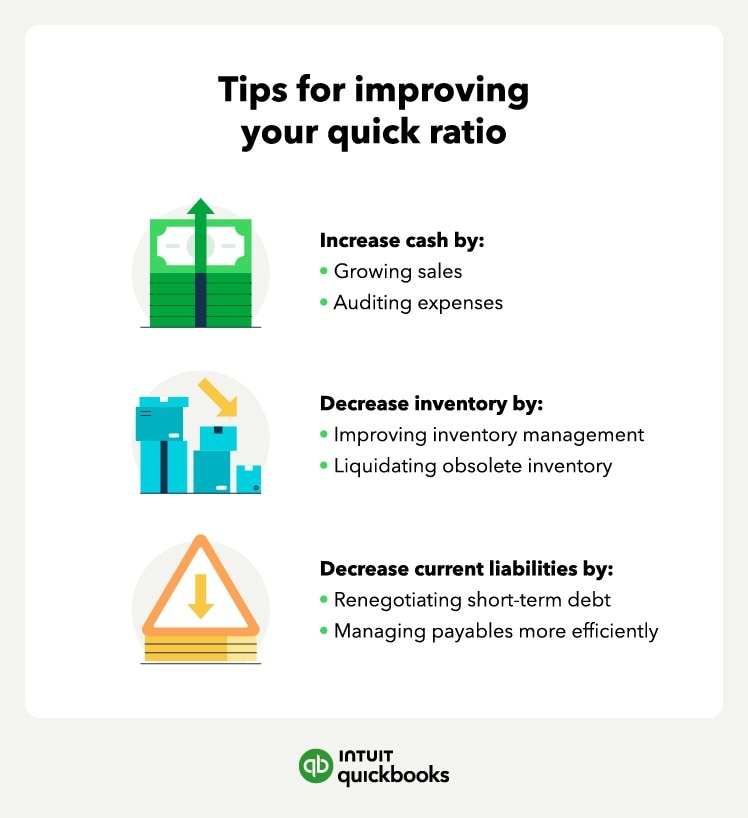
    10 ways finance teams can improve their quick ratio

    Mid-sized companies may come across liquidity challenges as they plan to expand operations.

    Here are 10 quick tips to help growing companies enhance their quick ratio:

    1. Increase your cash on hand.
    2. Minimize the cash you withdraw to preserve working capital.
    3. Improve your inventory turnover ratio.
    4. Reduce your excess inventory. 
    5. Sell off unwanted or unprofitable assets. 
    6. Pay off your short-term debt. 
    7. Decrease unnecessary expenses and overhead costs.
    8. Defer any non-essential capital expenditures.
    9. Negotiate payment terms with suppliers.
    10. Ensure customers are paying their invoices on time.

    By implementing these best practices, businesses can effectively elevate their quick ratio.

    Ways to improve your quick ratio.

    Using QuickBooks to scale your business 

    Conducting accurate financial forecasts can help companies prepare for potential financial strain. When finance professionals maintain an optimal quick ratio, their mid-sized business can obtain better interest rates on loans, manage its financial obligations, and attract potential investors. 

    Remember that while the quick ratio can help determine a company’s ability to pay off short-term financial obligations, it’s best to use this acid test ratio in conjunction with other liquidity ratios and reporting tools to gain a holistic view of a company’s financial well-being. 

    Accounting solutions can assist any growing business by helping with data analysis, generating custom reports, and tracking financial health. With QuickBooks Online Advanced, all the important numbers are tracked, calculated, and available to your finance team at a glance — making it easy to monitor your mid-sized company’s financial performance.

    Frequently asked questions

    Disclaimer

    Money movement services are provided by Intuit Canada Payments Inc.

    This content is for information purposes only and should not be considered legal, accounting or tax advice, or a substitute for obtaining such advice specific to your business. Additional information and exceptions may apply. Applicable laws may vary by region, province, state or locality. No assurance is given that the information is comprehensive in its coverage or that it is suitable in dealing with a customer’s particular situation. Intuit does not have any responsibility for updating or revising any information presented herein. Accordingly, the information provided should not be relied upon as a substitute for independent research. Intuit does not warrant that the material contained herein will continue to be accurate nor that it is completely free of errors when published. Readers should verify statements before relying on them.

    We provide third-party links as a convenience and for informational purposes only. Intuit does not endorse or approve these products and services, or the opinions of these corporations or organizations or individuals. Intuit accepts no responsibility for the accuracy, legality, or content on these sites.


    Your privacy

    We collect data when you use our website to improve its performance. Doing so also helps us provide a secure, personalized experience. Select 'Accept cookies' to agree or 'Cookies settings' to choose which cookies we use. You can change your preferences anytime by clicking the 'Manage cookies' link in the footer.

    Choose your cookie preferences

    Some cookies are needed to make our website work and can't be turned off. But we need your consent to use others that are not essential. You can make your choices below and update them at any time using the 'Manage Cookies' link. To find out more, visit our Cookies Policy.

    These cookies are necessary for the site to function. They also help us keep your data safe.
    These cookies allow us to enhance your experience and remember your preferences, region or country, language, and accessibility options.
    These cookies tell us how customers use our website. We study and organize this data to help us optimise our content and provide you with personalised experiences.
    These cookies help us provide you with relevant communications and ads in our products and on other sites.

    Looking for something else?

    Get QuickBooks

    Smart features made for your business. We've got you covered.

    Firm of the Future

    Expert advice and resources for today’s accounting professionals.

    QuickBooks Support

    Get help with QuickBooks. Find articles, video tutorials, and more.