A woman standing in front of an open sign on a store
Midsize business

Cost-plus pricing: Application, calculation, and strategy


Key Takeaways

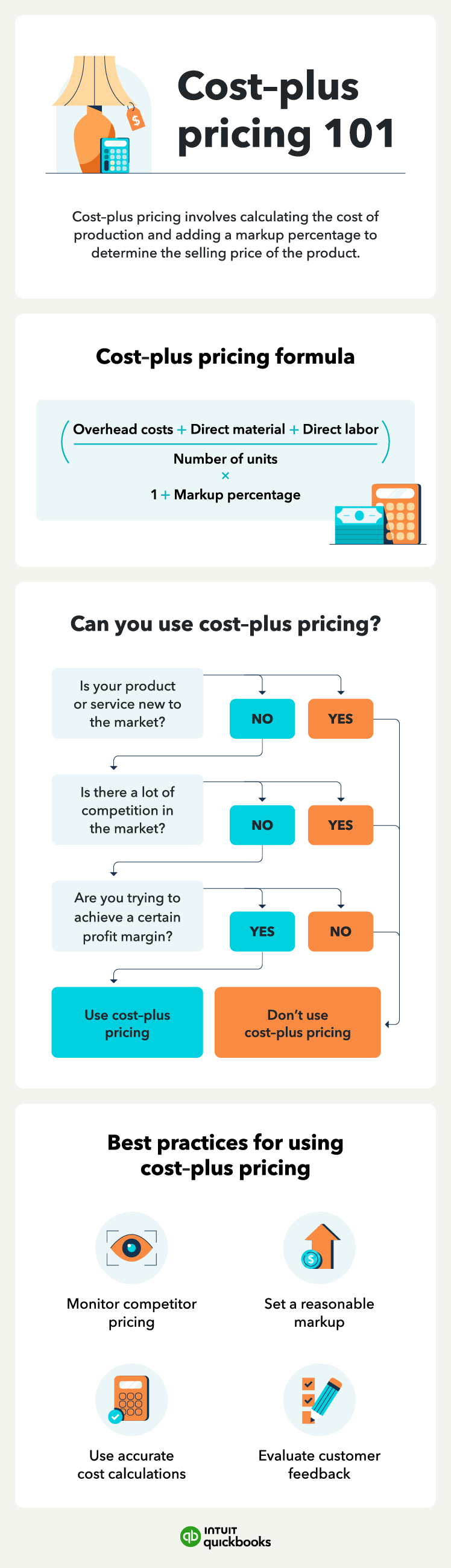
  • Cost-plus pricing is a pricing strategy that takes the total cost of the item and adds a markup percentage to determine the selling price.

  • While it’s a simple way to calculate the selling price, the formula excludes other factors such as customer demand and competitor pricing. 

  • This strategy is common in numerous industries, including manufacturing, retail, healthcare, grocery stores, and restaurants. 

  • A best practice is to monitor inflation and production costs so prices can be adjusted to ensure a mid-sized company’s profits have longevity.


  • Discovering the most effective way to price products can be challenging for mid-sized businesses. Whether you sell manufactured goods or professional services, you need to find a pricing strategy that can optimize your profit margins.

    With so many pricing methods to choose from, it can feel overwhelming for chief financial officers (CFOs) and finance teams to decide which is the right fit. But if you’re looking for a straightforward strategy, consider the cost-plus pricing formula.

    In this guide, we’ll explain how to calculate cost-plus pricing, review the benefits and pitfalls, and discuss best practices.

    How cost-plus pricing works

    The cost-plus pricing strategy takes the cost of the product and adds a markup to get the selling price. Typically, the markup is a percentage of the product, but it can also be a fixed dollar amount. Cost-plus pricing is a popular method that medium-sized companies — like grocery stores, retail stores, construction companies, and service providers — use regularly.

    H3: Cost-plus pricing formula 

    There are two ways to calculate your selling price using the cost-plus pricing formula.

    If you already know the cost of a single unit, the first formula is the most straightforward: 

    Item cost + Markup percentage = Selling price

    However, if your company produces goods in large quantities, it’s best to use the second formula:

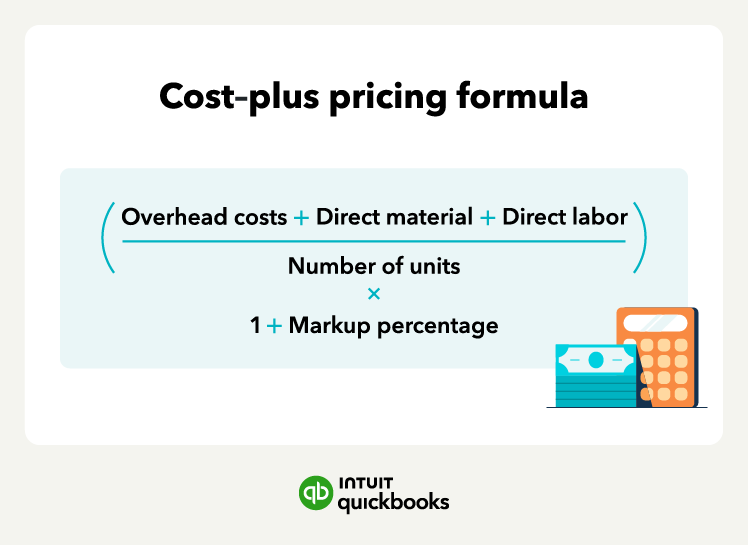
    (Overhead costs + Materials + Labour / Number of units) x (1 + Markup percentage) = Selling price

    The second method takes into account all the manufacturing costs and then divides it by the total units to establish the cost per unit.

    A printer is cutting a sheet of paper.

    3 steps to calculate cost-plus pricing 

    1. Calculate the total cost of the product 

    First, you’ll need to calculate the total cost of producing the product, which consists of material costs, labour costs, and overhead costs. Overhead costs include indirect expenses such as rent, utilities, and office expenses.

    If using the second formula above, you’ll need to go a step further by taking the total product cost and dividing it by the total number of units to determine the cost per unit.

    2. Establish the desired markup percentage 

    The next step is to decide how much you want to mark up the product. Each industry will have its own range. Other factors like price elasticity and government regulations can influence how your business will set the markup percentage. For example, retailers generally aim to have a 30% to 50% profit margin.

    3. Determine the selling price

    This is where you use the first formula, combining the total item cost and the markup percentage to finalize the selling price. This method is commonly used in companies that provide construction services

    However, companies that manufacture products in bulk quantities will use the second formula, taking the cost per unit and multiplying it by the markup percentage to determine the selling price.

    A person in a pink dress is looking at a laptop.

    Let's grow your business together

    Get flexible solutions and real-time data to do everything from managing your money to paying your team. All in QuickBooks Online Advanced.

    Cost-plus pricing examples 

    To get a better understanding of the cost-plus pricing strategy, consider two scenarios that illustrate both formulas.

    Service-based: Landscaping business 

    A landscaping business provides a quote to a customer.

    First, we need to add up all the relevant costs.

    Costs: 

    Supplies and materials: $125,000

    Labour: $300,000

    Overhead: $75,000 

    Total costs: $125,000 + $300,000 + $75,000 = $500,000

    Then, we take the markup percentage and multiply it by the total costs to determine the total markup amount.

    Markup:

    Percentage: 25% 

    $500,000 x 0.25 = $125,000

    The final step is to add the total costs and the markup amount to determine the selling price.

    Selling price:   

    • $500,000 + $125,000 = $625,000

    Physical products: Beverage manufacturer

    A local winery produces large quantities of wine.

    Batch quantity: 15,000 units

    Start by tallying all the costs together.

    Costs:

    Materials: $18,000

    Labour: $25,000

    Overhead: $30,000

    Total costs: $18,000 + $25,000 + $30,000 = $73,000

    Next, take the total costs and divide it by the total number of units.

    Cost per unit: 

    $73,000/15,000 = $4.86 

    Then, take the unit cost and multiply it by the markup percentage to determine the total markup amount. 

    Markup:

    Percentage: 200% 

    $4.86 x 2.00 = $9.72

    Lastly, add the unit cost and the markup amount to determine the selling price.

    Selling price: 

    $4.86 + $9.72 = $14.58

    Advantages and disadvantages of cost-plus pricing

    The cost-plus pricing strategy has benefits and drawbacks for finance teams to consider.

    Advantages 

    • Effective way to test the market: It's an easy way to figure out the price a customer is willing to pay for your product. This is especially helpful when you have limited competitive data in your market.
    • Easy to use: Compared to other pricing strategies, the cost-plus pricing formula is simple to use.
    • Upfront pricing: Since the pricing is based on costs, customers perceive this to be a fair way to establish the selling price.
    • Stable return on investment (ROI): If your costs remain the same, you’ll have assurance that every sale you make will help recoup your costs and maintain a fixed profit margin.

    Disadvantages

    • Excludes buying trends: Some items may become trendy, so companies can bump up their markup percentage. However, cost-plus pricing doesn’t factor this into the equation.
    • Relies on costs: The downside to relying on costs is that if a business scales and is able to reduce costs, this formula naturally implies that the pricing should also come down. However, if customers are willing to pay more for your product, you’re hurting your bottom line. 
    • May lead to price wars: If competitors start to lower their prices, it may lead to a price war. As a result, it will squeeze the profit margins of all companies participating in this pricing battle.

    Considerations when using the cost-plus pricing formula

    Businesses gravitate towards the cost-plus pricing model because it provides numerous advantages.

    Here are a few key factors to consider when deciding whether to use the cost-plus pricing strategy. 

    • Cost structure: It’s optimal to use cost-plus pricing when your business has steady costs. In contrast, businesses hampered with U.S. tariffs creating fluctuating costs may not find this method as useful.
    • Elastic demand: The cost-plus pricing formula works well when a product has low price elasticity. 
    • Industry standards: Grocery and retail stores favour the cost-plus pricing strategy because it provides transparency to their customers.
    • Competitive landscape: If your competitors sell a high-margin product, you have some wiggle room to compete with them. Conversely, if they sell a low-margin product, you have to differentiate your product to justify the higher price, or reduce your costs to have the same competing price point. 

    Best practices for cost-plus pricing 

    Finance professionals must constantly monitor internal and external factors that may affect their company’s bottom line.

    Here are several proven industry standards to implement so you can enjoy the benefits and mitigate any potential risks:

    • Validate calculations to ensure accuracy in the listed retail prices. 
    • Embrace the use of tools to help automate calculations and track financial data.
    • Monitor sales, inflation, and production costs to decide whether to make a pricing adjustment. Conduct a financial trend analysis to predict future trends.
    • Stay up-to-date on competitor pricing and consumer demand. 
    • Conduct surveys and collect feedback from customers to better understand buying behaviour.
    A mobile phone service for pay phones arranged in a neat arrangement.

    Alternative pricing strategies

    The cost-plus pricing strategy can be effective for some medium-sized businesses, but it’s crucial for financial executives to explore other pricing strategies in order to remain competitive and maintain profitability.

    Widely accepted approaches include:

    • Bundle pricing
    • Competitor-based pricing 
    • Demand-based pricing
    • Dynamic pricing
    • Freemium pricing
    • Keystone pricing
    • Manufacturer’s suggested retail price (MSRP)
    • Penetration pricing 
    • Promotional pricing
    • Value-based pricing
    • Learn more about various pricing strategies here.

    Enhancing financial management with QuickBooks

    Now more than ever, growing Canadian businesses need to be nimble with their pricing strategy. Whether you’re a new or established medium-sized business, a cost-plus pricing strategy is contingent on your finance team maintaining accurate financial reports. Having precise data empowers finance managers to forecast future sales and make critical decisions on how to expand a business. 

    If you’re looking to streamline your financial data, QuickBooks Online Advanced provides real-time financial insights that help mid-sized businesses achieve sustainable growth.

    Frequently asked questions

    Disclaimer

    Money movement services are provided by Intuit Canada Payments Inc.

    This content is for information purposes only and should not be considered legal, accounting or tax advice, or a substitute for obtaining such advice specific to your business. Additional information and exceptions may apply. Applicable laws may vary by region, province, state or locality. No assurance is given that the information is comprehensive in its coverage or that it is suitable in dealing with a customer’s particular situation. Intuit does not have any responsibility for updating or revising any information presented herein. Accordingly, the information provided should not be relied upon as a substitute for independent research. Intuit does not warrant that the material contained herein will continue to be accurate nor that it is completely free of errors when published. Readers should verify statements before relying on them.

    We provide third-party links as a convenience and for informational purposes only. Intuit does not endorse or approve these products and services, or the opinions of these corporations or organizations or individuals. Intuit accepts no responsibility for the accuracy, legality, or content on these sites.


    Your privacy

    We collect data when you use our website to improve its performance. Doing so also helps us provide a secure, personalized experience. Select 'Accept cookies' to agree or 'Cookies settings' to choose which cookies we use. You can change your preferences anytime by clicking the 'Manage cookies' link in the footer.

    Choose your cookie preferences

    Some cookies are needed to make our website work and can't be turned off. But we need your consent to use others that are not essential. You can make your choices below and update them at any time using the 'Manage Cookies' link. To find out more, visit our Cookies Policy.

    These cookies are necessary for the site to function. They also help us keep your data safe.
    These cookies allow us to enhance your experience and remember your preferences, region or country, language, and accessibility options.
    These cookies tell us how customers use our website. We study and organize this data to help us optimise our content and provide you with personalised experiences.
    These cookies help us provide you with relevant communications and ads in our products and on other sites.

    Looking for something else?

    Get QuickBooks

    Smart features made for your business. We've got you covered.

    Firm of the Future

    Expert advice and resources for today’s accounting professionals.

    QuickBooks Support

    Get help with QuickBooks. Find articles, video tutorials, and more.