Year-End Learning! AI Webinar: Watch by Dec. 31. Watch Now! 
A photo of a business professional looking at AI demand forecasting data.
Enterprise

What is AI demand forecasting? Everything you need to know


Key takeaways:

  • AI demand forecasting utilizes machine learning to estimate future demand for products or services more quickly and accurately than traditional methods.
  • AI systems can analyze large volumes and broader ranges of data, including ongoing market trends and consumer behavior.
  • This process can help you optimize supply, production, and distribution plans, reducing costs and enhancing customer satisfaction.
  • AI demand forecasting has applications across many industries, including retail, manufacturing, logistics, and healthcare.


Predictive analytics has become one of the highest-priority processes for growing companies. In the 2024 Intuit QuickBooks Business Solutions Survey, 72% of respondents said they’d use time saved through automation to analyze data and guide future growth—the top answer by far.

AI demand forecasting is an advanced form of predictive analytics that reduces manual work and delivers more accurate estimates. It can help you lower costs, optimize inventory, and respond faster to sudden market shifts.

Let’s explore how AI demand forecasting works, what it can offer your company, and potential use cases across industries.

Jump to:

Introducing Intuit Enterprise Suite

Simplify complex operations with multi-entity management, custom roles and permissions, and automated revenue recognition. Make faster decisions with multi-dimensional reporting and deeper insights in real time.

What is AI demand forecasting?

AI demand forecasting is a predictive analytics method that uses AI to estimate future demand for products or services. More specifically, it leverages machine learning (ML), a type of AI that can quickly process vast amounts of data, find hidden patterns, and improve responses over time.

While traditional forecasting methods rely primarily on historical information, AI systems can incorporate real-time variables into their predictive models. For example, that might include:

  • Inventory levels
  • Weather patterns
  • Raw material prices
  • Market sentiment trends

For example, an electronics manufacturer might use an AI model to predict component demand. The system could monitor external supply chain reports and factory data. If the AI detects a logistics delay, it will predict an upcoming inventory shortage and alert the procurement team, allowing them to find alternative sources of supply before a slowdown occurs.

In other words, while traditional methods mostly analyze what happened before, AI forecasting takes into account what’s happening now. This can help you better align your supply, production, and distribution plans with shifting market trends and consumer behavior.

The 3 steps of AI demand forecasting

AI demand forecasting tools can analyze complex, unstructured data and continuously learn from it. This is their greatest strength, but it also means they need large volumes of information for training and maintenance. Let’s explore their underlying mechanics to clarify the inputs you’ll need to prepare.

An image showing the three steps of AI demand forecasting, along with what that means and why it matters.

Step 1: Diverse data collection

Purpose: Build a comprehensive data foundation to help train and inform predictive analytics.

AI demand forecasting starts with gathering a wide range of internal and external data. Internal sources often include historical sales and inventory records, while external data may include weather trends or economic indicators.

For example, in the C3 AI for Demand Forecasting Study, an agribusiness and food manufacturing company implemented systems that unified 72 million rows of data from 18 different sources. This included inventory levels, shipping documents, order history data, and manufacturing specifications.

Step 2: Advanced model development

Purpose: Configure forecasting systems that can rapidly identify complex patterns and predict future demand.

AI demand forecasting systems process training data using sophisticated machine learning algorithms, like neural networks, decision trees, and linear regression. These can detect intricate relationships between dozens of variables that humans might miss.


note icon

This makes AI demand forecasting models much more precise than traditional methods. For example, the food manufacturer in the C3 AI for Demand Forecasting Study saw an 8% increase in prediction accuracy.


Step 3: Continuous learning and refinement

Purpose: Allow businesses to respond faster and more appropriately to market shifts.

Unlike traditional forecasting models, AI systems can continuously update their predictions as new data becomes available. This can help you adapt in near real-time to changes that may affect demand or supply, improving operational efficiency.

For example, the systems implemented in the C3 AI for Demand Forecasting Study use AI to automatically incorporate the latest available data. This helped the agribusiness shift from weekly to daily demand forecasting and reduced the time to generate production schedules by 96%.

Core capabilities of AI demand forecasting

AI demand forecasting isn’t a single tool but a suite of complementary capabilities. Let’s explore its three core components to help you determine how best to use the technology in your financial planning.

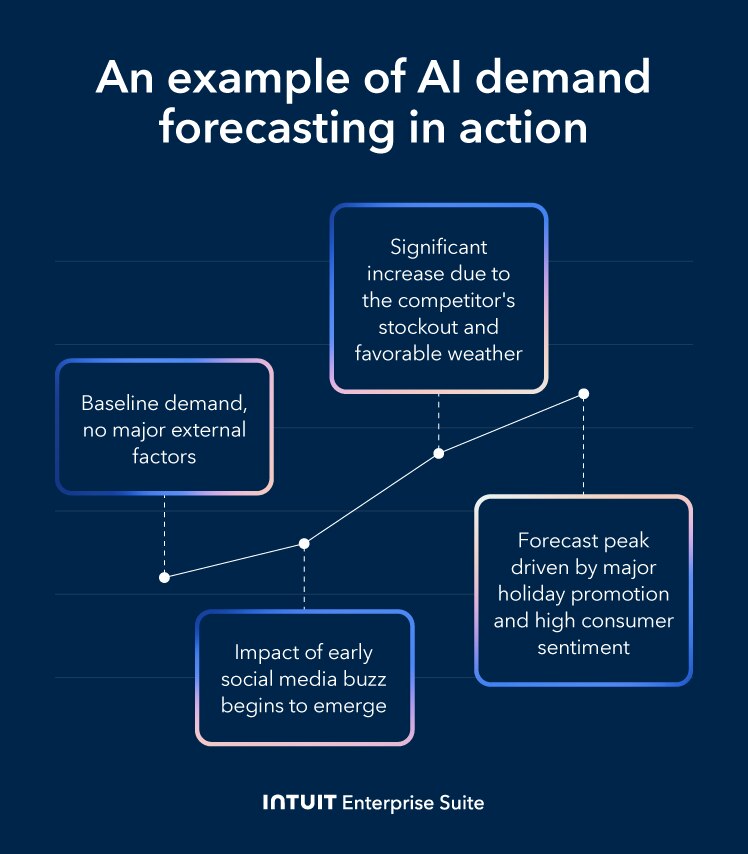
An image showing an AI demand forecasting tool demonstrating a potential increase in demand over time.

Real-time analysis

Real-time analysis refers to an AI forecasting tool’s ability to process and analyze incoming data as it arrives. Instead of waiting for end-of-week or end-of-month reports to revise projections, they can incorporate emerging trends almost in real time.

In addition to improving accuracy, this often dramatically reduces the time it takes to produce estimates. As a result, it’s a significant factor that lets AI system users react quickly to market changes.

Dynamic scenario simulation

This is an AI forecasting tool’s ability to simulate “what-if” scenarios, such as the effects of a new product launch or price change. It’s what allows their systems to generate predictions given various assumptions.

In addition to forecasting, you can use this capability to conduct scenario planning. It’s a technique that involves visualizing the potential outcomes of strategic choices to help optimize decision-making.

Granular predictions

AI can process and parse vast datasets. These can also include diverse information sources, such as point-of-sale transactions, regional weather patterns, and inventory levels.

As a result, AI tools can produce highly specific forecasts. For example, one might predict demand for something as targeted as a stock keeping unit (SKU) in a given locality—or even a single store.


note icon

Intuit’s AI Finance Agent can automate forecasting and scenario planning using real-time performance data and peer benchmarks. This can help your team make informed choices that better align with your financial goals.


Benefits of adopting AI demand forecasting

AI demand forecasting capabilities translate into tangible business value. Let’s explore some of the benefits you can expect after adoption to help you gauge the potential return on investment.

Improved Accuracy and Precision

AI-driven models have been shown to significantly reduce the frequency of forecasting errors, resulting in more reliable predictions. This can improve confidence in strategic planning and help keep operations aligned with business goals.

For instance, according to the McKinsey and Company AI-Driven Operations Forecasting in Data-Light Environments report, AI-based demand forecasting in supply chain management can reduce errors by between 20% and 50%.

Optimized inventory management

The more accurate your demand forecasting, the easier it is to optimize inventory levels. This can help you minimize expenses by avoiding overstocking and maximize sales by preventing stockouts.

The McKinsey and Company AI-Driven Operations Forecasting in Data-Light Environments Report also found that AI-driven forecasting can reduce lost sales and product unavailability by up to 65%.

Cost reduction

Enhanced forecasting accuracy can help you strategically reduce costs in more ways than one. By preventing overstocking, it can also indirectly reduce materials and inventory waste, minimize storage expenses, and eliminate unnecessary transportation and labor costs.

In fact, the latest McKinsey and Company State of AI survey found that supply chain and inventory management are the business segments that benefit most often from the use of generative AI.

Of the surveyed businesses using the technology, 61% reported cost reductions in this area during the second half of 2024, including 22% who saw reductions of more than 10%. These numbers increased from 46% and 15%, respectively, in the first half of the year.

Enhanced customer satisfaction

In addition to having tangible financial benefits, more accurate forecasting can help build brand loyalty. Ensuring products are available when and where customers want them can improve their experience and foster goodwill.

For example, research published in the Journal of Knowledge Learning and Science Technology (JKLST) found that a global biopharma company increased customer retention by 11% after implementing AI-driven inventory management systems. Alongside an integrated accounting platform, these tools also support real-time visibility into core operations.

Keep growing with a more powerful suite

Boost productivity with business and financial management in one solution. Make faster decisions with real-time data and visibility across your portfolio.

When you schedule a demo, you agree to permit Intuit to use the information provided to contact you about Intuit Enterprise Suite and other related Intuit products and services. Your information will be processed as described in our Global Privacy Statement.

Use cases for AI demand forecasting

AI demand forecasting can be valuable to many types of businesses. Let’s explore some potential use cases across industries to help you imagine how your company might apply the technology.

Retail & e-commerce

AI demand forecasting has some of its most direct applications in retail and e-commerce, where inventory management is everything. For example, AI-driven systems have become the key to allocating stock between stores and fulfillment centers during high-traffic periods.

Walmart, for instance, relies heavily on AI-powered models during the stretch between Thanksgiving and Cyber Monday. During this period, it serves roughly 200 million customers online and in-store.

AI- and ML-based predictions anticipate regional demand surges and adjust inventory accordingly across Walmart’s network. This helps ensure products are in the right location at the right time to fulfill physical and digital carts.


note icon

The global AI in supply chain market was valued at $5.05 billion in 2023. It’s expected to reach $51.12 billion by 2030, representing a compound annual growth rate of 38.9%. This explosive growth highlights how quickly AI is becoming an industry standard.


Manufacturing

Manufacturing is another space where AI demand forecasting is readily applicable. Accurately aligning production schedules and raw material orders with demand minimizes overproduction and supply chain bottlenecks, supporting profitability and customer satisfaction.

For example, the agribusiness and food manufacturing company featured in the C3 AI for Demand Forecasting Study operates eight separate production lines. These produce over 80 million pounds of food products annually across more than 90 product codes.

This sheer volume, combined with the perishable nature of their raw materials and finished goods, presented a significant challenge to production timing. As a result, faster and more accurate demand forecast generation proved invaluable for optimizing schedules.

Adopting AI systems increased on-time and in-full (OTIF) deliveries by 2%. This helped improve customer satisfaction and increased gross margin gains across facilities by roughly $30 million.

Logistics

AI-powered demand planning software can also be highly valuable to logistics and distribution companies. Improving supply chain forecasting can help optimize procurement and inventory management.

For example, one major building products distributor developed an AI-powered supply chain control tower. It proactively manages warehouse inventory levels and answers tactical questions using real-time data.

In addition to helping the distributor reduce manual tasks by automating analytical processes, implementing this control tower improved fill rates by 5% to 8%.


note icon

In fact, McKinsey & Company found that embedding AI into distribution operations can reduce inventory levels by 20% to 30%, logistics costs by 5% to 20%, and procurement spending by 5% to 15%.


Healthcare

AI demand forecasting has proven particularly valuable in healthcare, where hospitals can use it to anticipate patient admission rates. This helps them schedule staff appropriately and ensure they have an adequate supply of equipment and medications.

For example, research published in ScienceDirect confirms that AI systems can predict emergency department (ED) admission rates with impressive accuracy. The DoppelGANger model achieved a symmetric mean absolute percentage error (SMAPE) of 6.99% after training on four years of data.

In other words, its forecasts could predict admission rates with an average accuracy of 93.01%. Given how notoriously unpredictable ED patient flow can be, this highlights the power of AI-based solutions to complex problems.

Boost productivity and enhance profitability

AI demand forecasting can be invaluable to businesses across industries. By improving prediction accuracy, you can optimize inventory, reduce costs, and consistently satisfy customers.

AI agents, like those in the Intuit Enterprise Suite accounting solution, can enhance your forecasting models by delivering cleaner, more timely data. For example, the AI Accounting Agent can automate bookkeeping tasks for more reliable financial records and a faster month-end close.

Introducing Intuit Enterprise Suite

Simplify complex operations with multi-entity management, custom roles and permissions, and automated revenue recognition. Make faster decisions with multi-dimensional reporting and deeper insights in real time.


Recommended for you

How can we help?


Get product support

Looking for something else?

QuickBooks

From big jobs to small tasks, we've got your business covered.

Firm of the Future

Topical articles and news from top pros and Intuit product experts.

QuickBooks Support

Get help with QuickBooks. Find articles, video tutorials, and more.