Year-End Learning! AI Webinar: Watch by Dec. 31. Watch Now! 
A team discussing material costs.
Enterprise

Construction material costs: How to calculate, manage, and save

Construction material costs represent a significant portion of any project budget, so accurately calculating them is crucial when determining profitability

Understanding how to estimate these expenses effectively, navigate market volatility, and implement cost-saving measures is key to a successful construction business. 

It involves a comprehensive approach, from initial quantity takeoffs and price sourcing to real-time tracking and value engineering, achieving essential functions at the lowest cost without compromising performance or quality.

The current landscape of construction material costs

How material costs impact your construction projects

Step-by-step guide to estimating construction material costs

The fundamentals of construction material cost estimation

Practical methods and tips for construction material cost calculation

Managing estimates throughout the project

Leveraging Intuit Enterprise Suite for better estimates

Boost productivity and enhance profitability

The current landscape of construction material costs

As of 2025, the construction materials market presents a complex picture, with varying trends across key materials. The most common and necessary construction materials include lumber, steel, concrete, and insulation. 

Overall, this market’s characteristics include rising costs for most key materials, with particular volatility in lumber and steel. While concrete prices are rising steadily, the insulation market will likely see increasing costs in line with growing demand and a focus on energy efficiency.

Factors influencing these increased cost trends include:  

  • Inflationary pressures and economic conditions
  • Supply chain dynamics (like disruptions, bottlenecks, and lead times)
  • Labor availability and costs, which affect production and transport
  • Geopolitical events and trade policies, including tariffs 
  • Demand fluctuations across regional, national, and global construction activity
  • Energy costs, which impact manufacturing and transportation
  • Sustainability regulations and demand for green materials

The current construction materials landscape has profound implications for businesses in the industry, including:

  • Increased uncertainty regarding project delays, budget volatility, higher risk for contractors, and a greater possibility of contractual disputes
  • The need for robust estimation practices, considering more detailed estimates, contingency and scenario planning, and clear documentation and assumptions 
  • The need for robust management practices, including strategic procurement of construction materials, efficient inventory management, and proactive supply chain risk management

These challenges collectively necessitate a more resilient and forward-thinking approach to construction projects.

Construction material costs are influenced by natural disasters, interest rates, tariffs, supply and demand, and inflation.

How material costs impact your construction projects

Material cost fluctuations have consequences that extend beyond the bottom line. They impact all aspects of a construction project, including timelines, financing, construction contracts, and overall feasibility and risk profile. 

These price swings can erode profit margins and lead to stakeholder disputes regarding cost overruns. Ultimately, material pricing instability affects the project's immediate financial stability and long-term feasibility.

Direct effects on project budgets and bids

Surprise jumps in material costs can directly affect your project's bottom line. When you price a job based on what materials should cost, any unexpected surge directly cuts into your business’s projected earnings. 

This can impact your company's financial stability, making it tougher to invest back into the business or keep things running smoothly.

When trying to secure a new project, you will want to make your proposal enticing enough to win the job, while being smart enough to anticipate any rising costs later. Protecting your bottom line is difficult when the costs of materials fluctuate. You want to win the job, but to do so, you need to guarantee a "bet" on the financial future of your business.


note icon Finding the right balance is crucial—you don't want to bid too high and lose the project, but bidding too low could mean accepting a project that becomes financially unsound.


Potential for supply chain delays

Since construction materials are widely used in many projects, there is significant potential for supply chain delays. Many factors, including raw material shortages, transportation bottlenecks, and increased global demand, can worsen these delays and impact project timelines and budgets.

If those essential materials arrive late at the job site due to scarcity or higher costs, it creates a domino effect. It might fully delay the construction crew, resulting in wasted labor hours. Additionally, overhead costs, like site management and equipment rental, continue accumulating even when work unexpectedly ends. 


note icon Because so many construction tasks depend on each other, one delayed delivery can bring multiple parts of your project to a standstill, ultimately costing the business.


Influence on insurance and bonding requirements

When the cost of your essential building materials increases, the total price tag for your construction project naturally follows. You're spending more to buy and install the same materials, which means the overall financial size of the job increases, even if you're not building anything extra. This higher project value then has a ripple effect on other key areas.

For instance, because your project is worth more, you'll likely see your general liability and builder's risk insurance premiums increase. Insurers consider the total value when calculating their rates, as a more expensive project means a larger potential payout if something goes wrong. As material costs inflate, your project's worth can strain your bonding capacity, potentially limiting your ability to take on new and larger jobs. 

Unlock growth for your complex business

Power your accounting, marketing, HR and more in an AI-powered solution that scales across your business.

Step-by-step guide to estimating construction material costs

Developing a reliable material cost estimate follows a standard workflow, beginning with a thorough understanding of the project and progressing through detailed quantity takeoffs (the specific quantities of materials, labor, and equipment needed) and accurate pricing to arrive at a comprehensive cost projection.

Step 1: Thoroughly review plans and specifications

The first step in material cost estimation is to achieve absolute clarity on the precise materials needed for the project. This involves identifying each component and understanding the specified quality standards, ensuring compliance with project requirements and building codes. 

Additionally, any specific installation notes or manufacturer recommendations must be carefully reviewed and understood. This ensures that the subsequent steps of quantity takeoff and pricing are based on accurate and complete information, leading to a more reliable overall cost estimate. 

Key items to review include:

  • Architectural/structural drawings
  • Specification manual (especially relevant divisions)
  • Finish schedules
  • Addenda
  • RFI responses

Thorough comprehension of these documents lays the groundwork for a dependable and accurate material cost estimate.

Step 2: Conducting material quantity takeoffs

Once you’ve determined what materials you need, you must figure out how much you need of each. This process is known as the material quantity takeoff, which involves measuring and quantifying each material item required based on the project plans. This can be done manually by reviewing drawings and performing calculations, or to save time, you can use digital takeoff software that allows you to measure directly from digital plans.

Regardless of how you complete this step, organization is important. List out each material, specifying where it will be used in the project, and the quantity required, using standard measurements. Getting these quantities right is key, as any errors in quantity takeoffs will continue to compound in the pricing phase, leading to significant inaccuracies in the final cost estimate.



note icon Standard units of measure for material quantity takeoffs include square feet (SF), linear feet (LF), cubic yards (CY), and each (EA).


Step 3: Pricing the work—direct material costs

Once you have determined the amount of materials needed, the next step in estimating construction material costs involves sourcing current and reliable pricing information. 

This step applies current market costs to each material as of the present day. Given the inherent volatility in construction material markets, relying on outdated price lists or estimates can lead to significant inaccuracies. It’s essential to actively seek current pricing from suppliers, review recent quotes, and potentially consult industry benchmarks. 

Some sources for pricing include: 

  • Direct quotes from suppliers/vendors, which are often the most accurate for current projects
  • Historical cost data from past projects
  • Published cost databases, like RSMeans

Staying up-to-date with material costs is key for creating a realistic and dependable project budget.


note icon Don't forget sales tax and freight costs. These are often substantial add-ons, especially for large projects or distant suppliers, and must be included for an accurate final material cost.


Step 4: Accounting for related indirect costs & factors 

Material costs significantly influence several related indirect costs and crucial project factors, and while they are not direct material costs, these are essential for the total estimate. 

  • Waste factor: The anticipated volume and type of materials directly inform the waste factor, with allowances (as percentages) applied to account for loss during handling and installation.
  • Contingency: While a dedicated contingency for material price fluctuations might be detailed separately, the base material costs contribute to the overall contingency calculation. 
  • Overhead & profit: These are typically calculated as percentages of the total direct costs, meaning higher material expenses lead to a larger overhead and profit margin in the estimate.
  • Other factors: The total project value, heavily influenced by material costs, will directly impact expenses for related permits, insurance premiums, and bonding requirements.

Fluctuations in material pricing can have a cascading effect on the overall financial health of a construction project.

Step 5: Validating the estimate

Validating the material cost estimate is a crucial quality control step before finalizing the overall project budget or submitting a bid. This involves a full review of all aspects of the estimate, from the initial quantity takeoffs and unit pricing to indirect costs and allowances. 

Ideally, you should be able to identify and correct any potential errors, inconsistencies, or omissions that could lead to cost inaccuracies or project time.

Validation methods include:

  • Review by a second estimator or senior team member
  • Comparison with historical data for similar projects, while adjusting for scope and time
  • Using benchmark data (like cost per square foot for a material) as a sense check
  • Checking for common errors, like missed scope, math errors, or outdated pricing

This rigorous verification process significantly enhances the reliability and accuracy of the final cost projection.

How to estimate construction material costs.

The fundamentals of construction material cost estimation

Cost estimating is a predictive activity that assumes all material costs associated with completing a construction project. Correctly estimating construction material costs can depend on market fluctuations, delivery times, distances, and potential discount situations. Knowing the principles behind the process is important for contractors/developers/stakeholders' decision making, cost control activities, and project viability.

Defining the project scope and requirements

To estimate your construction costs accurately, you first need a clear picture of the entire project. That means truly understanding every detail in your plans, ensuring they are precise and leave no room for ambiguity. Consider your specifications book equally important—it outlines exactly what materials and work are required. 

Estimate material costs based on project scale

The scale of a construction project will, of course, directly influence the total material costs. Bigger projects will be more expensive to complete, and understanding this can help contractors and stakeholders set realistic expectations.

While there's no universal fixed percentage, material expenses typically constitute a significant portion of the project budget. In larger projects, material costs often fall within a predictable percentage bracket of the total project value.

The importance of accurate estimating

Accurate estimating is crucial in construction. It forms the financial blueprint for a project, directly impacting profitability and the ability to secure future work. 

Essentially, accurate estimating provides informed decision-making and effective budget management. Businesses that have accurate estimating also: 

  • Avoid underbidding and financial losses
  • Avoid overbidding and losing work
  • Builds client trust and reputation
  • Have a reliable baseline for project financial control
  • Have overall better resource planning

Since customers value supply chain visibility, proactively communicating potential material delays, their increasing costs, and their impact on the project timeline can help manage expectations and maintain trust.

Who is responsible for cost estimation?

Determining construction material costs is often a collaborative effort that requires input from different stakeholders to ensure accuracy. Dedicated estimators in larger firms generally perform this task, but their work is heavily informed by purchasing departments that provide pricing and availability information. 

Field supervisors offer insights into material usage and waste, and subcontractors supply specialized material costs for the overall estimate.


note icon In smaller companies, project managers, owners, or other senior personnel often handle estimation responsibilities, drawing on their diverse experience and knowledge.



Key components of a material cost estimate

Key components of a material cost estimate form the foundational building blocks for accurate project budgeting, so you can effectively plan your finances and ensure the profitability and successful completion of construction projects. These components include: 

  • Material quantities: The amount of each material needed, expressed in linear feet, square feet, or cubic yards 
  • Material unit costs: The cost per unit of each material, including purchase price, taxes, and delivery fees 
  • Labor costs (associated with materials): Wages and associated benefits (like insurance, taxes, and paid time off) for the workers directly working with the materials on the construction site
  • Waste factor: Allowance for cutting waste, spoilage, and minor damage 
  • Sales tax: Applicable taxes on purchased materials
  • Freight/delivery costs: Cost to transport materials to the site

Meticulous accounting of these elements is critical for a reliable and comprehensive cost projection.

Practical methods and tips for construction material cost calculation

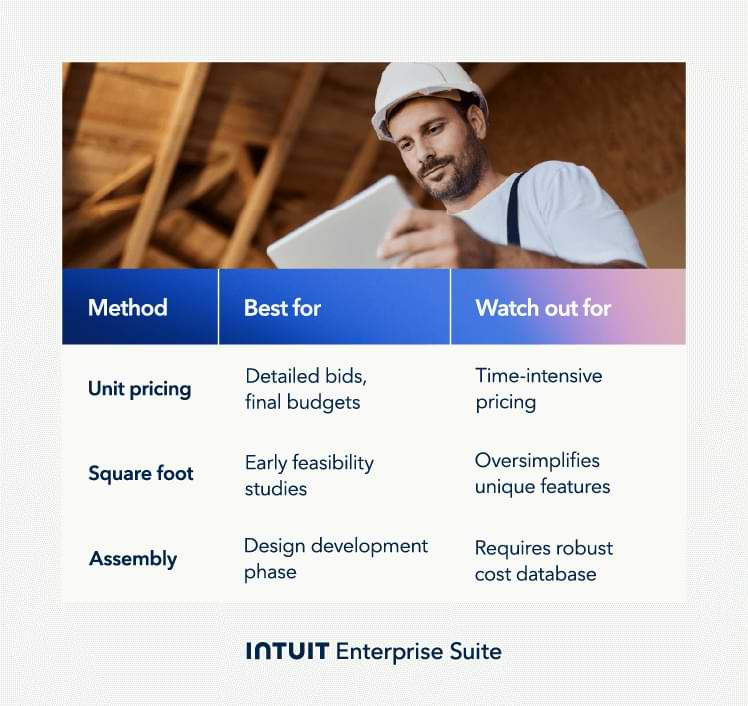
When considering how to estimate construction site costs, several methods are available, including unit pricing, the square foot method, and the assembly or systems method. 

Method 1: Unit pricing

Unit pricing involves assigning a specific cost to every individual material item or unit of work required for the project. For example, you might estimate the cost per brick, the cost per linear foot of piping, or the cost per cubic yard of concrete.

When done correctly, unit pricing offers high detail and precision in the cost estimate. This granular approach can be particularly useful for detailed bidding processes and for creating final project cost breakdowns. 

However, it can be very time-consuming, especially for projects with different materials and work items.


note icon Unit pricing is generally best where a thorough breakdown of costs is required, like preparing detailed estimates for bidding purposes or creating the final cost estimate that will serve as the project's budget baseline.


Method 2: Square foot method

The square foot method estimates the total material cost by multiplying the project's total square footage by an average cost per square foot. This average cost typically comes from historical data for similar building types and a general assessment of the desired quality level (e.g., basic, standard, premium).

While this method is exceptionally quick and easy to apply, it is the least accurate of the common estimating techniques. It relies on highly generalized averages and doesn't account for specific design details, material selections, or regional price variations.


note icon The square foot method is primarily suited for early-stage budgeting or initial feasibility studies, as it is ideal for generating very general cost estimates in the early stages of a project.


Method 3: Assembly or systems method 

The assembly (or systems) method involves pricing major building components or systems as pre-defined assemblies. For example, you would use a cost per square foot instead of pricing each stud, sheathing board, insulation layer, barrier, and siding piece individually for a complete "standard exterior wall assembly."  

This method offers significant time savings compared to unit pricing and provides greater accuracy than the square-foot method. However, this method relies on having a well-developed and up-to-date database of costs for many different common assemblies or systems relevant to the project type. 


note icon The assembly method is most helpful during the design development stage, when the major building systems are being defined. It allows for efficient comparison of different system options.


Practical methods and tips for construction material cost calculation.

Managing estimates throughout the project

Estimation for construction material costs doesn't end when the contract is signed—it's an ongoing process throughout the project lifecycle.

Updating estimates and control estimates

Updating estimates and diligently controlling them are vital throughout a project. The "control estimate" serves as the officially approved budget baseline. As your company purchases materials, it must track actual expenses against this baseline to identify any deviations. 

As the project progresses, re-evaluation of the estimated costs for the remaining scope of work must be considered, as well as any learned efficiencies or changes in market conditions. This iterative process of updating and controlling the estimate ensures proactive financial management and minimizes the risk of significant budget overruns.

Incorporating contingency allowances (5-10% rule)

Contingency in construction cost estimating refers to a specific sum of money included in the budget to cover unforeseen events or unexpected costs during the project lifespan. It acts as a financial safety net to absorb potential risks difficult to predict, like sudden and significant material price spikes or minor adjustments to material quantities. 

While a common range for contingency is typically between 5% and 10% of the total direct costs (including materials and labor), this percentage can change depending on the project's complexity, the level of uncertainty involved, and the overall risk assessment. Projects with higher inherent risks often warrant a larger contingency allocation. 

Handling variances and change orders

When considering construction material costs, variance refers to the difference between the initially estimated and actual costs. While the differences in cost can range from errors in initial pricing or quantity takeoffs to external factors such as market fluctuations in material prices, identifying the root cause of any variance is crucial for effective project control and future estimating accuracy. 

When project scope changes occur that impact materials, a formal change order process must be initiated. This involves documenting the exact nature of the scope change, quantifying the associated material adjustments, and pricing out these changes, including any labor or indirect costs. 


note icon Once approved, the change order serves as an official modification to the original contract and budget, ensuring that the financial impact of these material-related scope changes is accurately reflected in the updated project cost.


Accounting for cost escalation

Cost escalation refers to the risk that material prices will increase between the date the project estimate is prepared and when those materials are purchased. This tends to be a concern when a project has an extended timeline, like a multi-year infrastructure project or a large-scale commercial building development where material procurement can span several months or even years.

Contracts can include clauses for sharing these costs to address potential price increases. Securing firm quotes or early purchase agreements with suppliers is another effective way to account for cost escalation. However, companies can add an escalation factor to the estimate or in the contingency for high-risk materials or very long projects.

Leveraging Intuit Enterprise Suite for better estimates

Integrated construction software, like the Intuit Enterprise Suite, provides specialized tools that significantly enhance the accuracy, efficiency, and overall management of construction cost estimates, especially when it comes to tracking and controlling material expenses throughout the project lifecycle. 

Intuit Enterprise Suite centralizes historical project cost data, including past material prices, quantities, and supplier performance, for easy access and analysis. Estimators can leverage this to quickly reference past costs, providing more realistic and competitive bids grounded in actual expenditures. 

When compiling new bids, you can utilize past data to ensure your prices are realistic and competitive, based on actual expenditures. Additionally, it allows you to compare current supplier quotes with your past costs, enabling you to easily identify any price hikes or determine who offers the best value.

Boost productivity and enhance profitability

Running a growing construction business means you've got to be smart about tracking your job expenses, including construction material costs. Honing in on the process can give you much better control of your money and boost your bottom line, especially with volatile pricing.

An all-in-one system like Intuit Enterprise Suite can help you manage your project finances accurately and easily. From real-time reporting to leveraging historical data to create the perfect bid, it provides the tools to navigate material cost fluctuations and maintain profitability across all your projects.


Recommended for you

How can we help?


Get product support

Looking for something else?

QuickBooks

From big jobs to small tasks, we've got your business covered.

Firm of the Future

Topical articles and news from top pros and Intuit product experts.

QuickBooks Support

Get help with QuickBooks. Find articles, video tutorials, and more.