
Accounts receivable definition:
Accounts receivable is the money that customers owe a business for goods or services that have been delivered but not yet paid for.
Key takeaways:
- Accounts receivable (AR) is money customers owe your business for goods or services you’ve already delivered but haven’t been paid for
- AR sits on your balance sheet as a current asset, but it only becomes cash if you track it and collect it on a schedule
- US small businesses are owed an average of $17,500 in unpaid invoices, so AR management is cash flow management
Accounts receivable (AR) is the money customers owe your business for goods or services you’ve already delivered but haven’t been paid for yet. Every unpaid invoice you’ve sent is part of your accounts receivable. On your balance sheet, AR counts as a current asset, because it’s money you can reasonably expect to arrive within the year.
Whether it actually arrives is the part you control. According to the Intuit QuickBooks Small Business Late Payments Report, 56% of small businesses are owed money from unpaid invoices, with an average of $17,500 outstanding, and nearly half have invoices more than 30 days overdue. That’s real money sitting in a spreadsheet instead of a bank account.
Maybe you run a service business and the pile of “sent, not paid” invoices keeps growing. Maybe you just took over the books for a small shop and AR is the account you understand least. Or maybe you run a cash-basis business and you’re not sure this applies to you at all (there’s a section for exactly that question below).
We’ll cover the definition and the mechanics first: how the AR process works, AR versus accounts payable, and the ratios that measure your collection speed. Then the working half: a real aging schedule, a day-by-day collections timeline, and what to do when a receivable goes bad. Let’s start with the definition.
Three one-line answers cover the questions people ask most:
- Is accounts receivable an asset? Yes. AR is an asset, because it represents money you have a legal right to collect.
- Is it a current asset? Yes, in almost all cases. AR is expected to convert to cash within a year, usually much faster.
- Is accounts receivable a debit or credit? AR carries a debit balance. You debit AR when you invoice a customer and credit it when they pay.

How the accounts receivable (A/R) process works
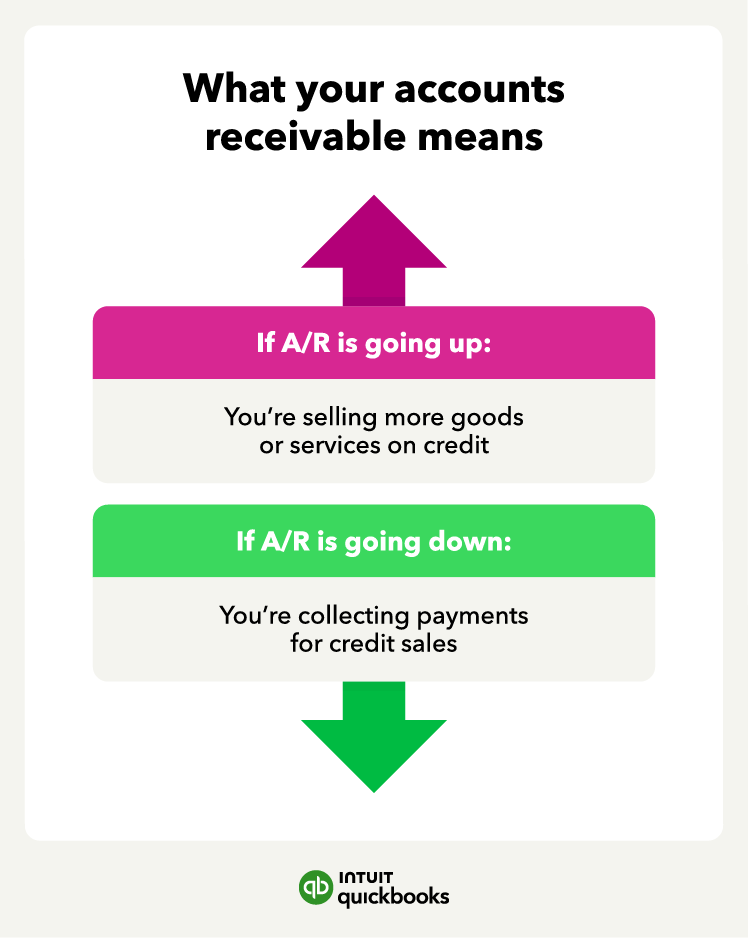
If you sell a good or product and invoice the customer, you’ll have accounts receivable. Accounts receivable appears as a current asset on the balance sheet. Here are some examples of current assets:
If your accounts receivable balance is going up, that means you're invoicing more. If the balance is going down, that means you're collecting customer payments from previous invoices.
Accounts receivable vs. accounts payable
Accounts payable (A/P) are invoices you owe to other companies. Your accounts payable is accounts receivable for the other company. In many ways, accounts payable is the opposite of accounts receivable. Accounts payable is a current liability on the balance sheet, while accounts receivable is a current asset.
For example, you buy $1,000 in paper from a supplier who sends you an invoice for the goods. You’d have $1,000 in accounts payable on your balance sheet for the invoice. Meanwhile, the supplier would have $1,000 in accounts receivable on their balance sheet.
Here’s the side-by-side:
- What it is: Accounts receivable is money owed to you by customers; accounts payable is money you owe to vendors.
- Balance sheet side: AR is a current asset; AP is a current liability.
- Created when: AR is created when you invoice a customer; AP is created when a vendor invoices you.
- Your goal: Collect AR faster; time AP strategically.
- The risk: AR becomes bad debt if it’s never collected; AP risks late fees and damaged vendor relationships.
One business’s receivable is always another business’s payable. The invoice you’re waiting on is sitting in someone else’s accounts payable queue, which is worth remembering when you design your payment terms: you’re competing for a spot in their payment run.
Accounts receivable formula and ratios
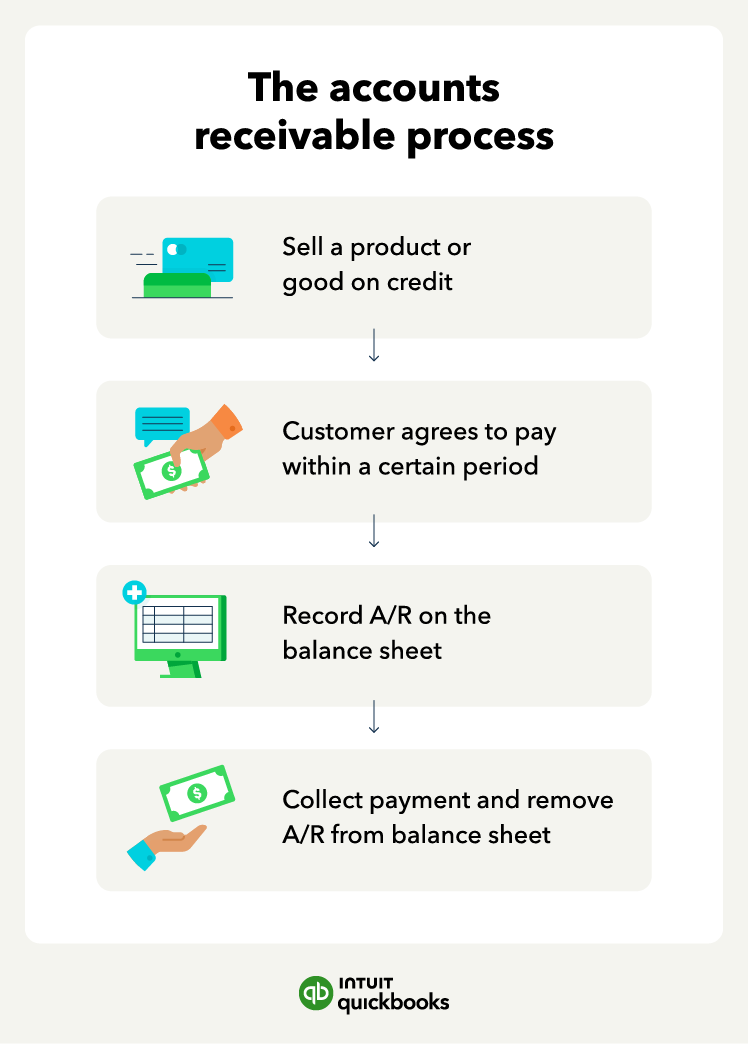
You can measure and track your accounts receivable in several ways, but let’s look at two key ratios:
Accounts receivable turnover ratio
No small business can last long if it can't collect enough cash to operate. The accounts receivable turnover ratio measures how quickly a company collects invoices. The higher the ratio, the better. Here's the formula:
Accounts receivable turnover ratio = Net credit sales / Average accounts receivable
Net credit sales is sales minus returns. Average accounts receivable is the beginning balance + ending balance divided by two.
This ratio tells you how many times you’re collecting your average accounts receivable balance. A higher ratio means that a company is collecting its receivables more quickly, which is a good thing.
A good turnover ratio depends on your industry. Customers at a grocery store or restaurant pay right away with cash or a card. But businesses that sell big-ticket or bulk items might not get paid for months. To see how you're doing, compare your turnover ratio to other businesses in your industry.
The more intuitive sibling of the accounts receivable turnover ratio is days sales outstanding (DSO): the average number of days it takes you to collect. Here’s the calculation with real numbers:
DSO = (Accounts receivable ÷ total credit sales) × number of days
Say your business has $30,000 in outstanding receivables and did $120,000 in credit sales over the last 90 days. DSO = ($30,000 ÷ $120,000) × 90 = 22.5 days. On average, your money spends about three weeks as an IOU before it becomes cash. Whether that’s good depends on your industry and your payment terms: 22 days is excellent on net-30 terms and alarming on due-on-receipt terms.
A/R aging report
An A/R aging report groups your unpaid invoices by how long they’ve been outstanding, usually in 30-day buckets. It’s the single most useful AR artifact a small business has, and it deserves more than a definition: the aging schedule section below builds one for a real business and shows what to do about each bucket.
DSO benchmarks: how fast businesses like yours get paid
A “good” DSO is relative. These are typical ranges for US small businesses, drawn from common industry guidance. Use them as direction, not gospel: your payment terms set the real target, and a healthy DSO is usually within about 10 to 15 days of your stated terms.
- Retail and food service: 0 to 10 days. Customers pay at the register.
- Ecommerce: 1 to 5 days. Card processors settle in days.
- Professional services: 30 to 60 days. Net-30 invoicing is standard.
- Construction and trades: 30 to 90 days, with general contracting at the top. Progress billing, retainage, and slow-paying GCs; individual trades often collect faster.
- Manufacturing and wholesale: 30 to 60 days. Net-30 to net-60 B2B terms.
- Healthcare practices: 30 to 70 days. Insurance reimbursement cycles.
- If your DSO is high but stable and near your terms: you don’t have a collections problem, you have generous terms. Change the terms if the float hurts.
- If your DSO is rising month over month: that’s the early-warning signal. Something changed — a big customer slowed down, or your follow-up rhythm slipped — and the aging schedule below will show you exactly where.
Accounts receivable example and journal entry
Bookkeeping can mean posting dozens of receivable transactions each week. You'll want a solid process in place to make sure you're posting accurate data. Let's say you have a tree service company, and you bill a customer $500 for removing a tree on March 25. Here's the journal entry to record the sale in your general ledger:
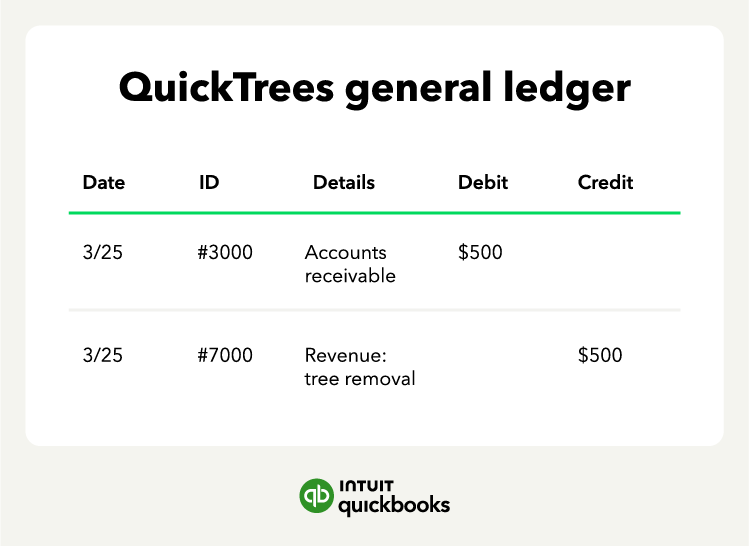
The March 25 transaction records the revenue from the tree removal project and increases the accounts receivable by the amount of the sale. When the customer pays the invoice on April 6, the tree service company posts a journal entry to reflect the transaction as follows:
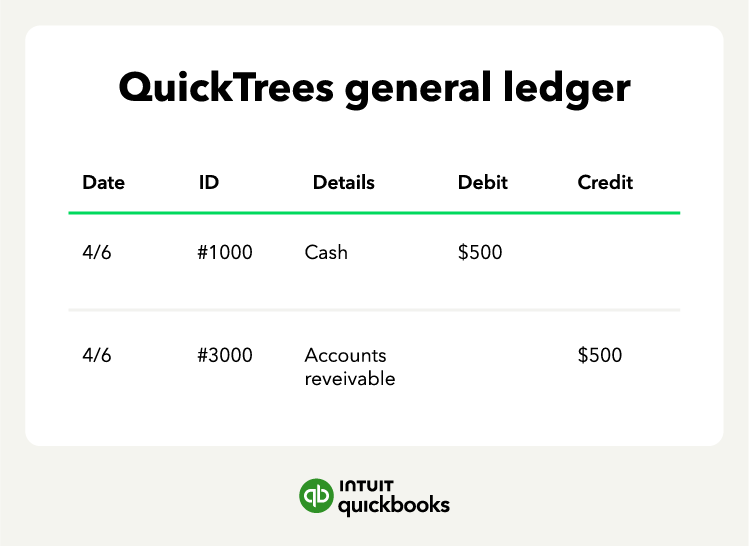
The April 6 transaction removes the accounts receivable from your balance sheet and records the cash payment. You receive the cash in April but correctly recorded the revenue in March.
When recording accounts receivable, you want to post the revenue in the month you earn it. This will keep your accounting records accurate and consistent with accrual accounting.
The A/R aging schedule: your collections to-do list
An aging schedule sorts every unpaid invoice by how overdue it is. Accountants read it as a risk report. You should read it as a to-do list, because each bucket has a different job. Here’s the Aging Snapshot for a sample HVAC company with $22,800 outstanding:
- Current (not yet due) — $9,500, 42% of total AR: Healthy pipeline. Your move: nothing; make paying easy.
- 1 to 30 days overdue — $6,200, 27%: Normal drift. Your move: a reminder with a payment link.
- 31 to 60 days — $3,800, 17%: A pattern forming. Your move: a phone call plus the late fee per your terms.
- 61 to 90 days — $1,800, 8%: Real risk. Your move: a demand letter, and stop new work for these customers.
- 90+ days — $1,500, 7%: Collection odds dropping fast. Your move: small claims, collections, or a write-off decision.
The shape matters more than the total. A business with $22,800 outstanding and 70% of it current is fine. A business with $12,000 outstanding and half of it past 60 days is in trouble that the bank balance hasn’t announced yet.
Picture the owner running this report on the first Monday of the month. The 31-to-60 bucket holds two customers, and one of them also has an invoice in the 61-to-90 bucket. That customer just became the morning’s first phone call, and new work for them goes on hold until the account clears. That’s the whole discipline: the report picks who you chase, so you never have to chase everyone.
The collections timeline: day 1 to day 90
Collections isn’t a confrontation. It’s a calendar. Most overdue invoices are drift, not disputes, and drift responds to a schedule you run the same way every time:
- Day 3: Friendly email reminder with the invoice reattached. It catches the buried-inbox cases.
- Day 15: Second reminder with the payment link up front. Most drift pays here.
- Day 30: Phone call plus the late fee your terms promised. Calls are harder to ignore, and enforcing the fee makes terms real.
- Day 45: Demand letter. An attorney-drafted letter typically runs $300 to $1,000 as a flat fee, online services charge less, and either changes the conversation.
- Day 60: Small claims or collections decision. Small claims limits vary by state; agencies take a percentage but take the chore.
- Day 90: Pursue or write off. Chasing has a cost too; the write-off rules are in the next section.
Three follow-ups do the heavy lifting. Automate the day-3 and day-15 reminders and you’ll never think about most of your receivables again. If you choose the agency route at day 60, here’s how to send someone to collections.
“It’s one thing to see, Okay, I’ve got expenses here, I’ve got some revenue here. A completely other thing is making sure you’re staying on top of those invoices.”
— Austin Hankwitz, co-host of Mind the Business, on “From Side Hustle to Spotlight”
One branch worth knowing: if you’re a contractor or tradesperson, you may have lien rights on the property you improved, and they expire fast — in many states within roughly 90 days of your last day on the job. That makes the lien question a day-30 decision, not a last resort. Prevention beats all of it: for large projects, structure terms as a deposit plus milestones (a common split is 50% up front, 25% midway, 25% on completion) so no single invoice is ever worth panicking over.
Does accounts receivable even apply to you? Cash basis vs. accrual
Here’s the fork most AR guides skip entirely, and it changes everything above:
- If your business uses accrual accounting: you record revenue when you invoice, so accounts receivable is a real account on your books. The aging schedule, the ratios, and the bad-debt rules all apply exactly as written.
- If your business uses cash-basis accounting (most very small businesses do): you record revenue only when money arrives. Technically, you don’t book accounts receivable at all. But your unpaid invoices still exist and still need chasing — you just track them as an operational list rather than a balance-sheet account. The aging schedule and collections timeline apply to you completely; the journal entries don’t.
The deciding factor is which method you chose when you set up your books (check your tax return: Schedule C filers mark it in the accounting-method box). The practical difference shows up at write-off time, covered next.
Say a freelance designer on cash-basis books is owed $4,000 across three clients. Her “AR” never appears on a financial statement, and at tax time there’s no bad-debt deduction if a client never pays, because the income was never recorded. Her collections calendar matters even more than an accrual business’s, because the only place that $4,000 exists is in her follow-up system.
Accounting for unpaid accounts receivable
What happens when a customer doesn't pay you? The easiest way to deal with this is to write off the debt as uncollectable. When you know that a customer can't pay their bill, you’ll change the receivable balance to a bad debt expense.
For example, let's say that Jones Manufacturing owes your tree service company $2,000. On April 30, the company declares bankruptcy and won't be able to pay your invoice. You would post this entry on April 30:
- Debit bad debt expense $2,000 (increase)
- Credit accounts receivable $2,000 (increase)
Note that you can also use the allowance for doubtful accounts method, but it’s a bit more complex.
The tax treatment depends on your accounting method, and this is where the cash-versus-accrual fork bites. If you’re on accrual, the unpaid invoice was already counted as income, so writing it off generally produces a deductible business bad debt per IRS Topic No. 453, Bad Debt Deduction. For the bookkeeping mechanics, see how to calculate and record bad debt expense; if you use the allowance for doubtful accounts method, the write-off works through the allowance instead. If you’re on cash basis, you never recorded the income, so there’s typically no deduction to take: the write-off is operational, not tax-deductible. Either way, document the collection attempts you made; deductibility requires showing the debt is genuinely worthless, and your reminder trail is that evidence. Keep those records for seven years, the IRS retention window for bad debt deduction claims.
Tips for improving A/R management
Everything above compresses into four moves. Here’s the order that pays off fastest:
- 1. Invoice the day work completes, with a due date in plain words and every payment method you accept. The payment clock starts when the invoice arrives.
- 2. Automate two reminders (day 3 and day 15 past due) so the routine follow-ups happen without you. This is what AR automation actually means for a small business: reminders, payment links, and reconciliation happening on schedule, not an enterprise software project. You don’t need a budget line to start: even free accounting software like QuickBooks Free tracks the invoices you send and lets customers pay by card, ACH, PayPal, or Venmo.
- 3. Run the aging report on the first Monday of every month and work it top bucket down, using the collections timeline for anything past 30 days.
- 4. Give credit deliberately. Deposits and milestone billing for big projects, early-payment discounts only where the margin math works (a 2% discount for paying in 10 days is cheap if it keeps you off a credit card charging north of 20%).
Do the first two this week and most of your receivables will never need the rest.
Streamline your accounting and save
Accounts receivable management comes down to knowing who owes you, chasing on a schedule, and making payment effortless. QuickBooks handles all three: it tracks every open invoice, sends the reminders automatically, and builds your aging report so the first-Monday review takes minutes instead of a morning. When you’re ready to spend less time chasing money you’ve already earned, explore QuickBooks accounting software and find the plan that fits.
Accounts receivable FAQ

Marshall Hargrave is a financial writer with over 15 years of expertise spanning the finance and investing fields. He has experience as an editor for Investopedia and has worked with the likes of the Consumer Bankers Association and National Venture Capital Association. Marshall is a former Securities & Exchange Commission-registered investment adviser and holds a Bachelor's degree in finance from Appalachian State University.
Call Sales: 1-877-866-5232




