What is an invoice? Definition, examples, and how to get paid on time
By Marshall Hargrave
August 6, 2026
Invoice definition
An invoice is a formal document that itemizes and records a transaction between a seller and a buyer, requesting payment for goods or services that have been delivered.
Businesses send invoices to clients after they deliver a product or service. Invoicing tells the buyer how much they owe the seller and establishes payment terms for the transaction.
Creating invoices with clear payment terms can save your business time and money. Learn what invoices are, why businesses use them, and the elements you need to create one in this guide. We’ll also provide examples, templates, and an invoice generator to help you streamline your invoicing process.

Invoices vs. bills vs. receipts: The main differences
Many people use invoice and bill interchangeably, but they aren’t quite the same. While both document sales transactions and request payment, invoices typically outline specific terms for payment at a later date, whereas bills are for immediate payment.
Document
Purpose
When issued
Payment timing
Key details included
Invoice
Request for payment from a seller to a buyer
Before payment, after goods/services are provided
Payment due later (e.g., Net 30)
Seller and buyer info, itemized goods/services, payment terms, due date
Bill
Request for immediate payment
At the time of purchase or service
Payment due immediately
Amount owed, basic description of goods/services, total due
Receipt
Proof of payment
After payment is made
Confirms payment has already been received
Seller and buyer info, items purchased, payment amount, date paid
Invoice vs. Bill
An invoice documents a sales transaction where the seller collects payment for products or services at a later date, often 30 days after receiving the invoice. A supplier may use “invoice” or “sales invoice” to describe a customer payment request.
A bill refers to a document of sale wherein customers pay immediately. Customers may also use the term “bill” to describe a request for payment from their vendor. Bills are often less detailed than invoices and require immediate attention.
Invoice vs. Receipt
While sales receipts and invoices contain similar information, they are different. An invoice is issued to collect payments from customers, while a sales receipt documents proof of payment that a customer has made to a seller.
Receipts are used as documentation to confirm that a customer has received the goods or services they paid for, and as a record that the business has been paid.
Parts of an invoice
A complete invoice has nine standard parts. Miss one and you slow your own payment down: a missing invoice number stalls the customer’s approval process, and a missing due date turns “net 30” into “whenever.” Here’s each part and what it needs to say.
Invoices can include whatever information and elements you need them to, but generally, you'll want to make sure they include the following:
- An invoice number
- Invoice date
- Business and customer contact information
- Description of goods and services
- Payment terms
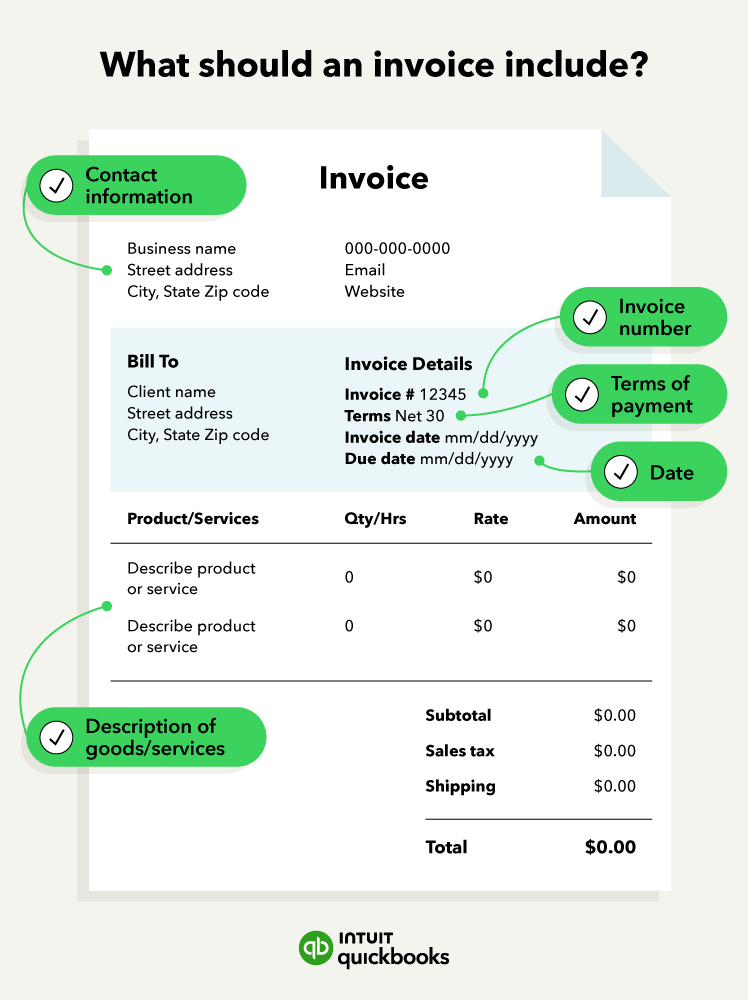
Invoice number
A unique invoice number should be assigned to each invoice you issue. This reference number establishes a paper trail of information for you and your customers’ accounting records. Assign invoice numbers sequentially so that the number on each new invoice is higher than the last.
Invoices aren’t necessarily due immediately when customers receive them. You may set invoice payment terms of up to three months to give your customers the flexibility to manage their cash. No matter what your payment terms are, express them clearly to your customer to ensure all parties are on the same page.
Date
The invoice date indicates the time and date the vendor officially records the transaction and bills the client. The invoice date is crucial as it dictates the payment due date and credit duration. Generally, the due date is 30 days following the invoice date, but this can vary based on a company’s needs and the agreement with the client or buyer.
Invoices should also include a payment due date to indicate when the business expects to be paid. This date is usually 30 days after the invoice date.
Business contact information
Within an invoice, you must provide your business contact information, including name, address, phone number, and email address, along with your client or buyer’s information.
Customer information
Make sure you address your invoice to the correct person. Verifying their information can prevent costly errors and increase your chances of receiving timely payment. Include the customer’s contact information on your invoice, including their:
- Full name
- Billing address
- Phone number
- Email address
Descriptions of goods or services rendered
You should enter every product or service you provide as a line item on your invoices. Include price and quantity for each line item. At the bottom of the invoice, add up all of the line items, and apply any tax charges.
Here’s what to include when listing products or services provided:
- The date you completed the service
- A description of services that specifies what you provided at the unit level
- How many units your customer ordered
- The rate per unit
- The total number of units
- The total amount due
Quantity
Always specify the quantity of goods or services provided. Clear unit counts prevent disputes, especially if you bill by hours, packages, or product units. Pair quantity with unit price so customers can easily verify totals.
Amount owed
Your invoice should also include other relevant information about the total cost, including:
- Initial subtotal
- Applicable taxes
- Additional fees
- Discounts
- Any other factors that would affect the total cost

Payment terms
To increase the likelihood of receiving payment on time, provide clear details about payment expectations. Your payment terms should specify the amount of time the buyer has to pay for the agreed-upon purchase.
Choose invoicing terms that encourage early payment to maximize your cash position and the likelihood of getting paid. You may choose to collect half of the payment upfront or partial payments over time or require immediate payment upon completion.
When setting payment terms, consider how to handle late payments. You might also consider a customer’s credit history when developing payment terms, particularly for large sales.
Then you can decide how long your customer needs to settle an invoice. Net 30 days (or “N/30″) is one of the most common terms of payment. It means that a buyer must settle their account within 30 days of the invoice date.
It’s important to remember that 30 days is not equivalent to one month. If your invoice is dated March 9, clients are responsible for submitting payment on or before April 8.
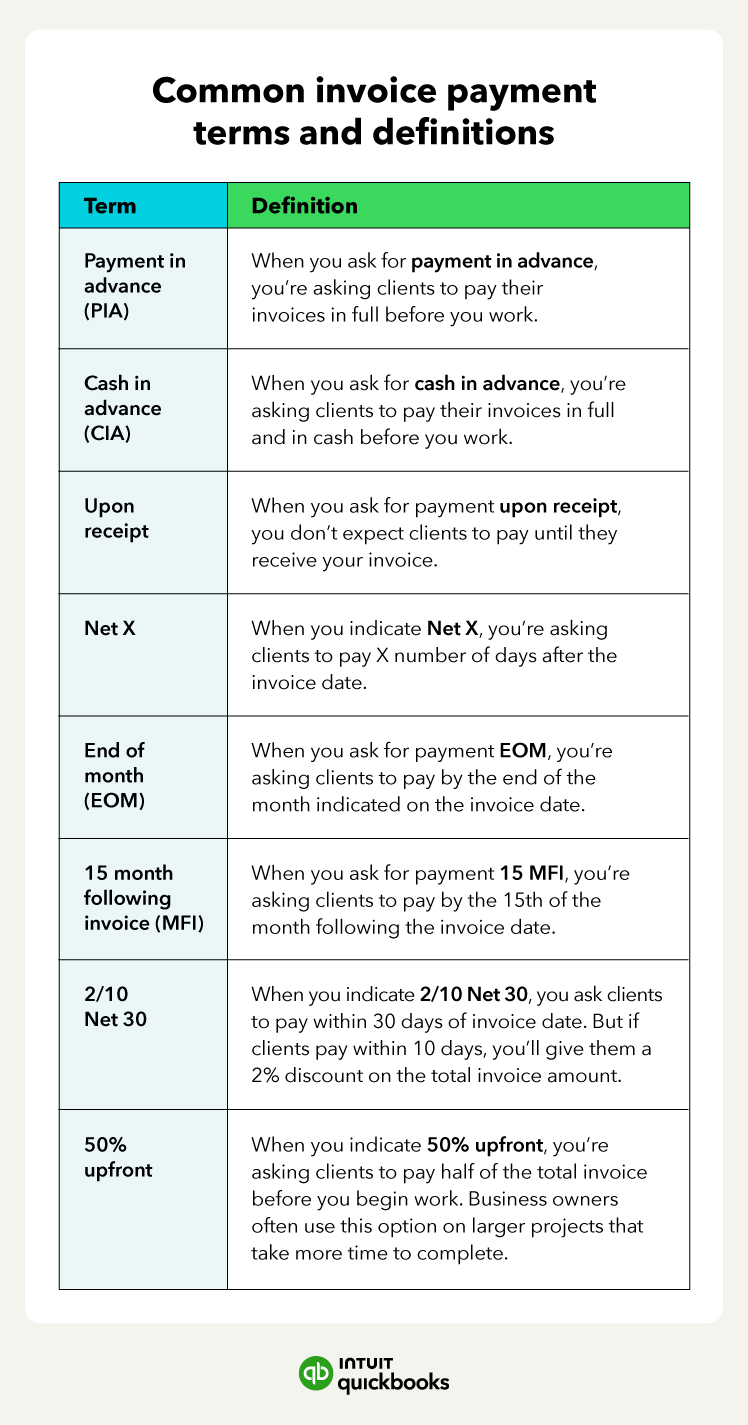
There are many different invoice payment terms, so it’s important to choose the right payment terms for your business. The chart below shows some of the common payment terms you may choose.
While net 30 is a common timeframe, your payment terms should align with your business needs and the specifics of each transaction. From requiring payment upfront to offering net 90 terms, be clear with customers so they know exactly when payment is due.
Payment method
Always specify how you want to be paid. Accepted payment methods may include:
- Bank transfers or ACH
- Credit or debit cards
- Checks
- Online payment platforms (e.g., PayPal, Stripe, QuickBooks Payments)
Providing multiple payment options can reduce barriers to payment and speed up processing.
Notes or special instructions
This optional section lets you add details that don’t fit elsewhere—such as “Thank you for your business,” warranty information, return policies, or reminders about upcoming projects. A personal touch here can strengthen customer relationships.
You can also use our free invoice generator tool to make and download custom invoices online.
Note: Your payment terms are a decision, not boilerplate. They change how fast you get paid, so we cover how to choose them in payment terms that get you paid faster below.
Best practices for formatting an invoice
A well-formatted invoice gets approved and paid faster because the customer never has to ask a clarifying question. Here’s what that looks like:
- Use one invoice numbering system and stick to it: sequential (INV-0042), date-based (2026-08-001), or customer-based (ACME-014). Gaps and duplicates are the fastest way to lose track of who owes you
- Put the total due and due date where they can’t be missed: top right, bold, no scrolling
- Describe the work the way the customer bought it: “Kitchen cabinet installation, 12 units” beats “Labor.” If the person approving the invoice can’t recognize the purchase, it goes to the bottom of their pile
- Spell out payment terms in plain words: “Payment due within 14 days of the invoice date” beats “Net 14”
- List every way they can pay: the fewer steps between reading and paying, the faster the money arrives
- Add a notes line: thank-yous, PO numbers, or anything the customer’s accounts payable team asked for
Say you run a two-person design studio and your biggest client’s accounts payable team keeps paying you late. You ask why and learn your invoices are missing their internal PO number, so each one sits in a manual review queue. One added line fixes a three-week delay. That’s the level formatting works at: it’s not decoration, it’s a payment speed lever.
Invoice example and template
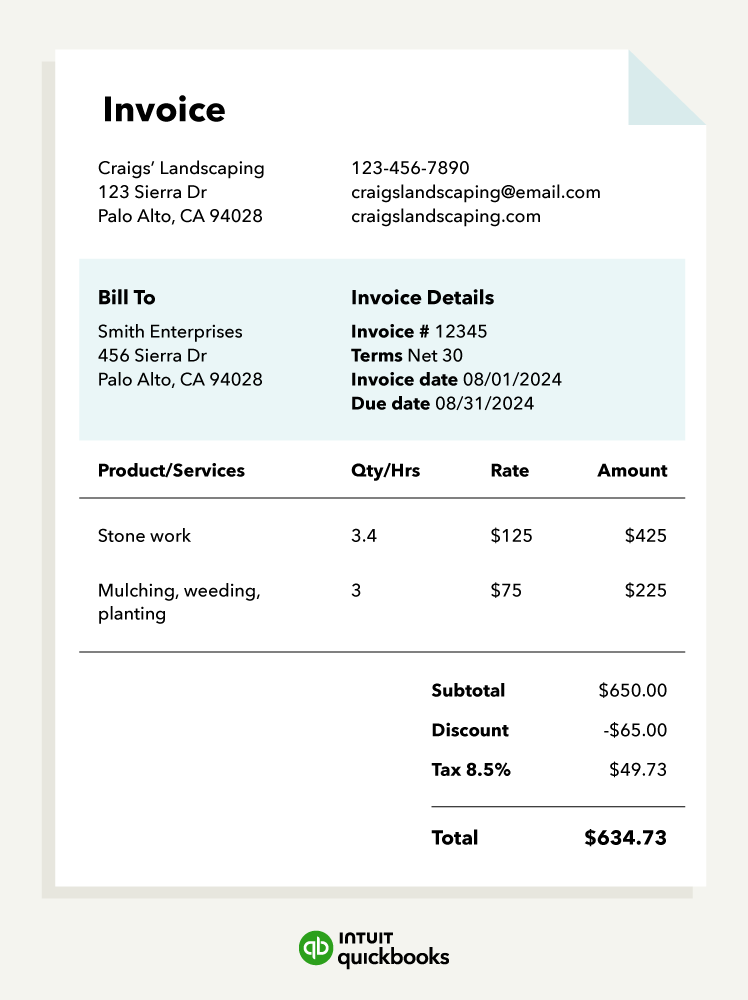
While invoices may vary by business, all typically follow the same structure. Here is how all of the above details come together into a sample invoice:
If you’re ready to create an invoice, QuickBooks offers many free, customizable invoice templates to help you create different types of invoices in a variety of file formats. Options include templates for pro forma invoices, freelancer invoices, service provider invoices, and more. Find a free invoice template that works for your business.
Industry Invoice Templates
Industry invoice templates help businesses bill clients professionally and accurately by providing pre-formatted documents tailored to specific services or goods. Using these templates can streamline your billing process, ensure you include the right details, and support faster payments.
Useful industry-specific invoice templates (with proper keywords):
- Automotive invoice template – Invoice for vehicle services, parts & automotive billing. Automotive Invoice Template
- Property management invoice template – Billing for rent, repairs & property services. Property Management Invoice Template
- Catering invoice template – Template for event catering & food service invoicing. Catering Invoice Template
- Construction invoice template – Invoicing for construction projects & contractor work. Construction Invoice Template
- Contractor invoice template – Invoice format for contractors and consulting services. Contractor Invoice Template
You can also use our free invoice generator tool to make and download custom invoices online.
9 common types of invoices
Different types of invoices can be issued to customers depending on the purpose of the invoice. Here are a few of the most common types of invoices you may use during the payment process.
Sales invoice
Also known as a standard invoice, a sales invoice documents the sale of goods or services and the expected payment amount, due date, and terms. Businesses in various industries use this versatile formal request for payment, and the sales invoice is the most basic form of invoicing.
Pro forma invoice
Pro forma invoices are issued to a customer before a product or service is delivered. Businesses use pro forma invoices to help customers understand the scope and cost of an upcoming project.
Pro forma invoices are sent before a formal invoice is issued to give customers an estimate of how much a product or service will cost once delivered. The terms in a pro forma invoice may need to be adjusted as a project progresses, but they can be a helpful tool to ensure businesses and customers are on the same page before work begins.
Interim invoice
Interim invoices are issued when a large project is billed across multiple payments. Businesses use interim invoices to collect progress payments before a project is completed.
Interim invoices can help businesses manage cash flow by allowing them to collect payments throughout the project and cover associated costs as work is completed, instead of waiting until the project is done.
Recurring invoice
Recurring invoices are issued to collect recurring payments from customers. Typically, recurring invoices are issued throughout an ongoing project. For example, a marketing agency may issue recurring invoices to clients every month to bill for services provided.
If a business bills a client for the same amount on a recurring basis, automating your invoices can reduce some of the work associated with creating and sending invoices. Learn how to schedule recurring invoices with our guide.
Credit invoice
A credit invoice is issued when a business needs to provide a customer with a refund or discount. The invoice will include a negative amount to cover the cost of the amount returned to the customer. If you overbill a client for services, you can issue a credit invoice for the amount overbilled. This invoice provides documentation of the amount you’re refunding to the customer.
Debit invoice
A debit invoice is issued when a business needs to increase the amount a client owes for a service or product. For example, if you underbilled a client for services, the scope of a project increased, or you worked additional hours on a project after sending an invoice, you can issue a debit invoice to account for the difference.
Commercial invoice
Commercial invoices are customs documents used when a person or business is exporting goods internationally. The information included in commercial invoices is used to calculate tariffs.
There is no standard format for commercial invoices, but some specific pieces of information are required:
- The name, address, and phone number of both parties involved in the transaction
- The goods being exported
- The reason for export
- A description of the goods being shipped, including what the item is used for, the number of units being shipped, and the value of the units
- The country or territory of origin
- The Harmonized System code assigned to the goods being shipped
- The number of packages being shipped and their total weight
- The shipper’s dated signature
Final invoice
Typically sent at the end of a project, the final invoice documents that the business has upheld its end of the deal and payment is due. This kind of invoice can follow after an initial pro forma or interim invoice to inform the customer that payment is required.
Overdue invoice
A past due or overdue invoice is an unpaid invoice past its due date. When an invoice is past due, your customer or client hasn’t paid you according to the agreed payment terms.
Past due invoices can impact cash flow, and collecting overdue invoices can cost business owners time and energy. Writing clear invoices that are easy to understand may help reduce the risk of an invoice being past due.
Offering a variety of payment options may also help reduce overdue invoices. Business owners may consider using pay-enabled invoices that allow customers to pay their bills directly from the online invoice
What late payments really cost small businesses
Late payments aren’t an annoyance. They’re one of the most common ways an otherwise healthy business runs out of cash.
According to the Intuit QuickBooks Small Business Late Payments Report, 56% of US small businesses are owed money from unpaid invoices, with an average of $17,500 outstanding per business. Nearly half (47%) have invoices overdue by more than 30 days. And the damage compounds: businesses with high volumes of overdue invoices are more than 1.4 times as likely to report cash flow problems, and 1.7 times as likely to say they’ve become more reliant on credit cards to cover the gap.
Picture a caterer who books $9,000 of corporate events in March on net-30 terms. April’s rent, payroll, and food costs arrive on schedule. Two of the three clients pay in May instead. Nothing about her business is broken, but she covers April on a credit card and pays interest on money she already earned.
That’s the real stake in the sections that follow. Payment terms and follow-up systems aren’t administrative details; they’re how you keep your own money from becoming an interest-free loan to your customers.
Payment terms that get you paid faster
Your payment terms are the single most controllable factor in how fast invoices get paid. The right terms depend on what you sell:
- If you sell products or one-off services: make invoices due on receipt. There’s no reason a completed transaction should carry 30 days of credit
- If you do large project work: don’t invoice once at the end. Ask for a deposit and bill in milestones. A common structure is 50% up front, 25% at the halfway point, and 25% on completion, so you’re never more than a quarter of the job exposed
- If you sell to larger companies: net 30 is often the price of admission because their accounts payable runs on cycles. Invoice the day work completes, get their PO number on the invoice, and treat day 31 as action day, not day 60
Here’s how to set your terms this week:
- 1. Pick a due-date rule: write it in plain words, like “Payment due within 14 days of the invoice date.”
- 2. Decide your deposit threshold: any job over a set dollar amount gets a deposit before work starts.
- 3. Add a late fee line: commonly 1% to 1.5% per month, and check that charging a late payment fee complies with your state’s rules.
- 4. Offer an early-payment discount only if the margin math works: “2/10 net 30” means the customer takes 2% off if they pay within 10 days; that’s worth it when cash now prevents credit card interest later.
Say you’re a landscaper quoting a $12,000 patio job. Invoicing the full amount at completion means floating $12,000 of materials and labor for weeks. On a 50/25/25 structure you collect $6,000 before breaking ground, $3,000 mid-project, and only ever risk the final $3,000. Same job, same price, a fraction of the exposure.
“I didn’t think about how I wanted to get paid for that first speaking engagement until they asked me for an invoice. So making sure that you have a system for getting paid...”
— Jannese Torres, host of Mind the Business, on “From Side Hustle to Spotlight”
The system is the point. Terms only work when they’re set before the work starts and enforced the same way every time. For more tactics beyond terms and follow-up, here are 20 ways to get clients to pay their invoices faster.
What to do when an invoice goes unpaid
Most unpaid invoices aren’t disputes. They’re drift: the customer is busy, your invoice is buried, and every silent week teaches them that paying you late has no consequence. The fix is a follow-up ladder you run the same way every time.
The Get-Paid Ladder
- Day 0: send the invoice the day work completes. Every day of delay adds a day to payment.
- Day 3: send a friendly reminder if the invoice is unopened or unacknowledged. This catches the “it went to spam” cases early.
- Day 15: send a second reminder with the invoice reattached. Most late payers pay here, so make paying one click.
- Day 30: call, and apply the late fee your terms promised. A call is harder to ignore than an email, and enforcing the fee makes your terms real.
- Day 45: send a demand letter. An attorney-drafted letter typically runs $300 to $1,000 as a flat fee, online legal services charge less, and either signals you’re prepared to escalate.
- Day 60: decide between small claims court and collections. Small claims limits vary by state, commonly $5,000 to $15,000; collections agencies take a cut but take the chore.
- Day 90: decide whether to keep pursuing or write it off. Chasing has a cost too; sometimes the write-off is the business decision.
If you choose the agency route at day 60, here’s how to send someone to collections.
Two situations change the ladder:
- If you’re a contractor or tradesperson: you may have lien rights on the property you improved, and they expire fast. In many states you must file within roughly 90 days of your last day on the job, so a lien decision belongs at day 30, not day 300
- If the customer is disputing the work rather than ignoring it: stop the ladder and resolve the dispute first. A demand letter escalates a misunderstanding you could have fixed with a conversation
Say a two-person painting crew finishes a $10,000 job for a property management company. The property manager goes quiet, months pass, and the crew keeps doing new work while the old invoice ages past a year. By the time they ask a lawyer about a lien, the filing window closed long ago. Every rung on the ladder existed; nobody climbed it. The ladder’s job is to make sure the decision points arrive on your calendar, not after they’ve expired.
One tax note for the worst case: whether you can deduct a written-off invoice depends on your accounting method. If your business uses accrual accounting, the unpaid invoice was already counted as income, so you can generally deduct it as a bad debt per IRS Topic No. 453, Bad Debt Deduction. If you use cash-basis accounting, you never recorded the income, so there’s usually nothing to deduct. It’s one more reason to loop in your accountant before you write anything off.
When should I send an invoice?
Send the invoice the day the work completes or the product ships. Not the end of the week, not the end of the month. Payment clocks start when the invoice arrives, so every day you wait is a day you’ve added to your own payment timeline.
Two exceptions:
- Recurring work: invoice on the same date every cycle so customers can build you into their payment runs
- Milestone projects: invoice at each agreed milestone, the moment it’s reached
If invoicing same-day feels unrealistic because creating invoices takes too long, that’s a tooling problem rather than a discipline problem. Free accounting software like QuickBooks Free is a $0-per-month way to create and send invoices with payment links built in, so the invoice can go out while the work is still fresh in the customer’s mind.
Send Online Invoices with QuickBooks
Everything in this guide gets easier when the invoice itself does the follow-up. QuickBooks lets you create professional invoices in minutes, schedule automatic payment reminders, and give customers one-click ways to pay so the money arrives days sooner. When you’re ready to stop chasing payments, explore QuickBooks invoicing software and find the plan that fits your business.

FAQ about invoices

Marshall Hargrave is a financial writer with over 15 years of expertise spanning the finance and investing fields. He has experience as an editor for Investopedia and has worked with the likes of the Consumer Bankers Association and National Venture Capital Association. Marshall is a former Securities & Exchange Commission-registered investment adviser and holds a Bachelor's degree in finance from Appalachian State University.


Call Sales: 1-877-866-5232




