Person holding a tablet in a workplace
accounting

Working capital explained: Formula, examples & best practices

Costs are climbing, and a lot of small businesses are feeling the squeeze. In a QuickBooks Small Business Insights report, 50% of US small businesses surveyed said rising costs and inflation are their biggest challenge right now. When expenses go up, it gets harder to predict what you’ll need on hand to cover payroll, rent, vendors, and taxes.

Working capital helps you measure that cushion. Below, we’ll break down what working capital is, how to calculate it, and how to use it to make smarter decisions about cash flow.

Jump to: 

What is working capital?

Working capital is the difference between current assets and current liabilities. It measures your ability to cover obligations due within the next year using assets you expect to convert into cash (or use up) within the next year.

Essentially, it answers the question: “Do I have enough short-term resources to pay my short-term bills and still run the business?”

If you have positive working capital, it can mean your business can pay its bills and invest in growth. On the other hand, negative working capital suggests potential cash flow problems that need immediate attention.

The working capital formula

The basic working capital formula is straightforward:

Working capital = Current assets - current liabilities

To use this formula effectively, you need to understand exactly what goes into each side of the equation.

Current assets

Current assets are resources your business owns that can typically be converted into cash within one year. These are the funds you rely on to cover your immediate expenses. Examples include:

  • Cash and cash equivalents: Money currently in your bank accounts or petty cash.
  • Accounts receivable: Money that your customers owe you for goods or services already delivered.
  • Inventory: Raw materials, work-in-progress, and finished goods that are ready to be sold.
  • Marketable securities: Short-term investments like stocks or bonds that can be easily sold.
  • Prepaid expenses: Payments made in advance for services like insurance or rent.
  • Other short-term assets: Any other assets expected to be converted to cash within one year.

Current liabilities

Current liabilities are the debts and obligations your business owes that must be paid within one year. These are the immediate financial pressures on your cash flow.

  • Accounts payable: Money you owe to suppliers or vendors for goods and services received.
  • Short-term debt: Loans or credit lines that need to be repaid within 12 months.
  • Accrued expenses: Expenses that have been incurred but not yet paid, such as wages or utilities.
  • Current portion of long-term debt: The specific amount of your long-term loans that’s due this year.
  • Taxes payable: Income, sales, or payroll taxes that are owed to the government.
  • Other obligations due within one year: Any other financial commitments due within one year.

How to calculate working capital: Step-by-step

You can get an accurate picture of where your business stands today by following the steps below.

Step 1: Gather your financial statements

Start with your most recent balance sheet. You'll need accurate figures for all current assets and current liabilities. If you use accounting software like QuickBooks Online, this report is readily available and up to date.

Step 2: Total your current assets

Add up all assets that will be converted to cash or used up within the next 12 months. This typically includes:

  • Cash on hand and in bank accounts
  • Money customers owe you (accounts receivable)
  • Value of inventory
  • Short-term investments
  • Prepaid insurance or rent

Step 3: Total your current liabilities

Sum all debts and obligations due within the next year:

  • Bills you owe suppliers (accounts payable)
  • Short-term loans or credit lines
  • Payroll obligations
  • Upcoming tax payments
  • Any portion of long-term debt due this year

Step 4: Subtract liabilities from assets

Simply subtract your total current liabilities from your total current assets. The result is your working capital. A positive number means you have surplus funds, while a negative number means you have more current debt than current assets.

Working capital calculation example

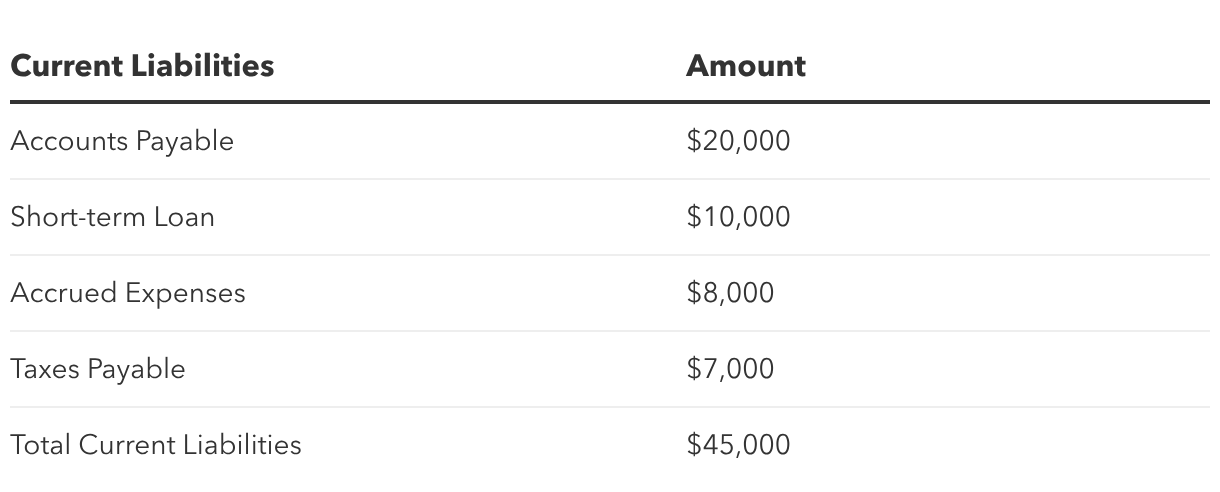
Let's look at a practical example for a small retail business to see how these numbers come together in the real world

Calculation:

$85,000 (assets) - $45,000 (liabilities) = $40,000

This business has $40,000 in working capital, meaning it has short-term resources left over after covering short-term obligations. That cushion can help absorb slower sales periods, unexpected expenses, or delays in customer payments.

Understanding working capital ratios

While the raw working capital number is useful, ratios provide deeper insights into financial health. They allow you to compare your performance against industry standards or your own historical data.

Here are some key ratios to consider.

Current ratio

The current ratio compares current assets to current liabilities. It gives you a quick snapshot of your liquidity.

Current ratio = Current assets ÷ current liabilities

Using our example: $85,000 ÷ $45,000 = 1.89

A current ratio above 1.0 indicates positive working capital. Generally, a ratio between 1.5 and 3.0 is considered healthy, though this varies by industry. A ratio above 3.0 might suggest you aren't using your assets efficiently to grow the business.

Quick ratio (acid-test ratio)

The quick ratio excludes inventory, which gives a more conservative measure of liquidity. It focuses on assets that can be turned into cash immediately.

Quick ratio = (Current assets - inventory) ÷ current liabilities

Using our example: ($85,000 - $40,000) ÷ $45,000 = 1.0

This ratio tells you whether you could cover your short-term bills without relying on selling inventory. That matters if your stock doesn’t move quickly or is hard to sell fast. In general, a quick ratio of 1.0 or higher suggests you’re in a solid spot.

What your working capital number means

Your working capital number gives you a quick snapshot of how comfortably your business can handle upcoming bills. Positive or negative, it helps you figure out what to focus on next.

Positive working capital

When current assets exceed current liabilities, you have positive working capital. This generally means:

  • You have the liquidity to meet supplier and vendor demands.
  • You have a financial buffer against emergencies.
  • You can invest in marketing, new equipment, or hiring.
  • There’s financial stability and creditworthiness, which lenders and investors generally view as a sign of good management.
  • You’re less likely to face immediate financial distress.

Negative working capital

When current liabilities exceed current assets, you have negative working capital. While it’s not always a disaster, it’s a warning sign that may signal:

  • You might struggle to pay employees or suppliers on schedule.
  • You may need to juggle payments or delay bills.
  • You might need a loan or line of credit to bridge the gap.
  • Your money might be tied up in slow-moving inventory or uncollected invoices.
  • The business is more vulnerable to market downturns.

However, it’s worth noting that some highly efficient businesses (like certain large retailers) successfully operate with negative working capital by collecting cash from customers immediately while negotiating long payment terms with suppliers.

Too much working capital

Excessive working capital isn't always positive. While it feels safe, holding too much cash or inventory might indicate:

  • An inefficient use of assets (e.g., cash sitting idle, inventory piling up)
  • You might be storing products that are becoming obsolete.
  • You aren't collecting payments fast enough, artificially inflating your asset numbers.
  • Missed investment opportunities. That excess cash could be used to expand or upgrade technology.
  • Your profitability ratios might suffer because assets are sitting idle.

The goal is balance: enough liquidity to operate efficiently without tying up resources that could be put to better use.

How to improve your working capital

If your working capital analysis reveals problems, don't panic. There are several strategies you can implement to strengthen your position.

Increase current assets

Boosting the assets side is usually the quickest way to improve liquidity. The goal is to bring more cash in (or free it up) without adding new short-term pressure.

Start by speeding up collections. Send invoices right away, follow up on overdue accounts, and consider an early-payment discount if it helps customers pay faster.

Next, look at inventory. If you have slow-moving stock, trimming it down and improving turnover can unlock cash you didn’t realize was stuck on the shelf.

You can also convert other assets to cash. Selling unused equipment or excess inventory can give you an immediate boost.

Finally, increase sales while keeping margins in mind. Revenue growth helps most when it’s profitable and doesn’t create a bigger cash gap.

Decrease current liabilities

Managing what you owe matters just as much as managing what you own. Here, the goal is to reduce near-term pressure without damaging relationships or credit.

One lever is better payment terms. If you can move from net 30 to net 45 or net 60, you give yourself more room to operate.

You can also refinance short-term debt when it makes sense. Shifting payments into a longer-term structure can lower monthly strain (even if the total cost changes).

Another step is to pay strategically. Pay bills on time, but avoid paying early unless there’s a discount worth taking.

And if expenses are creeping up, look for ways to cut operating costs without hurting quality or delivery.

Improve cash flow management

Working capital problems usually show up first in cash flow. Proactive cash flow management helps you spot issues early, not when you’re already behind.

Start with cash flow forecasting. Even a basic weekly or monthly forecast can help you see shortfalls coming and plan ahead. It also helps to have a line of credit in place before you urgently need one. It can be a backstop for slow seasons or unexpected expenses.

Also, don’t forget pricing. A quick pricing review can confirm your margins are strong enough to cover costs and still generate real cash.

Lastly, automate billing and collections where you can. Reminders, recurring invoices, and easier payment options can reduce delays and smooth out cash coming in.

Working capital management best practices

If you want more breathing room and fewer cash crunches, these best practices are a good place to start.

Monitor regularly

Run your working capital numbers monthly or quarterly, then look at the trend, not just one moment in time.

If your business is seasonal, compare this month (or quarter) to the same time last year. That helps you spot real issues versus normal ups and downs.

Set target levels

There’s no one perfect working capital number. A good target depends on how your business runs.

Ask yourself:

  • What do healthy competitors in your industry look like?
  • Are you gearing up for growth (or a big purchase)?
  • Do you need extra cushion for slow seasons?
  • How much breathing room helps you sleep at night?
  • How much cash does it take to keep things moving week to week?

Maintain balance

The goal is to have enough liquidity to operate without stress, but not so much that cash and inventory just sit there doing nothing. Too little can force you into panic decisions. Too much can mean you’re missing chances to invest, improve, or grow.

Use technology

If you’re using accounting software like QuickBooks, you can pull a balance sheet anytime and get working capital without manual math. That makes it easier to stay on top of the number and focus more on what it means than how to calculate it.

Create contingency plans

Working capital gets tested when life happens. Having a plan ahead of time makes it easier to respond fast.

Here are a few situations worth planning for:

  • Economic downturns
  • Seasonal slow periods
  • Rapid growth phases
  • Unexpected expenses
  • Market disruptions

Common working capital mistakes to avoid

Be sure to watch out for these common pitfalls when managing your working capital.

Ignoring accounts receivable aging

Don't let receivables pile up. Aging accounts receivable ties up working capital and increases bad debt risk. If customers aren't paying, that asset on your balance sheet isn't helping you pay bills. Keep an eye on your A/R aging report, follow up consistently, and set a simple process for past-due invoices.

Overstocking inventory

Buying in bulk can feel smart, especially if you’re getting a deal. But if that inventory sits for months, it ties up cash you could use elsewhere.

Extra stock also comes with hidden costs like storage, shrinkage, and markdowns. Try to keep inventory levels tied to real demand, not best-case scenarios

Missing early payment discounts

If suppliers offer 2/10 net 30 terms (2% discount if paid within 10 days), take advantage when cash flow permits. Just make sure paying early doesn’t create a cash crunch somewhere else

Confusing profit with cash

Sales aren’t cash until you collect them, and expenses usually hit before the money comes in. That gap is where working capital problems show up, so don’t assume a profitable month automatically means you’re safe.

Neglecting seasonal patterns

If your business has busy and slow seasons, your working capital should be planned accordingly.

A strong month in July doesn’t automatically cover a slow stretch later in the year. Build reserves during peak periods, and line up financing early if you know a dip is coming.

Using working capital calculators effectively

Online working capital calculators simplify the computation process. When using these tools:

  • Use current financial statements so your output is valid.
  • Update calculations regularly to track trends.
  • Compare results across multiple time periods to see the trajectory.
  • Understand the assumptions behind automated calculations.
  • Use results as starting points for deeper analysis.
  • Verify unusual results against your balance sheet.

Most accounting software, including QuickBooks, offers built-in working capital calculators that automatically pull data from your books to help you stay accurate and save time.

The bottom line

Working capital is a simple number, but it can tell you a lot. When you know how to calculate it (and what’s driving it), you can spot cash pressure earlier and plan for growth without getting caught off guard.

The easiest way to stay on top of working capital is to keep your books up to date and check in regularly. With QuickBooks Online, you can pull a balance sheet anytime, track trends over time, and get a clearer picture of what you can afford next.

Reach your business goals with QuickBooks

QuickBooks Term Loan ("Term Loan") and QuickBooks Line of Credit ("Line of Credit") loans are issued by WebBank.

Small business loans — big opportunities for growth

Get the funding you need fast with QuickBooks Term Loans or Lines of Credit.


Recommended for you

How can we help?


Get product support

Looking for something else?

QuickBooks

From big jobs to small tasks, we've got your business covered.

Firm of the Future

Topical articles and news from top pros and Intuit product experts.

QuickBooks Support

Get help with QuickBooks. Find articles, video tutorials, and more.