Types of capital
Capital comes in different forms, and each type plays a unique role in your business and offers different benefits depending on your goals and stage of growth.
Here are the most common types of capital:
Equity capital
Equity capital is money you raise by giving investors a piece of ownership in your business. This can come from angel investors, venture capitalists, or even friends and family. Instead of repaying the funds like a loan, you share a portion of your future profits or company value.
Example: You start a coffee shop and receive $50,000 from an investor in exchange for 20% ownership of your business.
Debt capital
Debt capital is borrowed money you agree to repay over time, usually with interest. This includes small business loans, lines of credit, and even business credit cards. You don’t give up ownership, but you do take on a repayment obligation.
Example: You take out a $100,000 loan to buy new equipment and pay it back monthly over five years with interest.
Working capital
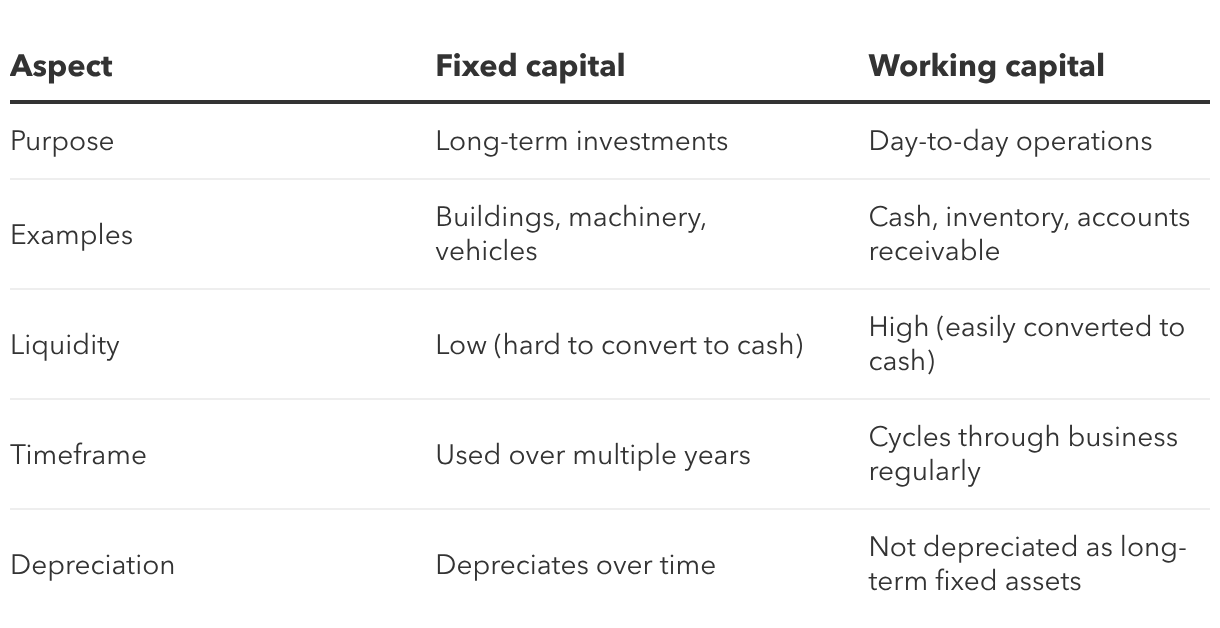
Working capital is the money available to run your day-to-day business operations. It’s calculated as your current assets (like cash and accounts receivable) minus your current liabilities (like bills and payroll).
Example: You use working capital to buy inventory, pay employees, and cover rent each month.
Human capital
Human capital refers to the skills, knowledge, and experience that people bring to your business. It’s not always measured in dollars, but it adds real value. Training, education, and employee development all contribute to this type of capital.
Example: Your lead technician has 10 years of experience and helps train new team members, adding value to your business.
Social capital
Social capital is the value of your relationships, networks, and reputation. This could include loyal customers, strong supplier partnerships, or industry connections that open doors.
Example: Your business gets referrals from a local chamber of commerce network you’re part of.
Natural capital
Natural capital refers to natural resources your business depends on, such as water, land, or raw materials. This is more common in industries like agriculture, energy, or manufacturing.
Example: A winery relies on fertile land and local water sources to produce grapes. Those natural assets are part of its capital.
Fixed capital
Fixed capital refers to long-term assets your business uses to produce goods or services—e.g., property, equipment, and machinery. These assets typically stay on the books for years and aren’t meant to be sold quickly.
Example: You buy a food truck to start your mobile taco business. That truck is fixed capital.
Trading capital
Trading capital is money you set aside for buying and selling assets in the financial markets. It’s purely for trading activities, like investing in stocks, bonds, currencies, or other financial assets.
Example: You run a small business, and you’ve set aside $25,000 just to invest in stocks and ETFs. That’s your trading capital.
What is a person’s capital?
A person’s capital is the financial and personal resources they can use to support or grow a business. It might include personal savings, investments, property, or even skills and experience that add value to a business.
For example, if you use $10,000 from your savings to launch an online store, that money is your personal capital. If you also bring years of marketing experience to the table and build the website yourself, that skillset is part of your human capital.
Is capital your own money?
Capital can be your own money, but it doesn’t have to be. If you're investing your personal savings into your business, it counts as capital. However, capital can also come from other sources, such as loans, grants, or outside investors. What matters is how it’s used in your business.
For example, you invest $8,000 from your checking account to open a bakery. That’s your capital. If your business partner adds $5,000 of their own, that’s capital, too, even though it’s not yours.
Is capital an asset?
Yes, capital is usually considered an asset, especially in accounting. Capital can show up as cash, equipment, tools, or any valuable resource your business uses to operate. On your balance sheet, capital might appear as owner’s equity or fixed assets.
Sources of capital
Every business needs capital, but where that capital comes from can vary depending on your size, goals, and stage of growth.
Here are some of the most common sources of capital for small businesses:
Personal savings
Using your own money is one of the most common ways to fund a business, especially early on. It gives you full control and avoids the pressure of repayments or giving up equity.
Example: You use $15,000 from your savings account to buy equipment and launch your small woodworking business.
Friends and family
Some entrepreneurs turn to trusted people in their lives for early funding. These contributions might be loans or equity investments, depending on the agreement.
Example: A friend lends you $5,000 to cover startup costs, with the agreement that you'll pay it back in two years.
Business loans
You can apply for funding through a traditional bank, credit union, online lender, or an organization like the Small Business Administration (SBA). Loans are usually repaid with interest over a set period.
Example:
You take out a $50,000 SBA loan with a 14% interest rate and a 5-year repayment term. You use the funds to remodel your storefront and stock up on inventory. You make monthly payments until the loan is fully repaid.
Lines of credit
A business line of credit gives you access to a pool of funds you can draw from as needed. You only pay interest on what you use, making it great for short-term needs or unexpected costs.
Example: You’re approved for a $25,000 line of credit with a 10% interest rate. In a slow month, you withdraw $8,000 to cover payroll and supplier invoices. You pay it back gradually over the next few months, and the funds become available again as you repay.
Equity investors
Angel investors or venture capitalists can provide large amounts of funding in exchange for equity (ownership). This is common in high-growth industries like tech.
Example: You bring on an investor who contributes $100,000 for a 15% stake in your business.
6. Grants
A small business grant is money offered by government agencies, nonprofits, and corporations to help fund your business. Grants don’t have to be paid back, but they’re competitive and usually require a detailed application process.
Example: You win a $10,000 small business grant from a women-owned business initiative to boost your social media ad spend.
7. Crowdfunding
Platforms like Kickstarter, Indiegogo, or GoFundMe let you raise money from a crowd of backers—often in exchange for a product, reward, or experience.
Example: You raise $18,000 on Kickstarter to fund production of your new eco-friendly kitchen tool.
8. Business revenue
As your business grows, reinvesting your own profits is one of the smartest and most sustainable ways to build capital. It helps you scale without taking on debt or giving up equity.
Example: You use $12,000 from last quarter’s sales to launch a new marketing campaign.
How to manage capital in 2025
Whether you're just getting started or scaling up, the way you handle capital can make or break your success. Here are some smart tips to manage capital effectively in 2025:
Know your numbers
Start with a clear picture of your capital—how much you have, where it’s coming from, and what it’s being used for. Use financial software or work with an accountant to stay on top of your reports.
Keep personal and business finances separate
Use a dedicated business bank account and credit line. Mixing funds can lead to confusion, tax headaches, and poor decision-making.
Build a capital reserve
Set aside funds for emergencies, slower seasons, or unexpected costs. A good rule of thumb is to save at least 3 to 6 months’ worth of expenses.
Use debt wisely
Borrow only what you need and understand the terms. Too much debt can hurt your cash flow and limit flexibility.
Track ROI on capital investments
Every capital investment should move your business forward. Tracking the return on investment (ROI) can help you understand what’s working and what’s not.
Reinvest profits strategically
Once you're turning a profit, consider putting a portion back into the business to fund growth—e.g., hiring employees, upgrading equipment, expanding your space, etc.
Review your capital structure regularly
Your mix of equity, debt, and retained earnings may need to shift as your business grows. Make sure your capital plan still supports your long-term goals.
Work with a financial advisor or mentor
An outside expert can help you build a strategy, spot issues early, and make smarter funding decisions.
Finding capital on a balance sheet
Capital shows up on the balance sheet as the value the business holds—either through your own investment or the profits you’ve kept in the business. You’ll usually find it in the equity section, which represents what you truly own after paying off your debts.
Here’s how to spot it and what each part means:
Owner’s equity (or shareholders’ equity)
This is where capital is most clearly shown. It reflects what’s left for the owner (or shareholders) after subtracting liabilities from assets. Depending on your business type, this could be listed as:
Example: If your business owns $150,000 in assets and owes $100,000 in liabilities, your equity—or capital—is $50,000.
Retained earnings
This is the total profit your business has earned and reinvested instead of distributing to owners or shareholders. Retained earnings are part of your equity and add to the capital you have to work with as your business grows.
Contributed capital (or paid-in capital)
This is the money you or investors have put directly into the business. It’s not from profits—it’s from outside investments. That money boosts your capital and gives the business more to work with.
Impact of limited business capital
When your business doesn’t have enough capital, it can hold you back from reaching your goals or even threaten your survival. Here are some ways limited capital can affect your business:
- Cash flow problems: Without enough capital, you may not have the cash to pay bills, buy inventory, or make payroll, especially during slow seasons or while waiting on customer payments.
- Missed growth opportunities: Capital helps you invest in marketing, technology, new products, or additional staff. Without it, you may have to pass on opportunities that could move your business forward.
- Higher risk of debt dependency: When capital is tight, you might rely more heavily on credit cards or short-term loans with high interest rates, which can snowball into long-term financial strain.
- Difficulty attracting investors or financing: Lenders and investors usually want to see that you already have capital or a plan to manage it wisely. A lack of capital can make it harder to secure outside funding.
- Limited resilience in tough times: Without a cushion of capital, even a small dip in sales or a sudden expense, like equipment repair or supply chain delays, can create major setbacks.
Conclusion
Managing capital starts with managing your money. With QuickBooks, you can track your income, expenses, equity, and more—all in one place. Stay organized, make informed decisions, and run your business with confidence.