
You could save up to 25% on transaction costs².
Speak with us now to see if you qualify.
Talk to sales 1-800-515-8366
Monday - Friday, 6 AM to 4 PM PT

Table of contents
Table of contents
As organizations scale, financial operations become more interconnected — and more exposed.
What may begin as a small accounting team managing a tightly controlled system often evolves into a multi-user environment with expanding access needs. Sales leaders need reporting visibility. Accounting teams process transactions. Operations managers review performance metrics. External auditors and advisors require limited system access.
Without a structured framework, financial systems can become overextended. Excess permissions, inconsistent onboarding, and unclear role definitions create risk, not only from a cybersecurity perspective, but from a governance and internal control standpoint.
For finance leaders, role-based access control (RBAC) isn’t simply an IT setting. It’s a core component of financial oversight, risk management, and scalable infrastructure.
Access governance directly affects financial integrity. As transaction volume increases and responsibilities expand across teams, maintaining clarity around who can view, edit, approve, and export financial data becomes essential.
When access controls are informal or reactive, control gaps emerge quietly. Over time, those gaps can affect reporting reliability, segregation of duties, and audit outcomes.
Accounting systems contain some of the organization’s most sensitive data — payroll records, vendor banking details, revenue performance, pricing structures, and profitability metrics.
Broad or undefined access increases exposure to internal misuse, accidental error, and compliance risk. Even well-intentioned employees can unintentionally create reporting issues if permissions exceed their responsibilities.
Role-based access ensures sensitive financial information is available only to those who require it to perform their role, protecting both data integrity and stakeholder trust.
Segregation of duties is a cornerstone of strong internal controls. The same individual should not be responsible for initiating, approving, and reconciling financial transactions.
Role-based access control helps finance leaders enforce this separation systematically. By defining roles aligned to job responsibilities, organizations reduce the risk of fraud, override authority, and control deficiencies.
Auditors evaluate not only financial results but also the controls surrounding financial systems. Clear documentation of user roles, controlled permissions, and consistent onboarding practices reduce the likelihood of audit findings.
Well-defined access governance signals discipline and maturity in financial management.
In fast-growing businesses, user access is often granted reactively. New hires are added quickly. Consultants are given temporary permissions. Employees change roles but retain previous access.
Over time, this creates “permission sprawl” — a situation where users accumulate access beyond what their responsibilities require.
These gaps may not surface immediately, but they increase exposure to financial error, fraud risk, and audit complications.
A structured RBAC model replaces ad-hoc permission management with standardized, repeatable governance.
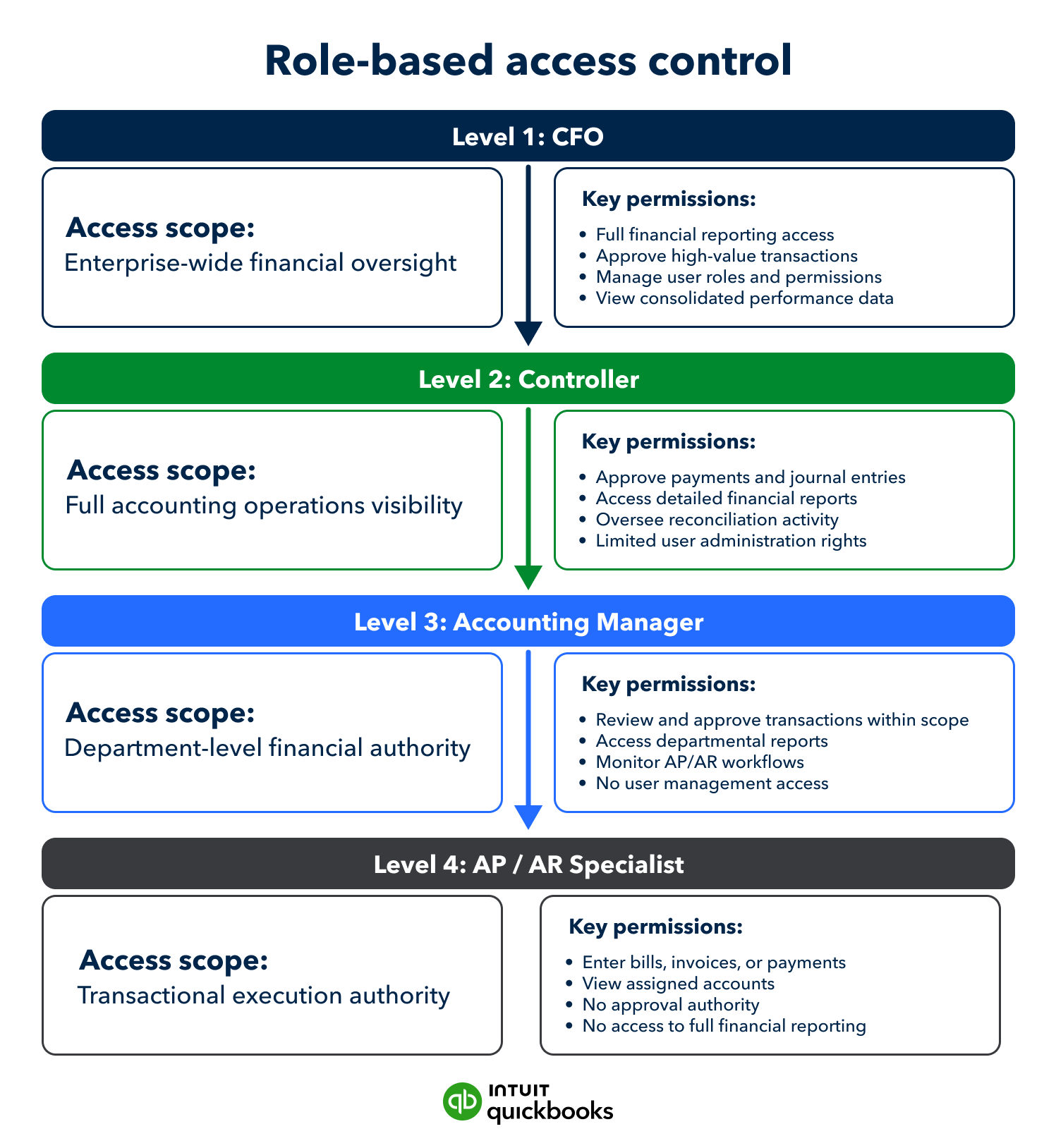
Instead of assigning permissions individually, finance leaders define roles based on job function — such as accounts payable specialist, accounting manager, or finance director. Each role carries a predefined set of permissions aligned with responsibilities.
This approach delivers several benefits:
As the organization grows, new employees can be assigned existing roles without reengineering access from scratch.
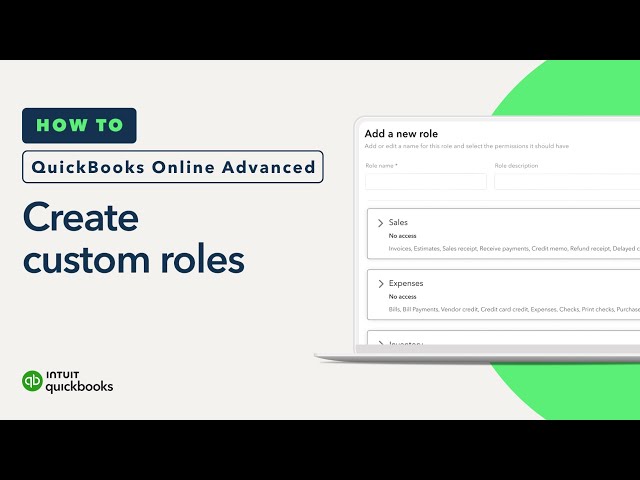
Modern cloud-based accounting platforms like QuickBooks Online Advanced allow finance leaders to assign customizable user roles aligned to organizational responsibility, helping maintain oversight without slowing operations
Effective access control requires ongoing oversight. Finance leaders can strengthen governance by following a few core principles.
Roles should reflect actual job functions, not individual preferences. Permissions must correspond directly to the tasks required for each position.
Over-customizing roles can introduce confusion and administrative burden. A streamlined set of clearly defined roles improves clarity and scalability.
Access decisions should be based on standardized policy, not personal discretion. This reduces inconsistency and reinforces control integrity.
Periodic reviews of user roles help ensure permissions remain appropriate as responsibilities evolve. Regular audits of system access support compliance and risk management.
Cloud accounting platforms introduce flexibility and scalability, but they also require disciplined oversight.
In multi-user cloud environments, finance leaders need the ability to:
QuickBooks Online Advanced supports these needs through customizable user permissions and role-based access management. Finance teams can assign access according to responsibility, maintain oversight across multiple users, and adjust permissions as the organization evolves.
By centralizing financial data within a controlled, cloud-based system, leadership gains clearer visibility into both performance and governance.
Delegation is essential in a scaling organization. Finance leaders cannot, and should not, manage every transaction personally. However, delegation must be accompanied by structured oversight.
Role-based access control enables teams to share workload responsibly while protecting sensitive financial information. It strengthens internal controls, supports audit readiness, and reduces operational friction.
As businesses grow, disciplined access governance becomes a critical component of financial leadership, ensuring that growth is supported by strong controls and reliable data integrity.
Learn more about QuickBooks Online Advanced.