You could save up to 25% on transaction costs².
Speak with us now to see if you qualify.
Talk to sales 1-800-515-8366
Monday - Friday, 6 AM to 4 PM PT

Table of contents
Table of contents
If vendors and supplier price rises are squeezing your profits, you can push back against them. Instead of just accepting their new rate card, think of it as the start of a contract negotiation. Prove your value as a customer and offer something concrete in return. You'd be surprised how quickly that new rate becomes flexible.
QuickBooks’ Small Business Insights survey shows that inflation has been the biggest challenge for SMBs since April 2023. Here are 10 strategies and three ready-to-use scripts to help you secure the best possible pricing from your suppliers.
“Price taking" is when you accept the rates your suppliers set without questioning or negotiating them. This leaves your business vulnerable because your cash flow and profitability rise and fall based on what suppliers charge.
In a volatile economy, prices can change fast and without warning. Moving towards a partnership model with a supplier means both parties agree on pricing together, rather than them telling you what you’ll pay. That puts you in a stronger position to adapt to market shifts.
There will nearly always be a cheaper supplier out there. But cheaper can be risky because a new supplier may not offer the same quality or reliability. Saving 5% on a contract might lead to missed deliveries, substandard products, or hours spent managing a supplier who doesn't know your business.
Your goal should be a fair deal with a supplier you can depend on.
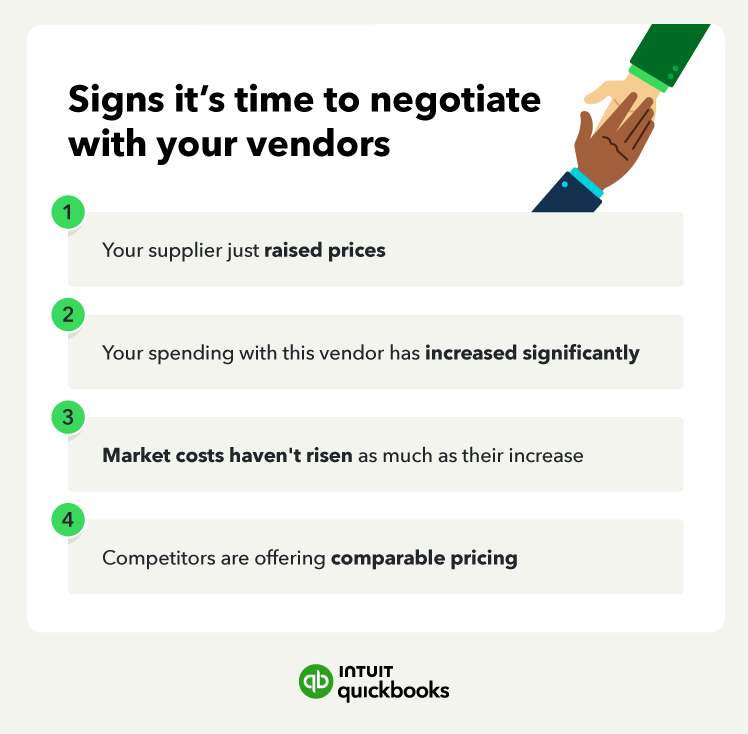
Negotiate every time a supplier raises their prices. Also, at least once a year, review how your overall spending with each supplier has changed.
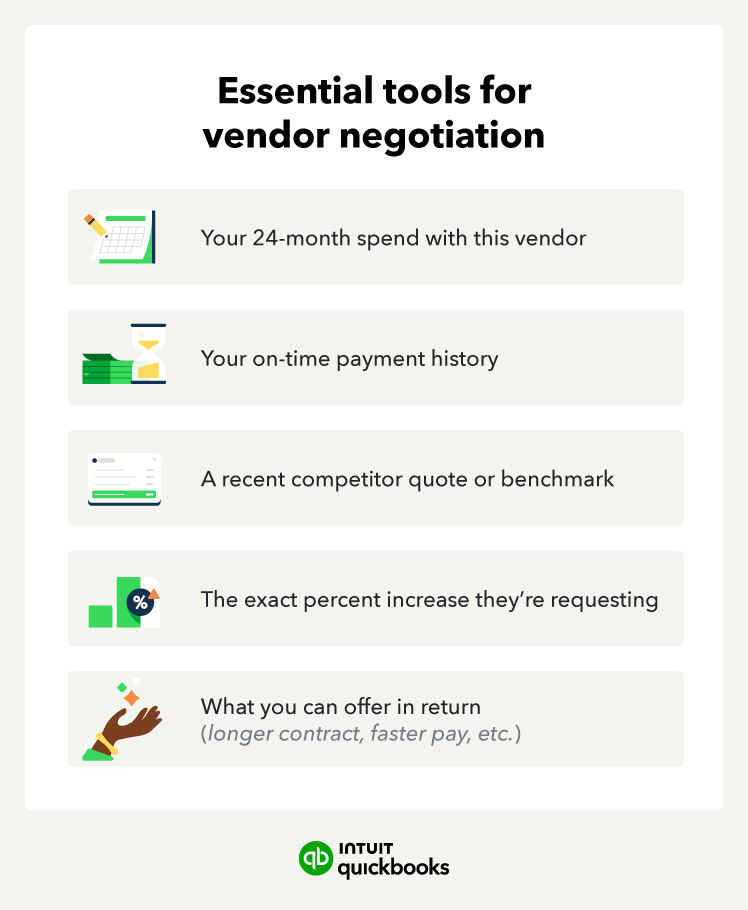
To give yourself the best chance of securing a discount, you need to know your numbers. Accounting software like QuickBooks can help here. Start by running an Expenses by Vendor Summary report in the QuickBooks platform and set it to display by month over the last 24 months.
This data shows whether your spending with a particular supplier has been trending upward, and exactly how much business you're bringing them. If you've spent, for example, $250,000 a year with them and have a good payment track record, they won’t want to lose your business.
Then compare their price increase to national indices (such as the Consumer Price Index or Fuel Index) to see if it’s proportionate. If they want 10% more but the relevant index is only 3% higher, that gap is your starting point.
So when you make your case, you'll have the evidence to back up everything you're asking for.
You’ll find some suppliers back down faster than others, often dependent on the revenue you generate for them. With others, you may need a combination of approaches before they start to reconsider.
Here are our best tips for negotiating with suppliers to secure the best pricing for your business:
An indexation clause ties the price you pay to a published index, like fuel, steel, or consumer prices.
When the index goes up, your supplier can raise their prices proportionally. When it comes down to it, so does what you pay. Instead of renegotiating every time there’s a change in the index, you both agree upfront on a formula.
This turns a difficult contract negotiation into a formula both sides agree on upfront. You're not forcing your supplier to absorb losses when their costs spike, and they're not asking you to pay inflated rates when prices cool back down.

Agree on a cap and a floor during indexation negotiations. This means prices can only go up or down by so much over the course of a year. You get protection against extreme price hikes, and they won't be pushed below a sustainable price.
“Bill and hold” is when you agree to buy inventory at today's price, but the supplier stores it and ships it to you in batches when you need it.
You lock in a lower cost of goods sold without overloading your warehouse, while your supplier gets a confirmed order and guaranteed revenue.
There are two main types of “bill-and-hold” arrangements:
Either way, get a fixed delivery schedule from your supplier. Also, make sure you agree on who carries the risk if the goods are damaged, lost, or stolen while still in your supplier’s possession.
Before you negotiate, find out what other suppliers in your market are charging for comparable products and services. Use those figures to show a supplier that their pricing is above what competitors are offering for similar quality and service levels.
Get the figures from:
These numbers put the burden on your supplier to justify their pricing. It also keeps conversations more professional and productive by grounding them in data rather than opinion.
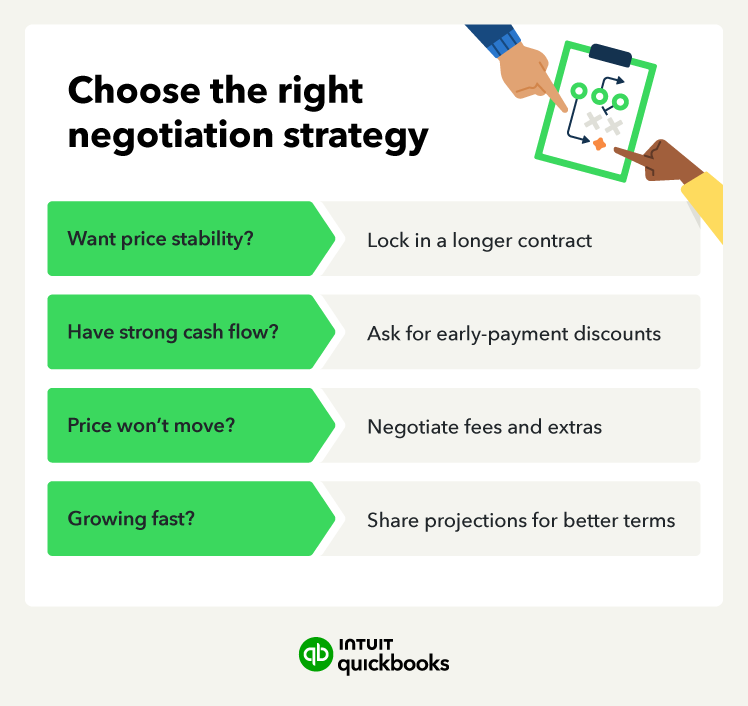
Show suppliers where your business is heading so they see the long-term benefit of keeping your account. Many will sacrifice margin now if they believe your volume will, for example, triple in the next 18 months.
Put together a simple forecast showing where your business is heading and demonstrate how that translates into bigger orders for them. Offer a larger share of future revenue in exchange for better terms now.
Use data from QuickBooks to back up your growth trend so far with real numbers. If lenders or investors have provided external capital, that's further proof that your projections are credible and not just optimistic. Evidence makes it much harder for a supplier to dismiss your forecasts.
The price on the invoice isn't always the total you pay. Shipping fees, restocking charges, minimum order surcharges, warranty terms, and payment processing fees all add up.
Ask vendors and suppliers for a full breakdown of all charges and negotiate each one separately.
You might not get a lower unit price, but free shipping above a certain order value, waived restocking fees, or extended warranty terms can save you a substantial amount over a year.
Working with more than one supplier for the same product or service is both good risk management and an effective negotiating tool. If your sole supplier has a production issue, a staffing problem, or goes out of business, your business keeps running.
As part of your supplier relationship management process, let vendors know that you regularly benchmark their pricing against competitors. Mention during a routine order that you've seen a competitor offering similar products at a lower price.
Your primary supplier is far less likely to push aggressive price hikes when they know you have alternatives.
Cash up front is worth more to most suppliers than a higher unit price paid in 60 or 90 days. Faster payment improves their cash flow and simplifies their accounts payable (AP) process.
Offer a larger deposit or faster payment terms and ask for a discount in return.
A common arrangement is "2/10 net 30", which means you get a 2% discount if you pay within 10 days instead of the standard 30. That might sound small, but if you spend $1m with a supplier over a year, you save $20,000.
A great payment record can also improve your business credit score, leading to better financing terms and higher limits on vendor credit accounts.
Strong negotiation skills are important, but you need the cash flow to make these payments without hurting your own financial position. If you’re having trouble getting your customers to settle their accounts, get paid up to five days faster on average with the QuickBooks Payments Agent.
When a supplier proposes a price increase, show them why it’s too high.
Use the Expenses by Vendor report in QuickBooks, covered earlier in this article, to show how much you’ve spent with that supplier. Combine that with market index data from your benchmarking.
Then reply with something like, “Based on current market indices and what we've been paying over the past two years, we were expecting a price closer to X."
You're comparing their proposed increase against both your value as a customer and what the market says is reasonable. Good negotiating skills come down to evidence, and that's much harder for a supplier to argue with than "we'd like it cheaper, please.”
If you're splitting orders for the same product across several suppliers, consider moving that volume to one. The more business you commit to them, the deeper the discount. You may qualify for tiered pricing that kicks in at certain volume thresholds.
There's risk in putting all your volume with one supplier, so put protections in place first. For example, a "liquidated damages” clause gives you a financial safety net if the supplier fails to perform with a late or missed delivery.
Suppliers prefer customers who pay on time, every time. Many use payment history to decide who gets priority stock allocation and delivery schedules.
Use QuickBooks Bill Pay to schedule vendor payments in advance via ACH or check. You can schedule payments up to 90 days ahead, so you'll never miss a due date.
Pay consistently on time to strengthen your position when negotiating with vendors and suppliers on better terms.
Below, find ready-to-use scripts you can adapt for emails and phone calls when negotiating with vendors and suppliers.
Choose the one that best fits your situation:
If you're willing to commit to a longer contract, say 18 to 24 months, you can use that commitment as leverage to lock in a fixed price. You're offering guaranteed volume and removing the risk of them losing your business to a competitor. What you want in return is a commitment to hold your pricing steady.
Here’s a script you can adapt:
"We'd like to continue working with you for the next 18 to 24 months. You know how much business we put your way, and we’re happy to commit to those levels. In return, we need you to lock in our current pricing for the duration of the agreement. That protects both of us from market fluctuations."
Cash in hand is worth more to a supplier than a promise of payment in 60 days. The latest QuickBooks Late Payments Report found that 60% of small businesses with longer payment terms reported cash flow problems. Since many suppliers use tools like invoice factoring, they may welcome faster payments in return for a discount.
Adapt this script to suit your business:
"We're currently on Net-30 terms. If we moved to Net-10, would you be able to offer a 3% early-payment discount? We pay you faster, and that gets rid of any chasing or waiting on our account for you.”
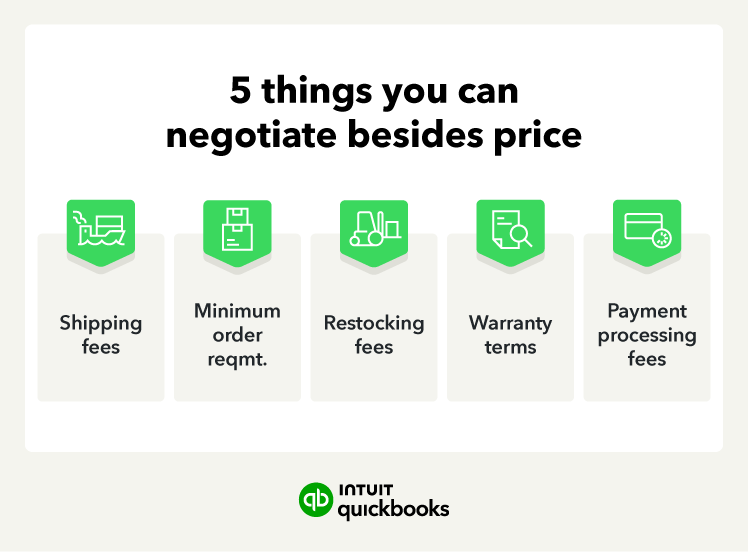
Some suppliers won't move on unit price, and pushing them too hard can damage the relationship, as their margins may already be tight.
In these cases, shift your focus to ancillary costs. For example, ask for free shipping above a certain order value, extended warranty terms, waived restocking fees, or a bill-and-hold arrangement.
Try this approach:
"We know your pricing is fair and reflects your actual costs. We’re not going to ask for a reduction on those, but could you look at dropping shipping fees on orders over $1,000? Also, can we set up a bill-and-hold arrangement when you expect prices to go up? We’re keen to find a way to keep working together that works for both parties."
A small drop in your input costs can have a dramatic effect on your profitability. Use the strategies and scripts in this guide as part of your wider cost reduction strategy to protect your margins and keep more of what you earn.
Manage your money better with QuickBooks. It contains all the spend data, vendor reports, and cash flow tools you need so you can secure the best deals with suppliers from a position of strength.

Call Sales: 1-800-285-4854