
You could save up to 25% on transaction costs².
Speak with us now to see if you qualify.
Talk to sales 1-800-515-8366
Monday - Friday, 6 AM to 4 PM PT

Table of contents
Table of contents
How do you calculate overhead costs?
To calculate total overhead costs, identify and list all your business's indirect expenses for a period, which includes all costs not directly tied to production. Then add up all these individual expenses to arrive at your total overhead cost for that period.
While driving revenue is vital, effectively managing your overhead costs—like rent, utilities, and administrative salaries—provides the financial stability needed to navigate uncertainty and weather economic fluctuations.
These costs can significantly impact your bottom line, especially in today's economic climate. In fact, the QuickBooks Entrepreneurship report found that 61% of business owners consider inflation a major obstacle to growth, which means managing overhead is more important than ever.
This guide will show you how to calculate and effectively manage your overhead costs. We'll explore different methods for tracking expenses, allocating overhead, and identifying areas where you can cut costs.
Small business owners need to track two main types of expenses to understand pricing, budgeting, reporting, and profitability. Operating expenses are costs that are directly related to the production or delivery of a product or service, and to producing revenue. These can vary according to business activity and include raw materials, parts, labor, and equipment.
Overhead expenses are what it costs simply to stay in business—your day-to-day business operations. These include costs such as:

While many people think of overhead as fixed rent payments, overhead costs actually fall into three distinct categories based on how they react to your business activity. Understanding these is the secret to accurate budgeting.
The table below shows examples of fixed, variable, and semi-variable overhead costs.
 Don't overlook the "opportunity cost" within overhead. An overly spacious, rarely used office might be considered a fixed cost, but the lost potential for subleasing or converting that space into revenue-generating activity is a hidden overhead expense.
How can you tell the difference between an operating cost and business overhead? One way is to think about which bills you’d have to pay even if you stopped making your product or delivering your service for a while.
You wouldn’t have to buy parts, pay your service delivery people, or advertise, but you’d have to keep making your rent, utility, and insurance payments.
To effectively manage your business finances and assess your profitability, you'll need to know how to calculate your overhead costs. These steps will guide you through determining the proportion of your sales revenue allocated to covering these vital operational expenses.
Start by tracking expenses for a specific period, typically a month. You need to capture all costs that aren't directly tied to producing your goods or services. Conceptually, these costs fall into broad categories often summarized by the formula:
Overhead cost = Indirect materials + Indirect labor + Indirect expenses
This means identifying and gathering costs such as:
More specific examples you'll look for on your expense list include:
Once you have identified and listed all relevant expenses fitting these categories for the period, add them all up to get your total overhead cost. This total will be used in the subsequent steps to calculate your overhead percentage.
Next, determine your total revenue generated during the period you calculated your overhead expenses for. This represents the total income your business earned from sales or services. This figure is essential for understanding the relationship between your overhead costs and overall sales performance.
To calculate your overhead percentage, you'll use a simple formula that compares your total overhead expenses to your total revenue. This percentage reveals the portion of each sales dollar that goes toward covering your overhead.
(Total overhead expenses ÷ total sales) x 100 = Overhead percentage

This formula provides a clear picture of your overhead burden and its impact on your profitability.
Now, plug in the numbers you've gathered into the formula and perform the calculation. For example, if your total overhead expenses are $120,000 and your total sales are $800,000, you would calculate it as follows:
($120,000 / $800,000) x 100 = 15%
This means that at Company A, for every dollar the company makes, 15 cents goes to pay overhead. When you consider that the average profit margin for most companies is 10%, 15% is a significant percentage. This is why it’s very important to have a handle on your overhead costs.
Calculating your overhead allocation rate is key to understanding how much of your overhead contributes to each unit of production, service, or activity. Let’s explore different methods for calculating this rate, so you can select the approach that best suits your business needs.
The labor hours method is ideal for businesses where labor hours are a primary driver of overhead costs. To determine the overhead allocated per labor hour, you'll divide your total overhead expenses by the total labor hours worked:
Total Overhead Costs ÷ Total Labor Hours = Overhead Allocation Rate (per labor hour)
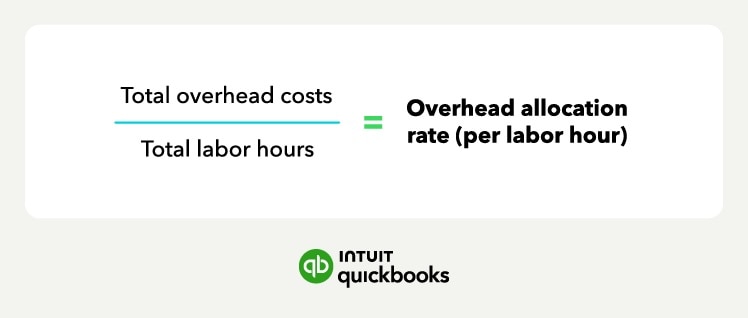
For example, if your monthly overhead is $20,000 and your employees worked a total of 800 hours, your overhead allocation rate would be $25 per labor hour ($20,000 / 800 hours = $25/hour).
This method provides a clear view of how much overhead is associated with each hour of labor, helping you analyze labor costs and pricing strategies.
When your workforce represents a significant chunk of your expenses, tying overhead to labor costs can be illuminating. This method reveals how much overhead is tacked onto every dollar you spend on salaries and wages.
(Total Overhead Costs ÷ Total Labor Costs) x 100 = Overhead Allocation Rate (as a percentage of labor costs)

If your monthly overhead is $20,000 and your total labor costs are $10,000, for example, your overhead allocation rate would be 200% (($20,000 / $10,000) x 100 = 200%). This means that an additional $2 is attributed to overhead costs for every dollar spent on labor.
This perspective can be a real eye-opener when it comes to understanding the true cost of your workforce and can guide decisions about staffing levels, compensation, and even automation.
In manufacturing environments where machinery is a major expense, allocating overhead based on machine hours is a practical approach. This method calculates the overhead cost associated with each hour of machine operation.
Total Overhead Costs ÷ Total Machine Hours = Overhead Allocation Rate (per machine hour)
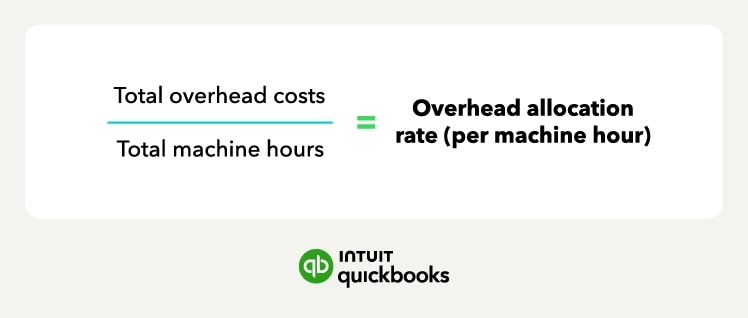
Let's say your monthly overhead is $30,000 and your machines are churning away for a total of 1,500 hours. Your overhead allocation rate would then be $20 for every hour the machines run ($30,000 / 1,500 hours = $20/hour).
This granular view of machine-related overhead can help you pinpoint areas for improvement in production efficiency, equipment maintenance, and even investment in new technology.
Do you have a sprawling retail space or a warehouse bursting at the seams? Allocating overhead based on square footage can be a game-changer. This method essentially assigns overhead costs based on how much space each department or area occupies.
(Department's Square Footage / Total Square Footage) x Total Overhead Costs = Overhead Allocated to Department

Imagine your total overhead is $50,000, your facility is 2,000 square feet, and your production area is 800 square feet. The overhead allocated to production would then be $20,000 ((800 / 2,000) x $50,000 = $20,000).
This spatial perspective on overhead can spark insightful questions: Are you maximizing the use of your space? Are there areas you could optimize or even downsize? Could you generate more revenue per square foot? It can be a powerful tool for strategic space planning and cost optimization.
 Don't just calculate your overhead allocation rate—use it. Analyze the results to identify areas where you can reduce costs, improve efficiency, and make more informed pricing and operational decisions.
To calculate overhead cost per unit, you need to choose an allocation method (e.g., labor hours, machine hours, etc.) and divide your total overhead costs by the total units of that allocation base. For example, if you allocate overhead based on labor hours:
Total Overhead Costs ÷ Total Labor Hours = Overhead Cost per Labor Hour
Then, multiply the overhead cost per labor hour by the number of labor hours required to produce one unit to get the overhead cost per unit.
Keeping a close eye on overhead is essential, but actively lowering those costs can significantly boost your bottom line. While many overhead costs seem fixed, there are often opportunities to trim expenses and improve efficiency. This section explores strategies to reduce your overhead and free up resources for growth and profitability.
Don't be afraid to regularly review your contracts with vendors and suppliers. Negotiating better rates, exploring alternative providers, or bundling services can lead to substantial savings over time. Even small reductions in recurring costs can add up significantly.
When negotiating, be prepared to leverage your loyalty and payment history as bargaining chips. Also, consider consolidating your purchasing with fewer vendors to increase your buying power.
Reducing your environmental impact can also lead to significant overhead savings. Begin by optimizing energy consumption: switch to energy-efficient lighting, optimize heating and cooling systems, and encourage employees to be mindful of energy use. In addition, consider transitioning to digital processes to reduce paper usage, printing costs, and storage needs.
Going paperless reduces overhead and enhances your company's image, potentially attracting environmentally conscious customers.
Technology can be a powerful tool for streamlining operations and reducing overhead. Explore automation options for tasks like accounting, payroll, customer service, and marketing. This can free up employee time for more strategic initiatives and reduce the need for additional staff.
Consider using AI-powered accounting software, such as QuickBooks Online, to automate tasks. With Intuit Intelligence, you can instantly surface expense trends, automate complex reconciliations, and receive real-time insights to help you cut costs and grow with confidence.
Evaluate your workspace and consider whether you're utilizing it effectively. Could you downsize to a smaller office, adopt a remote work model, or implement hot-desking to reduce rent and utility costs?
If downsizing isn't feasible, explore subleasing unused office space to generate additional income and offset your overhead expenses.
Some organizations find it helpful—and sometimes necessary—to split overhead costs into two different subcategories: manufacturing and administrative.
Separating them allows the organization to allocate manufacturing costs to works in progress or finished products. As a result, your business can conduct a more thorough examination of its profitability, giving you more knobs and levers to adjust overhead allocation. Job costing software like QuickBooks can make this process even easier.
For example, administrative costs cannot be easily adjusted without significant changes to the business’s infrastructure (i.e., reducing your workforce). Manufacturing overhead, however, might be adjusted by being more proactive with maintenance to avoid repair costs. Or, you could find a faster way to do things so that machines can consume less power.
Understanding the difference between overhead costs and operating expenses, and tracking them separately, is crucial for a clear picture of your company's financial health.
These two types of costs behave differently and impact distinct areas of your business, from product pricing to overall profitability. Keeping them separate provides the detailed insight needed for accurate accounting, effective budgeting, and informed decision-making.
Companies use cost accounting internally to figure out the true cost of production. That includes every last component that goes into producing the product, freight, labor hours per unit, etc. For total accuracy, some percentage of overhead expense has to go toward each unit of production.
Understanding your true costs gives your business more overhead and helps you figure out where you can save money. It also helps you identify the most profitable products and services, leading to more informed decisions.
When you price your products or services, you consider the cost of inventory or the labor and materials that go into them. Usually, it’s pretty clear what those are. But it would be a mistake to just look at those costs and add markup.
You also have to include your overhead costs in your pricing. Not knowing your overhead costs could result in you pricing your products too low and not making a profit. Or, you might price them too high, resulting in unsold inventory and a hit to your bottom line.
Companies use financial accounting to report externally to shareholders (if your company has them) and tax authorities on the income, expenses, and profitability of the business. Overhead costs appear on the company’s financial statements, specifically on the income statement, where they are deducted from profit.
In a manufacturing business, generally accepted accounting principles (GAAP) require overhead to be included on the balance sheet as part of inventory. It also must be included in the cost of goods sold on the income statement.
Since overhead costs generally have to be paid monthly, you must know your total minimum monthly cost—how much money you need to make just to stay in business. That’s simply because no business can operate for long at this level. It becomes even more important if your business is impacted by factors beyond your control, such as a natural disaster or global pandemic.
While overhead costs are simply part of the cost of doing business, no business can afford to ignore them. Getting a handle on your overhead expenses gives you a real appreciation of your cash flow needs and your overall financial position. It helps you set prices optimally, see where there may be an opportunity to cut costs, and make better business decisions overall.
Accounting software can be a lifesaver when tracking and managing your expenses. This can help you identify areas where you can reduce costs and improve efficiency.
QuickBooks Online, for example, allows you to categorize and monitor your overhead costs, generate reports, and gain valuable insights into your spending patterns.
If you're not ready to commit to a paid plan, free expense tracking software like QuickBooks Free offers a no-cost way to start categorizing your overhead expenses.

Call Sales: 1-800-285-4854