
You could save up to 25% on transaction costs².
Speak with us now to see if you qualify.
Talk to sales 1-800-515-8366
Monday - Friday, 6 AM to 4 PM PT

Table of contents
Table of contents
It's easy to forget to pay an invoice when you’re running a small business and you’re dealing with lots of responsibilities like serving customers and managing staff. But, missed payments can affect your business credit score, incur late fees, and damage relationships with your suppliers and vendors.
If you track your bills by hand through spreadsheets and paper invoices, that makes paying on time much harder. In fact, in the Intuit QuickBooks Small Business Insights survey, manual processing is the top internal reason small businesses pay late.
Managing it with accounting software instead keeps all your invoices in one place, showing you exactly what’s due and when, so you always pay on time. Below, you'll find out step-by-step how to manage your business bills in one place.
Many business owners start by tracking expenses in a basic grid, but as a business scales, these manual files become a liability. A single typo in a spreadsheet can lead to an overpayment or a missed liability that dings your professional reputation. Modern systems allow you to pay business bills through a centralized dashboard where data flows automatically from your bank and your vendors.
The longer you rely on spreadsheets to track bills, the more likely you are to run into these problems:
Here is how those limitations compare with a dedicated bill pay system:
The first step to staying organized is to ensure every bill lands in the same place. If your invoices are scattered across email inboxes, physical mail piles, and glove compartments, you are bound to miss something.
Creating a "digital front door" for your bills ensures that everything is captured the moment it arrives.
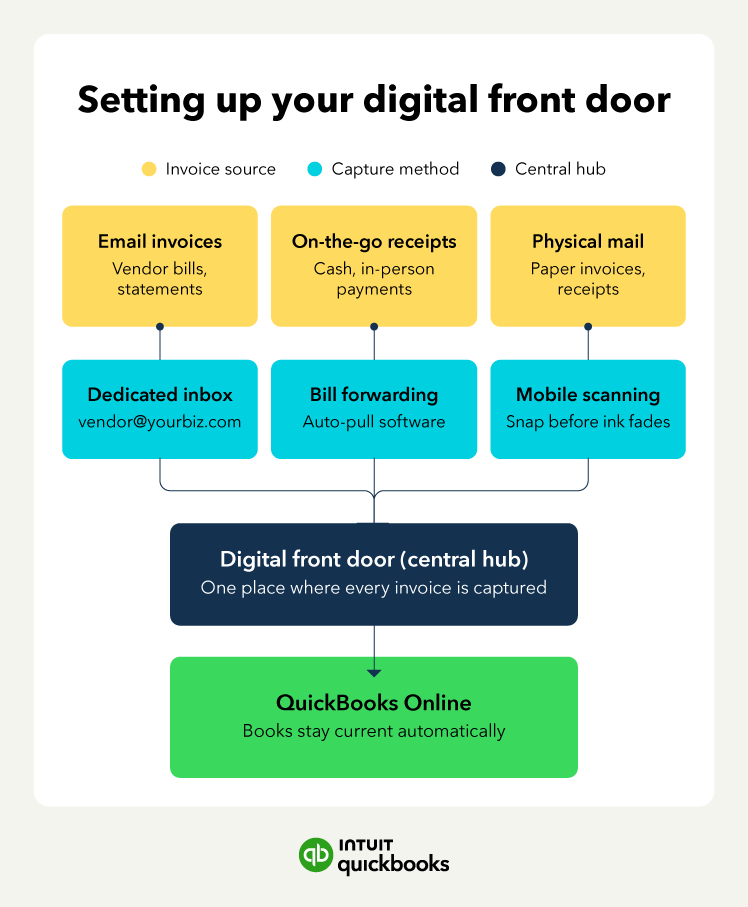
Follow these bookkeeping basics to ensure all your incoming invoices and receipts are close at hand:
Daily bill paying is a productivity killer, while monthly sessions are too infrequent to catch early-pay discounts. The "sweet spot" for most small businesses is a dedicated weekly window. This allows you to pay business bills in batches, which is far more efficient than handling them one by one as they arrive.
Once a week, for 30 minutes, pay your bills. Use a time tracking tool to make sure you don’t spend longer than you need to on these four steps:
Use this same project management logic on as many tasks across your business as possible, like reviewing your profit and loss, to track your performance and save time.

Two top internal reasons small businesses pay invoices late are forgetting (9%) and not having enough time (9%), according to the Intuit QuickBooks Small Business Insights survey. A weekly bill pay routine like the 30-minute power session solves both.
Small businesses use a variety of payment options, depending on the supplier/vendor, the invoice due date, and the size of the bill. Three popular methods include:
Not all bills are created equal. To effectively manage business bills, you must understand which payments are critical for operations and which offer incentives for early action. Strategic prioritization helps you keep your lights on while maximizing your liquid capital.
Decide which bills to pay first based on the effect they have on your cash flow:
Include your discretionary subscriptions like software tools or memberships, and pay everything in this order:
Knowing who to prioritize when making payments and who to ask for short delays are two effective ways of improving your cash flow management.
The era of the paper check is fading, and for good reason. Mailing a check is slow, expensive, and prone to mail fraud. When you pay business bills electronically, you gain a digital paper trail that makes tax season a breeze and keeps your vendors happy with faster funding.
Switch to digital payment methods when settling business bills for these three benefits:
Over half of small businesses already use online payment platforms, according to the Intuit QuickBooks Small Business Insights survey.
If you still rely on paper checks, switching to QuickBooks Bill Pay could save you up to 10 days in processing time per payment.
The most effective way to manage business bills is to let technology do the heavy lifting. Automation means setting the rules so you only have to intervene when something looks wrong. This "management by exception" approach saves hours of manual labor.
Use the smart accounts payable automation features in QuickBooks Online for these three advantages:
Plus, understand how canceled bills affect your business bank account. For example, if you cancel a $300 monthly software plan but do not update your budget, your projected balance may be $300 lower than your actual balance. Leaving old payments records in your books makes cash flow harder to read going forward.

Your accounts payable data is a goldmine of information. By looking at who you pay and when, you can negotiate better terms with vendors and identify areas where your business might be overspending. Regular reporting turns a chore into a strategic advantage.
Run these accounts payable reports to know exactly what you owe, to whom, and when:
Read these reports alongside your general financial statements so you get the complete picture of where your company is spending its money.
Without a reliable system for organizing and managing your business bills, you risk the good relationships you’ve built up with vendors and suppliers over the years.
That’s because they’re more likely to have to chase you to pay their invoices. Plus, at month-end or at tax time, you spend hours reconciling your books and getting your return ready.
QuickBooks Bill Pay is included with every QuickBooks Online plan. Automate accounts payable and manage bills, vendor records, 1099s, and financial reports in one place.
If you're just starting out, QuickBooks Free can help you get a handle on bills and cash flow before you're ready to upgrade.

Call Sales: 1-800-285-4854