- Start Your BusinessStart Your Business
- Starting a BusinessThe tools and resources you need to get your new business idea off the ground.
- PaymentsEverything you need to start accepting payments for your business.
- Funding & CapitalResources to help you fund your small business.
- Small Business StoriesCelebrating the stories and successes of real small business owners.
- Self-EmployedThe tools and resources you need to run your own business with confidence.
- Run Your BusinessRun Your Business
- Running a BusinessThe tools and resources you need to run your business successfully.
- AccountingAccounting and bookkeeping basics you need to run and grow your business.
- Cash FlowTax and bookkeeping basics you need to run and grow your business.
- PayrollPayroll essentials you need to run your business.
- TaxesTax basics you need to stay compliant and run your business.
- EmployeesEverything you need to know about managing and retaining employees.
- Grow Your BusinessGrow Your Business
- Growing a BusinessThe tools and resources you need to take your business to the next level.
- Sales & MarketingSpread the word: What you need to know about marketing your small business.
- FundingHow to find funding and capital for your new or growing business.
- Midsize BusinessesThe tools and resources you need to manage your mid-sized business.
- Enterprise Suite BlogThe tools and resources you need to grow your own business with confidence.
- E-CommerceHow to start and run a successful e-commerce business.
- TaxesTaxes
- How to fill out a 1099-NEC formLearn how to fill out and file 1099-NEC forms for independent contractors and freelancers.
- How to file small business taxesLearn how to navigate tax season with confidence and minimize your tax liability with this guide.
- Small business 1099: What you need to know for 2025Navigate the complexities of small business 1099 forms and filings with our comprehensive guide.
- 13 documents to give your accountant for small business taxesYour accountant will need these documents to file your small business taxes successfully.
- What's NewWhat's New
- NewsBrowse the latest news, press releases, and reports from QuickBooks.
- AI Resource HubFind the latest on Artificial Intelligence.
- Small Business DataThe latest research and insights for Small Businesses from QuickBooks.
- Small Business StoriesCelebrating the stories and successes of real small business owners.
- Holiday SuccessEverything you need to thrive during your business's busiest seasons.
- AI InnovationsBrowse the latest AI innovations in QuickBooks on the Intuit platform.
- ToolsTools
- All ToolsFree accounting tools and templates to speed up and simplify your workflow.
- AI-Powered Invoice GeneratorTry out this free invoice generator to create an invoice online using Intuit Intelligence.
- Payment Cost CalculatorFind out how much you could save by switching to QuickBooks Payments.
- Paycheck CalculatorAccurately estimate pay for all your employees.










As an e-commerce business owner, you know that you need to be on Amazon. When 66% of customers start their search for new products on that platform—even ahead of traditional search engines—having your products available on Amazon can help you reach a much wider audience than you would through your own site alone.
But, here’s the thing: You aren’t the only one who knows that. There are an estimated 6.3 million total Amazon sellers, and 1.5 million of them are active right this minute.
That means there’s great access and variety for customers, but a lot of competition for you as an ecommerce retailer.
That leads most sellers to this burning question: How can you build brand awareness, get your products in front of more shoppers, and ultimately make more sales?
From optimizing your product listings to target search terms to collecting more customer reviews, there are a number of strategies you can use to boost your visibility. But, if you’re looking for another way to get your products out there, it’s hard to overstate the importance of Amazon advertising.
What is Amazon advertising?
Amazon advertising is exactly what it sounds like: retailers pay money to get their products and brand in front of more shoppers.
They will create an ad campaign using Amazon’s advertising platform, with the goal of having their specific products show up for more customers than they would organically.
Since this advertising involves Amazon in some way (that doesn’t necessarily mean that the advertising itself has to happen on Amazon or even for Amazon products—which you’ll see a little later), you’ll also hear this referred to as “Amazon ads” or “Amazon marketing.”
Types of Amazon ads
The concept behind Amazon advertising is pretty straightforward, as it follows the model of pretty much all of the other digital advertising platforms.
However, since Amazon is such a huge marketplace, there’s understandably more complexity to their advertising business—particularly when it comes to the different types of Amazon ads that are available to sellers. Here are some of the most common Amazon ad types, according to Amazon itself:
1. Sponsored display ads
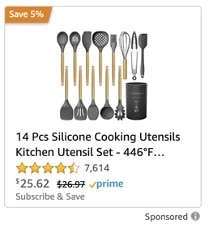
A sponsored display ad is an advertisement for a specific product that most frequently shows up in the sidebar of a website. You’ll see them in the sidebar on Amazon (usually under the section for adding something to your cart on a product page), but you can also see Amazon sponsored display ads in the sidebar of other sites.
When a shopper clicks the advertisement, they’re brought directly to the product detail page on Amazon where they can learn more and make a purchase.
2. Sponsored products
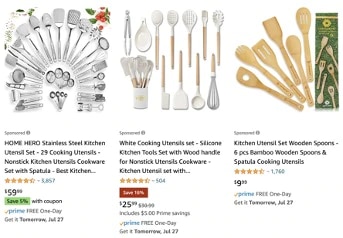
When you’ve searched for a product on Amazon, you’ve likely noticed that some of the earliest search results are noted as “sponsored.” Those are Amazon sponsored product ads.
With this type of Amazon ad, you’ll promote a specific product listing to be displayed in search results and on product pages. Like most Amazon advertisements, these are pay-per-click (PPC) advertisements, which means you’ll pay based on the number of shoppers who click on your sponsored product.
3. Sponsored brands
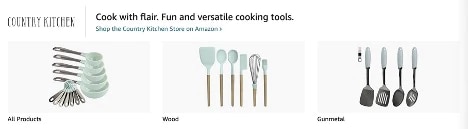
Rather than promoting one specific product, advertising as a sponsored brand (previously known as a headline search ad) on Amazon helps you boost brand awareness and get eyeballs on numerous products at once. You can also include your logo and a customized headline.
If you choose to do a sponsored brand advertisement, shoppers will see your brand information at the top of a relevant search results page on Amazon. From there, they can click through to shop your Amazon store and see all of your products.
4. Audio ads
The above types of Amazon ads cover the majority of the ones you’ll see on the Amazon marketplace itself. But they certainly aren’t the only option for retailers.
Audio ads are an audio-only advertisement (think like a traditional radio ad) that will play during ad breaks for people who listen to Amazon Music on mobile, desktop, and Alexa-enabled devices (like Echo and Fire TV).
If you create an audio ad, listeners will hear information about your brand and your products—as well as where they should go to learn more and make a purchase. You don’t need to sell on Amazon to use this type of advertising. You can also create an Amazon audio ad that pushes people directly to your own e-commerce site.
5. Video ads
Finally, video ads give retailers an opportunity to highlight their brands and products using multimedia advertisements. Amazon video ads fall into two categories:
- Over-the-top (OTT) video ads: Advertisements delivered to viewers before, during, or after OTT content—meaning, video content that is delivered via a video streaming service.
- Online video ads: Advertisements that appear in both in-stream and out-stream formats across browsers and apps.
Amazon has a number of creative requirements and other guidelines for video ads that are worth checking out to ensure your video advertisement is compliant and as effective as possible.
That scratches the surface on the primary types of ads retailers use on Amazon. However, the platform continues to explore new advertising avenues to both support sellers and grow their advertising business, which is a major revenue generator (Amazon ads bring in an estimated $7 billion per quarter).
That means there are other, newer options like Amazon Live (with shoppable livestreams) and the creation of curated posts and images in your brand’s feed (a program that’s currently in beta).
Where to buy Amazon ads
Sellers who decide to leverage Amazon advertising will become familiar with two different advertising platforms where they can invest their ad spend. These are:
- Amazon Seller Central: This Amazon-owned site is where sellers manage every aspect of their Amazon business, including purchasing ads for sponsored products, sponsored brands, and some display ads.
- Amazon DSP: Standing for demand-side platform , this Amazon product makes it easy for sellers to purchase display, video, and audio ads both on and off Amazon. It used to only be available through Amazon’s Managed Services but has since also rolled out a self-service DSP for retailers who want to DIY their advertisements.
Should you advertise on Amazon?
Here’s the short answer: It certainly doesn’t hurt to try. As all of the different types of Amazon ads will show you, Amazon advertising is highly customizable. So, it’s worth testing out to see if it’s effective at increasing sales of your products.
Benefits of Amazon advertising
Need a little more convincing to invest in ads on Amazon? There are a number of benefits to doing so, including:
1. Amazon ads are highly-targeted
Much like with other digital advertising methods, Amazon uses its deep well of data to empower sellers to create targeted ad campaigns. You can deliver advertisements based on a number of different criteria, such as:
- Competitors: Display your advertisement on the product details page for a competitive, high-performing product.
- Complementary products: Display your advertisement on the product details page of a complementary product (like showing your kitchen utensils advertisement on an apron product page).
- Keywords: Display your advertisement in the search results for specific keywords (like “kitchen utensils,” “spatula,” and more).
- Interests: Display your advertisement to shoppers who have expressed an interest in your category of products, based on their previous shopping habits.
2. Amazon ads are affordable
We’ll dig into the details of how much it costs to advertise on Amazon in the next section (along with some actual numbers for how much you can expect to spend). But, for now, take note that Amazon advertising can be surprisingly cost-effective.
The vast majority of Amazon ads use a pay-per-click (PPC) model. This means that you’ll pay based on how many users actually click on your advertisement.
Amazon makes it easy to set a budget (you choose how much you want to spend for a click, as well as your maximum daily ad spend) so you can make sure that your cost-per-click (CPC) performance metric is where you want it to be.
3. Amazon ads are effective
Amazon ads have an undeniably high conversion rate, which represents the percent of clicks on an advertisement that actually turn into sales.
Amazon’s average conversion rate is 9.55%, which is significantly higher than the average conversion rate of other e-commerce websites at just 2.86%.

How much does Amazon advertising cost?
You’re convinced that Amazon advertising is worth trying. But, as a business owner, you’re concerned with the bottom line. How much will you have to spend to see success with Amazon advertising?
Well, that depends. As mentioned earlier, Amazon uses a pay-per-click (PPC) advertising model, which means you won’t actually know how much it costs you until you see how many shoppers clicked on your ad. However, keep in mind that you can easily set a limit to make sure you don’t blow your budget.
Needless to say, the pricing of ads on Amazon can vary greatly. Some small sellers might spend a couple hundred dollars while larger brands can invest millions or even billions in advertising and marketing services that help them hit their desired sales metrics.
If you’re looking for an average cost or a rough idea of how much Amazon advertising will set you back, experts say that most sellers spend an average of $0.81 per click on an advertisement.
To be extra mindful of how much you’re investing in your advertising activities, it’s worth calculating your average advertising cost of sales (ACoS) by dividing your total ad spend by your total sales, with a goal of hitting about 15-20%.
Boost your online business with the right tools
Amazon advertising still isn’t quite as prevalent as some other platforms—Google and Facebook still reign supreme. However, it’s now the third largest digital ad platform in the United States.
What does that mean for you? If you want to increase awareness, win more customers, and make more sales, you need to invest time, energy, and yes, even money into getting your products seen on Amazon. Fortunately, Amazon advertising can help you do just that.
Want to grow your online business even further? See how QuickBooks Commerce can help.
Recommended for you



Explore what you can do with QuickBooks
Explore what you can do with QuickBooks

See profit at a glance


Get expert help
Looking for something else?
Firm of the Future
Topical articles and news from top pros and Intuit product experts.
QuickBooks Support
Get help with QuickBooks. Find articles, video tutorials, and more.
Call Sales: 1-800-285-4854





© 2026 Intuit Inc. All rights reserved.
Intuit, QuickBooks, QB, TurboTax, Credit Karma, and Mailchimp are registered trademarks of Intuit Inc.
Money movement services are provided by Intuit Payments Inc., licensed as a Money Transmitter by the New York State Department of Financial Services. For details about our money transmission licenses, or for Texas customers with complaints about our service, please click here.
By accessing and using this page you agree to the Website Terms of Service.