
You could save up to 25% on transaction costs².
Speak with us now to see if you qualify.
Talk to sales 1-800-515-8366
Monday - Friday, 6 AM to 4 PM PT

Table of contents
Table of contents
Accounting shows where your business stands today. Finance helps you decide where your business should go next.
Accounting records transactions and prepares financial statements. Finance uses that information to support budgeting, forecasting, and business planning.
Finance and accounting both help businesses make financial decisions, but they do it in different ways. Understanding the differences can help business owners decide what support they need, help students compare career paths, and give anyone curious about the fields a clearer picture of how they work together.
This guide explains how finance and accounting differ, the careers and education they offer, and when each is needed in business.
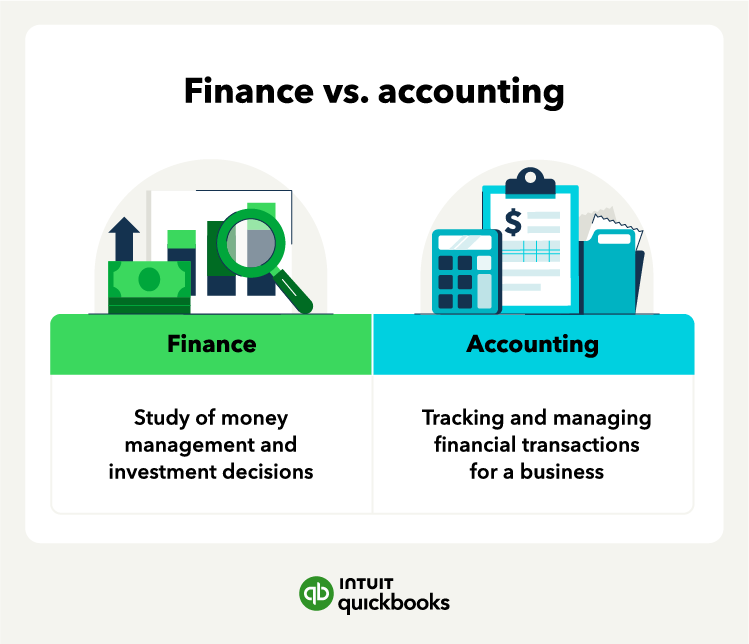
Finance is the study and management of money, investments, and other financial assets. It helps businesses prioritize their financial resources to meet short- and long-term goals.
Finance professionals often focus on:
Accounting is the process of recording, organizing, and reporting a business's financial transactions. It provides an accurate picture of a company's financial health and helps business owners understand how money is coming in, going out, and where it stands today.
Accounting professionals often focus on:
Watch the video: Learn accounting basics, key financial statements, and practical tips for managing your books with QuickBooks Online.

Finance and accounting complement each other. Accounting produces the financial data, and finance puts that data to work building budgets and forecasts, and creating growth plans.
For example: Your accountant tracks last quarter's expenses and records them accurately. Your finance team then uses that data to establish next quarter's budget and plan where to invest. One captures the numbers; the other decides what to do with them.
If you're deciding between a career in finance or accounting, understanding the education requirements can help you choose the path that fits your interests and goals.
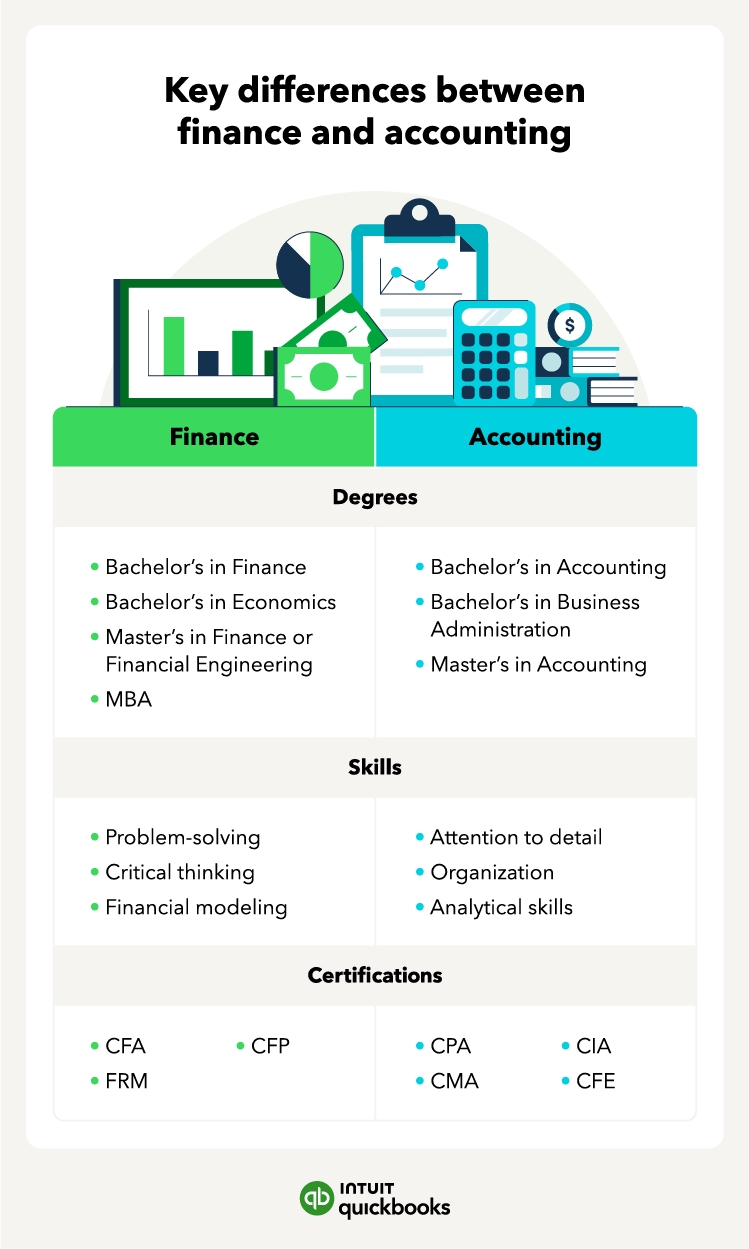
The education requirements for finance and accounting start similarly, but the coursework and career opportunities differ. Here's a side-by-side look at what you can expect.

Finance and accounting require many of the same workplace skills, but each field emphasizes specific strengths.

Some finance and accounting roles require a professional certification, while others don't. The following are the most common certifications for each field.

Pay varies widely by role, experience, and location. The salary figures below are based on recent national median and average wages reported by the U.S. Bureau of Labor Statistics (BLS) for common finance and accounting roles, plus national average salary data from private compensation surveys for senior titles such as controllers and CFOs.
Finance roles (approximate annual pay)
Accounting roles (approximate annual pay)
Whether you should study finance or accounting depends on your interests, skills, and goals.
Both fields offer a variety of career opportunities. Many professionals also move between finance and accounting as they gain experience or their interests change.
The best way to figure out which field is a good fit for you is to explore both.
Most businesses rely on both accounting and finance. In some small businesses, one person may handle both, though each serves its own purpose.
Accounting and finance often use the same financial information, but they apply it in different ways.
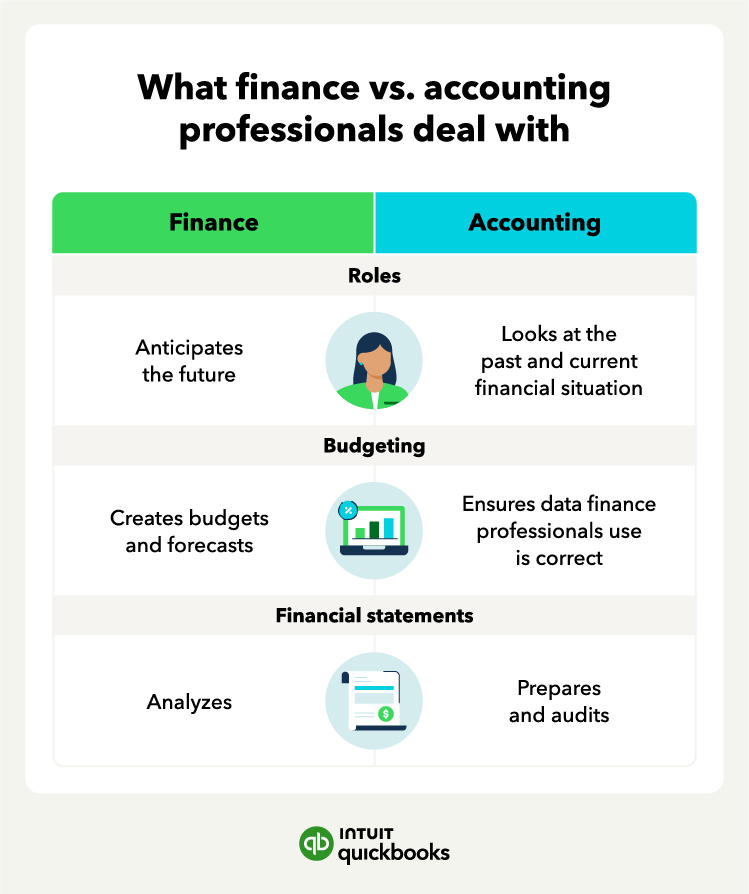
Budgets depend on reliable financial records. Before a business can decide where to invest, hire, or reduce expenses, it needs an accurate picture of current performance.
For example, if accounting reports higher supply costs over the past six months, finance can adjust future budgets or evaluate whether pricing or purchasing strategies need to change.
Accounting creates financial statements. Finance uses them to make business decisions.
Accounting teams prepare the income statement, balance sheet, and cash flow statement by recording and organizing financial transactions. Finance professionals analyze those reports to assess financial performance, create forecasts, and allocate resources.
The answer depends on where your business is today and the financial decisions you're making.
Most businesses start with accounting. Accurate bookkeeping, organized financial records, and tax preparation support day-to-day operations, reporting, and compliance.
As a business grows, finance becomes increasingly important. Business owners often look for additional financial guidance when they're:
Many small businesses don't have separate accounting and finance teams. A bookkeeper, accountant, CPA, or fractional CFO may cover some or all of these responsibilities, depending on the business's needs.
A variety of factors can influence the cost of hiring an accountant or finance professional, including:
Many small businesses begin with bookkeeping or accounting support and add financial planning services as their operations become more complex.
For current salary information by role and location, visit the U.S. Bureau of Labor Statistics Occupational Outlook Handbook and the Occupational Employment and Wage Statistics (OEWS) database.
Finance and accounting are essential to how businesses operate. Understanding each role can help you evaluate career opportunities, work more effectively with financial professionals, or manage your own business.
QuickBooks supports both functions by providing businesses with a single place to manage their financial information. From recording transactions and tracking income and expenses to generating reports and monitoring cash flow, QuickBooks helps businesses stay organized, understand their financial performance, and plan for what's next.
Ready to simplify your financial management? Explore QuickBooks accounting software to keep your books organized and gain a clearer view of your business finances.

Call Sales: 1-800-285-4854