
You could save up to 25% on transaction costs².
Speak with us now to see if you qualify.
Talk to sales 1-800-515-8366
Monday - Friday, 6 AM to 4 PM PT

Table of contents
Table of contents
If you're starting a business or thinking about restructuring, you’ve likely run into the LLC vs. S-corp question. The choice affects how you're taxed, how your personal assets are protected, and how your business grows.
Many new business owners default to a sole proprietorship because it feels simple. But that simplicity comes with risk, leaving you personally responsible for business debts and legal claims.
Forming an LLC creates a separate legal entity and adds liability protection. Once that legal entity is created, you can elect S-corp status as one of your options for federal taxation. From there, the differences come down to taxes, ownership rules, and administrative requirements. The right option depends on your profitability, growth plans, and how much complexity you're willing to manage.
This guide compares S-corps vs. LLCs, explains tax implications, and helps you decide what’s best for your business.
Before getting into the details, here's a side-by-side look at how these two structures compare across the most important factors.

A Limited Liability Company (LLC) is a business structure that combines personal liability protection with operational flexibility. It’s a popular option for small business owners who want legal protection without the complexity of a corporation.
An LLC offers unique benefits that make it a popular choice for business owners.

An S corporation (S-corp) is not a separate type of business entity. It’s a federal tax election available to eligible LLCs and corporations. To choose S-corp status, you must first form a corporation or LLC and then file Form 2553 with the IRS.
To qualify for S-corp status, your business must:
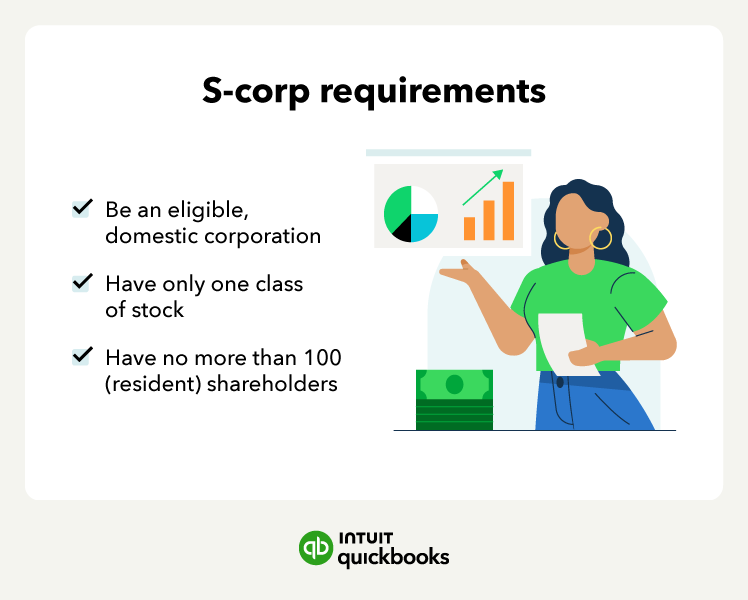
S-corps have a few characteristics that set them apart from other business structures:
How QuickBooks helps S-corp owners: QuickBooks Payroll makes it easier to run payroll, track salaries and distributions, calculate payroll taxes, and maintain detailed financial records to support IRS compliance.
While both LLCs and S-corps offer pass-through taxation, they have distinct differences in ownership structure, administrative requirements, and how they handle self-employment taxes. Below is a breakdown of how the two differ.
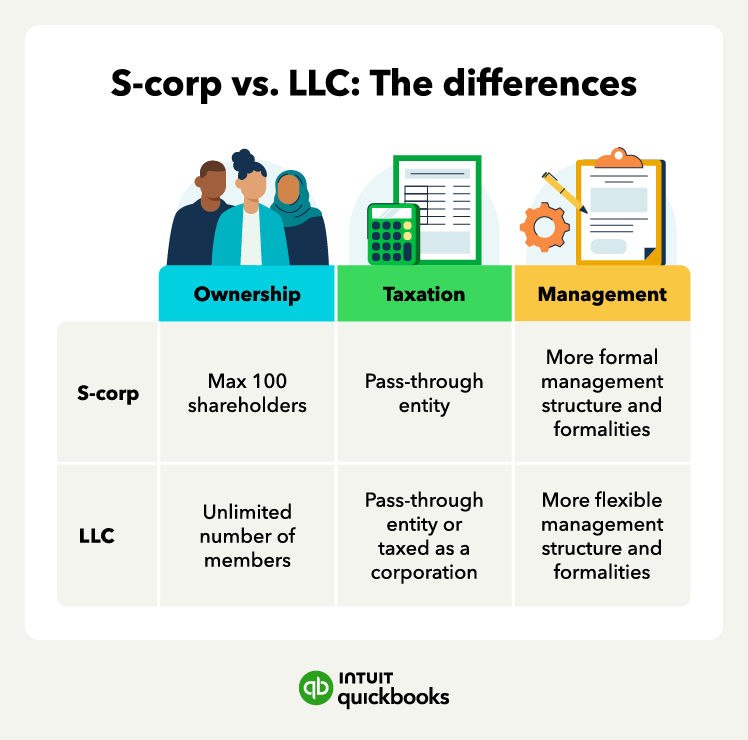
LLCs have no ownership restrictions. S-corps are capped at 100 individual shareholders who must be US citizens or qualifying residents—making it harder to bring in a wide range of investors.
Both structures use pass-through taxation, but how self-employment taxes are handled differs significantly. LLC members typically pay self-employment tax on all business profits. S-corp owners pay payroll taxes only on their salaries. Distributions are not subject to that tax, which can reduce the overall tax burden for high-earning owners.
LLCs offer flexible, informal management. S-corps require a traditional corporate structure: a board of directors, officer roles, shareholder meetings, and documented minutes. These requirements add administrative overhead that LLCs don't have.
S-corps can project a more established image to certain investors and lenders, thanks to their formal structure. LLCs, however, are often more attractive to a broader range of investors because they allow more flexible ownership and profit-sharing arrangements.
For many small business owners, the tax question is the deciding factor.
LLC members pay self-employment tax (currently 15.3% on net earnings up to the Social Security wage base, then 2.9% above that) on all business profits. Self-employment taxes replace payroll taxes for self-employed individuals. If your business earns $150,000 in net profit, that's a significant self-employment tax bill.
S-corp owners split their earnings between a salary and distributions. The salary is subject to payroll taxes; distributions are not. So if you earn $150,000 and pay yourself a reasonable salary of $80,000, only that $80,000 is subject to payroll taxes—potentially saving thousands per year.
Example: A business owner with $150,000 in net profit taking an $80,000 salary as an S-corp, could save roughly $10,000 or more in self-employment taxes compared to an LLC, depending on their situation. These savings must be weighed against the added cost of payroll administration, annual filings, and potential accounting fees.
The IRS requires that S-corp owner-employees receive "reasonable compensation" for their services. Underpaying yourself to minimize taxes is a red flag for audits. Work with a tax professional to determine what reasonable looks like for your role and industry.
S-corp status tends to make the most financial sense once your business is consistently profitable—typically when net income exceeds $40,000 to $50,000 per year, though this varies based on your salary requirements and state tax rules.
A few other factors worth weighing:
Yes—and this is one of the most flexible aspects of the US tax code. An LLC can elect to be taxed as an S-corp by filing Form 2553, without changing its legal structure. The business continues to operate as an LLC under state law but is treated as an S-corp for federal tax purposes.
This approach lets you keep the operational simplicity of an LLC while potentially accessing the payroll tax savings of an S-corp. It's a common strategy for single-member LLCs and small partnerships that have grown beyond a certain income threshold.
One consideration: You'll still need to meet all IRS S-corp requirements, including the reasonable salary rule and ownership limits. The LLC's operating agreement may also need to be reviewed to ensure it's compatible with S-corp tax treatment.
Before deciding on a structure, compare the benefits and drawbacks of an LLC and an S-corp.
LLCs are often the go-to choice for business owners who want legal protection without adding complexity too early.
As profits increase, the LLC tax structure can become less efficient.
When profits are stable and growing, the S-corp election may offer advantages.
The potential tax savings come with added responsibilities and costs.
There's no one-size-fits-all answer here. The right structure depends on where your business is today and where you want it to go. Ask yourself:
If most of these apply to you, an LLC may be the better fit:
If most of these apply, you may want to consider S-corp status:
If you want operational simplicity with potential tax savings, an LLC taxed as an S-corp may offer a middle ground.
Establishing a business structure is one of the most important early decisions you'll make. Both S-corps and LLCs provide liability protection and pass-through taxation (LLCs by default, S-corps by election). The liability protection provided by an S-corp arises from the underlying LLC or C-corporation. These are two major advantages over operating as a sole proprietor. The structure you choose also signals professionalism to investors, lenders, and partners.
But structure alone doesn’t keep your business on track. Staying organized—tracking income, running payroll correctly, separating owner pay, and keeping clean records—is what protects your time, your cash flow, and your compliance.
That’s where QuickBooks comes in. QuickBooks is bookkeeping and accounting software designed to support your business—no matter your structure.
See where your money is going, monitor cash flow, and run profit and loss reports without digging through spreadsheets.
Record member draws, shareholder distributions, and owner contributions properly so your books stay clean.
If you elect S-corp status, QuickBooks Payroll helps you pay yourself a salary, calculate payroll taxes, and handle required filings.
Use accurate financial reports to estimate payments and avoid last-minute surprises.
Organized books make tax prep faster and reduce year-end back-and-forth.
Clean books also make it easier to revisit your structure as your income grows. It’s common to start as an LLC and move to S-corp status later, when income is consistent enough to support payroll and compliance costs.
Before making a final decision, consult a qualified tax professional or business attorney. Your situation may require specific guidance.
When you're ready, set up your books with QuickBooks and keep your business compliant, organized, and ready to grow—regardless of which structure you choose.
If you plan to seek funding from investors, being positioned as an S corporation or an LLC can help. Many investors won’t fund a business that doesn’t operate under a formal business structure.
Knowing the difference between an S-corp vs. LLC can help you decide which business structure works best for you and offers benefits that align with your goals.
However, establishing a formal business structure is only one of the first steps to building a successful business. To confidently focus on running your business, get your finances and taxes organized with accounting software like QuickBooks.
An LLC taxed as an S-corp uses pass-through taxation, so profits flow to your personal return. A C corporation pays corporate income tax first, and dividends are taxed again at the shareholder level—that's double taxation.
Savings depend on your net profit and the salary you set. Generally, the higher your income above a reasonable salary threshold, the greater the potential savings—but you'll want to run the numbers with a tax professional to account for your state and business circumstances.
Yes. You can file Form 2553 to elect S-corp tax status at any point, provided you meet the IRS eligibility requirements. Many business owners start as an LLC and make the switch once income justifies the added structure.
LLC members typically receive distributions based on their ownership percentage, as outlined in the operating agreement. S-corp shareholders who work in the business must receive a reasonable salary, with any additional profit taken as distributions.
Yes. QuickBooks supports both LLCs and S-corps, including payroll processing for S-corp owner-employees, member draw tracking for LLCs, and tax reporting for both structures.

Call Sales: 1-800-285-4854