

BLACK FRIDAY SALE  
70% OFF 
QuickBooks
for 3 months  Ends 11/30
QuickBooks Blog
A person sitting at a desk with a laptop computer.
accounting

What is cash basis accounting? Definition and examples


What is cash basis accounting? Cash basis accounting is an accounting method that records revenues and expenses when businesses receive or pay cash instead of when they incur them.


Choosing the right accounting method is one of the most important decisions a small business owner can make. For many, cash basis accounting offers a simple and effective way to track income and expenses while maintaining a clear picture of their financial health. 

With more than half of accountants saying that rising prices are squeezing small businesses, finding the tools and methods to model your finances accurately is more important than ever. With the help of an AI accounting agent, cash basis accounting is simple—an agent can track transactions for you, automatically categorizing income as it's received and expenses as they're paid out. 

But how do you know if this method aligns with your needs? Cash method accounting focuses on when money actually enters or leaves your account, making it ideal for small businesses with straightforward transactions. Learn more about all things cash basis accounting here.

How does cash basis accounting work?

Who should use cash basis accounting?

Cash basis of accounting examples

Advantages of cash basis accounting

Disadvantages of cash basis accounting
How to implement cash basis accounting

Streamline your accounting and save time

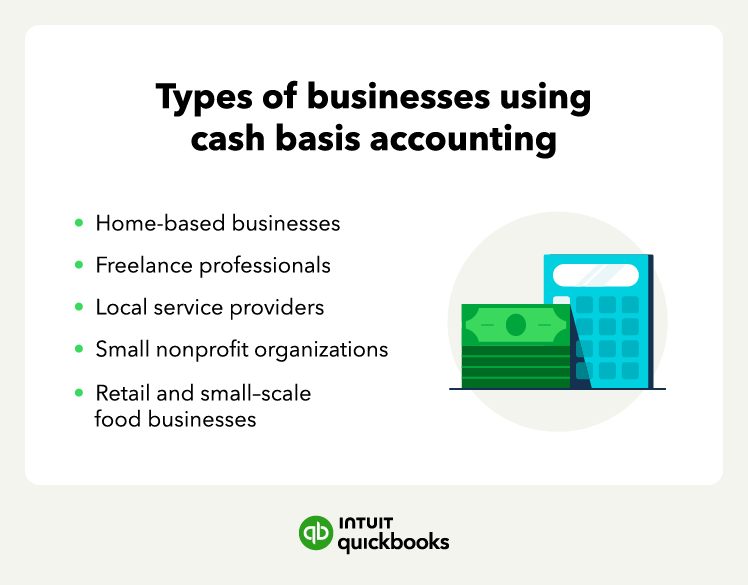
Types of businesses using cash basis accounting.

How does cash basis accounting work?

Cash basis accounting is an accounting method that records and tracks financial information by the actual flow of cash in and out of a business. In other words, it only records income when you receive or pay cash. 

The cash basis of accounting is easier to understand than other accounting methods because it focuses on cash transactions only. It also requires fewer journal entries in your accounting ledger.

Who should use cash basis accounting?

Cash basis accounting is a great fit for small businesses, sole proprietorships, startups, and self-employed individuals, because such businesses generally handle simpler financial transactions and don’t have to worry about things like extensive inventory or outstanding invoices. 

If you value simplicity in accounting, this method can be a lifesaver (especially if you don’t have a ton of accounting knowledge).

In essence, cash basis accounting focuses on actual cash flow—when money comes in and when it goes out. This gives you a clear, immediate picture of your financial situation, which is crucial for small businesses that need to keep a close eye on their funds. 

Plus, there’s a potential tax advantage. Since income is only reported when you receive it and expenses when you pay them, you might be able to defer some tax liabilities to the next year. That’s a win-win for cash flow management and tax planning.


note icon When considering cash basis accounting, think about how stable and steady your income flows are, as this will have a major impact on whether this method makes sense for you.


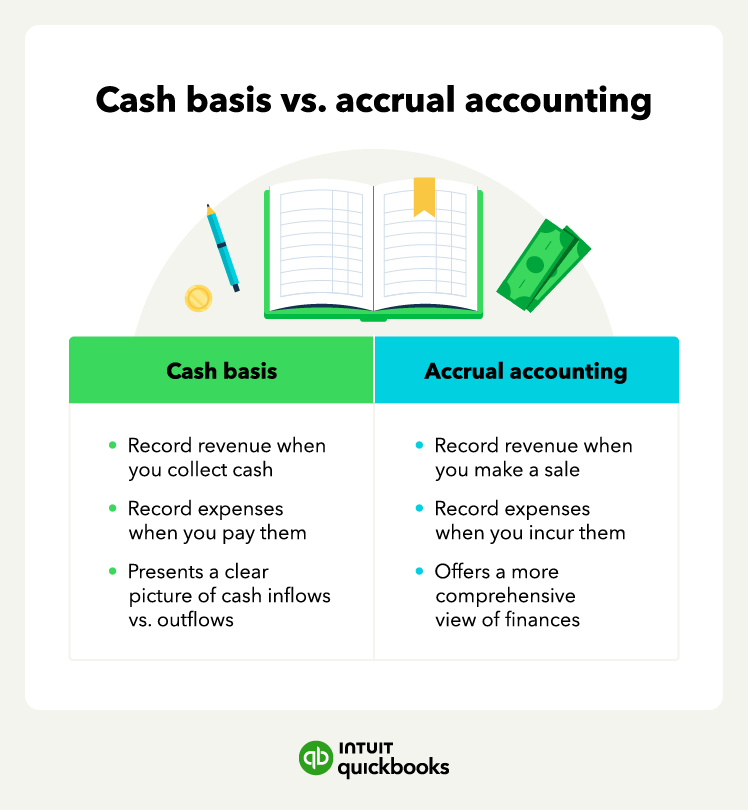
An illustration comparing cash basis vs. accrual accounting.

Should you choose cash basis vs. accrual accounting?

When it comes to choosing between cash basis and accrual accounting, there are many factors to consider. Cash basis accounting is simpler to understand and requires fewer journal entries. If you have a rather simple business with only minor fluctuations in cash flow, then cash basis accounting may work well. 

Accrual accounting records income or expenses as soon as they are incurred, regardless of when payment is made or received, and this can provide a more accurate picture of the company’s financial health. An accrual-based system may better meet your needs if you have inventory, accounts payable, or need more detailed financial information.

Note that corporations with average annual revenues of over $26 million for the previous three tax years must use accrual accounting.

Bring together all your financial, payroll, HR, marketing, and cash flow tools in one place with Intuit Enterprise Suite.

When should you not choose cash basis accounting?

While cash basis accounting has its perks, it’s not the right choice for everyone. For starters, it doesn’t give you an accurate picture of long-term profitability or overall financial health. If you’re running a business seeking financing or investment, lenders and investors will likely expect accrual-based records instead.

Another big drawback? It’s not compliant with Generally Accepted Accounting Principles (GAAP), which is often a requirement for larger companies. If your business deals with complex operations—like managing inventory or revenues over $26 million—you’ll need to stick with accrual accounting. In these cases, cash basis accounting simply won’t cut it.


note icon As your revenues, inventory, and business complexity grow, reevaluate your accounting methods and switch to something more comprehensive when the time is right.


Cash basis of accounting examples

An example of cash basis accounting would be a small retail store that purchases products from a supplier. The store would recognize the expense only once the product payment has been made rather than when it receives the goods.

Another example of cash basis accounting would be a service-based business that provides services to its customers on credit terms. In this case, the income would only be recognized once payment has been received from the customer. 

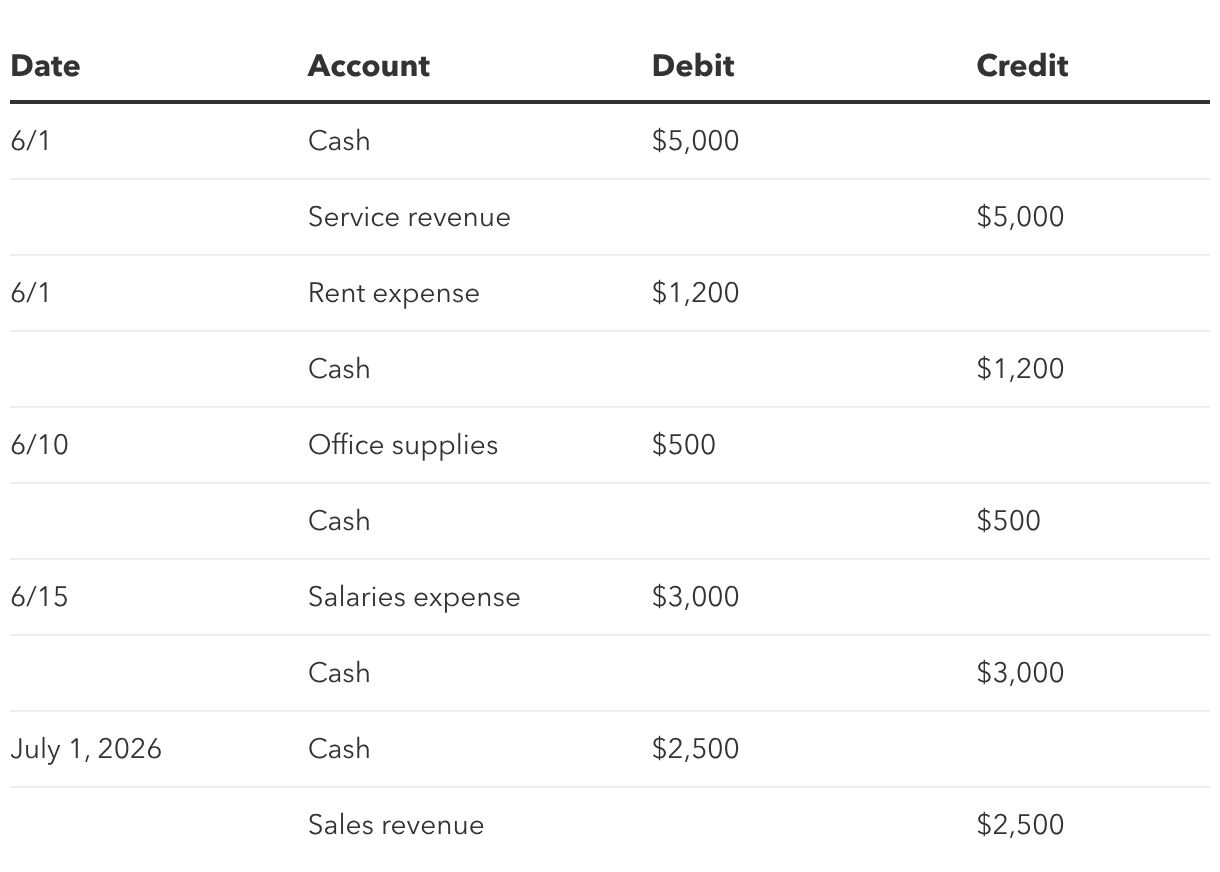
Or consider the following transactions for your business: 

  1. You receive a $5,000 payment from a client for services on June 1.
  2. You also pay office rent of $1,200 on June 1.
  3. Then you purchase office supplies worth $500 using cash on June 10.
  4. A few days later, you pay $3,000 in salaries to employees on June 15.
  5. You then collect $2,500 for a customer sale on July 1.

Here’s how the accounting journal entries would look in the accounting books:

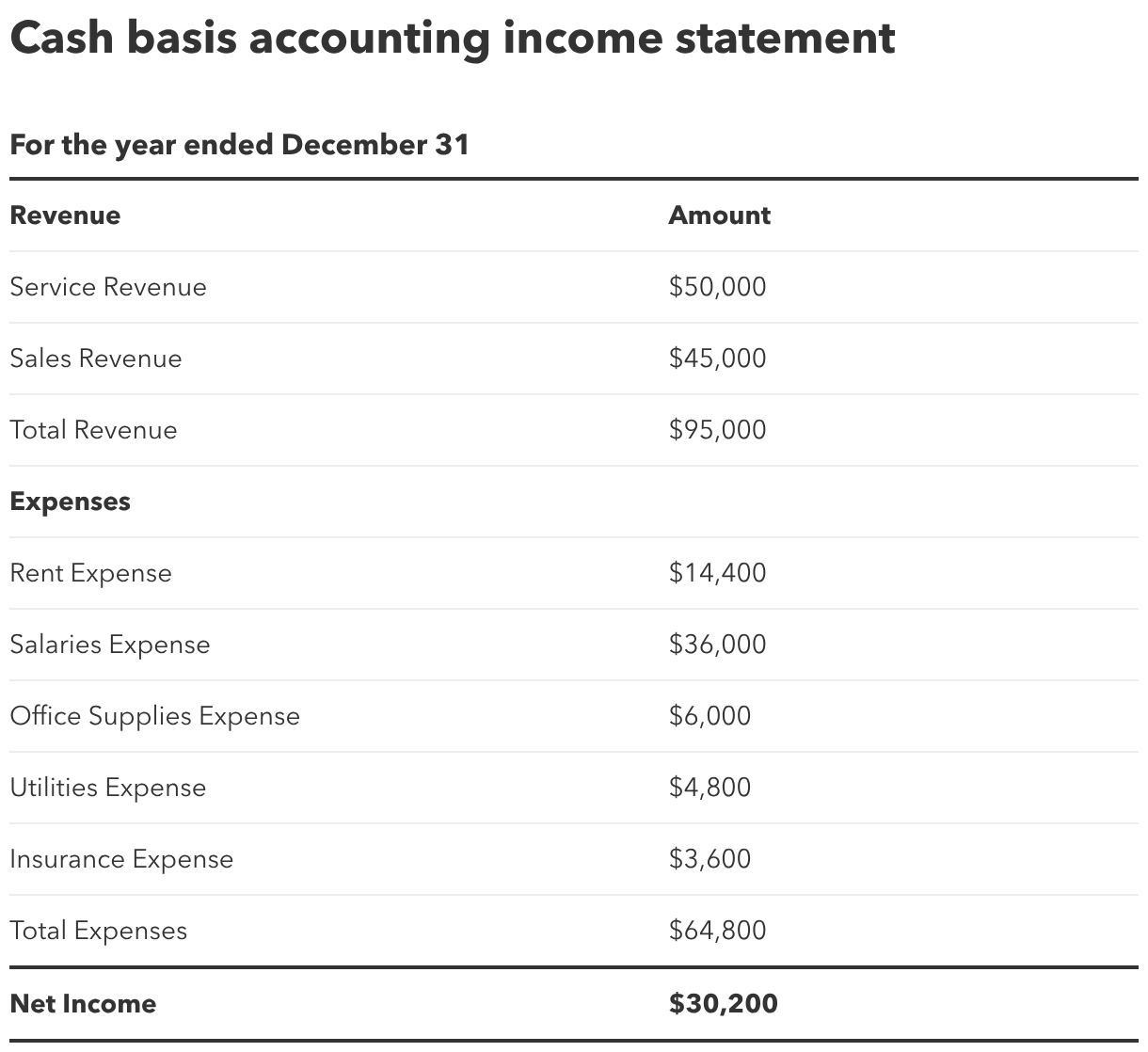
Also note that companies using the cash basis of accounting will have simpler financial statements. For example, here’s a cash basis income statement:

Revenue and expenses will only appear on a cash basis income statement after money exchanges hands. The balance sheet includes assets, liabilities, and equity but not inventory, payables, or receivables. Here’s an example:

And finally, the cash flow statement uses cash basis accounting—even if you use accrual accounting. Here’s what the cash flow statement looks like for our example company:

Note that the net income from the income statement carries over to the cash flow statement, and the cash at the end of the year on the cash flow statement matches the cash figure on the balance sheet.

Introducing Intuit Assist

Get paid 5 days faster on average when you send invoice reminders with Intuit Assist, an AI-powered assistant right in QuickBooks.

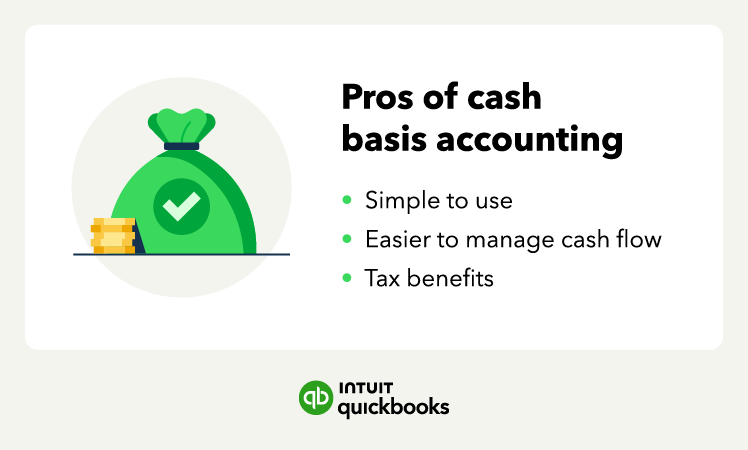
Pros of cash basis accounting.

Advantages of cash basis accounting

Cash basis accounting offers several benefits that make it appealing for small businesses and startups. From its simplicity to its focus on cash flow and potential tax advantages, this method can help business owners manage finances more efficiently while keeping their records straightforward.

Easy to understand 

Cash basis accounting is relatively easy to use and maintain, which makes it an attractive option for small business owners and individuals without extensive accounting knowledge. They can track their financial transactions based on cash inflows and outflows without the need to track accounts receivable or payable.

Focuses on cash flow

Focusing on the actual cash you receive and pay provides a clear picture of a company's cash flow. This clear picture is particularly important for small businesses and startups that must closely monitor their cash position to ensure they have enough funds to cover expenses and support growth. 

Your accounting software can help you with cash flow reporting, such as generating cash flow statements

Offers tax benefits 

Cash basis accounting may provide tax advantages for small businesses. Businesses using cash basis accounting only report income when they receive it and expenses when they pay them. 

This approach can result in deferring tax liabilities, as income recognition may occur in a later tax period, potentially giving the business more time to use those funds for growth or other purposes.

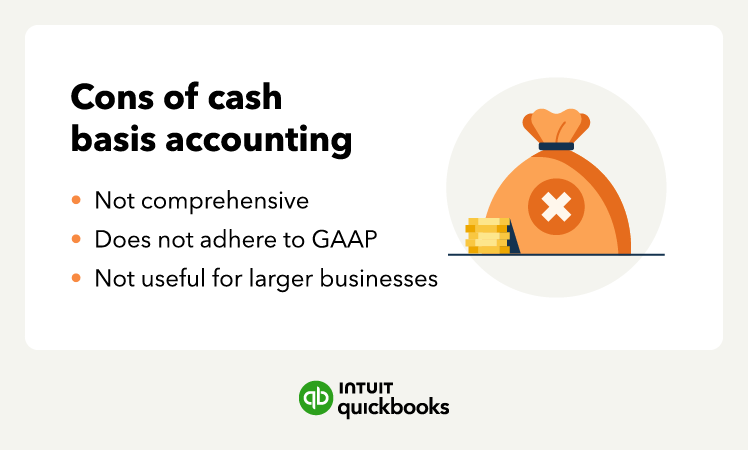
An illustration of the cons of cash basis accounting.

Disadvantages of cash basis accounting 

Cash basis accounting has its advantages, but it also carries some drawbacks. Although tracking expenses on a cash basis makes it easier to understand the immediate financial situation of a business, this system does not provide an accurate picture of long-term profitability or financial health

So, when should you use the cash basis of accounting? Cash basis accounting is usually unsuitable for businesses looking to secure financing or manage investments, as lenders and investors prefer to see accrual basis accounting practices.

Accrual is more comprehensive

Cash basis accounting recognizes revenues when cash is received and expenses when cash is paid. This can lead to an inaccurate representation of a company's financial health, as it does not account for revenue earned but not yet received or expenses incurred but not yet paid. 

As a result, a company's financial statements may not accurately reflect its true financial position compared to the picture painted when an accrual basis is used, meaning that, on the whole, it is difficult to assess its performance.

Not compliant with GAAP 

Cash basis accounting does not adhere to the GAAP, widely recognized accounting standards that govern financial reporting in the US. 

Most businesses are required to follow GAAP, especially if they are publicly traded or seeking investment. Using cash basis accounting can limit a company's ability to attract investors or secure financing, as it may not provide a comprehensive and accurate picture of the business's financial health.

Not suitable for larger companies 

Cash basis accounting is suitable for small businesses with simple transactions and few accounts receivable and payable. However, it may not be the best choice for larger businesses or those with more complex financial transactions. 

Larger companies typically have more intricate financial operations, such as inventory management and long-term contracts, which require accrual accounting to accurately reflect their financial performance. 

Additionally, cash basis accounting makes it challenging to analyze financial trends and make informed decisions about a company's future growth and profitability.

How to implement cash basis accounting

Implementing cash basis accounting is straightforward—just track the actual amount of money you receive and pay out. Let’s break it down with some examples:

  • Income example: Say you made a $10,000 sale, but you’ve only received $5,000 so far. With cash basis accounting, you’d only record the $5,000 you’ve received. The remaining $5,000 won’t show up until it hits your bank account.
  • Expense example: Imagine you purchased goods worth $2,000 but haven’t paid the supplier yet. You wouldn’t record this expense until you make the payment. Once the $2,000 leaves your account, that’s when it gets logged.

This step-by-step approach makes it easy to see exactly where your money is going and when—no guesswork, no confusion, just clear and simple tracking.

An image showing a step-by-step guide to implementing cash basis accounting.

Impact on financial statements and tax preparation

How does cash basis accounting affect your financial statements and taxes? Let’s take a closer look:

  • Income statement: Revenue and expenses only appear after cash has exchanged hands. For example, if you billed a client in December but didn’t receive payment until January, that income won’t show up until January. This tends to be fine for smaller businesses, but it can become burdensome as the number of contracts you track increases.
  • Balance sheet: Typically, you won’t see inventory, payables, or receivables here because these items aren’t tied to actual cash movements. Instead, the focus is on your cash position at any given time.
  • Cash flow statement: This one always uses cash basis accounting since it links your net income to your year-end cash balance.

Cash basis accounting simplifies things when it comes to taxes. You only report the cash you’ve actually received or paid during the tax year, which can help you defer tax liabilities and save time on preparation. For small businesses, this can mean less stress and more control over your finances.


note icon If you find that you’ve grown to a point where you’re getting lots of large, deferred payments, think about whether cash basis accounting still makes sense.


Streamline your accounting and save time

Cash basis accounting is a straightforward and effective method for small businesses, sole proprietorships, and startups that need simplicity and clear cash flow management. 

By focusing on actual money in and out, it provides a real-time snapshot of your financial health while offering potential tax advantages. If you’re ready to streamline your accounting process, explore how accounting software can help you implement this method seamlessly.

Ready to take control of your finances? With tools designed specifically for small business owners, QuickBooks makes managing your books easier than ever. Try our accounting software today and see how it can save you time, reduce stress, and keep your business on track.


Recommended for you

Mail icon
Get the latest to your inbox
No Thanks

Get the latest to your inbox

Relevant resources to help start, run, and grow your business.

By clicking “Submit,” you agree to permit Intuit to contact you regarding QuickBooks and have read and acknowledge our Privacy Statement.

Thanks for subscribing.

Fresh business resources are headed your way!

Looking for something else?

QuickBooks

From big jobs to small tasks, we've got your business covered.

Firm of the Future

Topical articles and news from top pros and Intuit product experts.

QuickBooks Support

Get help with QuickBooks. Find articles, video tutorials, and more.