- Start Your BusinessStart Your Business
- Starting a BusinessThe tools and resources you need to get your new business idea off the ground.
- PaymentsEverything you need to start accepting payments for your business.
- Funding & CapitalResources to help you fund your small business.
- Small Business StoriesCelebrating the stories and successes of real small business owners.
- Self-EmployedThe tools and resources you need to run your own business with confidence.
- Run Your BusinessRun Your Business
- Running a BusinessThe tools and resources you need to run your business successfully.
- AccountingAccounting and bookkeeping basics you need to run and grow your business.
- Cash FlowTax and bookkeeping basics you need to run and grow your business.
- PayrollPayroll essentials you need to run your business.
- TaxesTax basics you need to stay compliant and run your business.
- EmployeesEverything you need to know about managing and retaining employees.
- Grow Your BusinessGrow Your Business
- Growing a BusinessThe tools and resources you need to take your business to the next level.
- Sales & MarketingSpread the word: What you need to know about marketing your small business.
- FundingHow to find funding and capital for your new or growing business.
- Midsize BusinessesThe tools and resources you need to manage your mid-sized business.
- Enterprise Suite BlogThe tools and resources you need to grow your own business with confidence.
- E-CommerceHow to start and run a successful e-commerce business.
- TaxesTaxes
- How to fill out a 1099-NEC formLearn how to fill out and file 1099-NEC forms for independent contractors and freelancers.
- How to file small business taxesLearn how to navigate tax season with confidence and minimize your tax liability with this guide.
- Small business 1099: What you need to know for 2025Navigate the complexities of small business 1099 forms and filings with our comprehensive guide.
- 13 documents to give your accountant for small business taxesYour accountant will need these documents to file your small business taxes successfully.
- What's NewWhat's New
- NewsBrowse the latest news, press releases, and reports from QuickBooks.
- AI Resource HubFind the latest on Artificial Intelligence.
- Small Business DataThe latest research and insights for Small Businesses from QuickBooks.
- Small Business StoriesCelebrating the stories and successes of real small business owners.
- Holiday SuccessEverything you need to thrive during your business's busiest seasons.
- AI InnovationsBrowse the latest AI innovations in QuickBooks on the Intuit platform.
- ToolsTools
- All ToolsFree accounting tools and templates to speed up and simplify your workflow.
- AI-Powered Invoice GeneratorTry out this free invoice generator to create an invoice online using Intuit Intelligence.
- Payment Cost CalculatorFind out how much you could save by switching to QuickBooks Payments.
- Paycheck CalculatorAccurately estimate pay for all your employees.










Table of contents
Table of contents
Key tax updates for filing taxes in 2026:
- Form 1099-DA is a new tax document required for crypto, NFTs, and other digital assets starting in 2025.
- The Section 179 deduction for vehicles and equipment was raised to $2.5 million for the 2025 tax year.
- The IRS is increasingly relying on AI for flagging returns for audit.
Nervously, you open the letter from the IRS, and your heart sinks; it's an audit notice. Depending on the complexity of your business, you may have IRS agents combing through your finances for 6+ months.
No one wants to be in this situation, but is there anything you can do to help prevent an audit? While some audits are random, there are known triggers. In this article, we’ll take a look at what triggers a tax audit, what you can do to avoid the trigger, and what key steps you need to take to decrease your audit risk.

What is a tax audit? How the IRS evaluates your finances in 2026
An audit is an independent, objective examination of your company’s finances to verify accuracy and compliance. Typically, specialized IRS employees, such as revenue agents and tax auditors, conduct these audits.
Starting with your tax return, the IRS will use its Discriminant Function System (DIF) to score your return. The AI-backed system is looking for data discrepancies and deviations from the norm. In 2024, data discrepancies automatically triggered 77.9% of audits and letters from the IRS.
Thanks to the Inflation Reduction Act, signed in 2022, the IRS modernized many of its systems, using AI tools and financial data mining to quickly process returns and flag potential issues. In most cases, the IRS can handle an audit by mail, but it completed 22.1% of 2024 audits in person.

While several different issues can trigger an audit, below we’ll explore the top seven IRS audit triggers:
Trigger 1: Digital payment mismatches
As a sole proprietor, you are likely getting paid by more than one business or client. Sometimes you get a form, sometimes you don’t. For 2026, a Form 1099-K is required only if income exceeds $20,000 and you have 200+ transactions. Reporting apps like PayPal use the information you manually input to generate your 1099-K. If the information is incorrect, your form will be as well.
Double entry is another common issue that involves reporting the same income on your Profit or Loss form as you reported on Form 1099-K (Payment Card and Third Party Network Transactions). This can overly inflate your income, leading to tax overpayments and even the loss of certain deductions and credits. Or it can trigger an audit.
For QuickBooks customers, using bank feeds can automatically categorize 1099-Ks and other income correctly, helping to ensure that what you report on your Schedule C matches the IRS records.

In 2023, the IRS sent more than 1 million audit notifications that resulted from simple math errors.
Trigger 2: The new Form 1099-DA
For Crypto and NFT holders, there is a new specialized form for 2026, Form 1099-DA (Digital Asset Proceeds From Broker Transactions). This form is completed by brokers and reports the sale, disposal, and exchange of these digital assets.
Prior to this change, earnings from the sale of Crypto and NFTs were only self-reported. Now, if you report less than the broker does, or fail to report anything when the IRS has a 1099-DA on file, this will trigger an automatic audit.

Your accounting, your taxes. All in one place.
Save time by seamlessly moving from books to taxes in QuickBooks, then file your return with unlimited expert help and your maximum refund.*
Trigger 3: Contractor and third-party payment gaps
When you have multiple clients or revenue streams, you may end up with many 1099 forms—If you get them at all. The reporting threshold for 2025 is $600, but it increases to $2000 in 2026. This means that for every business or client you work for and earn less than $2,000, you won’t get a tax form. But just because you didn’t get one doesn’t mean you don’t have to report the income.
Any gaps between the income you report and the income the IRS has on record could trigger an audit. The good news for QuickBooks users is that the 1099 Wizard in Bill Pay helps track 1099 payments and ensures everything is accounted for correctly.
Trigger 4: The rounding red flag
When filling out your return, it's important to enter the actual value of business expenses and income. No rounding is allowed.
The IRS system uses algorithms to look for Benford’s Law patterns. This law governs the probability of digits. For example, the probability of a number starting with 1 is roughly 30%, whereas numbers starting with 9 occur less than 5% of the time. Numbers that consistently end in 0 are red flags as well, since legitimate expenses almost always end in irregular numbers (e.g., $432.87).
To prevent unintentional rounding errors and the audit triggers they cause, you need to enter exact numbers. The QuickBooks Receipt Capture feature can pull the exact total, including tax and tip, from an expense receipt and record it directly in your books.

Trigger 5: S-corp distributions
If you are an owner of an S-corp, your salary could trigger an audit. When an owner’s salary is particularly low, or 0, it's a red flag that the company may be doing something shady to avoid payroll taxes.
The IRS sets forth specific guidelines for S-corp pay:
- Pay must be reasonable
- Match what a non-owner would be paid for the same role
- Backed by research and the Bureau of Labor Statistics
One benchmark often used to determine what is reasonable is the Social Security wage base. Because of this, it's worth noting that the wage base increased to $184,500 for 2026.
If you're looking to minimize your payroll taxes and maximize distributions, check out QuickBooks Payroll Integration, which automatically makes the necessary calculations for you.

Maximize deductions for tax savings
Business Tax AI finds and suggests ways to optimize your tax savings year-round, helping you save time, stay compliant, and get every deduction you deserve.
For 2025, taxes filed in 2026, the Social Security wage base was lower at $176,100.
Trigger 6: The 3-out-of-5 rule
The 6th type of trigger revolves around your profit. As a business owner, you can deduct your business expenses, even if it puts you in the red for the year. But you must follow the 3-out-of-5 rule. This means your business can’t have a negative profit for 3 or more out of the last 5 years; this could trigger an audit.
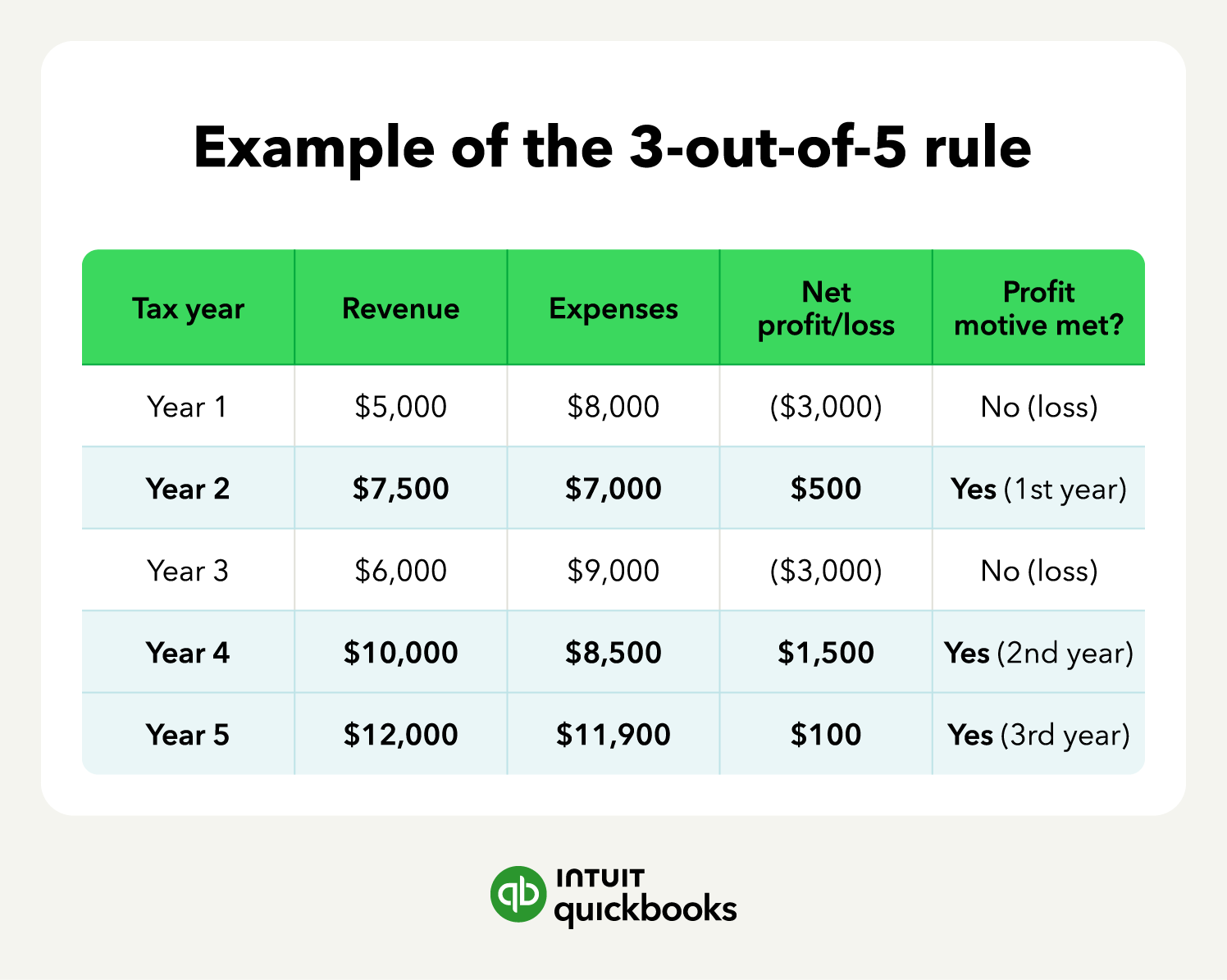
According to the IRS, if your business shows a loss for 3 or more years out of a set 5-year period, it will be reclassified as a hobby. Reclassification is less tax-beneficial because you can’t deduct expenses. Even as new, lucrative deductions are released, the 3-5 rule remains intact.
If you want to keep all your audit documentation prepared and easily accessible, consider using an Audit-Ready folder with business apps and IRS benefits.
Trigger 7: Excessive home office & vehicle claims
The final trigger we’ll discuss is excessive deductions, particularly when claiming against vehicle expenses and home office supplies. The IRS sets fixed rules for how much you can expense for these tax deductions. For example, the home office deduction maxes out at 300 square feet or $1,500. Trying to take more than this could be a red flag that could trigger an audit.
For vehicles and equipment, the cap was recently raised in 2026 to a maximum of 2.5 million, a significant increase. Because of this increase, the IRS may scrutinize the returns that use this deduction more closely. If you're going to max out the deduction for this category, make sure you gather as much evidence as possible. Tools like the QuickBooks Mileage Tracker can provide the proof you need.
For 2026, the standard mileage deduction rate has been set at 72.5 cents per mile.
How to protect yourself against a tax audit
While it is impossible to 100% prevent an audit, you can significantly reduce your risk—and your tax-season stress—by sticking to the fundamentals.
According to recent data, 77% of business owners feel tax stress, with the biggest wave of anxiety (32%) hitting exactly one month before the deadline. This stress is often driven by a "compliance first" mindset: 23% of owners worry more about underpaying and angering the IRS than they do about overpaying and losing business cash (12%).
To protect yourself against a tax audit, stick to these three tax basics:
1. Document meticulously: Every expense needs to have a receipt, and all income must be tracked. Periodically running reports for expenses, sales history, and profitability reports will help you to double-check your numbers. Software like QuickBooks offers Business Financial Reporting powered by a built-in AI Finance Agent to equip you with valuable insights.
2. Report all income: Even small amounts from side gigs or one-time payments like bonuses need to be reported as income, accurately.
3. Use realistic deductions: Don’t stretch the truth by inflating your office space or claiming personal meals as business expenses. You can use QuickBooks to help you record and calculate your deductions.
While 39% of small business owners plan to file early, the majority are racing against the clock. Filing early is one of the easiest ways to reduce the April anxiety that hits 77% of owners.
Find peace of mind come tax time
No one wants to be audited. It’s a stressful process that can cost you a lot of time and money. Thankfully, QuickBooks can help protect you from penalties by automating your accounting and providing detailed reports. You’ll also get guidance through tax prep to ensure you have peace of mind this tax season.
You could save up to 25% on transaction costs².
Speak with us now to see if you qualify.
Talk to sales 1-800-515-8366
Monday - Friday, 6 AM to 4 PM PT
Payroll Compliance

Details on the One Big Beautiful Bill Act and how it affects payroll

USPS changes may affect your postmark date

Mandatory State Paid Family Leave Programs
Accounting

Here’s what’s new in QuickBooks Online for August 2026

The accounting equation: A beginner’s guide with examples
Customer Stories

Why Amborella Organics trusts QuickBooks AI to handle the heavy lifting of a $10M+ vision
At Petal Salon, Amanda Lee Harvey keeps her clients in the pink

Normal Ice Cream saves 7 hours a week on banking admin thanks to QuickBooks Bill Pay

How The Baby Pantry shows up for families in need
Recommended for you




Explore what you can do with QuickBooks
Explore what you can do with QuickBooks

See profit at a glance


Get expert help
Looking for something else?
Firm of the Future
Topical articles and news from top pros and Intuit product experts.
QuickBooks Support
Get help with QuickBooks. Find articles, video tutorials, and more.
Call Sales: 1-800-285-4854





© 2026 Intuit Inc. All rights reserved.
Intuit, QuickBooks, QB, TurboTax, Credit Karma, and Mailchimp are registered trademarks of Intuit Inc.
Money movement services are provided by Intuit Payments Inc., licensed as a Money Transmitter by the New York State Department of Financial Services. For details about our money transmission licenses, or for Texas customers with complaints about our service, please click here.
By accessing and using this page you agree to the Website Terms of Service.