- Start Your BusinessStart Your Business
- Starting a BusinessThe tools and resources you need to get your new business idea off the ground.
- PaymentsEverything you need to start accepting payments for your business.
- Funding & CapitalResources to help you fund your small business.
- Small Business StoriesCelebrating the stories and successes of real small business owners.
- Self-EmployedThe tools and resources you need to run your own business with confidence.
- Run Your BusinessRun Your Business
- Running a BusinessThe tools and resources you need to run your business successfully.
- AccountingAccounting and bookkeeping basics you need to run and grow your business.
- Cash FlowTax and bookkeeping basics you need to run and grow your business.
- PayrollPayroll essentials you need to run your business.
- TaxesTax basics you need to stay compliant and run your business.
- EmployeesEverything you need to know about managing and retaining employees.
- Grow Your BusinessGrow Your Business
- Growing a BusinessThe tools and resources you need to take your business to the next level.
- Sales & MarketingSpread the word: What you need to know about marketing your small business.
- FundingHow to find funding and capital for your new or growing business.
- Midsize BusinessesThe tools and resources you need to manage your mid-sized business.
- Enterprise Suite BlogThe tools and resources you need to grow your own business with confidence.
- E-CommerceHow to start and run a successful e-commerce business.
- TaxesTaxes
- How to fill out a 1099-NEC formLearn how to fill out and file 1099-NEC forms for independent contractors and freelancers.
- How to file small business taxesLearn how to navigate tax season with confidence and minimize your tax liability with this guide.
- Small business 1099: What you need to know for 2025Navigate the complexities of small business 1099 forms and filings with our comprehensive guide.
- 13 documents to give your accountant for small business taxesYour accountant will need these documents to file your small business taxes successfully.
- What's NewWhat's New
- NewsBrowse the latest news, press releases, and reports from QuickBooks.
- AI Resource HubFind the latest on Artificial Intelligence.
- Small Business DataThe latest research and insights for Small Businesses from QuickBooks.
- Small Business StoriesCelebrating the stories and successes of real small business owners.
- Holiday SuccessEverything you need to thrive during your business's busiest seasons.
- AI InnovationsBrowse the latest AI innovations in QuickBooks on the Intuit platform.
- ToolsTools
- All ToolsFree accounting tools and templates to speed up and simplify your workflow.
- AI-Powered Invoice GeneratorTry out this free invoice generator to create an invoice online using Intuit Intelligence.
- Payment Cost CalculatorFind out how much you could save by switching to QuickBooks Payments.
- Paycheck CalculatorAccurately estimate pay for all your employees.









Table of contents
Table of contents
Key takeaways:
- An accounting system is a set of documents and processes businesses use to track, record, and analyze financial data.
- Legacy systems like manual spreadsheets and desktop software put the work on you. Modern cloud-based systems automate routine tasks, sync your data in real time, and free you up to focus on running your business.
- Double-entry accounting is the smarter, more modern standard. Recording each transaction in two accounts catches errors automatically and keeps your books balanced without relying on manual checks.
Your accounting system is the heart of your business. It helps you track expenses and manage invoices—keeping you on track with managing your cash flow. Yet, without accurate accounting data, businesses may struggle to make informed decisions.
According to a recent QuickBooks survey, 98% of accounting professionals now leverage AI to help clients and their businesses, underscoring how essential smarter tools have become.
But what exactly is an accounting system, and how do you use one? Let’s dive into the definition of an accounting system, its types, and how to make the most of yours.

Processes of an accounting system
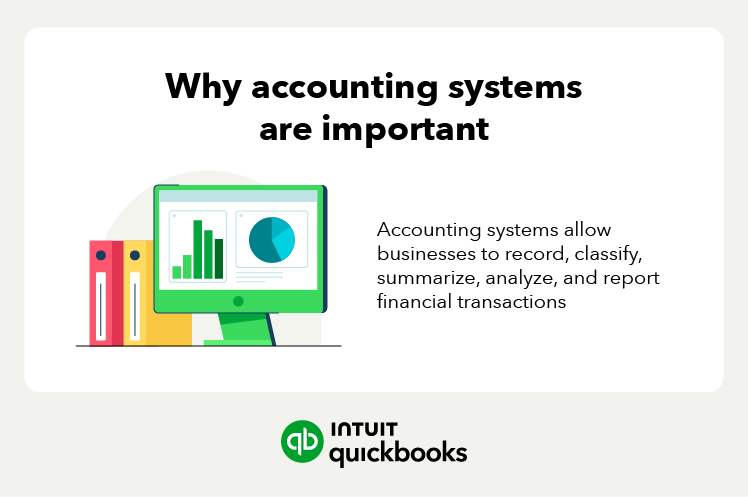
An accounting system tracks and records financial data, generates reports, and analyzes that data to help you make informed decisions. This process typically involves entering information, like sales invoices and receipts, into the accounting system, which stores it in a database.
Before diving into the steps, let's walk through the accounting systems typically use one of two methods:
- Cash-based accounting records income and expenses only when money changes hands. This method is straightforward and commonly used by sole proprietors and small businesses that don’t need to track complex transactions.
- Accrual-based accounting, records revenue and expenses when they’re earned or incurred (not when the cash is received or paid). This method provides a more complete picture of your company’s financial health, especially useful if you invoice customers or manage inventory.

To avoid confusion when classifying transactions later, use consistent naming for your categories (like utilities or office supplies). QuickBooks Intuit Inteligence can auto-categorize transactions for you.
Advanced systems can then generate reports such as balance sheets and income statements—and you can also create custom financial reports.
There are five key processes in an accounting system:
- Recording: The first step in an accounting system is recording financial transactions like sales, expenses, equipment purchases, loans, and asset sales.
- Classifying: The second process is the classification of the transactions. With this, you will categorize the transactions using categories like revenue, expenses, assets, and liabilities.
- Summarizing: The third step in the accounting system process is to summarize the transactions, usually in the form of financial statements. Key financial statements include the balance sheet, cash flow statement, and income statement.
- Analyzing: After summarizing the transactions and creating financial statements, it’s time to analyze these reports. Business owners will assess the company's performance and look for any problem areas or ways to improve their decision-making.
- Financial reporting: The last part of the process is financial reporting. You'll send financial info, such as financial statements and analyses, to relevant stakeholders. A company's key stakeholders may include creditors, lenders, management, or tax regulators.

The processes, however, can be easier depending on whether you use single- or double-entry accounting systems.
Single-entry vs. double-entry accounting systems
Single-entry and systems are the two most common types of accounting systems.
Single-entry accounting is simpler, as it only includes transactions on one side of the ledger. That is, you only book a debit or a credit. This system is especially useful for small businesses or individuals who don’t need to track complex financial records.
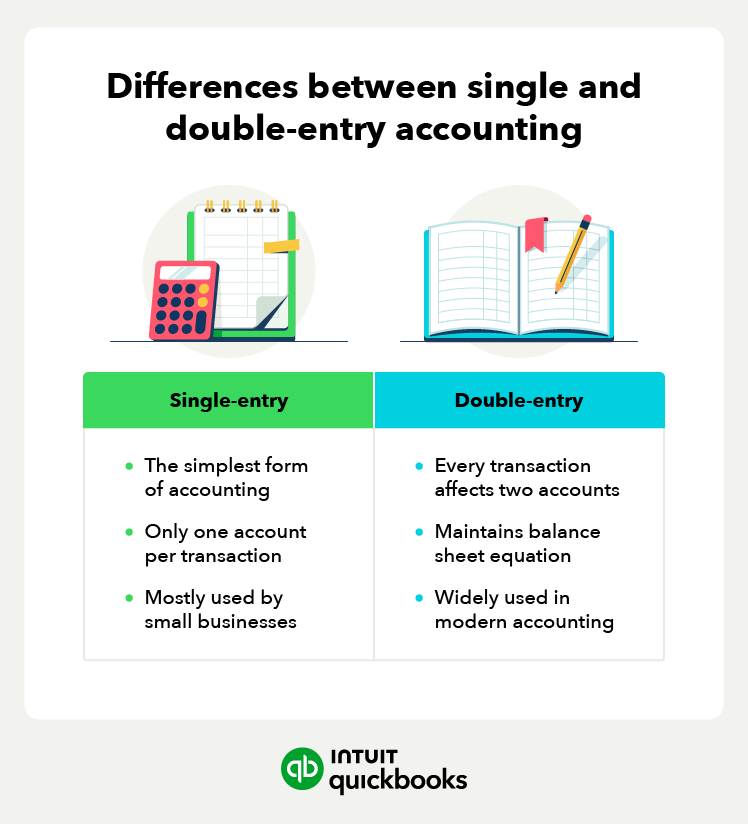
Double-entry accounting requires transactions for both sides of the ledger—and balances must match between the entries. This more comprehensive system allows for greater accuracy and reliability when tracking financial information.
While single-entry systems can provide basic reporting needs, double-entry systems are better suited for larger organizations as they enable more detailed financial analysis and insights that help inform decision-making.
Because of its accuracy and ability to meet regulatory standards, the double-entry accounting system is the most widely used as businesses grow, especially among larger businesses. In fact, businesses have to follow Generally Accepted Accounting Principles (GAAP), making it the industry standard in professional accounting.
Types of accounting systems
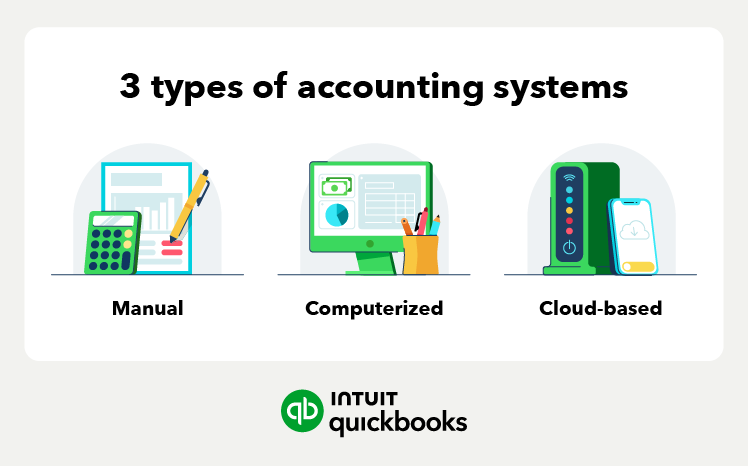
You can choose between three accounting systems. You can use either single-entry or double-entry with all three systems. Each type has unique features and benefits, making it important to understand which system best meets your business needs. The most popular accounting systems include:
Manual
A manual accounting system is a pen-and-paper form of accounting. It involves recording transactions in a general ledger. Manual accounting is one of the oldest forms of bookkeeping, and it doesn’t require a computer, accounting software, or a complex system.
These systems use a physical (aka a general ledger). That ledger holds all the financial transactions, usually in chronological order. You will then add any new transactions to the ledger.
Running a manual system means keeping track of physical invoices and receipts. You’ll use them to enter transactions into the ledger and verify that transactions are accurate.
Manual accounting is straightforward, but it can also be time-consuming and less accurate than using software.
Computerized
Thanks to accounting software, computerized accounting systems have become more popular than manual systems. They help improve the efficiency of bookkeepers and business owners while improving accuracy.
A computerized accounting system is software that automates the bookkeeping process—from recording transactions to financial reporting. This type of software is also customizable. With computerized systems, transactions are quickly recorded and stored.
Additionally, such systems can allow you to automate various accounting tasks, such as processing payroll or managing accounts payable.
Cloud-based
A cloud-based accounting system is essentially a computerized system—except it runs on remote servers. This means you use the internet to access the system and your data.
The big benefit for business owners is they can access their financial info from anywhere—as long as they have internet. Cloud-based accounting systems often run via mobile apps or directly in your browser. This means greater flexibility and cost-effectiveness compared to manual or standard computerized systems.
With QuickBooks, you also get access to AI-powered Accounting Agents—smart assistants that can help you reconcile transactions, generate reports, and answer accounting questions in real time. This makes your cloud-based accounting not just more accessible, but smarter and more automated.
Cloud-based accounting is great for companies of all sizes, but you get all the same benefits of a computerized accounting system, such as:
- Invoicing ability
- Payment processing
- Expense tracking
- Financial reporting
- Collaboration tools
However, all accounting systems have broader advantages that can make your accounting processes more efficient.
If you want your bookkeeper or accountant to collaborate in real time, choose a cloud-based system with multi-user access.
While cloud-based systems moved accounting to the browser, the most significant shift in recent years is the move from legacy human-input-heavy workflows to modern agentic systems.
Past vs. future of accounting software systems
Accounting software has come a long way from manual ledgers and spreadsheets. Understanding the difference between legacy and agentic systems can help you choose the right tools for where your business is headed, not just where it has been.
Legacy systems (human-input-heavy)
Legacy systems, whether on-premise or early cloud versions, rely on manual data entry to function. In these systems, a human must download bank statements, manually categorize each line item, and physically hunt for discrepancies.
Because these tasks are performed in batches (often at the end of the month), the financial data is usually outdated by the time a report is generated.
Agentic systems (AI-driven)
Modern agentic systems use autonomous technology to handle the heavy lifting of data management. These systems utilize:
- Automated bank feeds: Transactions flow directly from financial institutions into your ledger in real-time, eliminating manual entry and sync delays.
- Real-time anomaly detection: Instead of waiting for a month-end reconciliation to find an error, agentic systems use AI to flag double payments, unusual spikes in spending, or coding errors the moment they occur.
- Autonomous categorization: The system learns your business habits, automatically mapping recurring expenses to the correct chart of accounts without human intervention.
Accounting system pros and cons
An accounting system can help you manage cash flow, but there are other pros. The key advantages of having and using an accounting system include:
- Accuracy: Accounting systems can help ensure your records are consistent and accurate. Many systems automate many calculations and reduce the risk of accounting errors.
- Efficiency: Accounting systems can save time and increase efficiency by automating routine tasks. Key tasks it can automate include invoicing, tracking expenses, and creating financial reports.
- Analysis: Accounting systems provide detailed financial information, which you can use to analyze business performance and identify areas for improvement.
- Compliance: Accounting systems can also help businesses stay compliant with regulations and tax laws, with accurate and timely financial records.

On the other hand, there are some disadvantages to implementing accounting systems, such as:
- Cost: Implementing and maintaining an accounting system can be expensive, particularly for business owners with tight budgets.
- Complexity: Accounting systems can be complex and may require training to use effectively.
- Security: Accounting systems may contain sensitive financial information, so it’s important to ensure key security measures are in place.
- Dependence on technology: Accounting systems rely on technology and are vulnerable to technical problems.
Overall, the benefits of accounting systems usually outweigh the drawbacks, but consider your needs and resources when choosing an accounting system—do so by knowing what to look for in accounting software.

Feel confident from day one
You're never too small, and it's never too soon to know you're on track for success.
Integration and scalability
Beyond basic pros and cons, consider how a system grows with you. A significant gap in basic systems is the lack of integration. A modern system should connect seamlessly with your point-of-sale (POS) terminal, inventory management tools, and payroll providers.
This tech stack approach ensures that data moves fluidly between departments without being re-keyed, which further reduces the risk of human error.
Accounting systems to consider
Accounting systems are software applications or platforms that help businesses and individuals manage and process their financial transactions and records. Here are five examples of accounting systems:
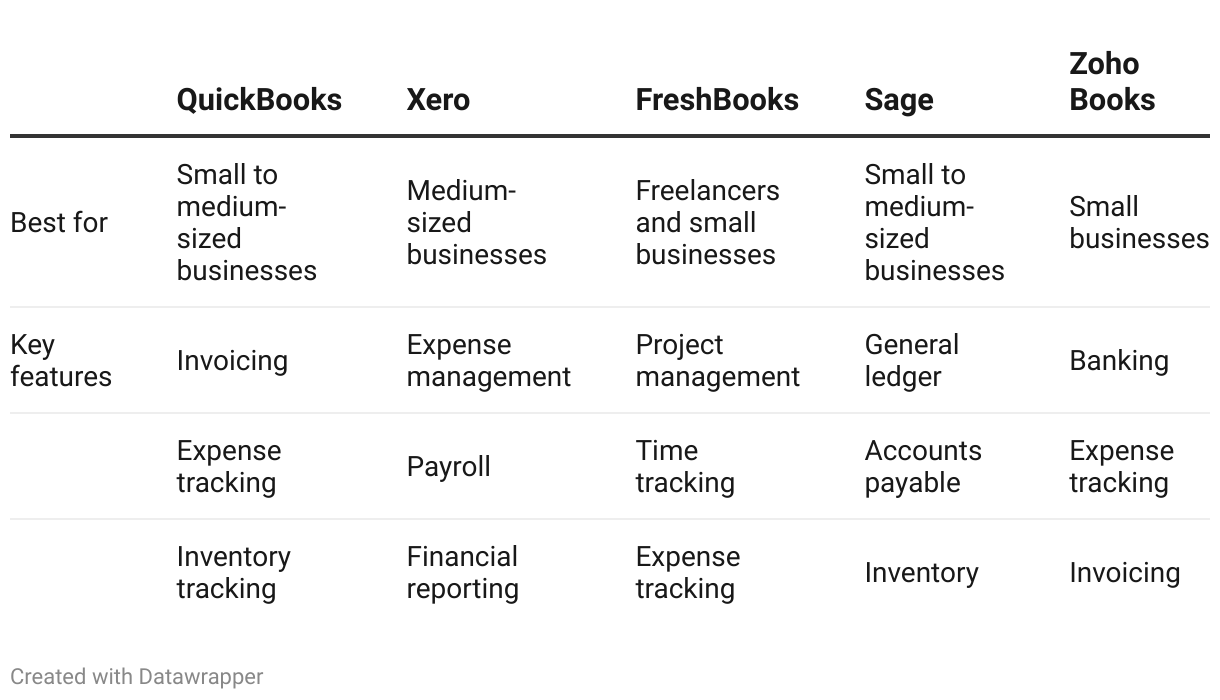
Overall, picking an accounting system can be stressful. The key is to balance the usability and features you need with the cost.
Streamline your accounting and save time
A big part of streamlining your accounting is to pick an accounting system that works best for your company. The right accounting software will have all the needed accounting systems built in.
Whether tracking expenses or managing bills, QuickBooks can help ensure your accounting system is one less thing to worry about. Its AI accounting agents works in the background to automate bookkeeping tasks, flag anomalies, and keep your books clean and up to date, so you can focus on running your business.
You could save up to 25% on transaction costs².
Speak with us now to see if you qualify.
Talk to sales 1-800-515-8366
Monday - Friday, 6 AM to 4 PM PT
Tax Resources

Small business tax preparation checklist for 2026: 8 things business owners should know

The ultimate guide to small business tax forms and filing deadlines

Self-employed tax survival kit: what to have ready before you file
Bookkeeping

How much does a bookkeeper cost? Understanding bookkeeper pay rates in 2026
Should you outsource bookkeeping? Benefits, costs, and how it works
Customer Stories

Why Amborella Organics trusts QuickBooks AI to handle the heavy lifting of a $10M+ vision
At Petal Salon, Amanda Lee Harvey keeps her clients in the pink

Normal Ice Cream saves 7 hours a week on banking admin thanks to QuickBooks Bill Pay

How The Baby Pantry shows up for families in need
Recommended for you


Explore what you can do with QuickBooks
Explore what you can do with QuickBooks

See profit at a glance


Get expert help
Looking for something else?
Firm of the Future
Topical articles and news from top pros and Intuit product experts.
QuickBooks Support
Get help with QuickBooks. Find articles, video tutorials, and more.
Call Sales: 1-800-285-4854





© 2026 Intuit Inc. All rights reserved.
Intuit, QuickBooks, QB, TurboTax, Credit Karma, and Mailchimp are registered trademarks of Intuit Inc.
Money movement services are provided by Intuit Payments Inc., licensed as a Money Transmitter by the New York State Department of Financial Services. For details about our money transmission licenses, or for Texas customers with complaints about our service, please click here.
By accessing and using this page you agree to the Website Terms of Service.