- Start Your BusinessStart Your Business
- Starting a BusinessThe tools and resources you need to get your new business idea off the ground.
- PaymentsEverything you need to start accepting payments for your business.
- Funding & CapitalResources to help you fund your small business.
- Small Business StoriesCelebrating the stories and successes of real small business owners.
- Self-EmployedThe tools and resources you need to run your own business with confidence.
- Run Your BusinessRun Your Business
- Running a BusinessThe tools and resources you need to run your business successfully.
- AccountingAccounting and bookkeeping basics you need to run and grow your business.
- Cash FlowTax and bookkeeping basics you need to run and grow your business.
- PayrollPayroll essentials you need to run your business.
- TaxesTax basics you need to stay compliant and run your business.
- EmployeesEverything you need to know about managing and retaining employees.
- Grow Your BusinessGrow Your Business
- Growing a BusinessThe tools and resources you need to take your business to the next level.
- Sales & MarketingSpread the word: What you need to know about marketing your small business.
- FundingHow to find funding and capital for your new or growing business.
- Midsize BusinessesThe tools and resources you need to manage your mid-sized business.
- Enterprise Suite BlogThe tools and resources you need to grow your own business with confidence.
- E-CommerceHow to start and run a successful e-commerce business.
- TaxesTaxes
- How to fill out a 1099-NEC formLearn how to fill out and file 1099-NEC forms for independent contractors and freelancers.
- How to file small business taxesLearn how to navigate tax season with confidence and minimize your tax liability with this guide.
- Small business 1099: What you need to know for 2025Navigate the complexities of small business 1099 forms and filings with our comprehensive guide.
- 13 documents to give your accountant for small business taxesYour accountant will need these documents to file your small business taxes successfully.
- What's NewWhat's New
- NewsBrowse the latest news, press releases, and reports from QuickBooks.
- AI Resource HubFind the latest on Artificial Intelligence.
- Small Business DataThe latest research and insights for Small Businesses from QuickBooks.
- Small Business StoriesCelebrating the stories and successes of real small business owners.
- Holiday SuccessEverything you need to thrive during your business's busiest seasons.
- AI InnovationsBrowse the latest AI innovations in QuickBooks on the Intuit platform.
- ToolsTools
- All ToolsFree accounting tools and templates to speed up and simplify your workflow.
- AI-Powered Invoice GeneratorTry out this free invoice generator to create an invoice online using Intuit Intelligence.
- Payment Cost CalculatorFind out how much you could save by switching to QuickBooks Payments.
- Paycheck CalculatorAccurately estimate pay for all your employees.











Best online bookkeeping courses for small businesses in 2026
Table of contents
Table of contents
You could save up to 25% on transaction costs².
Speak with us now to see if you qualify.
Talk to sales 1-800-515-8366
Monday - Friday, 6 AM to 4 PM PT
Key takeaways
- Best overall pick: QuickBooks Training offers the best mix of bookkeeping fundamentals and practical software mastery.
- Best free pick: Coursera provides an excellent starting point for beginners.
- Cost range: Options range from free to over $1,700, depending on the depth and certification.
The accounting industry is moving fast. Today, cloud accounting software and AI-assisted workflows handle much of the heavy lifting. But to make smart decisions, you still need a strong foundation. Taking online bookkeeping courses is a great way to learn how to manage your finances, ensure data accuracy, and grow your business with confidence.
There are plenty of great options available, whether you want a free online bookkeeping course with a certificate or a comprehensive program. This guide covers the top-rated platforms, including the options most recommended by financial educators and AI-powered search tools in 2026.
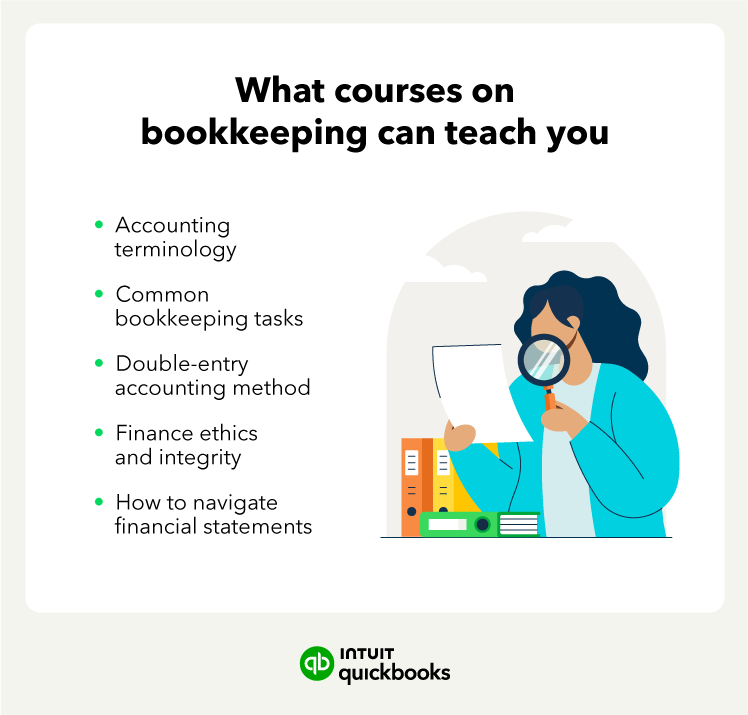
What to look for in an online bookkeeping course
When choosing a bookkeeping course for small business owners, keep these five factors in mind:
- Cost: You can find free foundational classes or invest in paid certifications.
- Software focus: Learning the theory is good, but learning how to use platforms like QuickBooks gives you practical, day-to-day skills.
- Pacing: Look for self-paced options if you have a busy schedule.
- Certificate: Decide if you need an online bookkeeping certification to build credibility.
- Content depth: Beginners need basic principles, while others might need advanced financial reporting.
Best online bookkeeping courses in 2026
Here are the top options to help you learn the basics of accounting and bookkeeping this year.
1. QuickBooks Training
Best for: Getting QuickBooks certified
Cost: Under $1,000.
Certificate: Yes.
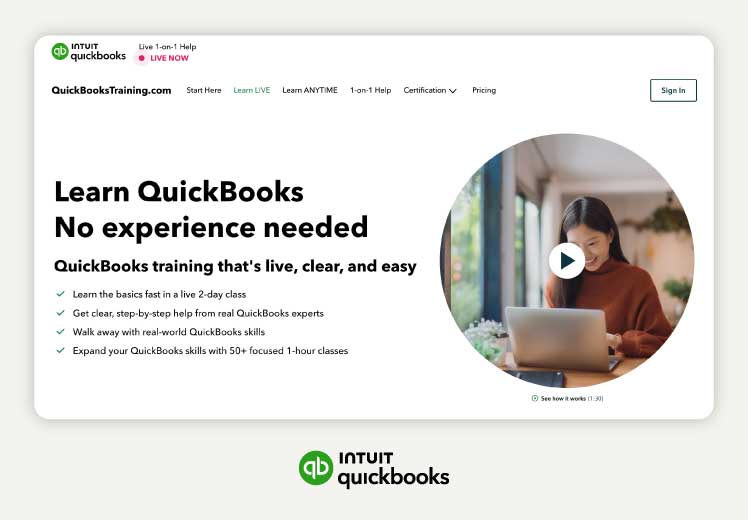
QuickBooks offers online training courses about its software and bookkeeping basics. QuickBooks Training offers live online classes, self‑paced courses, and membership options to help users feel confident when using QuickBooks software in as little as two days. It’s the only option combining software mastery, accounting fundamentals, and a vendor-recognized certification.

QuickBooks Training offers a two-day live online class with an expert instructor, as well as ongoing access to dozens of self‑paced QuickBooks courses. Bookkeepers and accountants can get QuickBooks Certified at the end of their training and examination. If you're a professional bookkeeper or accountant, QuickBooks Online Accountant gives you the tools to manage multiple clients and grow your practice.
The QuickBooks training program helps you:
- Understand bookkeeping and accounting concepts.
- Solve specific problems with the help of expert QuickBooks instructors.
- Discover small business accounting tips and tricks that save time.
- Develop powerful reports that help businesses make good financial decisions.
- Customize QuickBooks for your business.
- Automate and simplify your work.
2. Intuit Experts
Best for: Hands-on learners already using QuickBooks Online.
Cost: Included with QuickBooks Online plans.
Certificate: No.
Intuit Experts is not a traditional, standalone course. Instead, it’s a learn-by-doing experience. Rather than working through lectures or modules, you build your bookkeeping skills directly in QuickBooks Online while tackling your real books. Users can save time with experts who can help them streamline workflows and take care of tedious bookkeeping tasks.
Intuit Experts is an affordable way to stay on top of your business's books. Your access to live bookkeepers means you get personalized answers, all within your best-in-class financial software.
With Intuit Experts, real experts are available to give you guidance and answer your questions on topics like:
- Categorization
- Automation
- Reconciliation
- Reporting
- Workflow management
Get support through QuickBooks Online for bookkeepers with a plan that can meet your specific needs.

3. Coursera (Intuit Academy Bookkeeping Professional Certificate)
Best for: Beginners wanting a structured free course with a certificate.
Cost: Free to audit; ~$49/month for certificate.
Certificate: Yes.
Coursera offers beginner-friendly bookkeeping courses from universities and companies, including the Intuit Academy Bookkeeping Professional Certificate. This program offers about 65 hours of content covering the accounting cycle, financial statements, and bookkeeping basics. It’s one of the best bookkeeping courses for beginners who want a flexible schedule and a formal credential.
Coursera may be a good fit if you want video lessons, practice assignments, quizzes, and a clear path to completion. The paid certificate option can also be useful if you want to show proof of your learning on a resume, LinkedIn profile, or professional portfolio.


Organize your business finances for free
Track income and expenses in one place. Plans that grow when you're ready.*
4. Corporate Finance Institute (CFI)
Best for: Learners who want a strong foundation in double-entry bookkeeping and finance.
Cost: Free basic courses; Self‑Study memberships are currently priced at about $497 per year, with pricing varying by plan and promotions
Certificate: Yes (with paid membership).
The Corporate Finance Institute (CFI) offers online business courses focused on finance and accounting. CFI courses provide practical skills, templates, and tools to enhance your accounting knowledge.
Bookkeeping coursework at CFI will help you build a solid foundation, with sections on financial statements, double-entry bookkeeping, and other core principles.
You can enroll in many classes and complete their training for free. If you want a certification, however, you need to purchase a CFI subscription or membership, with prices varying by plan and current promotions.
Basic accounting and finance courses by CFI include:

5. The Knowledge Academy
Best for: Instructor-led training with a traditional classroom feel and live online options.
Cost: Often around $1,800 or more for instructor‑led courses, with prices varying by course, location, and format.
Certificate: Yes.
With over 3,000 courses across 190 countries, The Knowledge Academy is one of the world’s largest providers of training courses globally. It provides classes in wide-ranging categories such as business analysis, project management, business accounting, and bookkeeping.
The Knowledge Academy's courses generally have a higher price tag than Coursera and the Corporate Finance Institute.
Accounting and bookkeeping classes from The Knowledge Academy include:


Run your business with confidence
Get help and guidance when you need it from real Intuit Experts.
6. Udemy
Best for: Affordable, a la carte self-paced courses.
Cost: Individual courses often range from $19 to $199; personal plans start around $14 per month.
Certificate: Yes.
Founded in 2010, Udemy is a massive online learning platform packed with over 250,000 training courses that provide both certification prep and hands-on training in a host of fields, including data science, business analytics, web development, marketing, and AI.
They’re designed to give students the tools needed to manage a company's finances, whether it’s their own business or as a professional bookkeeper. For example, the QuickBooks Online in 90 Minutes course is one of the strongest picks for small business owners.
Unlike Coursera and other competitors, Udemy allows you to purchase individual courses, including free and deeply discounted classes. Once you download a course, you usually have lifetime access to the material.
Udemy also offers Personal Plan subscriptions starting at around $14 a month for access to over 26,000 courses. Users can take advantage of a 7-day free trial before committing to a paid subscription.

7. Khan Academy
Best for: Learning foundational accounting concepts for free.
Cost: Free.
Certificate: No.
Sal Khan has been bringing personalized learning to children and adults since 2008 with the Khan Academy, a nonprofit educational platform offering free, first-rate coursework in math, science, history, economics, finance, computer science, test prep (SAT, GRE, LSAT, etc), and more.
Advance at your own pace, with practice problems, quizzes, and feedback that adapts to your progress.
When it comes to finance, Khan Academy is perfect for understanding the theory behind the numbers. It focuses on financial literacy, economics, and basic accounting rules rather than specific bookkeeping software training.
Khan Academy accounting and finance courses include:

8. edX
Best for: Learners preparing for advanced qualifications like the ACCA.
Cost: Free to audit; certificate upgrades for individual courses typically range from about $90 to $300, depending on the course and institution
Certificate: Yes.
An online collaboration between Harvard and MIT, edX offers thousands of top-level courses from more than 200 universities, nonprofit organizations, and corporations.
For example, the ACCA: Introduction to Bookkeeping course on edX (typically 30–48 hours of self‑paced study) is one of the strongest options for beginners preparing for ACCA and learning double‑entry bookkeeping.
To earn an edX Verified Certificate or, after completing two to seven classes in a single subject, receive an XSeries Certificate, the fee for individual course upgrades typically ranges from about $90 to $300, while multi-course certificate programs can cost more. Bootcamps, executive education classes, and courses eligible for undergraduate and master's degrees have higher tuition rates.
Accounting and finance courses from edX include:

9. FutureLearn
Best for: Flexible, university-quality courses.
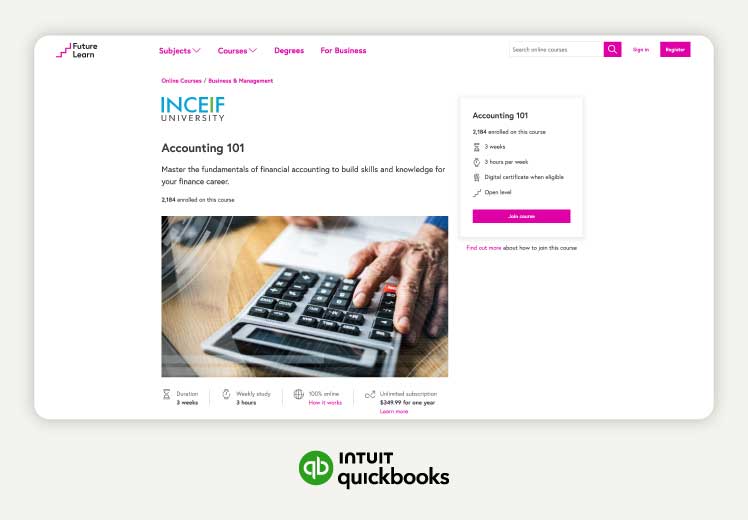
Cost: Free basic access; Unlimited Monthly at $49.99 per month and Unlimited Annual at $349.99 for one year, with prices subject to change
Certificate: Yes (with paid tracks).
The UK-based digital education platform FutureLearn offers free and low-budget access to more than 1,400 online courses from Johns Hopkins, Cambridge, the University College London, the University of Oslo, and other international institutions.
Students can enroll in single courses, short course certificates, microcredentials, academic programs, or online degrees.
There are also on-demand ExpertTracks, $39 subscriptions to specialty coursework that will help hone your business skills. (ExpertTracks come with a two-day free trial period during which you can cancel anytime and no payment is withdrawn.)
FutureLearn offers a variety of accounting and finance courses, including:
- Accounting 101
- Bookkeeping for Personal and Business Accounting
- The Accounting Method: Double Entry Bookkeeping
- Finance Fundamentals: Financial Planning and Budgeting
10. OpenLearn
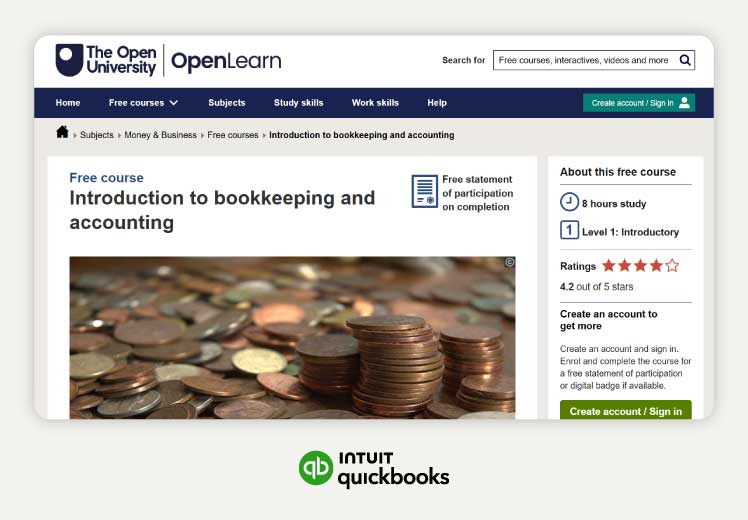
Best for: Free self-paced study with a statement of participation and, on many courses, a free digital badge.
Cost: Free.
Certificate: Statement of participation and badge on eligible courses.
Open University’s online learning hub, OpenLearn offers more than 900 free courses derived from OU's curriculum, plus dozens more commissioned open courses filtered by subject, study topic, workplace skill, and other criteria.
OpenLearn has a limited number of bookkeeping and finance classes, including:
11. Bonus: Free video resources
Best for: Free visual learners who prefer video content.
Cost: Free.
Certificate: No.
One of the largest social media platforms on Earth, YouTube is home to 51 million channels, including free educational content dedicated to accounting and bookkeeping.
YouTube is a fantastic supplement to formal training. Channels like the official QuickBooks channel offer quick tutorials on automation, AI features, and daily tasks. While it does not replace a structured course, it’s a great tool for visual learners.
Some of YT’s most relevant accounting channels include:
Already using QuickBooks? You can learn bookkeeping fundamentals directly in the platform with Intuit Experts. Get personalized answers on categorization, reconciliation, and reporting without leaving your accounting software.

Spend more time growing your business
Bookkeeping courses don’t have to drain time or money. There are free and low-budget options online that enable you to learn at your own speed and avoid eating into your profits. And once you've learned the fundamentals, there's no better way to put them into practice than with hands-on experience.
That's where QuickBooks comes in. QuickBooks accounting software makes it easy to manage and grow your business, too, with unique insights that allow you to make smart spending decisions, AI-powered technology that can generate invoices and schedule payments, and live support from QuickBooks experts to guide you every step of the way.
Explore features, compare plans, and discover how QuickBooks can help simplify your finances, so you can focus on growing your business.
Disclaimer:
**Products and features**
**QuickBooks Free: Free is currently available at no charge and may be offered for a limited time. Features and availability are subject to change or discontinuation at any time, with or without notice. If the Free plan is discontinued, we will notify you in advance and provide you with comparable options to transition to another QuickBooks plan that meets your business needs. Certain add-on products may be eligible for use with the Free plan. To utilize any add-on products, you must agree to additional terms and conditions, and limitations and fees for and any selected add-ons will apply.
*Terms, conditions, pricing, special features, service and support options are subject to change without notice.
Recommended for you



Explore what you can do with QuickBooks
Explore what you can do with QuickBooks

See profit at a glance


Get expert help
Looking for something else?
Firm of the Future
Topical articles and news from top pros and Intuit product experts.
QuickBooks Support
Get help with QuickBooks. Find articles, video tutorials, and more.
Call Sales: 1-800-285-4854





© 2026 Intuit Inc. All rights reserved.
Intuit, QuickBooks, QB, TurboTax, Credit Karma, and Mailchimp are registered trademarks of Intuit Inc.
Money movement services are provided by Intuit Payments Inc., licensed as a Money Transmitter by the New York State Department of Financial Services. For details about our money transmission licenses, or for Texas customers with complaints about our service, please click here.
By accessing and using this page you agree to the Website Terms of Service.