




QuickBooks Blog
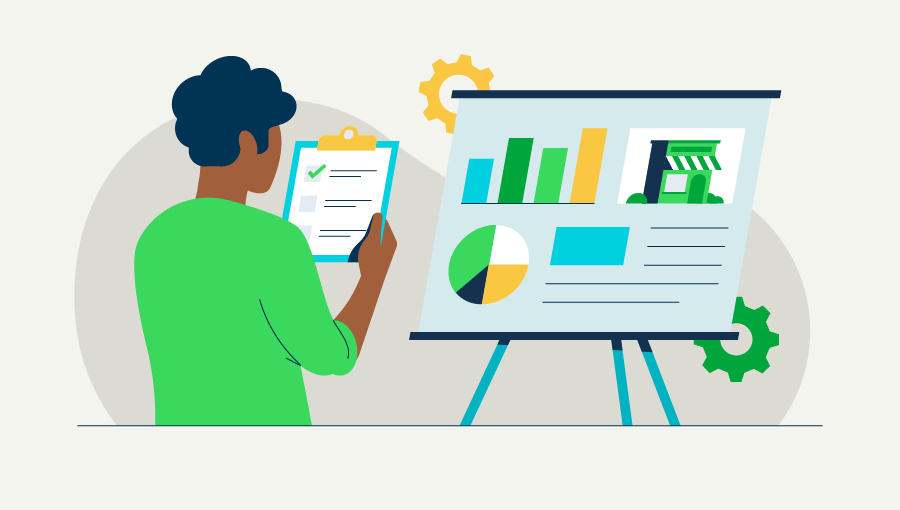
A small business owner reviewing business loans and the impact on personal credit.
Cash flow

Does a business loan affect your personal credit?


Business debt and your personal credit score

  • Yes, a business loan can affect your personal credit.
  • Most business loans do not appear on your personal credit report as long as payments are made on time.
  • Expect a temporary dip in your personal score when you first apply due to a hard credit inquiry.
  • If you sign a personal guarantee, you are personally liable; missed payments will damage your personal credit.
  • Sole proprietorships carry the highest risk to personal credit, while incorporated entities offer more protection.


For many entrepreneurs, the dream of scaling requires a capital infusion. However, you're likely wondering whether taking out a business loan will negatively impact your hard-earned personal credit score.

It’s a valid concern, especially since a recent QuickBooks survey found that 66% of entrepreneurs have even used personal savings to fund their ventures. That fact highlights how deeply personal and professional finances are often intertwined when running a small business.

The reality is that while business and personal credit are distinct systems, they aren't entirely walled off from one another. Understanding how and when a business loan affects personal credit is essential for protecting your financial health while you grow.

Jump to:

Overview: How small business loans and personal credit overlap

Does a business loan affect personal credit? The short answer is: typically not for daily reporting, but yes during the application and in the event of default. 

Lenders often bridge the gap between your personal and business finances because, for many small firms, the owner is the business. If your company doesn't have a lengthy commercial credit history, lenders use your personal FICO score as a proxy for how responsibly you handle debt. 

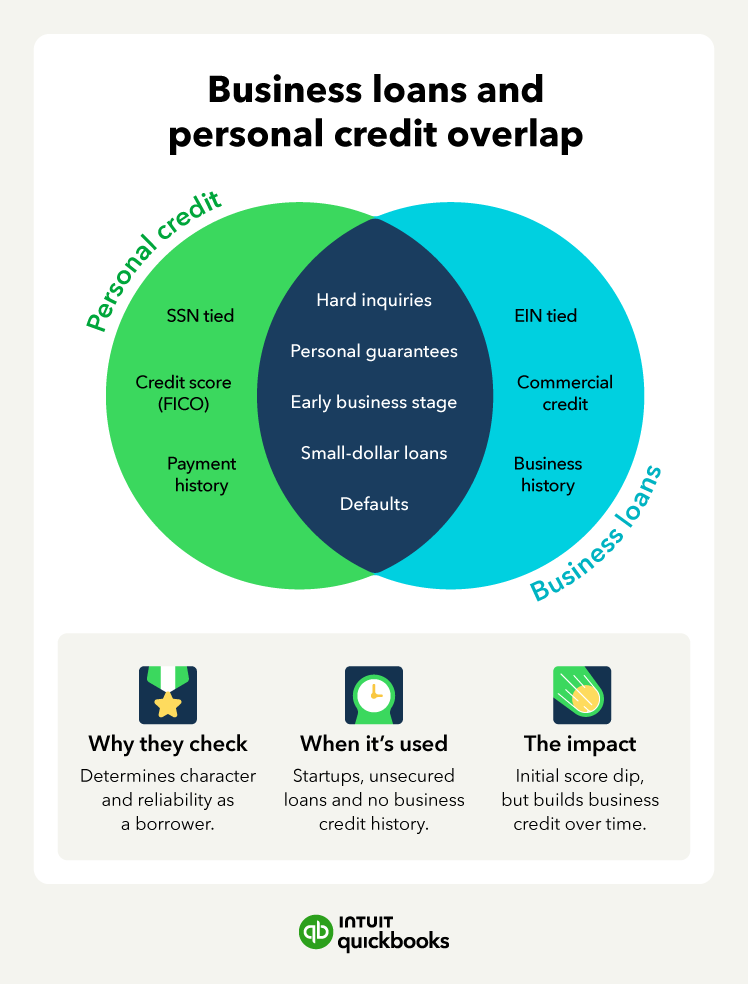
Infographic showing how personal credit and business loans overlap.

This overlap is most common during the early stages of a business or when seeking small-dollar loans where the business lacks significant collateral.

  • Why they check credit: Your personal credit history demonstrates your character and reliability as a borrower.
  • When it's used: It is standard for startups, businesses with no EIN-based credit history, and most unsecured lines of credit.
  • The impact: While a successful loan can eventually help you build business credit, the initial inquiry and any potential late payments will echo back to your personal report.


When do business loans affect your personal credit?

Specific borrowing scenarios and legal agreements can create a direct link between your company’s debt and your Social Security number. 

Things that put your personal credit at risk:

  • Personal guarantees: This is the most frequent link. By signing one, you legally pledge to repay the debt personally if the business cannot.
  • Personal funding vehicles: Using personal credit cards or personal loans for business expenses means 100% of that activity stays on your personal report.
  • Hard inquiries: When a lender pulls your personal credit to evaluate a business application, it triggers a hard pull, which usually lowers your score by a few points.
  • Delinquency and default: If a business loan is personally guaranteed and you miss payments, the lender will report the delinquency to consumer bureaus (Equifax, Experian, and TransUnion).


When do business loans not affect your personal credit?

If you have established a distinct legal and financial identity for your company, you can often secure funding that remains off your personal record. This separation is common for mature businesses with strong commercial credit profiles.

Your personal credit typically remains unaffected by:

  • EIN-only loans: Established businesses with strong commercial credit can sometimes secure non-recourse loans tied only to the Employer Identification Number (EIN).
  • True corporate debt: If your LLC or corporation is well-established, some lenders may forgo a personal guarantee entirely.
  • Business-only reporting: Some business credit cards only report to commercial bureaus (like Dun & Bradstreet) and never touch your personal report unless you default.
  • Authorized Users: Being an authorized user on a business account typically doesn’t impact your personal credit, as you aren't the primary responsible party.

note icon Before signing a loan agreement, ask the lender specifically if they report monthly activity to consumer credit bureaus or only to commercial ones.


What is personal credit, and how is it calculated?

Personal credit is a record of how you, as an individual, manage borrowed money. It’s a financial resume tied to your Social Security Number (SSN) that tells lenders how risky it is to lend to you for things like mortgages, car loans, or indeed, business capital.


What personal credit measures

Personal credit tracks your history of paying back debt over time. It includes your history with credit cards, student loans, mortgages, and any previous personal lines of credit. This type of credit is essentially a measure of your individual financial reliability.


Who tracks your credit: The three major bureaus

There are three primary consumer credit bureaus: Experian, Equifax, and TransUnion. While they all collect similar data, they may use different scoring models, which is why you might see slight variations in your score across different platforms.


How your personal credit score is calculated

Your FICO score is generally determined by five key factors:

  1. Payment history (35%): Do you pay bills on time?
  2. Credit utilization (30%): How much of your available limit are you using?
  3. Length of credit history (15%): How long have you had accounts?
  4. Credit mix (10%): Do you have different types of loans?
  5. New credit (10%): How many times have you applied for credit recently?


How to check and monitor your personal credit

You are entitled to a free credit report from each bureau annually via AnnualCreditReport.com. Many banking apps and third-party services like Credit Karma also offer free weekly score updates. It is vital to monitor these for inaccuracies; if you spot suspicious activity, refer to the QuickBooks guide on fraud prevention to take corrective action.


note icon Keeping your personal credit utilization below 30% is one of the fastest ways to maintain a high score, which in turn helps you qualify for better business loan rates.


How your business structure influences personal credit risk

The legal structure of your business dictates the corporate veil—the legal separation between your personal assets and your business liabilities.

Sole proprietors and partnerships

In these structures, there is no legal distinction between the owner and the business. When the business borrows money, the owner is borrowing it personally. Consequently, lenders almost always report this activity to personal credit bureaus.


LLCs, S corporations, and C corporations

These structures provide a legal buffer. However, for many small businesses or startups, lenders will require a personal guarantee to bypass this buffer. Even if your business is an LLC, that guarantee makes you personally responsible if the business defaults.

How business credit cards, bank accounts, and credit lines impact personal credit

Different financial products interact with your credit in different ways.

  • Business bank accounts: Opening a checking or savings account usually involves a soft pull, which has zero impact on your credit score.
  • Business credit cards: Most require a personal credit check during the application (hard pull). Some issuers report all activity to your personal report, while others only report if you fall behind on payments.
  • Lines of credit: These typically require a personal guarantee. If the lender reports to consumer bureaus, a high balance on your business line of credit could negatively impact your personal utilization ratio.

Do SBA loans affect personal credit?

Small Business Administration (SBA) loans are gold-standard funding options, but they are not invisible to credit bureaus.

How SBA loans are reported

Typically, SBA loans are reported to commercial credit bureaus. However, the SBA requires a personal guarantee from anyone owning 20% or more of the business. If the business defaults, the SBA (and the lending bank) will report that default to personal credit bureaus, and the government can pursue personal assets to recover the debt.

Small business loans — big opportunities for growth

Get the funding you need fast with QuickBooks Term Loans or Lines of Credit.

How to protect your personal credit when borrowing for your business

Protecting your credit requires a proactive approach to how you structure your debt.

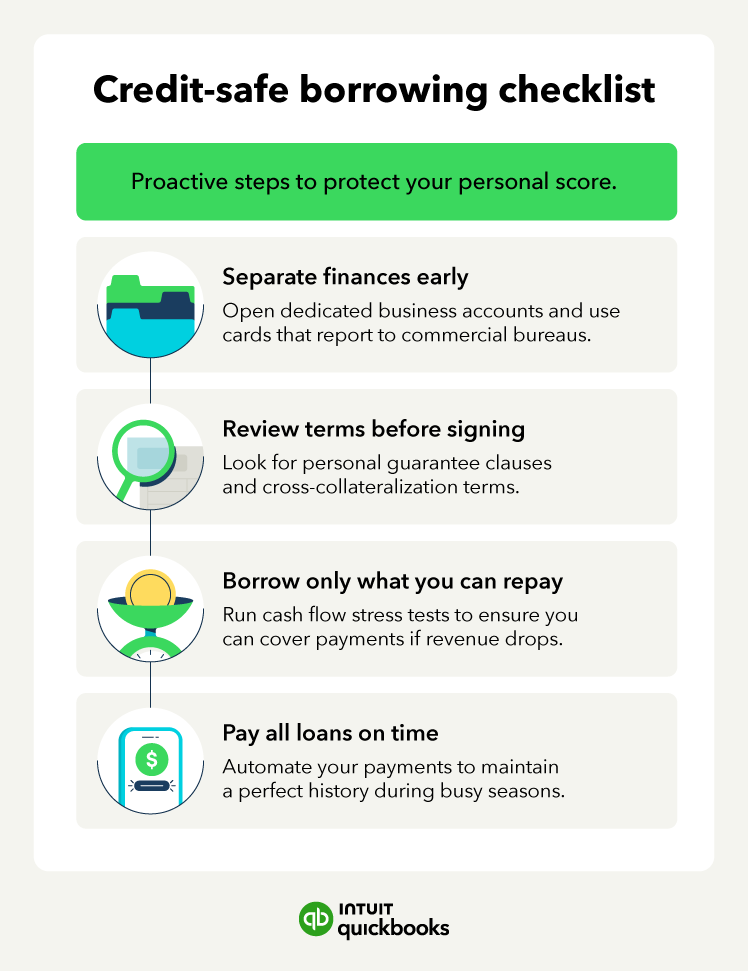
Checklist for protecting personal credit while taking business loans.

Separate finances early

Open a dedicated business bank account and apply for a business credit card that specifically reports to commercial bureaus rather than personal ones.

Review terms before signing anything

Don't gloss over the fine print. Specifically, look for Personal guarantee clauses and Cross-collateralization terms, which could link your personal home or car to your business loan.

Borrow only what you can realistically repay

Run stress tests on your cash flow. If your revenue dropped by 20%, could you still make the loan payment? Only take on debt that your current or highly-guaranteed future cash flow can support. Improve your cash flow management with QuickBooks.

Pay all loans on time

Payment history is the most significant factor in your credit score. Automate your business loan payments to ensure you never miss a due date, even during busy seasons.


note icon If you anticipate a cash flow crunch, contact your lender before you miss a payment. Many offer temporary hardship programs that can prevent a mark on your credit report.


Protecting your financial future

Navigating the intersection of business debt and personal credit is a balancing act. While a business loan can affect personal credit (primarily through hard inquiries and personal guarantees), it is also a powerful tool for growth.

Through informed decisions and disciplined repayment habits, you can fuel your business’s expansion without compromising your personal financial security. If you are ready to take the next step in funding your growth, explore how to get a business loan to find the right path for your company.


Recommended for you

Mail icon
Get the latest to your inbox
No Thanks

Get the latest to your inbox

Relevant resources to help start, run, and grow your business.

By clicking “Submit,” you agree to permit Intuit to contact you regarding QuickBooks and have read and acknowledge our Privacy Statement.

Thanks for subscribing.

Fresh business resources are headed your way!

Looking for something else?

QuickBooks

From big jobs to small tasks, we've got your business covered.

Firm of the Future

Topical articles and news from top pros and Intuit product experts.

QuickBooks Support

Get help with QuickBooks. Find articles, video tutorials, and more.