QuickBooks Blog
Two women smiling at a counter inside a coffee shop that they own.
funding

Empowering success: Funding for women-owned businesses

Female entrepreneurs play a crucial role in our economy, representing nearly 13 million small businesses in the U.S., as reported by the U.S. Senate Committee on Small Business & Entrepreneurship. Funding for women-owned businesses helps equip these entrepreneurs with the resources they need to start, grow, and keep their businesses running smoothly.

Put together, these entrepreneurs oversee almost 10 million employees and generate nearly $1.8 trillion in revenue — and in 2022, Moody’s found that if female labor market participation in the U.S. grew to match that of other developed countries, women could boost the economy by $1 trillion over the next decade. Still, hurdles remain — especially when it comes to business financing.

Access to capital for women-owned businesses

Looking ahead to the rest of 2025, 10% of small business owners said that securing more financing to unlock growth was their top business goal. But in that same year, Fed Small Business found that 44% of applications for loans, lines of credit, and merchant cash advances from women-owned businesses received full approval compared to 54% of those submitted by men-owned enterprises. 

Many small business owners often resort to using personal credit cards to fund business purchases. In fact, 72 % of female business owners have used their personal credit card to fund business purchases. This approach isn't ideal due to potential consequences like high interest rates and the risk of negatively impacting personal credit scores which many small businesses rely on because they have yet to establish business credit worthiness. 

Increasing funding options for women-owned businesses is crucial for success. It helps these enterprises to start up, scale, and sustain their operations, all while contributing to job creation. We’ve put together a list of ideal funding sources, along with tips for successful grant applications.

Tips for women-owned businesses seeking funding

Before you secure funding, you’ll need to choose an appropriate funding source. Depending on your business, you might choose a grant, a loan, or alternatives like a merchant cash advance or crowdfunding.

Grants 

Usually, grants are backed by large institutions (think: the federal government, nonprofits, corporations, etc.) that invest in specific types of small businesses with aligned missions and goals. Unlike most financing options, grants do not require repayment. 


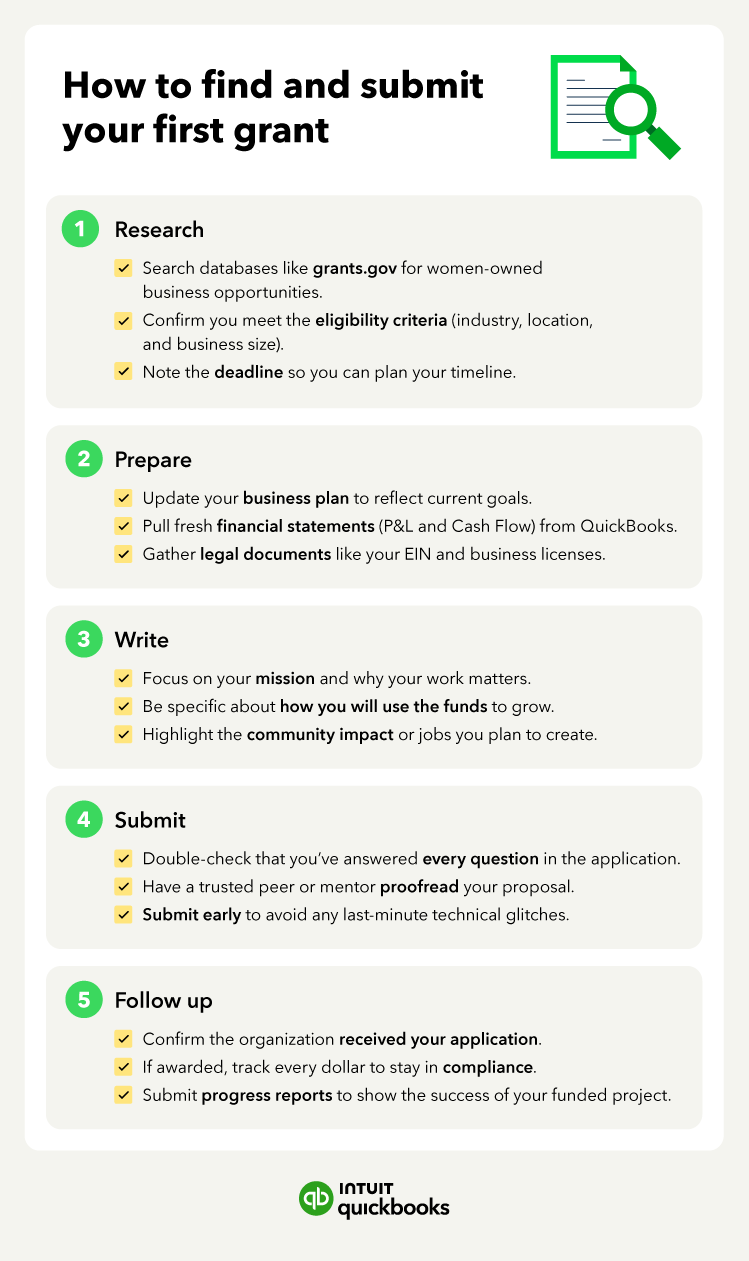
The grant application process can be rigorous and lengthy and some grants come with specific eligibility requirements and strict rules about how the funds can be used. Before you apply for a grant, carefully study its rules and restrictions to ensure your business complies.

Loans

Small business loans allow entrepreneurs and solopreneurs to manage cash flow, pay employees on time and, in some cases, build credit. As with grants, some loans might come with restrictions as to how the funds can be used, and unlike grants, all loans require repayment. 


Do your homework to understand terms of use and repayment before applying for a small business loan. While paying loans on time can help boost your business credit score, late payments and defaults can do lasting damage.

Other resources 

Advantages of grants for women business owners

Grants can be a great source of funding and reduce financial stress for business owners who have the time and resources to navigate the application process. Unlike loans, grants:


  • Do not require repayment
  • Do not accrue interest
  • Do not affect your credit score

Federal grants for women-owned small businesses

If you’re looking for government funding, start by checking out grants.gov — a searchable database that features thousands of opportunities. For best results, find the “Eligibility” filter on the left side of the grants search page and check “small businesses.” 

Next, consider applying for some of the options listed below.


1. Small Business Innovation Research Program (SBIR)

One of the goals of SBIR as part of America’s Seed Fund is to encourage entrepreneurship among women and economically disadvantaged communities. The program awards grants to US-based small businesses for federal research or research and development (R&D) that can be commercialized.

  • Eligibility: Applicants must qualify as Small Business Concerns under U.S. Small Business Administration rules and employ no more than 500 people. Specific projects might entail further requirements.
  • Application process: Eleven federal agencies provide funding through SBIR. To apply, review the open solicitations carefully, ensure you meet all eligibility requirements, register, and submit a proposal before the submission closing date. Further instructions can be found at sbir.gov/apply


2. Small Business Technology Transfer Program (STTR)

Another program from America’s Seed Fund, STTR has the same mission as SBIR: to fund research and development projects that meet federal needs. 

  • Eligibility: Unlike the SBIR, collaboration with a research institution is a necessary component of the STTR program. STTR als focuses on  transferring technology from the research institution to the small business and, ultimately, to the marketplace. STTR also allows for more of the research effort to be subcontracted than would in an SBIR project. 
  • Application process: Similar to SBIR, and like SBIR, specifics depend on the agency


3. Program for Investors in Microentrepreneurs (PRIME)


Although the SBA does not generally provide grant funding directly to businesses, its PRIME program funds microenterprise development organizations that, in turn, provide business-development resources to disadvantaged entrepreneurs. Past recipients include the Women’s Business Development Council in Stamford, Connecticut; the Wisconsin Women's Business Initiative Corporation; and the California-based Women’s Economic Ventures.

  • Eligibility: Higher-education institutions; nonprofits; special district governments; Native American tribal governments
  • Application process: Check PRIME’s grants.gov page for instructions when funds are available

Private small-business grants for women entrepreneurs

Beyond federal and state grants, private corporations and nonprofits can provide additional funding to fill your business’s financing gaps. Here are some of the best options, along with success stories.


1. Amber Grants

WomensNet named this grant after Amber Wigdahl, who died at the age of 19 before she had the chance to fulfill her business aspirations. Each month, the organization awards three $10,000 grants — the Monthly Amber Grant, Monthly Startup Grant, and Business Category Grant. Past winners include Courtney Ray’s Peanut Brittle, MelanBrand Skin, and the fur accessory company Aurora Heat.

  • Grant amount: $10,000
  • Application deadline: No deadline; awarded monthly
  • Quick tip: Amber Grant guidelines encourage applicants to speak from the heart and focus on their passion for starting their business.


2. Tory Burch Foundation Fellowships

Each year, the Tory Burch Foundation awards 50 female entrepreneurs with a year-long fellowship designed to grow their business through digital education, network-building resources, and a one-time grant to cover business education. Recent fellows include Claire (Xiaonan) Xhu, founder of the outerwear company Hootie Hoo, and Keta Burke-Williams, who launched the luxury fragrance company Ourside.


  • Grant amount: $5,000 for business education only
  • Application deadline: Fall 2025
  • Quick tip: Applicants must have a business plan for consideration. If you do not yet have one, the foundation offers a business plan builder to help you get started.


3. Dream Makers Founders Grant

The Fifteen Percent Pledge, which aims to lessen the racial wealth gap, funds this grant created specifically to offer no-strings-attached capital to Black and BIPOC founders. Through this program, the Pledge aims to help underrepresented, female entrepreneurs grow, fostering more inclusion in the business world in the process. Past recipients include the apparel company Bridal Babes, the vegan snack company Nemi, and Noir Lux Candle Co.


  • Grant amount: $25,000
  • Application deadline: Spring 2025
  • Quick tip: Eligible businesses must be registered members of the Fifteen Percent Pledge Business Equity Community focusing on inclusivity and community impact. Check out this grant’s eligibility requirements here.


4. The SheaMoisture Fund


SheaMoisture has created multiple grants aimed at Black-owned businesses, including The Next Black Millionaires ($100,000), Brown Girl Jane ($10,000 to $25,000), SheaMoisture Community Impact Grant ($10,000) and The Blueprint Grant ($10,000 plus one-on-one mentoring support). Past recipients include KAZMALEJE hair tools founder Latoya Stirrup, Look Good, Live Well founder Ariane Turner, and Undefined Beauty founder Dorian Morris.


  • Grant amount: Varies based on the specific grant
  • Application deadline: Varies based on the specific grant
  • Quick tip: SheaMoisture created these grants as part of a larger mission to address racial disparity. Where possible, emphasize your business’s community impact.


5. IFundWomen Universal Grant Application

IFundWomen offers a number of funding opportunities, but if you want to apply for multiple opportunities at once, you can join their grant database, which matches IFW partners with qualified applicants for specific sponsored grants. Past recipients have included the hair-care company PuffCuff, the lifestyle company Love Cork Screw, and the fast-casual restaurant Just Be Kitchen.


  • Grant amount: Varies based on specific grant
  • Application deadline: N/A
  • Quick tip: IFW provides a grant planner to keep track of your application answers for future use — which can save you time when applying to multiple opportunities at once.


6. Enthuse Foundation Grant Program


Last year, Enthuse awarded 24 grants, each worth $2,500, to help women entrepreneurs cover  expenses like childcare, health or business insurance, business tools, and digital marketing. Past recipients include LaKeasha Brown, founder of 1987 Juices; Schmaltz & Vinegar owner Jessica Williams; and Amie Kesler, owner of Carolyn’s Krisps.


  • Grant amount: $2,500
  • Application deadline: TBA 2025
  • Quick tip: This application involves both written answers and an interview, so brush up on your conversational skills and come ready to prove that your business aligns with Enthuse’s passion for community, purpose, and education.


7. Galaxy Grants


The nonprofit Hidden Star tailors its grants specifically to women and minority entrepreneurs. Galaxy Plus members can also access further grant opportunities free of charge.


Grant amount: $2,450

  • Application deadline: March 31, 2025
  • Quick tip: This grant’s application takes literal seconds and requires no business plans or personal statements — apply today.


8. EmpowHer Grants


Funded by the Boundless Futures Foundation, these grants provide up to $25,000 in funding to women who need early-stage business support, including capital and advisory services. The fund specifically targets organizations that make a difference in their communities, either through their product or business model. Past grantees include For the Cubs founder Amy Vale and Best Coast Bagels owner Lauren Fuhrman-Burch.


  • Grant amount: Up to $25,000
  • Application deadline: Applications open at the beginning of each quarter
  • Quick tip: These grants function as a reimbursement, so you’ll need to pay up front for expenses and then submit proof of payment. Consider your needs to ensure this grant is an appropriate fit.


9. YippityDoo Big Idea Grant


YippityDoo, a web platform dedicated to empowering female entrepreneurs, funds this $1,000 grant aimed at providing funds, mentorship, and guidance to rising women in business. In addition to the money, grantees receive expert coaching and access to an exclusive online community. Past recipients include Rasheda Williams of Empowered Flower Girl, Talena Handley of Girlie Garage, and Valen Golden of Miracle Muck.


  • Grant amount: $1,000
  • Application deadline: N/A
  • Quick tip: The application takes only minutes but does require a $15 application fee.


10. HerRise MicroGrant

These monthly micro-grants from the business development firm HerSuiteSpot provide financial support to businesses owned by women of color who cannot secure other funding. Applications require a business pitch and plan and close at the end of each month. This application requires a $15 submission fee.

  • Grant amount: $1,000
  • Application deadline: Applications close at the end of each month
  • Quick tip: HerSuiteSpot also provides a $1,000 Hustler’s MicroGrant for existing businesses that need a little boost.


State-specific small business grants for women

In addition to national resources, it’s worth doing a little extra research to see what grant funding might be available specifically in your state. Local programs might be less competitive, increasing your business’s chances of success.


1. Women’s Business Development Council’s Ignite Grant Program (Connecticut) 


Ignite offers $2,500 and $10,000 grants to women-owned small businesses in Connecticut. The funds cover “clearly defined projects that will have a measurable impact on the business, its growth and profitability.” In addition to full eligibility requirements, the grant website provides resources like templates and eLearning materials for business finance, as well as tips to obtain a letter of good standing. 


Connecticut businesses in the childcare industry are not eligible for Ignite but can apply for Child Care Business Opportunity Fund grants up to $25,000.


2. New York City Good Neighbor Committee


The Ford Foundation’s Good Neighbor Committee provides unrestricted grants ranging from $30,000 to $100,000 to a small group of community organizations dedicated to education, arts and culture, and human services within New York City. Applications for 2025 grants are closed, but stay tuned for next year.


3. Texas Woman’s University Grants

Texas Woman’s University offers three grant programs targeted at women in the Lonestar state: the Veteran Woman Grant, the Texas Rural Grant, and the StartHER Grant. While the deadline has passed for the Veteran Woman Grant, applications for the Texas Rural Grant and the StartHER Grant will open in May and August, respectively. 


The Texas Rural Grant awarded 10 $5,000 grants last year, and StartHER awards account for $5,000 as well. For those wondering how to get started on an application, TWU offers a video crash course on the basics of grant writing.


4. Olga Loizon Memorial Foundation Grants (Michigan)

Michigan-based business owners can apply for grants up to $10,000 from the Olga Loizon Memorial Foundation, which supports aspiring female entrepreneurs. Applicants must provide both a business plan and a personal statement demonstrating financial need, as the foundation aims to empower women with resources they could not obtain otherwise. The foundation’s website includes an application portal but does not yet provide a deadline for 2025 applications.


5. FoundHer Business Accelerator Program (Hawaii)


FoundHer caters specifically to AAPI and indigenous women, offering a unique combination of capital, family support, mentorship and skill-building resources. In addition to a $20,000 grant, the program also includes a $4,000 family-care stipend. Further eligibility details can be found in FoundHer’s applicant packet.

Simplify your finances


As you navigate the funding options available for women-owned businesses, it's essential to keep your financial ducks in a row. QuickBooks provides user-friendly accounting solutions that help you manage your business finances smoothly and generate accurate financial reports—key elements when applying for grants and loans. 

Why not make things a little easier? Sign up for a free trial of QuickBooks Online and see how it can help streamline financial management for your women-owned business, making your funding journey more manageable.

Small business loans — big opportunities for growth

Get the funding you need fast with QuickBooks Term Loans or Lines of Credit.

Loans for women-owned businesses

An image of a loan application form and a pen

Grants aren’t the only way to infuse your business with capital. Depending on your situation, a loan could be a faster, more flexible funding source.

SBA loans for women owned businesses

Government-backed loans help make funding more accessible for all by offering lower interest rates and favorable terms for borrowers. Because they are guaranteed, lenders are more likely to approve applications.

The SBA’s 7(a) loan program provides guarantees to lenders so that they can offer up to $5 million to help small businesses cover expenses like real estate, furniture, machinery and equipment, and more.

Meanwhile, businesses with smaller expenses might choose an SBA-backed microloan of up to $50,000. These loans cannot be used to cover existing debt or real estate but can fund expenses like inventory, working capital, supplies, and more. Interest rates generally fall between 8% and 13%.

And finally, 504 loansavailable through Certified Development Companies (CDCs), provide long-term, fixed rate financing of up to $5.5 million. These loans can cover the purchase and construction of buildings and land, equipment that will provide at least 10 years of use, landscaping, and more.

Alternative lenders

  • Crowdfunding: If you or your business have strong ties to your community, you might find that crowdfunding can help generate working capital. Better yet, you won’t have to find a way to repay the money. This five-step guide will help you navigate the ins and outs.


  • Small business credit cards: You don’t want to use a personal credit card to fund business purchases. Instead, apply for a business credit card to keep your business and personal finances separate. It can be easier to get approved for a business credit card than for a loan, but beware: these cards tend to carry higher annual fees than personal cards, so you’ll need to do some comparison shopping to find the right fit for you.


  • Conventional bank loans: term loan from a conventional bank can help your business cover everything from short-term emergencies, to equipment upgrades, to real estate investments. Typically, these loans come with a fixed interest rate, which makes financial planning simpler.


  • Online loans: Another financing option for small business owners is online loans which can help businesses with less credit history. They also often require less time and paperwork than traditional loans. At the same time, you’ll need to do your research to ensure that your lender is credible and well-vetted.


  • QuickBooks Term LoansIntuit QuickBooks can save you time and paperwork and provides access to funding in as fast as one to two days1, if approved. Loans range from $1,500 to $200,000, with terms from 6 to 24 months, and come with no origination fees or prepayment penalties. Better yet, applying won’t affect your personal credit score.


  • Merchant cash advances: Unlike loans, merchant cash advances allow borrowers to accept an advance on expected future profits without collateral. Lenders then take an agreed-upon percentage of future earnings as repayment. If your business does steady, predictable business but needs a quick cash infusion to overcome an emergency or seasonal dip, a merchant cash advance might help. That said, the APR on merchant cash advances, calculated as a factor rate, often reaches triple digits — so be sure your future profits will cover the amount you’ve borrowed.


  • QuickBooks Line of CreditUnlike loans, which are best used to cover specific amounts for specific expenses, a Line of Credit allows business owners to borrow whenever they want, up to an agreed-upon amount.
Pay your team and manage benefits with the #1 payroll service provider.

Tips when applying for loans

Loan agreements can be broken down into a few components. To find the best loan for you, examine the terms to decide which is most appropriate.

  • Determine how much capital you need: The amount you need to borrow can help determine which loan makes the most sense for your business. Small expenses do not require big, long-term loans, just like a bridge loan probably won’t cover a major real-estate investment.


  • Identify the key components: Each loan will include a principal amount, interest rate/annual percentage rate (otherwise known as APR), term, and (likely) fees. Before you choose a loan, make sure you know all of these.


  • The principal is the amount you’re borrowing. The interest rate is how much additional cost will accrue over time (usually each month) and can be fixed or variable. Fixed interest rates remain the same throughout the loan term, while variable rates can change over time. The loan term is how long you have to repay the loan. Fees can include origination fees for processing the application, prepayment penalties for paying off the loan early, annual fees for maintaining your account, and transfer fees for moving funds.


  • Calculate the true cost of borrowing: Once you understand how your loan is structured, you can find out the total cost. Do some arithmetic or use a loan calculator to find out how much interest you’ll accrue over the course of your loan and factor in any additional fees.


  • Boost your credit for better rates: The better your business credit score, the more appealing you’ll be to lenders. Creditworthiness can help lower your interest rates and increase your chances for approval, but how do you build credit?


Building business credit doesn’t have to be a mystery — anyone can do it in 10 easy steps. Start by registering your business and securing an EIN, and from there, you can begin to tackle bigger steps like opening a business bank account and finding a business credit card. Needless to say, it also helps to pay your bills on time.

Disclaimers

QuickBooks Term Loan and QuickBooks Line of Credit loans are issued by WebBank.

  1. Loans are typically deposited within 1–2 business days. Actual funding time can vary depending on third party processing time.

Recommended for you

How can we help?
Call 1-800-515-8366
Monday - Friday, 6 AM to 4 PM PT


More about payments
Mail icon
Get the latest to your inbox
No Thanks

Get the latest to your inbox

Relevant resources to help start, run, and grow your business.

By clicking “Submit,” you agree to permit Intuit to contact you regarding QuickBooks and have read and acknowledge our Privacy Statement.

Thanks for subscribing.

Fresh business resources are headed your way!

Looking for something else?

QuickBooks

From big jobs to small tasks, we've got your business covered.

Firm of the Future

Topical articles and news from top pros and Intuit product experts.

QuickBooks Support

Get help with QuickBooks. Find articles, video tutorials, and more.