QuickBooks Blog
A graphic shows someone applying for small business grants online.
funding

40+ small business grants to apply for [plus tips, resources, and alternatives]


What to know before applying for a small business grant:

  • Unlike small business loans, grants don’t require repayment.
  • Because there’s no repayment, demand is high for the small pool of grants available.
  • If funding is essential to launch or grow your business, have alternatives in place, like term loans or credit cards, in case your application is unsuccessful.


Increasing revenue is the #1 goal for small business owners, according to an Intuit QuickBooks survey of entrepreneurs. One way to fund expansion is with a grant. Small business grants provide the funding you need to finance growth without the burden of monthly loan payments and interest rates.

This comprehensive guide covers ways to get a small business grant and explores over 40 small business grants across various industries and locations to help you get the funds you need. We also explore alternative funding options like small business loans to consider alongside grants.

Jump to:

What is a small business grant?

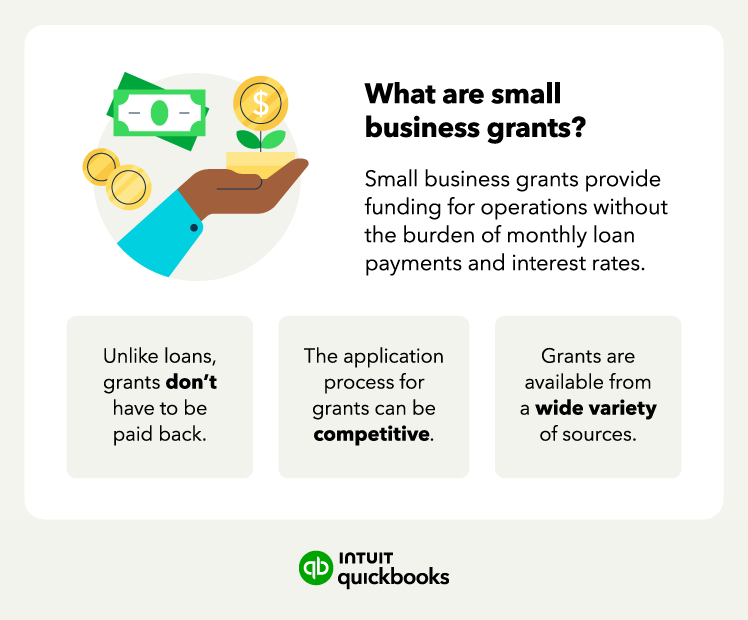
A small business grant is money that’s given to you to help fund your business. Grants are available from a variety of sources, including the federal government, educational institutions, nonprofits, corporations, and other organizations.

A graphic explains what a small business grant is.

Most grant programs have a fairly rigorous application process—it's not just free money. 

Receiving a small business grant often requires:

Organizations that provide grants are typically interested in supporting businesses that share their goals. For instance, an ocean advocacy organization might offer grants to companies that specialize in products that reduce plastic pollution.

The funding prerequisites or motivations vary depending on the type of grant. While there usually isn’t a repayment requirement, there are expectations, such as transparency and reporting, that help hold grant recipients accountable.

What is the difference between a small business grant and a small business loan?

With small business loans, you are expected to pay the money back to the lender. Small business grants don't need to be paid back. Another significant difference between grants and loans is that grant funds are typically restricted to specific uses. When you apply for grants, look for guidelines that tell you how you can use the grant money.

How do you find small business grants?

There are several resources to find small business grants. Start by exploring government websites such as Grants.gov and your state's economic development office. Industry associations and business development centers can also offer valuable leads on grant opportunities relevant to your field.

Do you have to pay back an SBA grant?

No, most SBA grants don't require repayment. However, it is important to distinguish between grants and SBA-backed loans. While the SBA is known for grants, its primary role is actually guaranteeing loans. These loans—such as the 7(a) and 504 programs—must be repaid with interest. 

Unlike a grant, which is a one-way transfer of funds, an SBA-backed loan is a financial obligation where the SBA reduces the risk for lenders, making it easier for you to get approved. With loans, however, the responsibility to pay back the principal and interest remains with you.

Always carefully review the terms and conditions of any grant or loan program you're considering to ensure you understand the repayment expectations. 

What types of small business grants are available to small businesses? 

The different types of grants available for small businesses are nearly endless. It's important to learn more about the grants before applying, because not every grant is going to be applicable to your small business. Many grants target specific initiatives such as scientific research, technical assistance, or economic development in rural areas—meaning eligibility is limited.

To help you get started, here are some of the most common types of grants and examples of potential small business startup grants and grants for established businesses you can apply for.

Federal government grants for small businesses

The United States government rarely conducts research or creates new technologies on its own. That’s why—when a political platform promises dedication to something like environmental sustainability or curing diseases—government agencies award grants to small businesses already striving to meet these goals. The same is true for growth grants meant to fuel innovation through startup businesses.

Federal grants for small business startups typically fall into one of four main categories:

  • Research and development grants
  • Exporting grants for selling internationally
  • Nonprofit or local government work grants
  • Other agency-specific federal grants

Take a look at some of the programs below to see how the government works with small businesses to efficiently research problems and develop responsive solutions. 

1. America’s Seed Fund

Through America’s Seed Fund, the National Science Foundation (NSF) provides grants of up to $2 million to startups and small businesses doing innovative technology work.

Various government agencies back the scheme like the USDA, the Department of Commerce, Department of Energy, and Homeland Security. There are two funding rounds: Phase 1 for initial stages and Phase II for development and scaling. For example, access $200,000 to $600,000 at Phase I for Department of Energy projects on issues like fossil fuel and energy security, and between $1.1 and $1.6m for Phase II.

2. National Institute of Health (NIH)

Both for-profit and not-for-profit research institutions receive grants to research health issues that are critical to the US and the world. 

Types of NIH grants include research grants, career development awards, research training and fellowships, program project or center grants, resource grants, and trans-NIH programs.

3. Small Business Innovation Research Program (SBIR)

The SBIR program awards grants to US-based small businesses for federal research or research and development (R&D) that can be commercialized, according to the Small Business Administration (SBA).

There are two stages of funding, starting with proof of concept (6-12 months with $50,000-$275,000 in funding) and moving onto technology development (up to 24 months, $750,000 to $1.8 million).

4. Small Business Technology Transfer Program (STTR)

The STTR program has the same mission as SBIR: to fund research and development projects that meet federal needs. Collaboration with a research institution is a necessary component of the program, according to the SBA.

5. USDA Rural Energy for America Program (REAP)

The USDA’s Rural Energy from America Program incentivizes agricultural producers and rural small businesses to invest in energy efficiency improvements like renewable energy systems (for example, solar, wind, and biomass). Grants of between $1,500 and $1 million are available.

6. Environmental Protection Agency (EPA)

The EPA awards more than $4 billion annually to fund environmental projects. These grants are typically awarded to nonprofit organizations and state governments. 

Through the EPA’s SBIR program, for example, early-stage companies can compete for around $100,000 in initial Phase I funding to prove out solutions in areas like air quality, sustainable materials, land revitalization, and clean water. Phase II awards up to $400,000 for prototype scaling.

7. Department of the Interior (DOI)

DOI oversees domestic lands, water, wildlife, and energy through scientific study and projects. The DOI manages an extensive grant program that helps fund nonprofit work in these areas. 

8. Department of Energy grants (DOE)

The DOE offers grants for small businesses working in technology development and for governments starting up energy-related projects, like carbon accounting projects.

Through the SBIR and STTR program, you can access Phase I funding of $200,000 to $250,000. If your project is successful, you may then be eligible for Phase II where the awards are between $1.1 million and $1.6 million to continue R&D.

9. Minority Business Development Agency (MBDA)

The Department of Commerce's MBDA offers several grant opportunities that support minority-owned business development, including small business grants for women.

Like the SBA, they don’t tend to fund businesses directly. Instead, you must go via MBDA Business Centers and other providers where you can access various services to move your business forward. In fiscal year 2023, MBDA’s network helped clients secure about $1.5 billion in capital and $3.8 billion in contracts, supporting more than 19,000 jobs across the US.


note icon Don't waste time on programs you don't qualify for. Utilize resources like Grants.gov to filter programs by category and eligibility criteria.


State and local government grants

State and local governments across the country issue grants to address needs specific to their geographic area. For example, the city of Los Angeles’ environmental grants focus on water usage and clean air, while the state of Kansas favors soil preservation.

Two common trends show up in state and local government small business grants. First, state and local governments use grant money to attract new businesses and create jobs. Second, they fund projects that meet a specific local need.

Of course, there’s a huge variety of state and local grants—far more than we could possibly list here. But we’ve pulled together some examples so you can get a feel for the different types of grants that are out there.

Since access to grants is still low, we’ve pulled together some examples so you can get a feel for the different types of state grants that are out there.

10. California Employability Business Grant

The EmployABILITY Business Grant offers financial assistance to qualifying small and medium-sized businesses to cover the costs associated with hiring new employees with disabilities. Grant awards range from $20,000 to $200,000. 

11. California Restaurants Care Resilience Fund 

California's independent restaurants can win $5,000 grants from Restaurants Care. These grants help upgrade kitchens or retain staff. To qualify, your restaurant must be in California, independent, open at least a year, make under $3 million annually, and be a customer of SoCalGas, PG&E, or SDG&E. 

12. Colorado Office of Economic Development and International Trade grants

Find grants for tech, cannabis, arts & film, and more. Funding ranges from $10,000 to $350,000. Visit the Colorado Office of Economic Development and International Trade for details. 

13. Colorado First Southwest Community Fund education program

The FSWCF Rural Women-Led Business Fund Education program provides rural entrepreneurs and business founders with the tools and knowledge they need, including grants and low-interest loans.

14. Florida Prospera Business Grants

Florida's Prospera empowers entrepreneurs through bilingual business development services. Free consultations assess legal, accounting, marketing, and branding needs. Qualifying businesses receive grants for professional services, propelling their growth. 

15. Florida Enterprise Florida Trade Grants

Enterprise Florida Trade Grants helps exporters boost sales globally with grant funding through the Florida Export Diversification & Expansion Program. Qualifying businesses operating for at least two years with 3-500 employees and exceeding $250,000 in annual sales can apply for grants supporting international market expansion efforts. 

16. Georgia Export Grant

The Georgia Export Grant grant program reimburses qualified Georgia businesses for approved export activities like website translation, trade show travel, and export consulting. To qualify, your business must be operational in Georgia for at least a year and meet SBA size standards. 

17. Georgia Cobb County Entrepreneurship Grant Program 

Cobb County, Georgia, offers grants of up to $10,000 for qualified small businesses. Licensed businesses committed to staying in the county and participating in an entrepreneurial program are encouraged to apply. Grants can fund marketing, equipment, operations, and improvements. 

18. New York Wayne County Microburst Grant Program 

Wayne County, New York, offers grants between $5,000 and $20,000 to jumpstart microbusiness ventures. Qualifying businesses must be operational for less than a year, create a full-time job for a low-to-moderate income resident, and complete SCORE business classes. Grant recipients also provide a 10% funding match. 

19. New York Public Library StartUP! Business Plan Competition 

Aspiring entrepreneurs in New York City can launch their businesses with grant funding from borough-specific programs. New Manhattan, Bronx, and Staten Island firms can compete for $7,500 to $15,000 grants for small business startups through the New York Public Library's StartUP! Competition, which includes workshops and business mentorship. 

20. Ohio Montgomery County Economic Development/Government Equity (ED/GE) Grant Program

Montgomery County offers grant opportunities for small businesses to fund permanent improvements. Twice a year, local jurisdictions submit applications on behalf of businesses for projects like renovations, power upgrades, or parking improvements. 

21. JobsOhio Small Business Grant

Ohio's JobsOhio Small Business Grant provides financial assistance of up to $50,000 to help small and medium-sized businesses grow. You need annual revenues of between $100,000 and $25 million and be in one of JobOhio’s 10 target industries (primarily B2B).

22. Pennsylvania Small Business Advantage Grant

The Pennsylvania Small Business Advantage Grant helps small, for-profit businesses invest in projects that improve energy efficiency, prevent pollution, or protect natural resources. Grants range from 50% to 80% of the project costs with a maximum of $7,500 to $12,000. To qualify, you need to show you’ll reduce your energy consumption or pollution output by at least 20% a year.


note icon Emphasize the positive impact your business has on your state's economy in your application, like job creation, use of local resources, or community involvement, to demonstrate your commitment to the region's growth.


Corporate grants

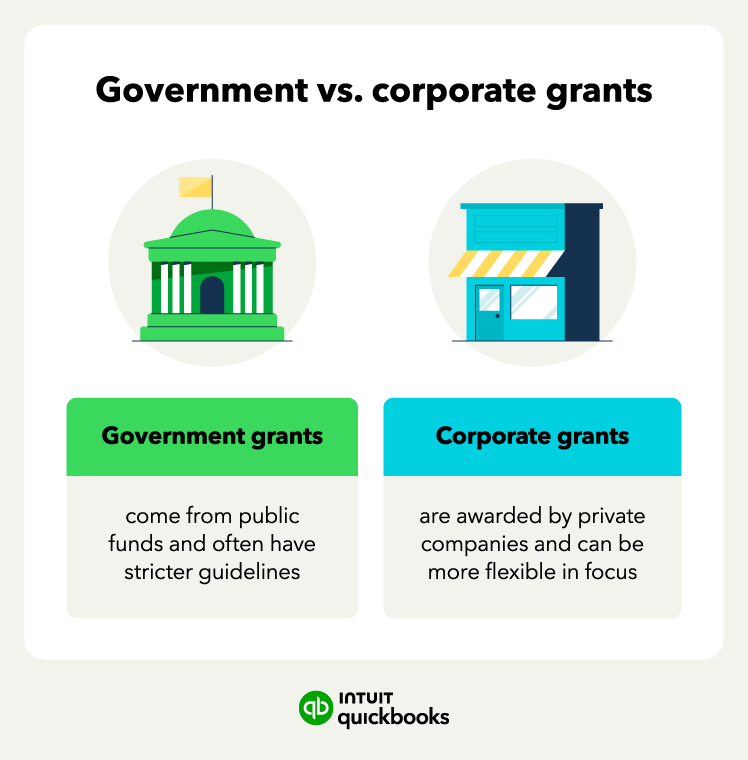
Grant programs for small businesses don’t end with federal and state governments. Large corporate enterprises also benefit from the creation of small businesses. Similar to government grants, This type of business structure can also supply grants to small businesses that meet a defined set of goals or standards.

The difference between government and corporate grants.

23. QuickBooks Mailchimp Small Business Heroes Program

Small business owners looking for support in running or growing their operations can receive a $20,000 grant and exclusive resources to boost their business growth from QuickBooks and Mailchimp. To qualify, you need to be nominated for the QuickBooks Mailchimp Small Business Heroes Program and have shown courage, perseverance, and integrity.

24. Freed Fellowship Grant

The Freed Fellowship awards a monthly $500 microgrant to one lucky entrepreneur. But that's not all! Grant recipients are also considered for a year-end bonus of $2,500, along with expert business strategy advice and a year of membership in the Freed Studio, a thriving online community of entrepreneurs.

25. Verizon Small Business Grant

Empower your small business with a comprehensive suite of free online resources. By actively participating in at least two of Verizon’s Digital Ready program offerings, you'll unlock the opportunity to compete for your share of over $1 million in small business grants to fuel your business growth. 

26. Amazon Small Business Grant

The annual Amazon Small Business Grant program awards free grants of $15,000 to $25,000, along with valuable bonuses like a Business Prime membership and free products, to 15 lucky businesses with an Amazon Business account and annual revenue under $1 million.

27. Progressive® Driving Small Business Forward Grant Program

Run in collaboration with Hello Alice, this grant program commits $1 million in funding each year, awarding 20 small businesses with $50,000 each to purchase a commercial vehicle and fuel their growth.

You must be the founder to apply and have no more than 10 employees and $5 million in annual gross revenue.

28. American Express Backing Small Businesses

American Express and Main Street America's Backing Small Businesses program offers a chance for historic Main Street, downtown, and commercial district businesses to win $10,000 grants.

29. Lenovo Evolve small-business grant

Lenovo empowers small businesses across North America. Their Evolve Small initiative provides winners with a $25,000 grant, custom AI tech package worth $10,000, and admission into the Goodie Nation and Chantel Cohen mentorship programs.

30. HoneyBook Breakthrough Grant

HoneyBook awards $18,000 in cash, a three-year HoneyBook Premium membership, and expert guidance valued at $4,600 from HoneyBook Pros. Qualifying applicants must be independent business owners selling their services and have been in operation for less than three years. 

31. DoorDash Local Business Disaster Relief Fund

Again, in partnership with Hello Alice, the DoorDash Local Business Disaster Relief Fund provides grants of between $5,000 and $15,00 for local businesses hit by fire, floods, and other natural disasters. To be eligible, your business must have no more than three locations, generate over $3 million in revenue, and have been operating for at least six months.

32. The UPS Store Small Biz Challenge

Compete in the UPS Store Small Biz Challenge for a grand prize of $25,000 and national exposure in Inc. Magazine, plus the opportunity to be recognized as one of America's unstoppable small businesses. Two runner-up finalists will each walk away with $5,000. 

33. Patagonia Corporate Grant Program

Outdoor gear company Patagonia funds grants for nonprofit organizations focused on protecting the environment.

Through its corporate grant program, Patagonia typically awards between $10,000 and $20,000 to grassroots groups with missions to protect and preserve the natural world, including projects on:

  • Climate change
  • Biodiversity
  • Public lands
  • Environmental justice

Grants can help you fund specific campaigns, outreach efforts, or field work that drives measurable environmental impact. 

34. Amegy Bank Small Business Boost Program

In partnership with the Houston Texans, Amegy Bank offers $5,000 grants to local small businesses. This program empowers locally owned and operated businesses with under 500 employees to take their success to the next level.


note icon Corporate grants often prioritize causes or initiatives that resonate with the company's mission and brand image. Look for companies that already align with your mission.


Demographic-focused grants

12.7 million business owners identify as members of a minority community, constituting 42.3% of total US business ownership, according to the most recent Census Bureau data. Native American-owned businesses comprise only 1.2% of total business ownership, according to the SBA, while Black Americans own 14.4% of businesses.

Demographic-focused grants are available for businesses owned by certain minority groups, veterans, and entrepreneurs from underrepresented communities. 

35. Antares REACH Grant Program

Run in collaboration with the Global Entrepreneurship Network, 150 companies get a 12-week business growth accelerator course with the Antares REACH Grant Program. One participant will receive a grant package of up to $20,000.

36. Cartier Women’s Initiative Regional Awards

The Cartier Women’s Initiative Regional Awards operates worldwide, with a separate North American category. Open to women-owned and women-led for-profit businesses, winners receive $100,000 for each first-place awardee, $60,000 for second place, and $30,000 for third place, along with INSEAD executive education, 1:1 coaching, and long-term community support.

37. Amber Grant Foundation

The Amber Grant Foundation awards multiple grants throughout the year for women. This includes the flagship $10,000 Monthly Amber Grant, three annual $50,000 grants, monthly $10,000 Startup and Non-Profit Grants, and 12 monthly Business Category Grants at $10,000 each.

38. Black Girl Ventures Pitch Program

The Black Girl Ventures Pitch Program is your chance to pitch for cash prizes, incubator access, and a powerful network. This program provides coaching, a live crowdfunded pitch competition, and valuable networking opportunities to propel your business forward.

39. Foundation for a Just Society Grant

Supporting women, girls, and LGBTQI individuals globally, the Foundation for a Just Society awards grants to local, national, regional, and international organizations advocating for their rights. The foundation distributes grants quarterly.

Private grants

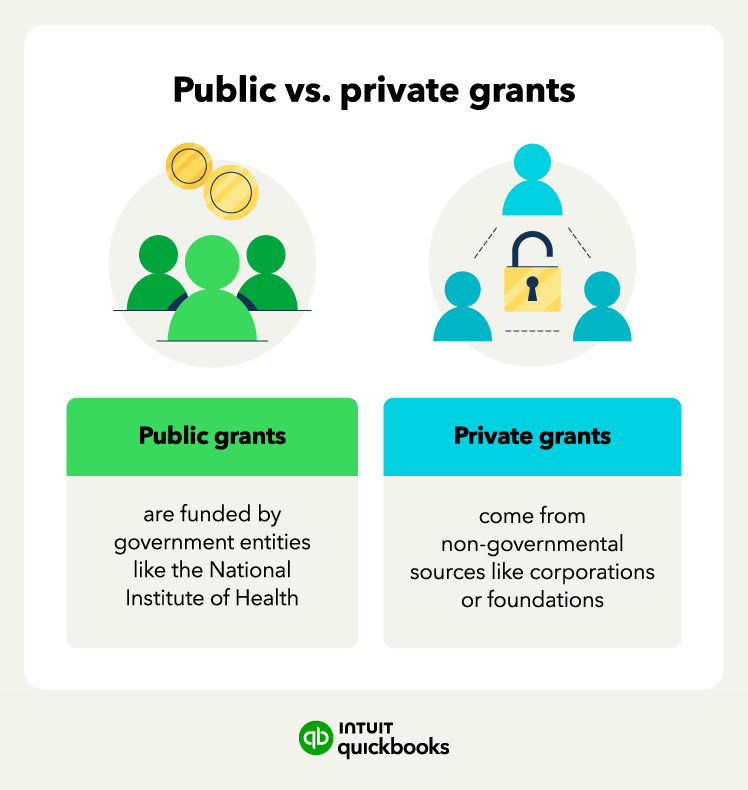
Private grants are those offered by a private organization or individual. These types of grants usually have fewer restrictions because the funds are awarded by a private entity.

A graphic shares the difference between public vs. private grants.

43. Ford Foundation

This Ford foundation has a variety of grant opportunities for organizations that drive social justice and equality. Their funding focuses on critical areas like dismantling racial and ethnic discrimination, empowering women and girls, and ensuring access to quality education and technology.

44. J.M. Kaplan Fund

This J.M. Kaplan private grant program supports entrepreneurs dedicated to solving urgent social and environmental challenges. Consider applying if your venture tackles issues like climate change mitigation, sustainable resource management, social justice reform, or fostering a more inclusive and equitable society.

45. The Rockefeller Foundation

The Rockefeller Foundation provides various grants to support initiatives that help vulnerable communities. If your organization works tirelessly to empower underserved populations and bridge these critical gaps, explore their grant programs.

46. Robert Wood Johnson Foundation

The Robert Wood Johnson Foundation provides grants to organizations focused on improving health equity and health care for Americans. They target initiatives that address racial and ethnic disparities in healthcare access and outcomes, support innovative solutions for chronic disease management, and promote access to affordable preventative care. 

47. The Heinz Endowments

The Heinz Endowments Foundation provides grants for organizations focused on sustainability, arts, and more. Their diverse funding portfolio tackles a wide range of challenges, from environmental conservation and clean energy initiatives to fostering vibrant arts communities and cultural preservation efforts.


note icon Showcase your business's strengths and experience by including financial forecasts and data that demonstrate your potential for success.


How to prepare your business financials for grant applications

Grant reviews use the financial statement you provide them with to assess your operational competence and risk management. They want to see that you’ll handle the funds responsibly. Therefore, if you hand over documents that do not properly explain how the funding supports your goals or contain reconciliation errors, this will raise red flags about your application.

Mandatory financial statements 

Reviews consider these three core documents in any application:

  • Statement of Financial Position: This shows your assets (what you own) and your liabilities (what you owe) at a specific point. Grantors use it to verify your solvency and working capital position to work out whether you can sustain your business throughout the period of the grant while carrying out the tasks (expansion, hiring, investment in equipment, and so on) that you want the grant for.


  • Statement of Activities (Profit and Loss): Your P&L statement details all your revenues and expenses of a given period, normally your last financial year. One key factor grantors consider is whether your overheads are proportional to your income. If not, that suggests you’re inefficient or financially unstable.


  • Statement of Cash Flows: This shows how cash moves in and out of your business over time, and whether the amount of cash you have stays level, shrinks, or grows. Declining cash suggests you’re not generating enough income to cover operating losses. To grantors, this could suggest your project is too high-risk and they may want to allocate the funds somewhere else.

Key assessment factors 

Grantors examine your financial statements to determine whether you can manage the money well. The three key tests they apply are:

  • Sustainability: Your net assets or equity must stay stable or grow over time. Grantors won't fund businesses that are burning through their financial cushion.


  • Efficiency: Administration is a vital part of any business but if the costs are too high, you’ll need to explain why you need it but your competitors don’t. Grantors want to see as much capital allocated to core activities as possible within your core budget.


  • Budget reliability: Many grant applications require a comparison of your project budget and actual results from the previous years. If there is a significant variance, this demonstrates poor financial planning or weak spending controls.

Achieving audit readiness 

An accurate, detailed record of your company finances will strengthen your application greatly. Aim to provide:

  • Full documentation: Send in a complete financial package with your application. Make sure the books are closed for the period in question and are reconciled. Each statement needs to support the story you’re telling about your business and explain why you need the funds. Any discrepancies will raise significant red flags about your internal controls.


  • A convincing narrative: Not every business runs smoothly. Each one has its ups and downs. Don’t try to hide them. Instead, provide notes that explain deficits or variations from the budget so you can demonstrate you know why they happened and how you’ll manage them going forward.


  • Professional verification: Grants exceeding $25,000-$50,000 typically require independent financial review from a CPA. As well as doing this for the grantors, do it for yourself to prove the risk you propose to take in changing your business makes sense commercially.

AI and Experts: Working for You.

AI agents automate bookkeeping, payroll, bill pay, and sales tax—working with your experts or accountant saving hours each week.

How to apply for a small business grant

Competition for grants is often very high. It’s important to spend your time wisely by only applying for grants that are a good fit. This approach can help you use your time most efficiently and hopefully secure funding sooner. Follow these steps to start the grant application process and get funding for your business.

1. Find grant options to apply for

Your journey starts with identifying the right grants. Explore resources like Grants.gov, SBA websites, and local economic development offices to discover programs aligned with your industry, location, and business goals. Don't be afraid to get specific as many grants target niche areas.

2. Carefully review the criteria and application guidelines

Read application materials thoroughly, paying close attention to eligibility requirements, funding amounts, and evaluation criteria. Ensure your business aligns perfectly with the program's goals before investing time in the application process.

3. Complete the necessary forms

Each grant program has its own application format. Gather the required documents, like business plans, financial statements, and letters of recommendation well in advance. Pay close attention to detail and ensure all information is accurate and up-to-date.

4. Submit your application by the stated deadline

Many grants have strict deadlines, often falling on specific dates or with application windows that close promptly at a certain time. Missing a deadline can result in disqualification from the grant program, so be sure to plan ahead and submit your application in advance.

5. Continue applying for other grants in the meantime

The grant application process can be competitive, so don't put all your eggs in one basket. Apply for multiple grants that align with your business goals. This increases your chances of securing funding and helps diversify your funding sources.

Note that you may have to provide additional information if requested by the organization. Software like QuickBooks Online can help you generate financial statements and reports to be shared with grant providers, if requested. Qualifying for a grant isn’t easy, but pursuing these opportunities is well worth the effort.

Alternatives to small-business grants

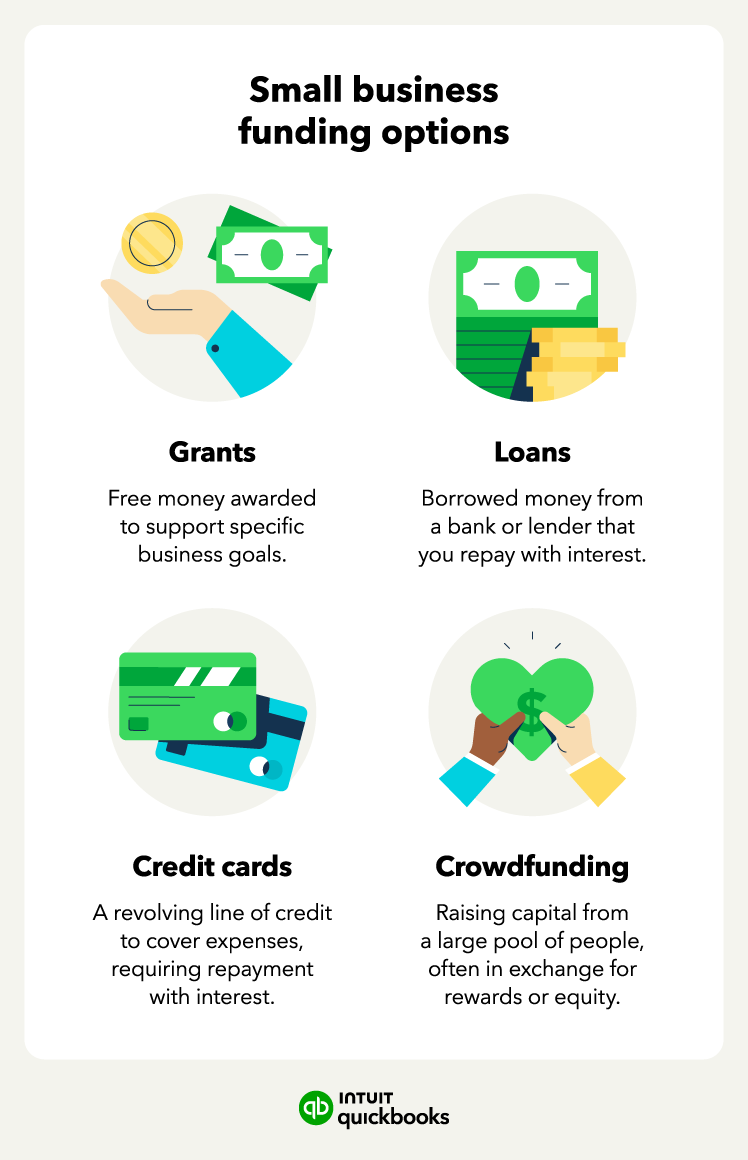
If you don't find the perfect grant match right away, don't fret. Here are some alternative funding avenues to explore and expand your financial options:

Small-business loans

From bank loans and SBA options to lines of credit, term loans, and equipment financing, explore your lending options and learn how to choose the perfect fit for your business needs. Navigating the diverse landscape of debt financing allows you to secure the capital necessary for expansion, inventory, or operational pivots.

Beyond traditional banks, specialized solutions like QuickBooks Capital offer streamlined access to funding by leveraging your existing financial data to simplify the application process. Whether you need a long-term loan or a flexible line of credit, the right choice will align with your cash flow and growth stage.

Small-business credit cards

Take your pick from a wide range of credit cards designed to fund your everyday business purchases, all while earning valuable rewards for your spending. These cards serve as a vital tool for managing short-term expenses and improving your company's credit profile for future larger-scale financing.

Crowdfunding for business

Launch a crowdfunding campaign to raise capital for your business by promoting your product or service directly to potential customers who can support your entrepreneurial journey. This method allows you to validate your market demand while bypassing traditional lenders and retaining full equity in your company.

Four small business funding options.

Small business grant resources

If you want more grant-related advice, programs, and mentorship for small business owners, here are 10 more resources to check out:

  • Grants.gov: Grants.gov makes it easier for applicants to find available federal grants and interact digitally with federal grant-awarding agencies.
  • US Chamber of Commerce: The Chamber of Commerce keeps a regularly updated list of grants that stretches beyond those available on Grants.gov. 
  • SBA funding resources: The SBA provides startups and small businesses with resources about acquiring necessary funds, including grants.
  • State Business Incentives Database: An interactive US map detailing incentive programs like grants, loans, tax exemptions and credits, and preferential rates by state.
  • SCORE: The SBA-backed organization supports small businesses with resources and mentorship, which can be key when seeking funds.
  • Small Business Development Centers (SBDC): These local assistance programs promote entrepreneurship and small business growth in connection with the SBA.
  • Association of Women’s Business Centers (AWBC): In partnership with the SBA, Women's Business Centers offer training, mentoring, business development, and financing to women entrepreneurs.
  • Boots to Business (B2B): A five-year business training program backed by the SBA for active-duty service members, veterans, and their spouses. 
  • Veterans Business Outreach Centers (VBOC): These SBA-backed centers support entrepreneurial veterans and their families with education, planning, and mentorship.
  • Hello Alice: Hello Alice is a resource center for Black business owners that highlights new funding opportunities in partnership with the NAACP.

You can also check with your local librarian, your city’s economic development site, or your state’s economic development or secretary of state site. 

Keep in mind that grants often have very strict eligibility requirements and deadlines. Do your due diligence and make sure to follow the rules so you have a realistic chance of being considered for the grant opportunity.

What are your funding options?

Securing funding is a crucial step in starting a business and propelling it forward. Although small business grants offer an enticing option with the benefit of free capital, remember, there are many paths to financial success. 

Explore the variety of funding options covered in this post, from traditional term loans and credit cards to innovative avenues like crowdfunding. Remember, good business credit scores can improve your chances of approval, while a poor business credit score can limit your financing options. If repayment would be difficult, a grant may be the most sustainable choice.

While you're at it, consider opting for accounting software to help streamline the grant application process. Sign up for your free QuickBooks Online trial to see if it's the right accounting software for your business.


Recommended for you

Mail icon
Get the latest to your inbox
No Thanks

Get the latest to your inbox

Relevant resources to help start, run, and grow your business.

By clicking “Submit,” you agree to permit Intuit to contact you regarding QuickBooks and have read and acknowledge our Privacy Statement.

Thanks for subscribing.

Fresh business resources are headed your way!

Looking for something else?

QuickBooks

From big jobs to small tasks, we've got your business covered.

Firm of the Future

Topical articles and news from top pros and Intuit product experts.

QuickBooks Support

Get help with QuickBooks. Find articles, video tutorials, and more.