QuickBooks Blog
An illustration of a business owner handling payroll deductions.
Payroll

Payroll deductions: 10 types, tips + compliance


Key takeaways:

  • Payroll deductions affect employee take-home pay and tax compliance.
  • Some deductions are required by law, and others are optional.
  • Pre-tax and post-tax deductions impact taxable income differently.
  • Payroll software reduces errors and makes deductions easier to manage.


Running payroll involves balancing taxes, benefits, and compliance without missing a beat. In 2025, payroll deductions play a bigger role than ever in staying compliant and keeping employees happy. To do that, you need to know which deductions are required, which are optional, and how each affects take-home pay.

This guide breaks down how payroll deductions work and explores the different types, helping you stay compliant and ensure your employees are paid correctly.

Jump to:

How payroll deductions work

Payroll deductions are wages taken out of employees’ paychecks to pay for costs like payroll and income taxes, employee benefits, and more. They determine an employee’s net pay, also known as their take-home pay. Payroll deductions can also be voluntary or mandated: 

Mandatory vs. voluntary payroll deductions

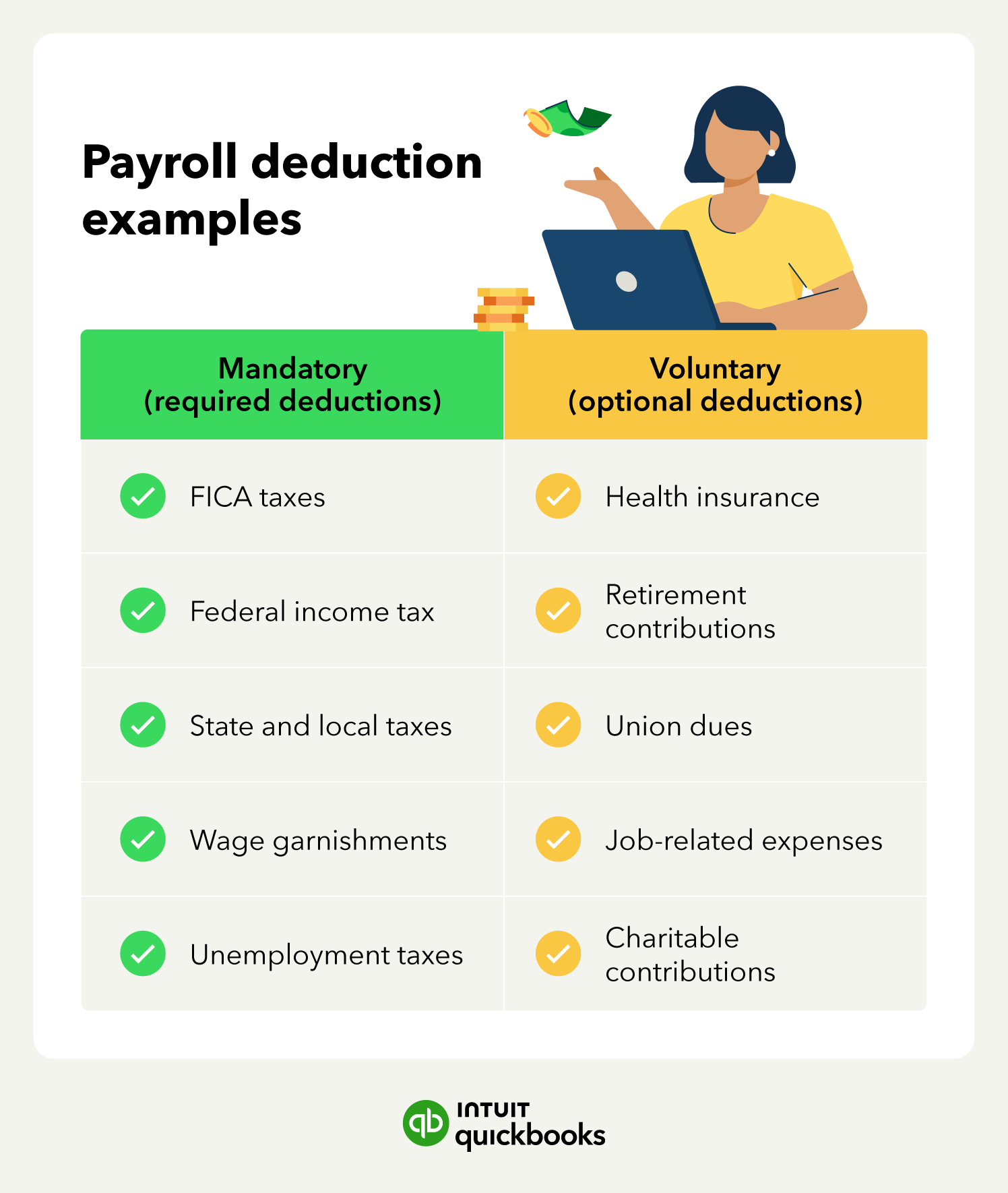
The law requires employers to pay mandatory deductions by sending them to tax agencies. Federally mandated taxes, such as FICA tax and federal income tax, are standard payroll taxes that must be taken out from an employee’s paycheck. Many employers choose to use a payroll provider to automate deductions and reduce errors.

An infographic listing examples of payroll deductions

Voluntary payroll deductions, on the other hand, aren’t required by law and only apply if an employee opts in. With employee consent, employers can withhold money for benefits like health insurance, retirement plans, charitable contributions, and other optional programs.

While voluntary deductions offer flexibility and valuable benefits to employees, employers are still key in making them available. Setting up and administering these deductions, such as insurance or retirement plans, requires:

  • Selecting providers
  • Establishing accounts
  • Ensuring legal compliance
  • Integrating the deductions into the payroll system

Pre-tax vs. post-tax deductions

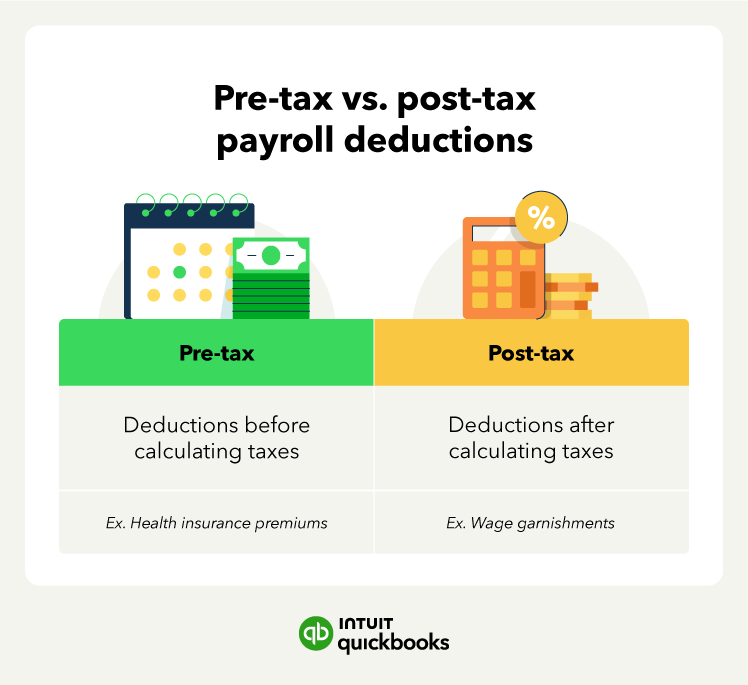
Some payroll deductions happen before other taxes are withheld—known as pre-tax payroll deductions. Meanwhile, certain deductions are only taken out after tax withholding—these are known as post-tax payroll deductions.

Pre-tax deductions are taken from an employee’s gross pay before any payroll taxes are withheld. Like employee tax deductions, pre-tax deductions reduce an employee’s taxable income, which is the money they owe to the government. Common pre-tax deductions include health insurance and retirement plans.

On the other hand, employers withhold post-tax deductions from an employee's net pay. Common post-tax deductions include wage garnishments and job-related costs like travel. 


note icon

Many employees don't fully understand how deductions work, leading to confusion and frustration. A short presentation during onboarding can clear things up and help improve employee satisfaction.


Your accounting, your taxes. All in one place.

Save time by seamlessly moving from books to taxes in QuickBooks, then file your return with unlimited expert help and your maximum refund.*

Types of payroll deductions

There are various payroll deductions that can either be mandatory or voluntary. Here are eight of the most common: 

1. FICA taxes

Mandatory payroll deduction

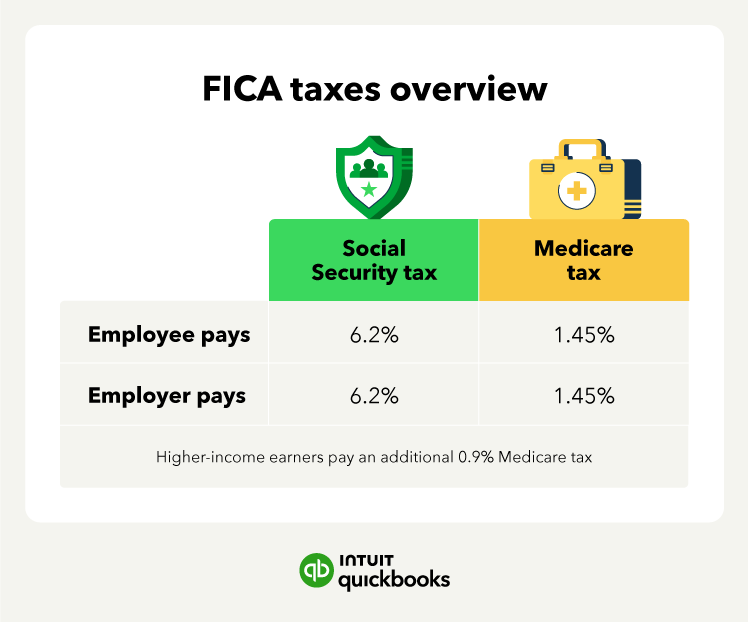
Federal Insurance Contributions Act (FICA) taxes include Social Security taxes and Medicare taxes. Employee and employer contributions for FICA are equal, with the current rate being 6.2% of gross wages coming out of an employee’s paycheck for Social Security and 1.45% going to Medicare. Employers match both of these contributions for a total of 15.3%.

An illustration of FCIA taxes and the tax rates for employees and employers.

If a company doesn’t report these taxes, it can get in trouble with the law. The amount an employee pays in FICA taxes per pay period depends on their pre-tax deductions, which lower their taxable income.

2. Federal income tax

Mandatory payroll deduction

The amount of federal income tax you withhold depends on each employee’s Form W-4. Employees fill out the W-4 to tell you how much to withhold based on things like filing status, dependents, and additional withholding preferences.

Because federal income tax is usually the largest deduction from an employee’s paycheck, keeping W-4 forms updated is essential for accurate withholding.

3. State and local taxes

Mandatory payroll deduction

Like federal income taxes, state and local payroll taxes are mandatory payroll deductions and must be paid to the appropriate tax authorities. Each state sets its income tax rate. An employee’s gross income and any pre-tax deductions will determine the amount they pay in state and local taxes.

If you work in one state, and all of your employees live in that state, then the state tax you’ll owe is pretty straightforward. However, if you have multiple offices in different states or remote employees in different states, your state payroll liabilities will be a bit more complicated.


note icon

Alaska, Florida, Nevada, South Dakota, Texas, Washington, and Wyoming are states with no income tax.


Smarter automation. Expert support.

From clean books to more leads, QuickBooks agents work for you when you need them.

4. Unemployment taxes

Mandatory payroll deduction

Unemployment taxes are paid by employers to fund federal and state unemployment programs. These programs provide temporary financial assistance to workers who have lost their jobs through no fault of their own. At the federal level, the Federal Unemployment Tax Act (FUTA) dictates the tax, while state unemployment taxes (SUTA) vary by location.

Employers are responsible for paying FUTA tax and reporting it on Form 940

FUTA tax is 6% of the first $7,000 of each employee's wages. However, employers can generally receive a tax credit of up to 5.4% if they pay their SUTA taxes on time, reducing the effective FUTA tax rate to 0.6%. 

SUTA tax rates and wage bases (the maximum amount of wages subject to tax) vary by state.

5. Wage garnishments

Mandatory payroll deduction

Employees with unpaid debt or other obligations may have wage garnishments as payroll deductions. Wage garnishments are sent by a court or government agency like the IRS and require employers to withhold money from an employee’s paycheck. 

The deductions are on a post-tax basis and usually go toward debts or obligations like:

  • Taxes
  • Alimony
  • Child support
  • Defaulted loans

The wage garnishment letter will explain how much of an employee’s paycheck has to be withheld and where the money has to be sent.

6. Health, disability, and life insurance

Voluntary payroll deduction

Health insurance and other premiums are voluntary payroll deductions that are typically made on a pre-tax basis. If you offer health benefits for your employees, you can have them pay part of their premiums via paycheck deductions. This also includes other health benefits, such as dental insurance or health savings plans. 

7. Retirement plans

Voluntary payroll deduction 

As another employee perk, companies can offer retirement plans, such as a 401(k) plan that lets employees save for retirement. Employees can have a part of their paycheck withheld as a voluntary deduction and invested in their 401(k). 

An employer can offer a few retirement plan options, and the type of retirement plan will determine whether it’s pre-tax or post-tax. For example, money put into a traditional 401(k) can be pre-tax, while money put into a Roth IRA must be post-tax.


note icon

Educate employees about the benefits of participating and starting early: Many people under-estimate how much they need to save for retirement.


8. Union dues

Voluntary payroll deduction 

Members of unions usually make regular payments to the union they’re a member of. These dues are post-tax, so they won’t offer a tax benefit. 

Union dues can go toward an employee’s membership, along with other taxable benefits offered by the union, which are all deducted on a post-tax basis.

9. Job-related expenses

Voluntary payroll deduction 

Other job expenses an employee might deduct include:

  • Meals
  • Travel
  • Uniforms
  • Home office equipment
  • Parking
  • Transit
  • Medical exams. 

These job-related costs are also deducted on a post-tax basis. 


note icon

Keep detailed records of any job-related expenses deducted from employee paychecks. This will help ensure compliance with tax laws and make it easier to answer any employee questions about these deductions.


10. Charitable contributions

Voluntary payroll deduction

Employees can choose to make charitable contributions directly from their paychecks. These deductions are typically post-tax, but they can be pre-tax if the employer has a workplace giving program that partners with a qualified charitable organization.

The advantage of payroll deductions for charitable giving is convenience. Employees can set up recurring donations to their favorite charities without having to write a check or make an online payment each time. Employers may also choose to match employee contributions, further incentivizing charitable giving.

Tips for managing paycheck deductions

Once you have all your payroll deductions in order, you’ll want a way to manage them effectively. 

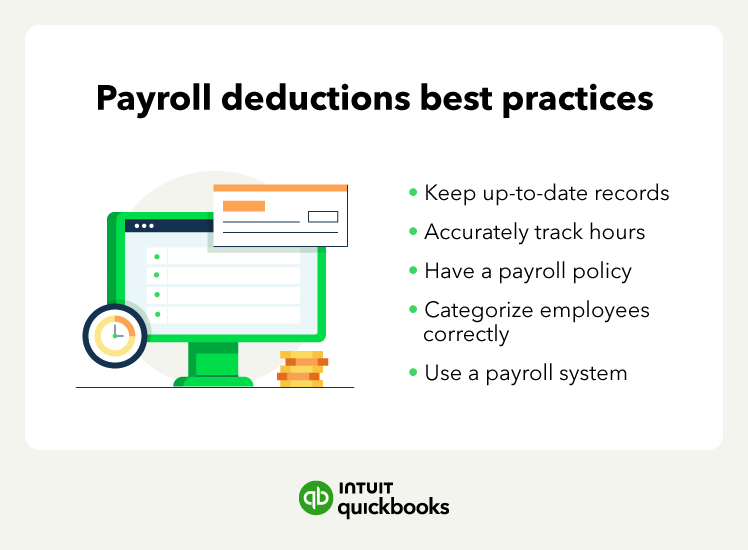
Here are some tips for staying on top of paycheck deductions: 

  • Ensure you have up-to-date employee records: This includes having a process in place for updating employee pay rates, addresses, and tax withholdings.
  • Track employee hours reliably: Use time-tracking software or apps, paper timesheets, or time clocks to ensure precise payroll if you have hourly employees. 
  • Create a payroll policy: Establish a clear policy outlining the payroll process, employee classifications, salary determinations, and reporting obligations. 
  • Categorize employees accurately: Properly classify employees as hourly or salaried to comply with legal regulations, and adhere to the Fair Labor Statistics Act (FLSA). 
  • Invest in a payroll system: Pick a system that works best for your business, whether it’s manual processing, outsourcing, or using payroll software.
An illustration of payroll deduction best practices.

How you manage your payroll will depend largely on your budget and time available, as well as your confidence in keeping all your payroll tasks in order. 


note icon

Regularly audit your payroll deductions to ensure accuracy. Mistakes can be costly and time-consuming to fix.


Next steps for streamlining your payroll process

Managing payroll deductions across multiple employees, tax rules, and benefit plans can get overwhelming fast. The good news? You don’t have to manually manage payroll taxes, tracking garnishments, benefits, and more.

Payroll software like QuickBooks Payroll, and now Intuit AI agents, can help you automate calculations, stay compliant, and reduce data entry mistakes before they happen.

Disclaimer:

QuickBooks Online Payroll & Contractor Payments: Money movement services are provided by Intuit Payments Inc., licensed as a Money Transmitter by the New York State Department of Financial Services, subject to eligibility criteria, credit and application approval. For more information about Intuit Payments Inc.’s money transmission licenses, please visit https://www.intuit.com/legal/licenses/payment-licenses/


Recommended for you

Mail icon
Get the latest to your inbox
No Thanks

Get the latest to your inbox

Relevant resources to help start, run, and grow your business.

By clicking “Submit,” you agree to permit Intuit to contact you regarding QuickBooks and have read and acknowledge our Privacy Statement.

Thanks for subscribing.

Fresh business resources are headed your way!

Looking for something else?

QuickBooks

From big jobs to small tasks, we've got your business covered.

Firm of the Future

Topical articles and news from top pros and Intuit product experts.

QuickBooks Support

Get help with QuickBooks. Find articles, video tutorials, and more.