for 3 months









Key findings:
- Entrepreneurial intent is skyrocketing in 2026: 33% of U.S. adults plan to start a business or side hustle next year — a 94% year-over-year increase.
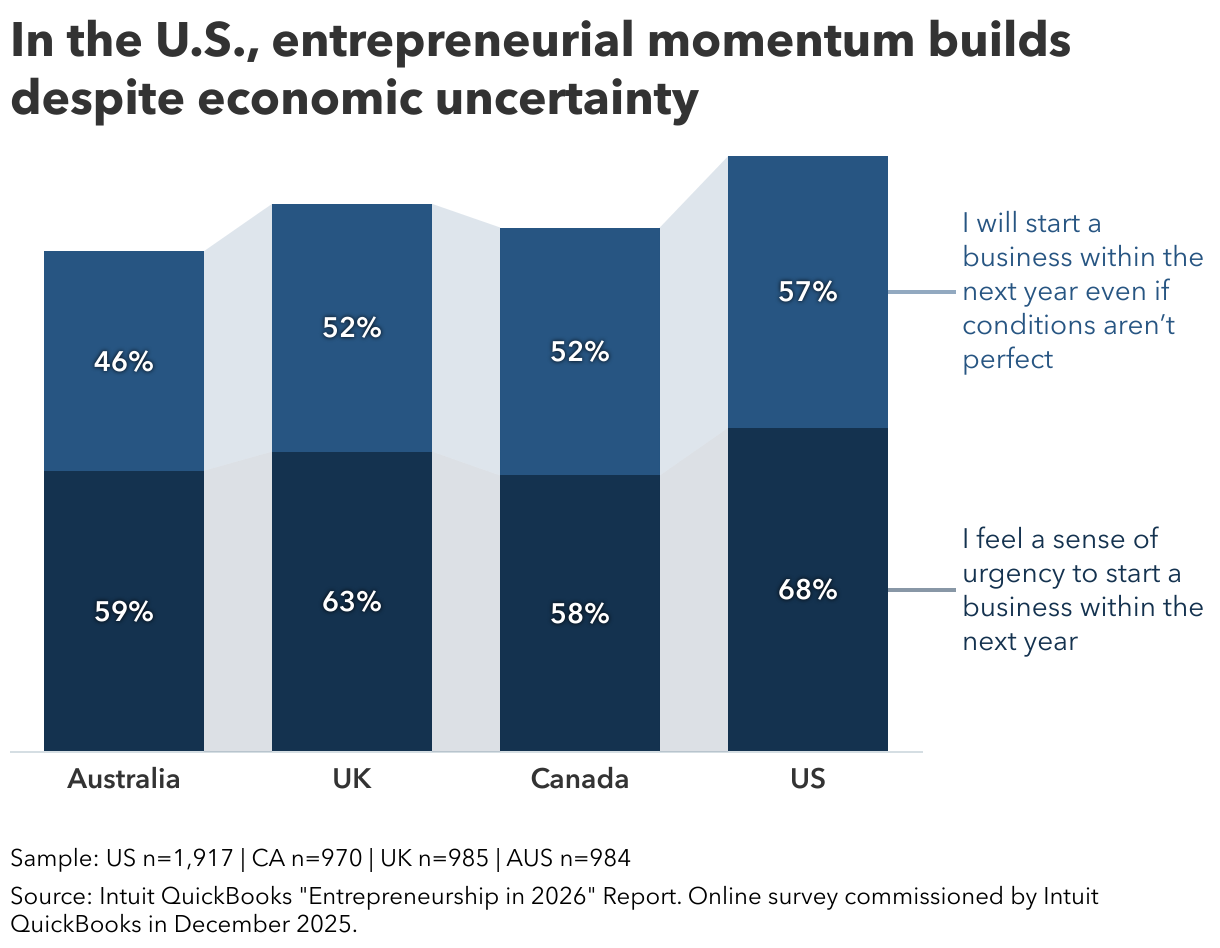
- Aspiring entrepreneurs feel pressure to launch: 68% feel a sense of urgency to start a business in 2026, and 57% say they’ll launch even if economic conditions aren’t ideal.
- Money is the biggest barrier to starting a business: 47% cite cost as the top obstacle. Americans estimate they need $28,000 to start a business, though the median actual startup cost is just $12,000.
- Financial confidence remains low: More than half of U.S. adults say they lack confidence in key business finances — from cash flow management to taxes — and 7 in 10 say this impacts their ability to reach financial goals.
- Side hustle activity is booming — but largely unregistered: 47% earned money from a side hustle in the past year, yet only 1 in 5 registered their business, fueling a growing informal entrepreneurship economy.
- Younger generations are driving new business trends: Gen Z leads in entrepreneurial intent (43%), while Millennials feel the most urgency (74%) — signaling a major generational shift in how Americans build wealth.
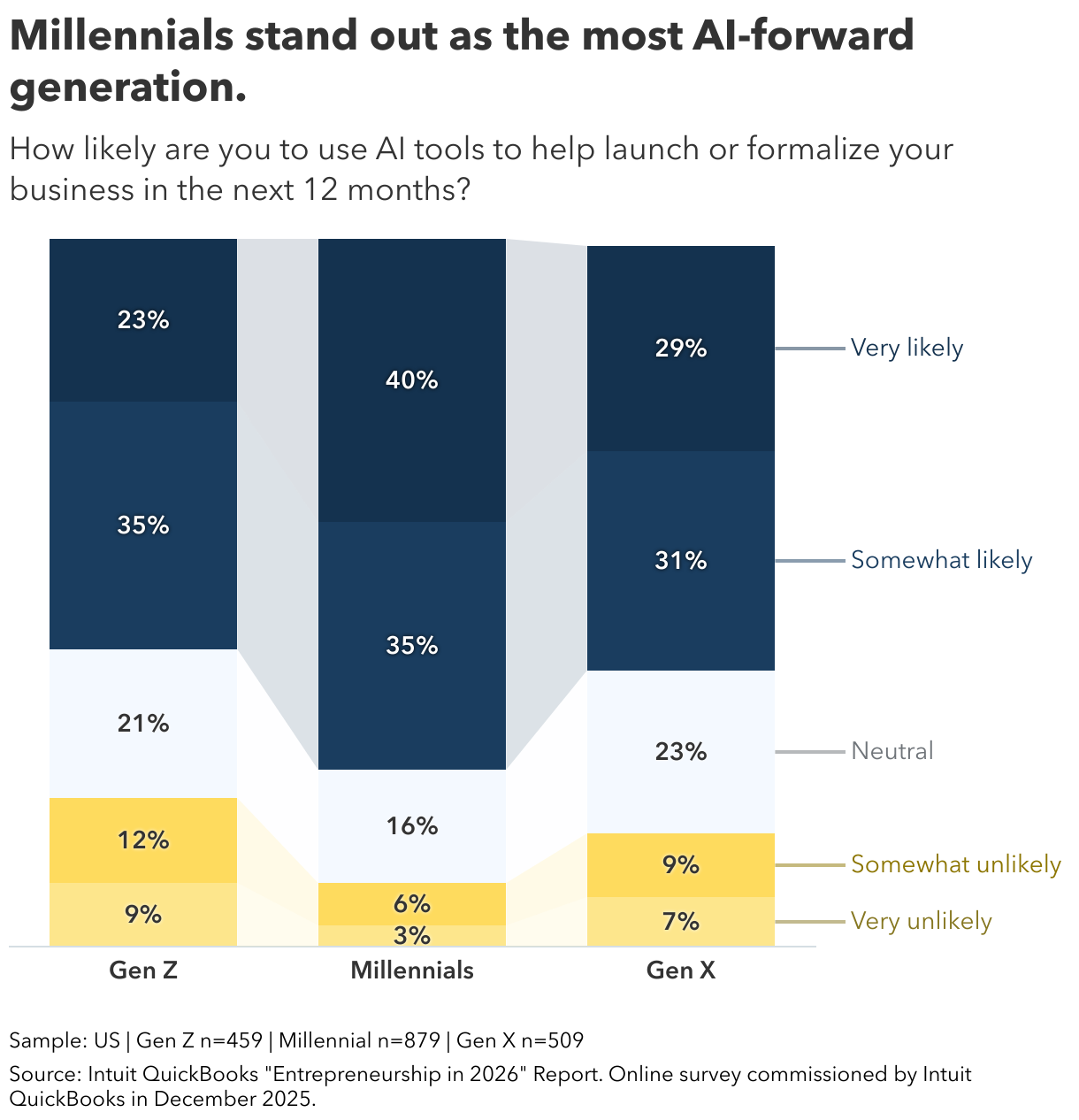
- AI is emerging as a major startup tool: More than 60% of aspiring entrepreneurs say they’ll use AI to help launch their business in 2026. Millennials are the most AI-forward, with 75% planning to use AI for branding, research, and more.
America is heading into 2026 with unprecedented entrepreneurial energy. One in three U.S. adults (33%) plan to start a new business or side hustle within the next 12 months—a 94% jump from last year—as more people view entrepreneurship as their best path to financial stability and wealth.
These insights come from a new survey commissioned by Intuit QuickBooks of more than 3,000 U.S. adults and 1,500 respondents each in Canada, the UK, and Australia, conducted to understand international entrepreneurship trends for 2026.
The data reveals a clear tension: Americans feel an urgent pull toward business ownership, yet many are held back by financial fears, funding gaps, and low confidence in core business finances. Meanwhile, a growing informal entrepreneurship economy—powered by side hustles and AI tools—is reshaping how new businesses begin.
Read on to get the full picture.
The entrepreneurial surge of 2026
Entrepreneurial ambition is accelerating in all four countries—but nowhere more than in the United States. One in three U.S. adults (33%) say they plan to start a new business or side hustle in 2026, a remarkable 94% increase over last year’s 17% and the highest level of intent among all four countries surveyed. By comparison, just 25% of Australians, 27% of Canadians, and 30% of Brits say they plan to launch a business next year, underscoring how uniquely energized the U.S. entrepreneurial landscape has become.

Across every country, the motivations are strikingly consistent: people want greater income, greater control, and a more secure financial future. Entrepreneurship now ranks as the number one wealth-building strategy heading into 2026—outranking saving cash, investing, or earning more in a traditional job. For many, starting a business isn’t just an aspiration; it’s a financial strategy.

And younger generations are leading the charge. Gen Z shows the highest entrepreneurial intent, with 43% considering starting a business in 2026—more than Millennials (39%) and more than double Gen X (21%). For Gen Z, entrepreneurship appears to be not only attainable but expected, a natural extension of how they earn income and build wealth. Their enthusiasm is a major driver behind the national surge.
The data paints a clear picture: entrepreneurial energy is building fast, and 2026 may mark one of the strongest years yet for new business creation—formal or otherwise.
The need for speed: There’s no time like the present for future founders
If entrepreneurial intent is high heading into 2026, the sense of urgency behind it is even higher. In the United States, 68% of adults who are considering starting a business say they feel pressure to get moving within the next year. More than half (57%) say they plan to start even if economic conditions are less than ideal. That willingness to move forward, despite uncertainty, sets the U.S. apart from other countries surveyed.
This urgency may stem from increasing financial pressure. Many Americans feel they need new income streams or greater control over their financial future, and they see entrepreneurship as the most direct way to get there.
Across all four countries surveyed, increasing income and building wealth is the number one motivation for starting a business—making entrepreneurship less of a long-term dream and more of a near-term necessity. For many aspiring founders, waiting no longer feels like a safe option.
Millennials feel this shift more than any other generation. Nearly three-quarters (74%) say they feel an urgent need to start their business in the next year, compared to 67% of Gen Z and 61% of Gen X. Millennials are also the most determined to launch even if conditions aren’t perfect. For many, the risk of waiting feels greater than the risk of starting.

All signs point to an entrepreneurial movement defined by determination. People want to launch sooner, not later, and they’re increasingly willing to do so under imperfect circumstances.
The question is what happens when this urgency meets the financial realities of starting a business?
The financial reality: What’s holding people back?
For all the excitement around starting a business in 2026, money remains the biggest obstacle. The financial realities of entrepreneurship are creating a wide gap between people who want to start a business and people who feel ready to take the next step.

Perceived cost vs. actual cost
A major part of the challenge is perception. Americans believe it will cost an average of $28,000 to start a business. Current business owners, however, report that the actual median startup cost is closer to $12,000.
That difference is significant. When the imagined cost to start is more than double the real cost, fear and hesitation naturally follow. Many aspiring entrepreneurs stop before they ever begin, simply because they don’t think they can afford it.

Funding gaps
Even for those who are ready to try, funding is a hurdle. Only 13% of aspiring entrepreneurs in the U.S. say they have most of the money they need to launch. One in three (32%) have less than a quarter of the required funds.
People are split almost evenly on whether they’ll use personal (53%) or business financing (47%) to start. In practice, many expect to rely on personal savings (66%) or personal credit cards (45%). Rising interest rates and the cost of borrowing add another layer of pressure.
Money as the No. 1 barrier
When asked what stops them from starting a business, almost half of U.S. respondents (47%) say money. Fear of financial failure comes next—33% say they worry about losing money. And 24% point to challenges with accessing credit.
These concerns aren’t just about dollars and cents. They speak to deeper questions about stability, risk, and what happens if things don’t go as planned.
Low financial confidence
On top of these barriers, many aspiring entrepreneurs in the U.S. feel unprepared to manage the financial side of running a business. More than half (52%) say they lack confidence in essential tasks like managing cash flow, tracking expenses, invoicing customers, or handling taxes. Seven in 10 (71%) say this lack of financial knowledge makes it harder to reach their personal financial goals.
People are motivated to start businesses, and many feel a strong need to act quickly. Yet money, confidence, and economic uncertainty slow their ability to move from idea to action.
For many, the next best option is to start small and informal—often through a side hustle.
The rise of the “invisible entrepreneur”
When financial barriers feel too big to overcome, many aspiring founders look for another way in. That’s where the informal economy comes in. Instead of launching a fully registered business, millions of people are turning to side hustles. These ventures are smaller, scrappier, and easier to start, which makes them a natural first step for anyone testing the waters of entrepreneurship.
Nearly half (47%) of Americans say they earned income from a side hustle in the past year, but only 20% of them registered their work as a business. Many also skip the basics that come with running one—they don’t track expenses, send invoices, or have a business bank account. In other words, they’re doing the work of an entrepreneur without any of the formal structure.

Side hustles offer something many aspiring entrepreneurs want: a way to build income and momentum without the upfront costs or complexity of a formal launch. For many, it is the most realistic wealth-building path available right now.
This approach isn’t unique to the United States. Side hustles are common across all four countries surveyed, although Americans tend to devote more time to their side hustles (an average 19.5 hours per month) and they earn more from this extra work (an average $2,038 per month). What is consistent everywhere is the pattern: People want new income, and they want to get started quickly, so they build something lightweight and flexible. It’s entrepreneurship in its earliest form.

This behavior also helps explain a broader trend: Despite high interest in starting businesses, official business formation numbers don’t always reflect the level of activity happening on the ground. According to the U.S. Census Bureau, there were 473,679 business applications filed in August 2025, and only 28,725 of those are projected to become employer businesses within four quarters. In other words, only a fraction of entrepreneurial activity shows up as formal business creation, and only a fraction of those go on to become employer businesses. Many people start earning before they ever register. Some never register at all.
The rise of the “invisible entrepreneur” matters for 2026 because it highlights both the opportunity and the challenge ahead. People are already acting like business owners. They’re already generating income. What they need are tools, confidence, and clarity to take the next step and formalize their work… if and when they’re ready.
The role of AI in lowering barriers to action
As more people look for faster and more affordable ways to start a business, AI is emerging as a key tool for new entrepreneurs in all four countries, but especially in the United States. Here, 65% of aspiring business owners say they’re likely to use AI to help launch their ventures in 2026. More than three in ten (31%) say they’re very likely—at least five percentage points higher than other countries surveyed. For many, AI feels like a shortcut through the parts of entrepreneurship that once felt too slow, too expensive, or too complicated. Only 16% say they’re unlikely to leverage any AI tools.

Aspiring founders plan to use AI for a wide range of early startup tasks including brainstorming business ideas or conducting market research (29%), creating websites or product listings (19%), and developing names, logos, and branding assets (14%). These steps can feel daunting for anyone who’s short on time or unsure where to begin—which many are.
About a quarter (24%) of aspiring entrepreneurs say lack of time is the biggest barrier to business ownership, and 22% cite lack of business acumen. AI helps close that gap. It gives new entrepreneurs a virtual partner they can turn to for guidance or hands-on support, and it can complete work in minutes that might take days or weeks on their own. The combination of speed, lower cost, and on-demand expertise can make the path from idea to action feel far more achievable.
Millennials stand out as the most AI-forward generation. About 40% say they’re very likely to use AI to launch their business, and 75% say they’ll use AI in some capacity. That’s a higher adoption rate than both Gen Z (59%) and Gen X (61%). Millennials’ willingness to embrace new tools, paired with their strong sense of urgency, positions them as a driving force behind AI-enabled entrepreneurship.
In a landscape where money is tight and confidence is mixed, AI represents something rare for aspiring founders. It’s a tool that reduces friction, speeds up early decisions, and makes entrepreneurship feel more achievable.
What this means for aspiring entrepreneurs in 2026
The survey findings point to a defining moment for entrepreneurship. Americans are entering 2026 with record-high interest in starting businesses, strong motivation to build wealth, and a growing sense of urgency to take action. At the same time, financial fears, funding gaps, and low confidence in core business skills continue to hold many people back.
This tension is shaping a new kind of entrepreneurial landscape. More people are choosing to start small through side hustles, which has created a fast-growing informal economy of “invisible entrepreneurs.” Others are turning to AI to simplify early startup tasks, lower costs, and help them navigate areas where they feel least confident. These shifts suggest that while the path to entrepreneurship may look different than it used to, the desire to build something of one’s own has never been stronger.
The opportunity moving into 2026 is clear: If aspiring founders can get better access to financial guidance, funding solutions, and easy-to-use tools that help them formalize their work, millions more may be able to turn their ideas into real businesses.
Sample & methodology
In December 2025, Intuit QuickBooks commissioned an online survey of 3,000 U.S. adults age 18+, along with 1,500 adults each in Canada, the United Kingdom, and Australia. The survey focused on entrepreneurship trends and predictions for 2026, including respondents’ intent to start a business or side hustle, financial confidence, funding expectations, use of AI tools, and perceived barriers to starting a business. To ensure the findings are as representative as possible, survey results have been re-weighted using post-stratification. Percentages have been rounded to the nearest whole number, so values shown in charts and graphics may not add up to 100%. Responses to multiple-choice survey questions are shown as a percentage of the number of respondents, not the total number of responses, so will always sum to more than 100%. Responses were collected using Pollfish audience pools and partner networks with double opt-ins and random device engagement sampling to ensure accurate targeting and high-quality results. Respondents received remuneration.
Where this report references official U.S. business formation activity, data is sourced from the U.S. Census Bureau’s Business Formation Statistics (August 2025).
Recommended for you


Get the latest to your inbox
No ThanksLooking for something else?
Call Sales: 1-800-285-4854





