QuickBooks Blog
A small business owner reviewing how to start an S-Corp.
Starting a business

How to start an S-corp in 5 steps (with checklist)


Key tax updates for filing taxes in 2026: 

  • Permanent extension of the Section 199A Qualified Business Income (QBI) Deduction: The 20% deduction for QBI, a significant benefit for S-corporations and other pass-through entities, is now permanent. 

  • Changes to the State and Local Tax (SALT) Deduction cap: For tax year 2025, the cap is being raised to $40,000. 

  • Permanent elimination of personal exemptions: The TCJA temporarily eliminated personal and dependent exemptions, a provision that was set to revert in 2026. However, the new tax law has made this elimination permanent. 


The QuickBooks Entrepreneurship in 2025 survey found that a majority of respondents plan to start a business this year. If this describes you, restructuring as an S-corp could help you save money during tax season.

Structuring your business as an S-corp changes the way the IRS taxes your company. Unlike a C corporation, which faces "double taxation" on profit, an S-corp operates as a "pass-through" entity. This means its profits and losses pass directly to the owner (you), who then reports the income on their personal tax returns.

In this guide, we'll cover the five essential steps you need to take to start an S-corp and set your business up for success.

Jump to:
What is an S-corp?

An S-corp itself isn’t a business entity but a special tax status you elect for your business with the IRS. It gets its name from Subchapter S of the Internal Revenue Code and combines the limited liability of a corporation with the tax benefits of a partnership.

More than 5 million businesses in the US have elected to be taxed as S-corps, making it a common choice for entrepreneurs. 

Can you create an S-corp as a one-person business?

Yes, it is possible to establish an S-corp as a one-person business. While traditionally S corporations are formed with multiple shareholders, the IRS allows a single individual to set up an S corporation. As an individual, you can be the sole shareholder, director, and employee of the S-corp.

How much does it cost to start an S-corp? 

The cost to start an S-corp will vary by state and the services you choose. You will incur state filing fees to form the initial business entity, ranging from under $50 to several hundred dollars. 

Then, you might pay professional service fees to a legal service, accountant, or attorney to handle the paperwork, ranging from a few hundred to over a thousand dollars.

All that said, the IRS does not charge a fee to file Form 2553, the document you submit to elect S-corp status.

Intuit Assist: A faster way to more money

Get paid 45% faster when you send invoice reminders with Intuit Assist.

How to start an S-corp in 5 steps

Starting an S-corp or changing your current business's classification may sound overwhelming, but it's actually simpler than it seems.

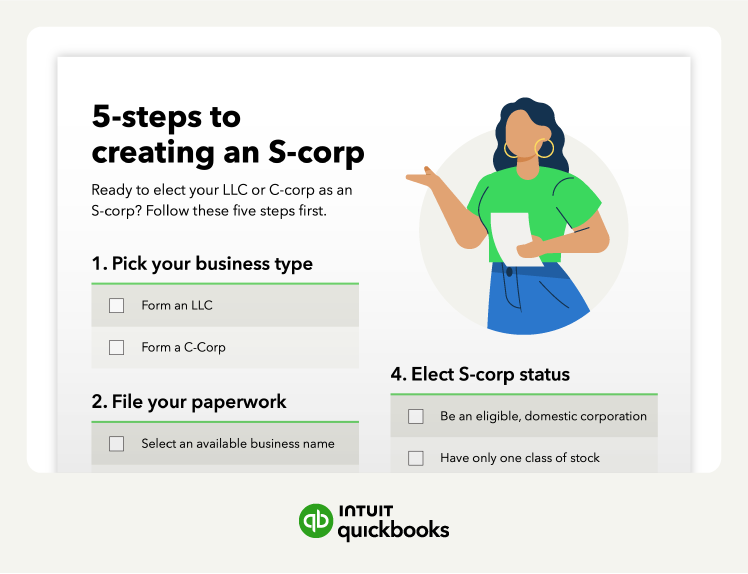
We created this five-step guide and checklist to help you navigate the process of forming an S-corp, from filing your initial paperwork to staying compliant with the IRS.

1. Pick your business type

The first step in starting an S-corp is choosing your business structure type. You typically have two options when preparing your entity for S-corp status:

  • Start an LLC: An LLC (Limited Liability Company) is a business structure that offers liability protection while allowing for flexible management. It’s a popular choice for small businesses and startups due to its simple operations and pass-through taxation.
  • Form a C-Corp: A C corporation is a distinct legal entity owned by shareholders that provides limited liability protection. It requires that shareholders hold meetings and maintain records. Each shareholder is taxed separately from the entity.

Choosing your business type carefully is crucial since this will become the foundation of your S corporation, once you elect S-corp status. After making your selection, you’ll have to register your entity with your local government. Learn more about the difference between an S-corp and an LLC.


note icon

If you have an existing Limited Liability Company (LLC), you don't need to dissolve it to become an S-corp. It is possible to convert an LLC to an S corporation.


2. File your paperwork

Whether you form an LLC or a C-Corp, the next step in forming your corporation is to select an available business name to register it under. To find out if your business name is available, you can search on your local Secretary of State’s website. If your business name is anything but your actual name, you’ll also need to file a “Doing Business As” (DBA) name.

You will also need to determine which state you’ll incorporate your business in. Consider the following logistics while making your location decision:

  • Your business’s physical location
  • Where you’ll hire employees
  • Where you’ll register your bank accounts
  • How you will accept orders

You may need the help of a registered agent, someone who receives and shares legal communications for your company, to complete S-corp setup. They will generally correspond with the government on matters like your business taxes.

3. Get an EIN

After you’ve successfully registered your corporation with your state, you’ll need to apply for an Employer Identification Number (EIN) with the IRS. An EIN is a unique nine-digit number the IRS assigns to domestic businesses for identification and tax reporting purposes.

An EIN allows you to accomplish the following:

  • Hire employees
  • Open a business account
  • Pay taxes for your business

You get your EIN by preparing and submitting Form SS-4 to the IRS. It’s important to note that an EIN is also known as a Federal Tax ID Number and a Federal Employer ID Number. This number is free to obtain and is crucial to running a legally sound business.

4. Elect S-corp status

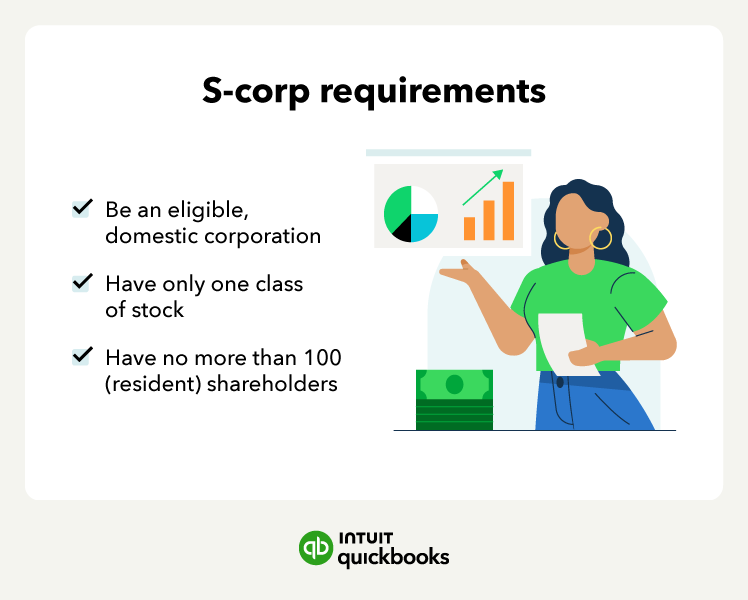
Now that you have a legal entity, complete with a registered name and EIN, it’s time to review the S-corp election requirements and elect S-corp status. Below are the criteria that qualify your LLC or C-corp as an S-corp:

  • Be an eligible, domestic corporation: Insurance companies, financial institutions, and some internationally operating domestic sales corporations don’t qualify.
  • Have only one class of stock: You cannot have distinct stock types that are entitled to different treatment, such as class A and class B, or voting and nonvoting shares.
  • Have no more than 100 (resident) shareholders: Large entities with over 100 shareholders do qualify for S-corp status.

If your corporation can satisfy all of the requirements above, you can file S-corp Election Form 2553 to apply for S-corp status. In general, you have two and a half months from the beginning of the tax year to complete the application process and claim S-corp status.

A list of S-Corp requirements.
  • Be an eligible, domestic corporation: Insurance companies, financial institutions, and some internationally operating domestic sales corporations don’t qualify.
  • Have only one class of stock: You cannot have distinct stock types that are entitled to different treatment, such as class A and class B, or voting and nonvoting shares.
  • Have no more than 100 (resident) shareholders: Large entities with over 100 shareholders do qualify for S-corp status.

If your corporation can satisfy all of the requirements above, you can file S-corp Election Form 2553 to apply for S-corp status. In general, you have two and a half months from the beginning of the tax year to complete the application process and claim S-corp status.

5. Keep up with S-corp requirements

Along with the S-corp eligibility requirements shown above, you must also pay attention to the following factors to keep your S-corp status active:

  • Salaries vs. Distributions: Since shareholder income from an S-corp isn’t treated as self-employment income, S-corp owners must maintain a proper balance between wages and distributions to ensure compliance with IRS guidelines. 
  • Reasonable salaries: The IRS requires that S-corp owners pay themselves a reasonable salary for the work they perform, taking into consideration industry standards, job responsibilities, and the company's financial situation. 
  • Fringe benefits: An S-corp must include non-wage compensations, like health insurance, retirement plans, and imputed income with its shareholder-employee wages when it issues annual W-2 forms. Keep track of the payments made for these premiums throughout the year and report them on line 29 of your Form 1040.
  • Stock ownership: Managing stock ownership is critical in S-corps to ensure proper governance and decision-making processes, as well as to determine the distribution of profits and dividends among shareholders.
  • Form 1099-MISC: As an S-corp, you will use the 1099-MISC form to report various payments made to individuals or unincorporated businesses. This is required for payments exceeding $600 in a tax year.

note icon

Note that if your S corporation is terminated, the business and its shareholders may be subject to specific tax consequences for five years. During this time, certain tax benefits may be unavailable.


As long as you can adhere to the regulations that come with being an S-corp, you can take full advantage of the taxation benefits that popularize this business type. Let’s explore the advantages of starting an S corporation below.

Introducing Intuit Assist

Your new generative AI-powered financial assistant. Intuit Assist handles administrative items on your to-do list, so you can focus on big picture growth.


note icon

Form 2553 is the form required to elect S corporation status. By submitting this form, you are informing the IRS of your business's new tax designation.


Advantages of electing S-corp status

The tax advantages and liability protection offered by S-corp status make it an attractive option for small business owners and solopreneurs alike. 

Electing S-corp status has major pros for shareholders:

S-corp self-employment tax

For S-corp owners who also work for the company, part of your income can be classified as salary, subject to payroll taxes, while the remaining profits are distributed as dividends and may not be subject to self-employment tax.

Pass-through taxation

Refers to the taxation method where business profits "pass-through" the S-corp and are directly taxed on the owners' individual income tax returns, allowing S-corporation profits and losses to be reported on shareholders' personal tax returns, avoiding double taxation.

Limited liability protection

Like a C corporation, an S-corp is a separate legal entity from its owners. This means that as a shareholder, your personal assets are protected from the business's debts and liabilities. This separation provides a crucial layer of security, giving you peace of mind as you grow your business.

Shareholder and stock limits

To qualify for S-corp status, a business must meet strict IRS requirements. These include having no more than 100 shareholders, all of whom must be US citizens or residents. The company can only have a single class of stock.

Although an S-corp has unique taxation requirements, there are payroll services for S corporations available. If these tax write-off wins sound advantageous for your business, it’s time to consider whether an S-corp is right for you.

How to know if an S-corp is right for you

Determining whether an S-corp or C-corp is the right choice for your business requires careful consideration.

Here are some key points to help guide your decision:

  • When to elect to be an LLC: Opting for an LLC may be more suitable if you prioritize simplicity or are anticipating substantial growth with numerous shareholders. As your business grows, considering S-corp taxation is a natural next step since it allows owners to be employees and take home a salary subject to payroll taxes.
  • When to elect to be a C-corp: Choosing a C corporation might be preferable if you intend to attract external investors and raise substantial capital for your business. Select this option if you foresee the need for multiple classes of stock, as well as more complex ownership and management structures.

Regardless of whether an S-corp is the right status for your business, consult with your financial advisor and tax professionals before electing a new business status.

A flowchart showing how to choose if an S-corp is the right structure for your business.

Grow your business with confidence

Now that you have a clear plan for starting an S-corp, you can take control of your finances. By taking the time to understand the legal requirements and tax implications of each type of business structure, you are building a strong foundation for long-term success.

When you're ready to manage your new business, QuickBooks is here to help. Our powerful accounting software makes it easy to track your income and expenses, pay your team, and stay on top of your finances.


Recommended for you

Mail icon
Get the latest to your inbox
No Thanks

Get the latest to your inbox

Relevant resources to help start, run, and grow your business.

By clicking “Submit,” you agree to permit Intuit to contact you regarding QuickBooks and have read and acknowledge our Privacy Statement.

Thanks for subscribing.

Fresh business resources are headed your way!

Looking for something else?

QuickBooks

From big jobs to small tasks, we've got your business covered.

Firm of the Future

Topical articles and news from top pros and Intuit product experts.

QuickBooks Support

Get help with QuickBooks. Find articles, video tutorials, and more.