- Start Your BusinessStart Your Business
- Starting a BusinessThe tools and resources you need to get your new business idea off the ground.
- PaymentsEverything you need to start accepting payments for your business.
- Funding & CapitalResources to help you fund your small business.
- Small Business StoriesCelebrating the stories and successes of real small business owners.
- Self-EmployedThe tools and resources you need to run your own business with confidence.
- Run Your BusinessRun Your Business
- Running a BusinessThe tools and resources you need to run your business successfully.
- AccountingAccounting and bookkeeping basics you need to run and grow your business.
- Cash FlowTax and bookkeeping basics you need to run and grow your business.
- PayrollPayroll essentials you need to run your business.
- TaxesTax basics you need to stay compliant and run your business.
- EmployeesEverything you need to know about managing and retaining employees.
- Grow Your BusinessGrow Your Business
- Growing a BusinessThe tools and resources you need to take your business to the next level.
- Sales & MarketingSpread the word: What you need to know about marketing your small business.
- FundingHow to find funding and capital for your new or growing business.
- Midsize BusinessesThe tools and resources you need to manage your mid-sized business.
- Enterprise Suite BlogThe tools and resources you need to grow your own business with confidence.
- E-CommerceHow to start and run a successful e-commerce business.
- TaxesTaxes
- How to fill out a 1099-NEC formLearn how to fill out and file 1099-NEC forms for independent contractors and freelancers.
- How to file small business taxesLearn how to navigate tax season with confidence and minimize your tax liability with this guide.
- Small business 1099: What you need to know for 2025Navigate the complexities of small business 1099 forms and filings with our comprehensive guide.
- 13 documents to give your accountant for small business taxesYour accountant will need these documents to file your small business taxes successfully.
- What's NewWhat's New
- NewsBrowse the latest news, press releases, and reports from QuickBooks.
- AI Resource HubFind the latest on Artificial Intelligence.
- Small Business DataThe latest research and insights for Small Businesses from QuickBooks.
- Small Business StoriesCelebrating the stories and successes of real small business owners.
- Holiday SuccessEverything you need to thrive during your business's busiest seasons.
- AI InnovationsBrowse the latest AI innovations in QuickBooks on the Intuit platform.
- ToolsTools
- All ToolsFree accounting tools and templates to speed up and simplify your workflow.
- AI-Powered Invoice GeneratorTry out this free invoice generator to create an invoice online using Intuit Intelligence.
- Payment Cost CalculatorFind out how much you could save by switching to QuickBooks Payments.
- Paycheck CalculatorAccurately estimate pay for all your employees.








Key difference between a budget and a forecast: Budgeting provides a roadmap for allocating resources and managing cash flow, while forecasting enables businesses to anticipate market conditions and make proactive decisions.
While many business owners have to focus on managing the day-to-day, planning for the future is key to managing cash flow and finding growth opportunities. Budgeting and forecasting are essential financial tools businesses use to plan for the future, but they serve different purposes.
After all, 60% of small business owners report that cash flow has been a problem, and nearly 59% admit they've made poor decisions because of it—highlighting how critical proactive financial tools are. Budgeting and forecasting both play key roles in this process, but they serve different purposes.
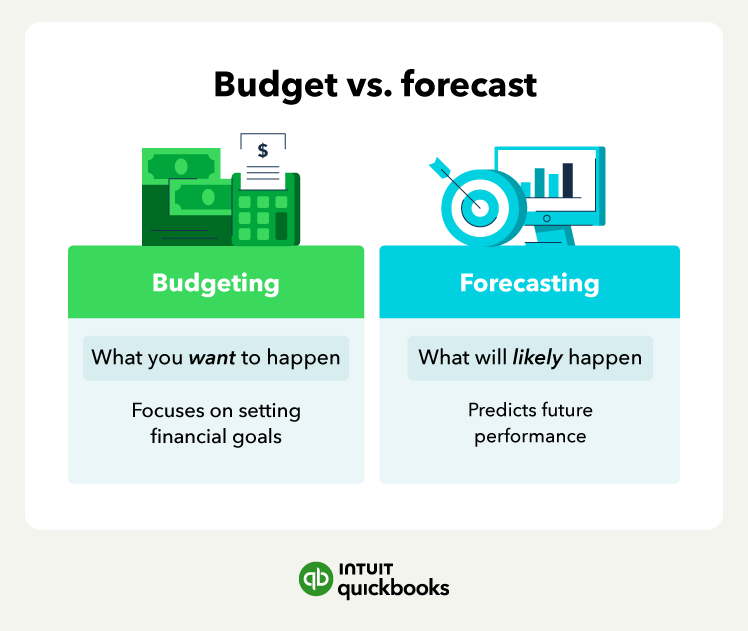
Think of a budget as where you want to go, but a forecast is where you think you’ll go. Let’s look at how to determine the differences between the two and how each can help your business:
Budget vs. forecast: 3 key ways they differ
What is a budget?
A budget is a financial plan for spending based on estimates of expenses and income over a specific period (usually a year). The purpose of a budget is to set and track financial goals for the business. It provides a framework for businesses to make strategic decisions on allocating resources and prioritizing expenses.
Depending on the company's size, there may be a budgeting process—often done toward the end of the year. The budget tends to have input from various departments and managers. In smaller companies, the owner or a few key employees, such as the bookkeeper, handle budgeting.
Most budgets are static and set for the company’s fiscal year, although you can create monthly budgets. You’ll want to periodically compare the actual results to the budgeted amounts to identify discrepancies and take corrective actions if necessary.
 Some companies use the budget to award performance-based compensation.
What is a forecast?
A financial forecast is a projection of what will likely happen—generally at a higher level, such as crucial revenue items or total expenses. You can forecast for various periods, such as short-term (a couple of months) or long-term (aka five years).
A longer-term forecast might look out over several years and be part of a longer-term strategic business plan. Shorter-term forecasts are for operational reasons.
There are different types of forecasts, such as a revenue forecast for determining headcount, production, and inventory. For accurate forecasts, rely on up-to-date financial reports, historical data, and market research.
Service businesses often use these forecasts to determine necessary staffing levels.
Which comes first: budget or forecast?
In most cases, you’ll want to create a budget first. A budget sets specific financial targets and provides a roadmap for allocating resources and managing cash flow. Once your budget is in place, forecasting comes in place to help you project how real-world performance may differ from your plan—giving you time to make course corrections.
Budget vs. forecast: 3 key ways they differ
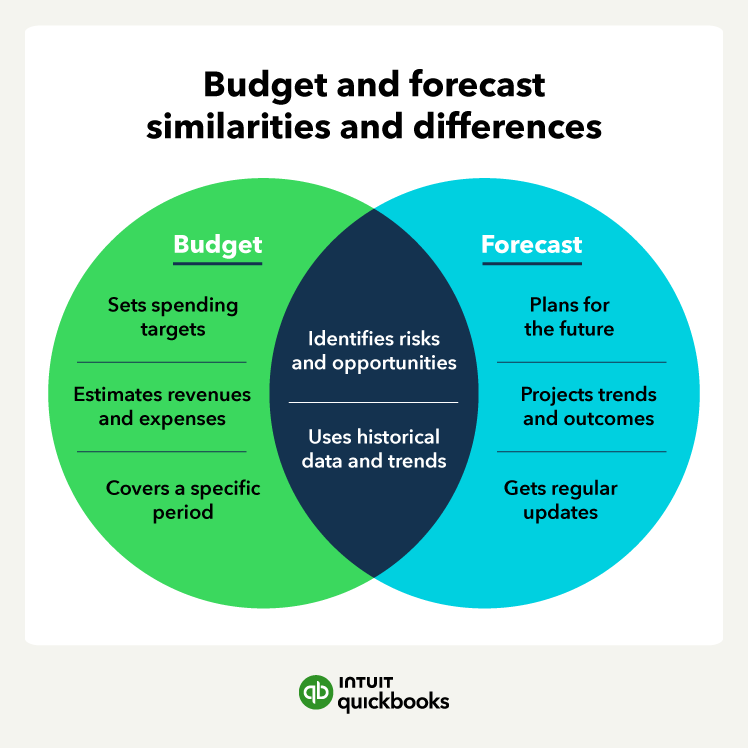
Budget and forecast are important tools in financial planning for businesses. While they share some similarities, there are key differences between the two. Let’s look at three ways in which budgets and forecasts differ:
1. Why you create them
A budget and a forecast provide a roadmap for allocating resources and guide your operations and decision-making. But businesses tend to create:
- A budget to set financial goals and track performance.
- A forecast to predict future financial outcomes and make informed decisions.
Budgets help businesses maintain financial discipline by avoiding overspending and ensuring you manage effectively. It allows businesses to plan for future investments, expansion, or debt reduction by allocating resources accordingly.
Using a forecast offers several benefits for businesses. You can use them to create pro forma financial statements or optimize operations by aligning resources and activities with projected financial outcomes. It also helps identify potential financial gaps or shortfalls, allowing businesses to take proactive measures like securing additional funding or adjusting their spending plans.
2. What periods they cover
Budgets and forecasts serve distinct purposes in business planning and tend to cover different periods (although they can cover the same ones).
The periods they cover are:
- Budgets generally cover set periods, such as one year.
- Forecasts cover longer-term periods, such as many years.
Budgets, once set, remain in place for the period. They provide a plan of action for the upcoming year. Forecasts can span several years, but you will want to update them on a rolling basis, such as monthly.
Updating your forecasts will ensure accuracy and relevance. It’s a tactical tool that helps businesses monitor and adjust items like inventory forecasts in response to changing market trends and business conditions.
3. What they track
Budgets and forecasts also differ with what they track, in particular:
- Budgets primarily track planned revenue and expenses.
- Forecasts track predicted financial outcomes.
A budget's key metrics or components include revenue targets, variable costs, and debt reduction goals. By setting revenue targets and estimating expenses, budgets enable business owners and management teams to monitor progress and make necessary adjustments to achieve desired financial outcomes.

Forecasts project future financial outcomes based on historical data, market trends, and business conditions. You can also forecast in different ways, such as top-down vs. bottom-up forecasting.
Tracking these metrics helps business owners and management teams anticipate revenue fluctuations, prepare for market changes, and make well-informed decisions.
4. Plan vs. forecast vs. actual
Financial planning often involves three layers: a plan (or budget), a forecast, and actual results.
- A plan or budget sets financial goals and expectations, such as target revenue, spending limits, and profit margins.
- A forecast is a forward-looking analysis that updates those expectations based on market conditions and real-time performance.
- Actuals are the real outcomes from your income statements and other financial reports.
Comparing forecasts and actuals against your original plan helps you make timely adjustments and improve your next round of financial projections.
Best practices for budgeting and forecasting
Ideally, you’ll use a budget as a management tool to run the business. Compare your results to your budget periodically to see how you’re doing. If expenses in a certain area exceed your budget, dig deeper to see if the overage is from overspending.

Are revenues and profits on track with the budget? Did the company add additional revenue or lose business that was part of the budget? Reviewing the budget is a key step in managing your business finances.
Here’s how to get the most out of your budgeting efforts:
- Start with a realistic projection: Your revenue projections will drive this part, but you should also do a cash flow projection and be conservative here.
- Differentiate expenses: Break out your essential expenses, like electricity and internet, from your discretionary expenses, which are not essential to running the company, such as entertainment.
- Build in debt and cash: Include debt payments and incorporate building cash reserves into your budget to ensure any extra profits are a cushion against a future downturn in business.
Forecasting is an important tool to help a company make necessary adjustments in spending and focus during the year as the business changes. For example, if a major customer plans to reduce or add to their volume of business, this will have a significant impact on operations and cash flow.
Here are some best practices for forecasting:
- Consider using more than one forecast: Generally, you’ll want to create three. One that reflects an optimistic outlook, one that’s pessimistic, and one that’s most likely to happen. You can then plan for growth but must be able to make adjustments in case opportunities don’t materialize or happen slower than originally thought.
- Update your forecast regularly: Things change, such as market conditions, so you can prepare by updating your forecast monthly or quarterly.
- Involve key members of your team: Leverage managers or your sales team to get a better look at what’s happening in your markets. Your forecast will be more accurate with this information.
Using a budget and forecast, businesses can establish realistic financial goals, track their progress, and ensure long-term viability.
Run your business with confidence
Budgeting involves setting financial goals, such as revenue targets or expense limits, and tracking your progress. Forecasting, on the other hand, helps you create financial projections based on real-time data and market trends. Both tools work together to give you visibility into your business’s financial health and agility to pivot when needed.
To effectively utilize budgeting and forecasting, it’s crucial to have a flexible and accessible solution. The solution should be easy to use, allowing business owners and team members from different departments to collaborate seamlessly. Accounting software, such as QuickBooks, can help generate budgets and projections without much effort.
Recommended for you


Explore what you can do with QuickBooks
Explore what you can do with QuickBooks

See profit at a glance


Get expert help
Looking for something else?
Firm of the Future
Topical articles and news from top pros and Intuit product experts.
QuickBooks Support
Get help with QuickBooks. Find articles, video tutorials, and more.
Call Sales: 1-800-285-4854





© 2026 Intuit Inc. All rights reserved.
Intuit, QuickBooks, QB, TurboTax, Credit Karma, and Mailchimp are registered trademarks of Intuit Inc.
Money movement services are provided by Intuit Payments Inc., licensed as a Money Transmitter by the New York State Department of Financial Services. For details about our money transmission licenses, or for Texas customers with complaints about our service, please click here.
By accessing and using this page you agree to the Website Terms of Service.