- Start Your BusinessStart Your Business
- Starting a BusinessThe tools and resources you need to get your new business idea off the ground.
- PaymentsEverything you need to start accepting payments for your business.
- Funding & CapitalResources to help you fund your small business.
- Small Business StoriesCelebrating the stories and successes of real small business owners.
- Self-EmployedThe tools and resources you need to run your own business with confidence.
- Run Your BusinessRun Your Business
- Running a BusinessThe tools and resources you need to run your business successfully.
- AccountingAccounting and bookkeeping basics you need to run and grow your business.
- Cash FlowTax and bookkeeping basics you need to run and grow your business.
- PayrollPayroll essentials you need to run your business.
- TaxesTax basics you need to stay compliant and run your business.
- EmployeesEverything you need to know about managing and retaining employees.
- Grow Your BusinessGrow Your Business
- Growing a BusinessThe tools and resources you need to take your business to the next level.
- Sales & MarketingSpread the word: What you need to know about marketing your small business.
- FundingHow to find funding and capital for your new or growing business.
- Midsize BusinessesThe tools and resources you need to manage your mid-sized business.
- Enterprise Suite BlogThe tools and resources you need to grow your own business with confidence.
- E-CommerceHow to start and run a successful e-commerce business.
- TaxesTaxes
- How to fill out a 1099-NEC formLearn how to fill out and file 1099-NEC forms for independent contractors and freelancers.
- How to file small business taxesLearn how to navigate tax season with confidence and minimize your tax liability with this guide.
- Small business 1099: What you need to know for 2025Navigate the complexities of small business 1099 forms and filings with our comprehensive guide.
- 13 documents to give your accountant for small business taxesYour accountant will need these documents to file your small business taxes successfully.
- What's NewWhat's New
- NewsBrowse the latest news, press releases, and reports from QuickBooks.
- AI Resource HubFind the latest on Artificial Intelligence.
- Small Business DataThe latest research and insights for Small Businesses from QuickBooks.
- Small Business StoriesCelebrating the stories and successes of real small business owners.
- Holiday SuccessEverything you need to thrive during your business's busiest seasons.
- AI InnovationsBrowse the latest AI innovations in QuickBooks on the Intuit platform.
- ToolsTools
- All ToolsFree accounting tools and templates to speed up and simplify your workflow.
- AI-Powered Invoice GeneratorTry out this free invoice generator to create an invoice online using Intuit Intelligence.
- Payment Cost CalculatorFind out how much you could save by switching to QuickBooks Payments.
- Paycheck CalculatorAccurately estimate pay for all your employees.










Average Costing vs FIFO: What’s the best way to analyze inventory costs?
Average Costing is used to track inventory costing via ‘average’ cost, or by averaging the costs of all the quantities that are in stock divided by the total cost of those purchases. The Average Costing Method takes the last purchase of on-hand stock, and any prior purchases, in order until all quantities are accounted for. This ‘average’ cost is then posted when the item is sold. It doesn’t change until a new purchase, at a different cost, is made.
First-In, First-Out (FIFO) is one of the most commonly used methods used to calculate the value of inventory and cost of goods sold (COGS) during an accounting period. The FIFO Method assumes that inventory purchased or manufactured first is sold first and that the newest inventory remains unsold. So the cost of the older inventory is assigned to the cost of goods sold and the cost of the newer inventory is assigned to ending inventory.
An example will make this clearer.
Let’s consider a retailer that sells computer components. They purchase the computer components from several suppliers:
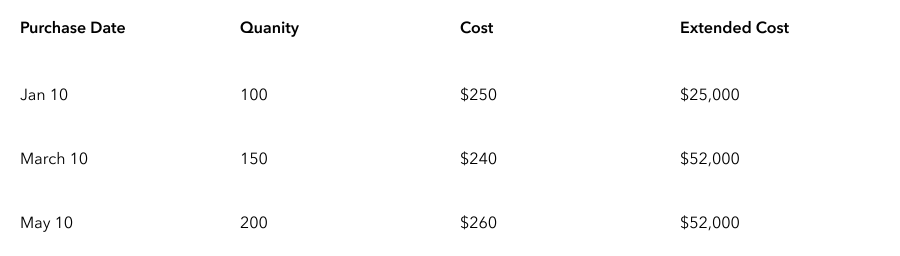
By May 10th the distributor has received 450 units in stock at an average cost of $251.11 each ($113,000/450 units), assuming that there were no sales in that period. If he sells half of his stock after that date, using average costing he will have a cost-of-goods-sold of $56,500.00.
Under FIFO, however, the costs are pulled as items are sold from the oldest purchase date, until that costing layer is exhausted, before moving on to the next. In this scenario, the distributor’s COGS would come out to $55,000 ((100 X $250) + (125 X $240)).
While that difference might not seem significant (about $1500.00), when you apply this over thousands of products and millions of dollars of goods, it can greatly change the cost that shows up on the books.
Incidentally, QuickBooks desktop software products (Pro, Premier and Mac) use ‘average costing’ versus QuickBooks Online, which uses ‘FIFO costing.
Something to consider if you are thinking of switching from ‘average costing’ to ‘FIFO costing’ is the significant impact on all financial statements. Every business switching will need to consider whether it needs to restate its financial data for prior years to reflect the new method or only apply the new method to the current and future years. Normally, the business will report the gain or loss as a line item within the financials, and should always disclose the change in the footnotes to the financial statements. However, I firmly believe, that this is a conversation that should take place with your accountant before a decision is made.
Now that we understand the difference between ‘average costing’ and ‘FIFO costing’ let’s discuss the implementation with your taxes. When you file your first corporate tax return, you can choose any of the permitted accounting methods. You do not need to obtain the Internal Revenue Service’s (IRS) approval when making your initial choice in accounting methods. However, you must use this method consistently from year to year and it must clearly reflect your income.
Once you have established your accounting method with the IRS, you must receive approval before you change your method. A change in your accounting method not only includes a change for cash to accrual but also the treatment of any material item. A material item is one that affects the time for proper reporting of the income or deduction.
The following are examples of changes in accounting method that require IRS approval.
- A change from the cash method to an accrual method or vice versa.
- A change in the method or basis used to value inventory (Average Cost, LIFO or FIFO).
- A change in the depreciation or amortization method (except for certain permitted changes to the straight-line method).
To request approval for a change in the cost basis for your Inventory valuation, look up and file IRS Form 3115 Application for Change in Accounting Method. This will notify the IRS of the change (or contact your accountant). This is usually only an informational filing, and is usually granted. It is also advisable and easiest to make the change at the start of a new fiscal year.
Many wholesalers and distributors prefer FIFO costing because it tends to match how their products flow through the warehouse, making matching cost and sales price more accurate. And, in some cases, there may be tax advantages to using this method.
If you are a current QuickBooks Desktop (Pro, Premier and Mac) user, and have made your decision to convert to QuickBooks Online , you should run the Balance Sheet and Inventory Valuation Summary reports prior to conversion to be able to tie back to your desktop file. Upon completion of the conversion, you should be able to tie these reports confirming the conversion was successful.
Whichever method you choose, QuickBooks will help keep your books in order. Above all else, clarity around your inventory will help you analyze and forecast future investments.
You could save up to 25% on transaction costs².
Speak with us now to see if you qualify.
Talk to sales 1-800-515-8366
Monday - Friday, 6 AM to 4 PM PT
Payroll Compliance

Details on the One Big Beautiful Bill Act and how it affects payroll

USPS changes may affect your postmark date

Mandatory State Paid Family Leave Programs
Accounting

Here’s what’s new in QuickBooks Online for August 2026

The accounting equation: A beginner’s guide with examples
Customer Stories

Why Amborella Organics trusts QuickBooks AI to handle the heavy lifting of a $10M+ vision
At Petal Salon, Amanda Lee Harvey keeps her clients in the pink

Normal Ice Cream saves 7 hours a week on banking admin thanks to QuickBooks Bill Pay

How The Baby Pantry shows up for families in need

Explore what you can do with QuickBooks
Explore what you can do with QuickBooks

See profit at a glance


Get expert help
Looking for something else?
Firm of the Future
Topical articles and news from top pros and Intuit product experts.
QuickBooks Support
Get help with QuickBooks. Find articles, video tutorials, and more.
Call Sales: 1-800-285-4854





© 2026 Intuit Inc. All rights reserved.
Intuit, QuickBooks, QB, TurboTax, Credit Karma, and Mailchimp are registered trademarks of Intuit Inc.
Money movement services are provided by Intuit Payments Inc., licensed as a Money Transmitter by the New York State Department of Financial Services. For details about our money transmission licenses, or for Texas customers with complaints about our service, please click here.
By accessing and using this page you agree to the Website Terms of Service.