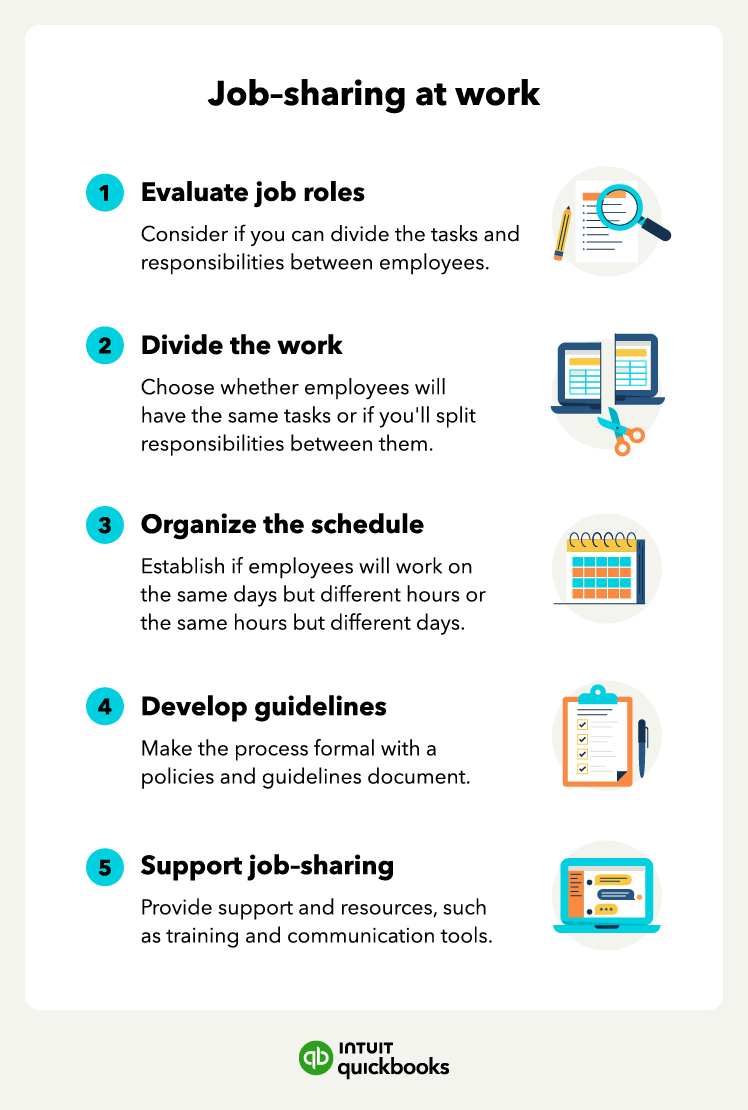
If you’re interested in implementing job-sharing into your business, planning ahead of time and establishing clear guidelines will lead to a successful flexible work arrangement.
Some best practices when implementing work sharing include:
- Ensure partner compatibility: If possible, allow employees to pair up with each other, and ensure partners have a similar work ethic and complementary skills.
- Foster effective communication: Establish open and transparent communication between partners and provide the right tools to ensure they can easily communicate and get information about tasks and responsibilities.
- Establish a clear schedule: Define each partner's job description both verbally and in writing, tasks, and responsibilities, as well as ensure they have a set schedule to avoid overlaps and gaps in coverage.
- Align on handover procedures: Create a process for handing over processes and tasks with pending tasks and ongoing projects to ensure a smooth transition between jobs.
- Provide training: Provide special training to the manager overseeing the arrangement and encourage meetings between partners to discuss tasks, projects, and concerns.
- Keep improving: Monitor the job-sharing arrangement, evaluate its effectiveness, and make adjustments based on outcomes and feedback.
Tailoring these tips to your business needs and employees and providing sufficient training can help you successfully implement a work-sharing arrangement to benefit your employees and your business.
Job-sharing examples in small businesses
Job-sharing is more common and might work best in roles you can split into clear tasks or parts, such as administrative positions, customer service, and project management. It may not work for jobs that require employees to be present all the time, such as certain customer-facing and managerial roles.
For example, an administrative assistant might need more personal time but would still want to keep working. Since you can divide their position into two part-time positions, you can create a job-sharing arrangement with one employee working Monday through half of Wednesday, and the other from Wednesday through Friday.
Each partner would be responsible for the same tasks while clearly communicating with each other on Wednesdays what the other needs to complete. It’s also helpful to have a manager overseeing and documenting the process to ensure employees are handing off and completing tasks properly.
A marketing specialist still completing their graduate program is another example of job-sharing. They may want to work part-time while studying, but your business needs a full-time employee. As a workaround, two marketing specialists can job-share a position, with one focusing on digital marketing while the other handles content creation and social media management.
Run your business with confidence
While flexible work arrangements might not work for every business, job-sharing could be an opportunity to provide your employees with a better work-life balance and give them the chance to spend more time with family or pursue a passion project. In return, it may help you retain top talent and increase employee productivity.
Now that you know what job sharing is, consider how this arrangement can benefit your small business and whether it outweighs the challenges you may face. And remember, for a successful job-sharing arrangement, you need to ensure employees are tracking time correctly and managing their time effectively.