QuickBooks Blog
A small business owner filing their quarterly business taxes.
taxes

What is Form 941? Your guide to quarterly federal payroll taxes


Key tax updates for filing taxes in 2026:

  • A new version of Form 941 for reconciling federal payroll taxes was released in March 2025, removing expired COVID-related credits.
  • The wage base for calculating Social Security tax increased from $168,600 in 2024 to $176,100 in 2025.
  • The due date for filing your Q4 2025 return is February 2, 2026.


Accurately calculating payroll taxes is key to running a business, and Form 941 is important to complying with these requirements. Nearly all employers use this form to report federal income tax, Social Security tax, and Medicare tax withheld from employee paychecks.

The 941 return serves a critical function: it allows you to reconcile your tax liability against your deposits for the quarter. Given that the IRS processes millions of Forms 941 each year, this is one of the most common tax forms for American businesses.

In this article, we’ll explore how Form 941 works, review the filing deadlines, and take a look at some real-world 941 return filing examples.

What is Form 941?

Who must file Form 941?

What does Form 941 report?

When to file and pay Form 941

How to fill out Form 941

Find peace of mind come tax time

What is Form 941?

Form 941, Employer's Quarterly Federal Tax Return, is a form you, the employer, will need to fill out when reconciling your payroll taxes. 

The purpose of the IRS Form 941 is simply to reconcile the tax dollars you’ve paid versus your actual tax liability. Most businesses have to make tax payments throughout the quarter, not when filing a 941 return. 

At the end of each quarter, employers who paid wages subject to federal taxes can complete the form to determine their tax liability. Employers will report federal income, Social Security, and Medicare tax withholdings (which includes both the employee and employer portions).


note icon If your 941 return shows you overpaid taxes, you can apply the funds to next quarter’s return or request a refund. If you underpaid, you’ll need to pay immediately.


Who must file Form 941?

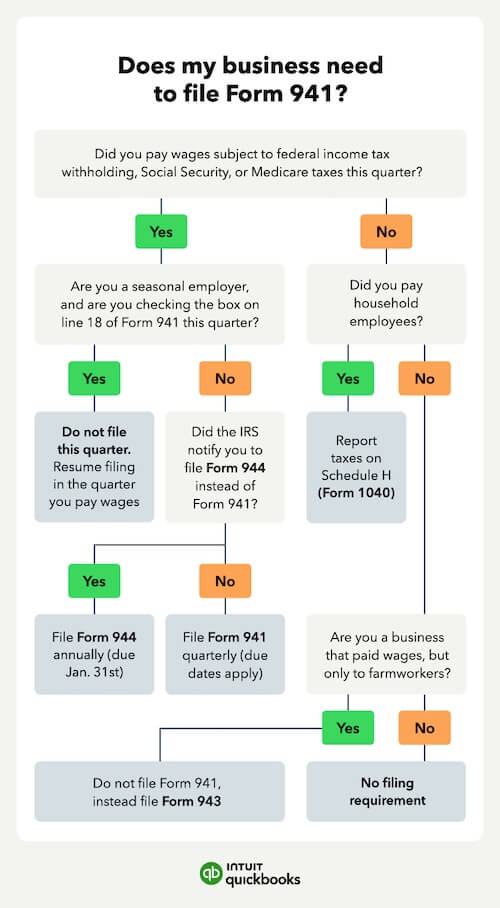
Most businesses that pay wages subject to federal income, Social Security, or Medicare taxes must file Form 941. 

An image showing a flowchart for businesses to determine whether or not they need to file Form 941.

However, the IRS does outline a few limited exceptions: 

  • Seasonal employers only need to file 941s for the quarters in which they paid wages
  • Very small businesses can file an annual tax return (Form 944) if notified by the IRS
  • Agricultural businesses file an annual Form 943 instead of a 941
  • Household employers or those who pay household workers, like nannies or housekeepers, can report payments made on Schedule H of their 1040
  • Businesses with no employees or those that only use independent contractors do not need to file a 941
  • Closed businesses that have already filed their final 941 don’t need to file one for the remaining quarters of the year

Outside of these exceptions, your business must file a quarterly 941, even if you didn’t pay wages that quarter. 

Form 941 vs. other employment tax forms

Form 941 is just one of the many tax forms you may need to fill out as a small business. From reporting taxes paid to recording wages, here's a quick summary of the most common employment tax forms.

What does Form 941 report?

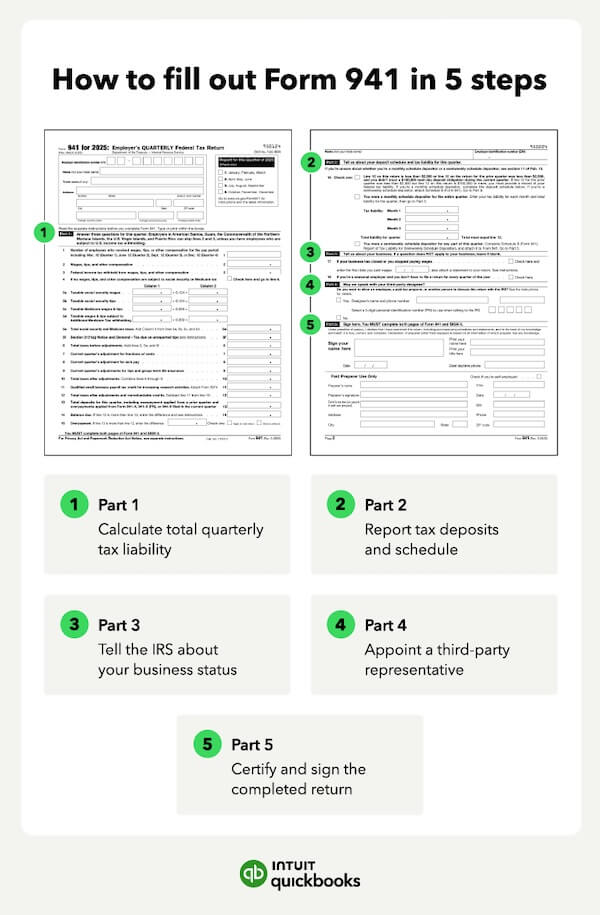
Tax Form 941 records the tax withheld from employees’ wages plus the employer portions of Medicare and Social Security tax. The form is broken up into five parts. 

The reporting of wages paid and payroll taxes collected is addressed in Part I of the form. You’ll need to record information like:

  • The number of W-2 employees paid
  • The total wages you issued that quarter
  • Taxable tips
  • Federal income tax liability of 12.4% (6.2% for employees plus 6.2% employer portion) 
  • Social Security tax liability of 2.9% (1.45% employee and employer portions)
  • Additional medicare tax of 0.9% for wages exceeding $200,000 ($250,000 for married couples filing jointly)
  • Adjustments for sick pay and life insurance
  • The amount of payroll taxes already withheld and deposited

It's worth noting that up to $176,100 (for 2025) worth of an employee’s income is subject to Social Security tax, but there is no taxable limit on Medicare tax. You can also report certain exemptions and other situations on Form 941, like being a seasonal employer.


note icon If you file a 941 return and then discover there are errors, you can file a Form 941-X to correct the return.


When to file and pay Form 941

Form 941 is filed quarterly with a due date of the last day of the month following a quarter. For instance, for the first quarter ending in March, payment would be due by April 30th, or the next business day after the 30th.  

Tax payments, on the other hand, need to be paid on your deposit schedule. After completing the 941, you’ll need to remit payment immediately if you find you’ve underpaid. 

Quarterly due dates for 2026

For 2026, the quarterly due dates for Form 941 are:

  • 4th quarter of 2025: February 2, 2026
  • 1st Quarter: April 30, 2026
  • 2nd quarter: July 31, 2026
  • 3rd quarter: October 31, 2026
  • 4th quarter: January 1, 2027

For businesses with a tax liability of less than $2,500 in any quarter, tax payment is due when the form is due, provided you don’t incur a $100,000 next-day deposit obligation during the current quarter.

Tax deposit schedules

When paying payroll taxes, you will be assigned a deposit schedule based on your overall tax liability. There are two main schedules: monthly and semiweekly. 

The IRS uses a 12-month lookback period ending June 30th of the previous year to determine which schedule to use. So, for your 2025 deposit schedule 2025, the IRS will look at July 2023 through June 2024.

During those 12 months, you would be assigned the monthly schedule if you had a tax liability of $50,000 or less. Deposits will be due on the 15th of the month following the payroll date. So if payroll was issued on April 14th, your tax deposit would be due by May 31st.

Businesses with a tax liability of more than $50,000 or those with a single-day liability of over $100,000 will be assigned the semi-weekly schedule. Deposits are due every other week on either Wednesday or Friday, depending on when payroll is issued. 

However, there is one notable exemption to the deposit schedule. Small businesses with a tax liability of less than $1,000 can make annual tax payments and use Form 944 in place of Form 941.


note icon If you’ve just launched your business, you have no lookback period, so the IRS will automatically assign you to the monthly deposit schedule.


What is Form 944 vs. Form 941?

The most important difference between Form 941 and Form 944 is how frequently you file each form. 

  • Form 941 is filed quarterly by most employers.
  • Form 944 is filed annually and is intended for very small businesses whose annual tax liability for Social Security, Medicare, and withheld federal income tax is $1,000 or less.

The IRS must notify a business in writing if they are eligible and required to file Form 944 instead of Form 941. You can't just choose to file the annual form. If you haven't received official notice from the IRS, you must file Form 941 quarterly.

How to fill out Form 941

The Employer’s Quarterly Federal Tax Return form is divided into five parts. From calculating taxes owed to providing information on who prepares your taxes, here’s some guidance on filling out each of the sections accurately.

An image showing the five steps of filling out Form 941.

Part 1: Quarterly tax information

Part 1 is where your tax liability is calculated. And perhaps more importantly, this section will tell you whether or not your withholdings are accurate. 

In this section, you’ll need to report wages paid, tips paid, and taxes withheld. You’ll also need to perform detailed calculations on your tax liability. Let’s look at an example scenario. 

Example

A small marketing agency has five employees, and for quarter 1, these employees were paid a total of $70,000. The employees did not earn tips. 

The Social Security income tax calculation would be $70,000 × 0.124 = $8,680. The Medicare tax valuation would be $70,000 × 0.029 = $2,030. The business owner would then add these two results to the federal income tax withheld to determine their total tax liability minus any adjustments. 

If the final tax liability is lower than the total tax the marketing agency deposited, then they would be owed a refund. But if the liability is higher, they would need to pay the outstanding total immediately. 

Part 2: Deposit schedule and tax liability

The next section of Form 941 looks at your deposit schedule as well as the dollar total of your tax liability. As a business, you’ll need to select whether you deposit monthly or semiweekly and record your tax liability. How this is reported will depend on your deposit schedule. Let’s look at an example. 

Example:

Susie owns a donut shop employing one baker and one counter clerk. For the 2nd quarter, she paid $20,000 in wages. Her tax liability for this quarter comes to $3,050. Per the IRS lookback period, she was assigned to the monthly schedule. 

In part II, Susie would check the second box and enter her tax liability for April, May, and June individually, along with the total. 

If Susie’s total liability was less than $2,500, she could check the first box. In contrast, if Susie owned several successful donut shops and were assigned the semiweekly deposit schedule, she would check the third box. She would need to attach a separate Schedule B to show a breakdown of her tax liability.


Your accounting, your taxes. All in one place.

Save time by seamlessly moving from books to taxes in QuickBooks, then file your return with unlimited expert help and your maximum refund.*

Parts 3-5: Your business, third-party designee, and signature

The final three sections of the 941 are much shorter. Part 3 lets you designate whether you are a seasonal business or have permanently shut down operations. Part 4 is to give the IRS permission to discuss your taxes with your tax preparer (or other 3rd party designee), and Part 5 is where you sign the return. 

For example, let’s say you owned a seasonal shop that sells Halloween costumes. In part 3, you could check the seasonal employer checkbox. If you also have a CPA, you can provide the IRS with their information, along with permission to discuss your return in Part 4. And once you’ve completed the 941 and verified its accuracy, you would sign it in Part 5.

Find peace of mind come tax time 

Completing Form 941 is an essential part of filing your taxes as a business. By reconciling your FUTA taxes each quarter, you can ensure your taxes get fully paid and avoid costly IRS penalties. However, to fill out the form accurately, you’ll need to carefully track your payroll, compensation, tax payments, and more. 

This is where tax and accounting software comes in. From tracking business expenses and filing your taxes to pulling payroll reports, QuickBooks can help you with all of your bookkeeping, tax, and accounting needs.


Recommended for you

Mail icon
Get the latest to your inbox
No Thanks

Get the latest to your inbox

Relevant resources to help start, run, and grow your business.

By clicking “Submit,” you agree to permit Intuit to contact you regarding QuickBooks and have read and acknowledge our Privacy Statement.

Thanks for subscribing.

Fresh business resources are headed your way!

Looking for something else?

QuickBooks

From big jobs to small tasks, we've got your business covered.

Firm of the Future

Topical articles and news from top pros and Intuit product experts.

QuickBooks Support

Get help with QuickBooks. Find articles, video tutorials, and more.