

QuickBooks Blog
Two business owners discussing how intercompany transactions work.
bookkeeping

5 ways to strengthen your supply chain strategy with examples


Key takeaways:

  • Efficient intercompany accounting is vital for accurate financial reporting and business growth.
  • You can streamline operations and enhance transparency by implementing standardized policies, automation, and regular reconciliations.
  • Use QuickBooks Online Advanced for real-time visibility into intercompany balances and performance metrics.


Managing intercompany transactions across multiple entities can feel like navigating a maze of invoices, reconciliations, and compliance checks. You juggle differing currencies, shifting tax rules, and scattered data—and every misstep can eat into your bottom line. 

Too often, teams spend hours chasing internal reimbursements or correcting misposted entries, only to face audit risks and frustrated stakeholders.

Imagine streamlining those cross-company charges into a single, transparent workflow, where balances settle themselves, reporting aligns in real time, and you’ve built in controls. Discover some proven best practices for intercompany accounting that turn complexity into clarity and keep your multi-entity books audit-ready.

What are intercompany transactions + how do they work?

Why intercompany transactions matter

Key challenges with intercompany transactions

Best practices for managing intercompany transactions

How to eliminate intercompany transactions in consolidation

Technology that simplifies intercompany accounting

Is your intercompany transaction process scalable?

Spend more time growing your business

What are intercompany transactions + how do they work? 

Intercompany transactions are financial activities that occur between two or more legal entities under the same parent organization. These multi-entity transactions span everything from internal sales to cost allocations, forming a core part of intercompany accounting.

An image of how an interal sale of equipment works.

They work through a series of negotiated agreements, invoices, and reconciliations. Each entity records its side of the transaction—one as a receivable and the other as a payable. Those entries then undergo intercompany reconciliation. Automation tools can match invoices and payments, align balances, and flag discrepancies.

Here are some common types of intercompany transactions:

  • Sale of goods/services: One entity sells products or provides services to another internal division.
  • Loans or advances: Short‑ or long‑term financing flows between group companies.
  • Cost allocations: Shared expenses, such as IT, HR, and rent, are distributed across subsidiaries.
  • Revenue sharing: Profits from joint projects or pooled resources are divided according to an agreed-upon formula.
  • Asset transfers: Fixed assets like equipment or property move between entities, often at book or fair value.

Accurate tracking of these accounting transactions is vital for regulatory compliance and audit-readiness. When entries and reconciliations stay aligned, you mitigate tax risks, maintain clean financial statements, and simplify the audit process. This helps keep your multi‑entity books both transparent and reliable.

Why intercompany transactions matter

Effective management of intercompany transactions ensures your business has balanced ledgers and transparent reporting during consolidation. It helps you avoid reconciliation delays, audit findings, and stakeholder frustration.

When handled correctly, intercompany transactions lead to:

  • Accurate financial reporting across entities: Proper recording and elimination of internal transactions ensures that both subsidiary and consolidated statements reflect only genuine external activity.
  • Streamlined consolidations and audits: Automated netting and settlement workflows accelerate the financial close and simplify audit procedures by preparing reconciled balances for review.
  • Stronger internal controls and transparency: A robust system of automated controls offers end‑to‑end visibility over transaction lifecycles, reducing manual errors and enhancing governance.
  • Enhanced risk management and compliance: Clear documentation, transfer pricing governance, and regular reconciliation minimize regulatory exposure and ensure adherence to global tax and accounting standards.

note icon Use comprehensive accounting software to auto‑generate elimination journal entries and net intercompany balances. It will help you speed up your close and eliminate manual posting errors.


Key challenges with intercompany transactions

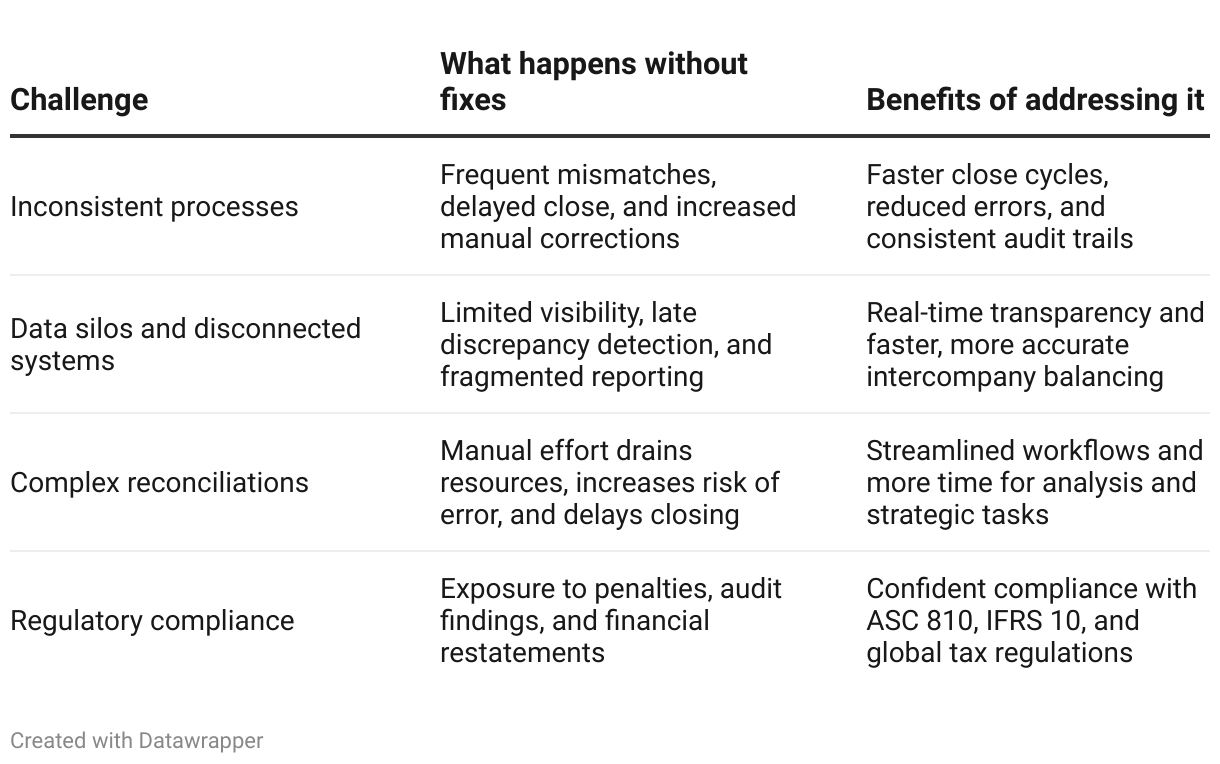
Intercompany transactions often encounter hurdles due to nonstandardized procedures, fragmented data, and manual workflows. To maintain accuracy and audit readiness, you must address these issues with consistent processes, integrated systems, and automation. 

Inconsistent processes

Without standardized workflows across entities, you lack uniform initiation, approval, and posting sequences. These can lead to frequent reporting mismatches and reconciliation bottlenecks. Teams often resort to ad‑hoc manual corrections, which delay the financial close and heighten the risk of misposted or duplicated entries.

Data silos and disconnected systems

Subsidiaries operating on disparate accounting platforms create data silos that block real‑time visibility into intercompany balances. These fragmented systems prevent seamless data flow, delaying the identification and resolution of discrepancies until period‑end close.

Complex reconciliations

Manually matching offsetting entries across multiple ledgers is labor‑intensive and prone to human error. It often extends the financial close by days. When reconciliation tasks dominate your team’s workload, there’s little time to investigate anomalies or optimize processes.

Regulatory compliance

Cross‑border intercompany activities must comply with complex transfer pricing frameworks and diverse tax regimes to avoid penalties and audit adjustments. Compliance with consolidation standards like ASC 810 and IFRS 10 demands detailed documentation, timely eliminations, and transparent reporting.

Best practices for managing intercompany transactions

You need to treat intercompany accounting as a strategic advantage, not as a headache, to reap maximum benefits. Here are some best practices for treating intercompany transactions to ensure accuracy, boost transparency, and reduce close-cycle stress. 

Establish clear policies

Start by defining and documenting standardized policies for initiating, approving, recording, and reconciling the transactions. These policies should cover acceptable pricing models, such as cost-plus or market-based, specify required documentation, and outline approval workflows. Clear guidance keeps all entities aligned.

Automate intercompany processes

Automating intercompany tasks helps reduce human error and speeds up financial operations. When automating, focus on:

  • Eliminating manual journal entries based on predefined rules, ensuring accuracy and timeliness.
  • Auto-matching and reconciling intercompany balances across ledgers, reducing close-time burdens.
  • Implementing real-time data syncing across entities, making reporting faster and more reliable.

note icon Use platforms like QuickBooks Online Advanced, NetSuite OneWorld, or Oracle Cloud EPM to auto-post intercompany entries, track exceptions, and create consolidated reports with ease.


Maintain a consistent chart of accounts

Create and distribute a master chart of accounts template, and enforce its use during setup and updates.

Using a uniform chart of accounts across all entities simplifies consolidation, reporting, and variance analysis. It eliminates the need to map or translate account codes between subsidiaries and allows for apples-to-apples comparisons at the entity and enterprise levels.

Use intercompany clearing accounts

Set up dedicated clearing accounts for each entity pair, and automate entries where possible.

Clearing accounts act as an internal ledger between entities, helping you track reciprocal transactions and record both sides of an entry. This approach is key to preventing imbalances and providing a clean audit trail for intercompany activity.

Introducing Intuit Assist

Your new generative AI-powered financial assistant. Intuit Assist handles administrative items on your to-do list, so you can focus on big picture growth.

Reconcile frequently

Schedule regular reconciliation checkpoints and use automation tools to flag mismatches.

Don’t wait until quarter-end or year-end to reconcile. Monthly—or even real-time—reconciliations help catch discrepancies early, reduce period-end pressure, and ensure financials are always up to date.

Conduct regular audits

Develop an audit checklist and assign periodic reviews to a cross-functional internal team.

Regular internal audits or process reviews help validate intercompany activity, identify compliance gaps, and improve control effectiveness. These reviews also ensure that documentation is for external audits or tax reporting.

How to eliminate intercompany transactions in consolidation

When subsidiaries within a corporate group engage in transactions, such as sales, loans, or asset transfers, with each other, you must eliminate these activities during consolidation. 

For instance, if Subsidiary A sells goods to Subsidiary B, you must remove both the recorded revenue in A and the corresponding expense in B from the consolidated income statement. This ensures that internal transactions do not artificially inflate the group's overall financial results.

Without properly eliminating intercompany transactions, your business’s financial reports can reflect inflated revenues, expenses, assets, or liabilities. This can lead to potential misinterpretations of financial health and performance.

Real life consolidation adjustment examples for intercompany transactions

Eliminating intercompany transactions removes internal sales, loans, or expenses between entities to avoid double-counting in consolidated financials. Adjusting consolidations involve broader changes to align and finalize the group’s financial statements. These changes can be currency conversion or minority interest adjustments.

Here are a few examples:

  • Intercompany sales elimination: Subsidiary A sells $500,000 worth of goods to Subsidiary B. In the consolidated income statement, that $500,000 in sales and corresponding cost of goods sold are eliminated to avoid overstating revenue and expenses.
  • Intercompany loan elimination: Parent Company lends $1 million to its Subsidiary. On the consolidated balance sheet, the intercompany receivable and payable are eliminated to prevent inflating both assets and liabilities.
  • Unrealized profit elimination: Subsidiary A sells inventory to Subsidiary B at a markup, and the goods haven’t been sold to a third party yet. The unrealized profit is removed from consolidated profits until the goods are sold externally.
  • Currency conversion adjustments: A European subsidiary reports in euros, but the parent company consolidates in US dollars. The subsidiary’s financials are converted to USD, and any resulting translation differences are recorded in other comprehensive income.
  • Minority interest adjustment: Parent Company owns 80% of Subsidiary C. When consolidating, 20% of Subsidiary C’s net income and equity is attributed to non-controlling interests.

These adjustments ensure the consolidated financial statements present an accurate and fair view of the overall group’s financial position.

Technology that simplifies intercompany accounting

Multi-entity accounting is a financial management system that supports multiple subsidiaries or branches under a single umbrella. It simplifies consolidation, centralized reporting, and compliance management across different jurisdictions.

Using built-in automation, QuickBooks can help identify and eliminate intercompany transactions, reducing manual entries and minimizing reconciliation errors.

Is your intercompany transaction process scalable?

As your business grows, you will face more complexities while managing intercompany transactions. To ensure your processes can scale effectively, ask yourself:

  • Can we reconcile all intercompany transactions within 48 hours of closing?
  • Are we still doing manual eliminations in spreadsheets?
  • How confident are we in our audit trail across entities?
  • Do we have standardized policies for intercompany accounting?
  • Are our systems integrated to provide real-time visibility?
  • Is our current process adaptable to future growth?

If you can’t properly answer any of these questions, it may be time to reassess and enhance your intercompany transaction processes to support your business's scalability and compliance needs.

Spend more time growing your business

Accurate intercompany accounting is essential for maintaining financial integrity and supporting business growth. By implementing standardized policies, automating processes, and utilizing appropriate tools, you can reduce errors, ensure compliance, and streamline financial operations.​

Solutions like QuickBooks Online offer customizable dashboards and reporting tools for real-time visibility into intercompany balances and performance metrics. Explore more about it and how it can benefit your small business.


Recommended for you

Mail icon
Get the latest to your inbox
No Thanks

Get the latest to your inbox

Relevant resources to help start, run, and grow your business.

By clicking “Submit,” you agree to permit Intuit to contact you regarding QuickBooks and have read and acknowledge our Privacy Statement.

Thanks for subscribing.

Fresh business resources are headed your way!

Looking for something else?

QuickBooks

From big jobs to small tasks, we've got your business covered.

Firm of the Future

Topical articles and news from top pros and Intuit product experts.

QuickBooks Support

Get help with QuickBooks. Find articles, video tutorials, and more.