SALE EXTENDED  
70% OFF 
QuickBooks
for 3 months  Ends 12/8
QuickBooks Blog
Female evaluating the cost of payroll providers.
Payroll

Switching payroll providers: 6 steps to follow for a seamless transition

As your company grows, your payroll software needs to grow with you. If you’re tired of working with clunky, outdated, and overcomplicated payroll processing software, consider switching payroll providers. 

According to the QuickBooks Entrepreneurship in 2025 report, 44% of business owners are looking to expand their team in 2025. That means it's more important now than ever to have the right accounting software for your business.

Why switch to a new payroll provider?

Your service provider should work for you, not the other way around.


If your business has outgrown your current payroll provider's services, you’ve become disillusioned with recurring mistakes, poor service, lack of integration, or some other issue is rubbing you the wrong way—don’t hesitate to explore your options.


You may find that another provider can offer: 


  • Lower prices
  • Efficient and streamlined services
  • User-friendly software with the latest technology
  • Fewer payroll processing and tax filing errors


When is the best time to switch payroll providers?

The best time to switch payroll providers is at the start of a new tax year. 


This ensures that your new provider will have all of the information they need to help you file your taxes next year and to send out the correct forms to your employees and contractors. 


Later, we'll share a more detailed guide about the timeline you should use to switch providers and what to do if you decide to switch mid-year. 


But for now, let’s discuss tips for choosing a new payroll provider.


How to choose a new payroll provider

If your current payroll system isn’t up to your standards, do some research and find one that is. 


The best way to do this is by creating a list of payroll companies that meet your needs, checking their reviews, and trying out their software for yourself. Here’s how you can get started: 


  • Determine which payroll features you need. Make a list of the features that are most important to you. This may include things like creating paychecks, handling direct deposits, filing taxes, or keeping track of payroll reports.  
  • Make a list of recommended providers. Compile a “maybe” list of providers who offer the features you outlined previously. 
  • Examine referrals and reviews. Investigate their online reviews and request testimonials from current and former clientele. 
  • Assess their software. Find out which payroll system is the most intuitive, includes the features that are important to you, and can grow with you. 
  • Request a free trial. Ask to try out the software free of charge before you commit to purchasing. 

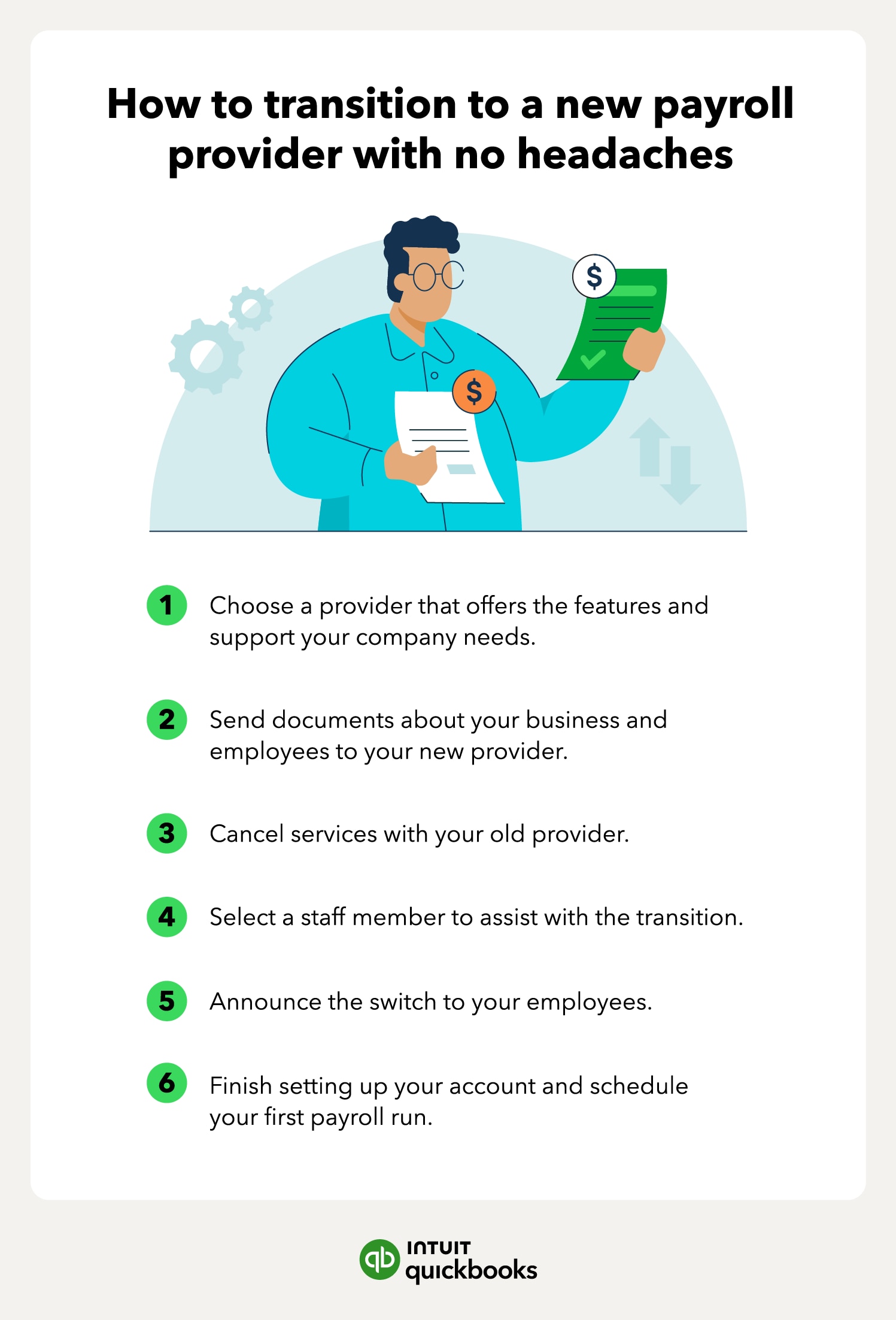
How to switch payroll providers in 6 steps

A list explaining the steps on how to switch to a new payroll provider.

If you didn’t sign a contract with your current payroll provider, switching services can be done in five easy steps. To pull off a seamless transition, you just need to:


  • Agree on services and a start date with your new provider.
  • Send employee and business information and tax history to whoever is helping you create an account.
  • Discuss next steps for canceling services with your current provider.
  • Choose someone in your organization to help you transition services.
  • Finalize your new account, verify that all of the information is correct, and process your first payroll. 

 1. Choose a new provider

Not all payroll providers offer the same services, and those that do might have varying levels of quality or customer support. 


Some may only handle the paperwork and direct deposits while others will help you set up automated tax filing, time tracking integrations, and professional advising. 


Ultimately, you need to choose the services that suit your business’s unique needs. 

2. Prepare for the new provider

Before you can set up your new account, you need to gather information about your payroll schedule, company details, and at least a year’s worth of historical information including tax reports and employee earnings. 


Here is some of the data you will need: 


  • Business information: Federal Employer Identification Number (FEIN), legal name, business structure, state and local tax IDs, address, and state unemployment insurance number.
  • Employee data: Direct deposit information, compensation, mailing address, Social Security number (SSN), and tax withholding information.
  • Payroll information: Current schedule, quarterly reports, tax returns, and paystubs for current and former staff (including contractors). 
  • Banking information: Bank account with routing number and a voided check.


You can download most of this information yourself. However, if you run into trouble, you can also reach out to customer service for help. 

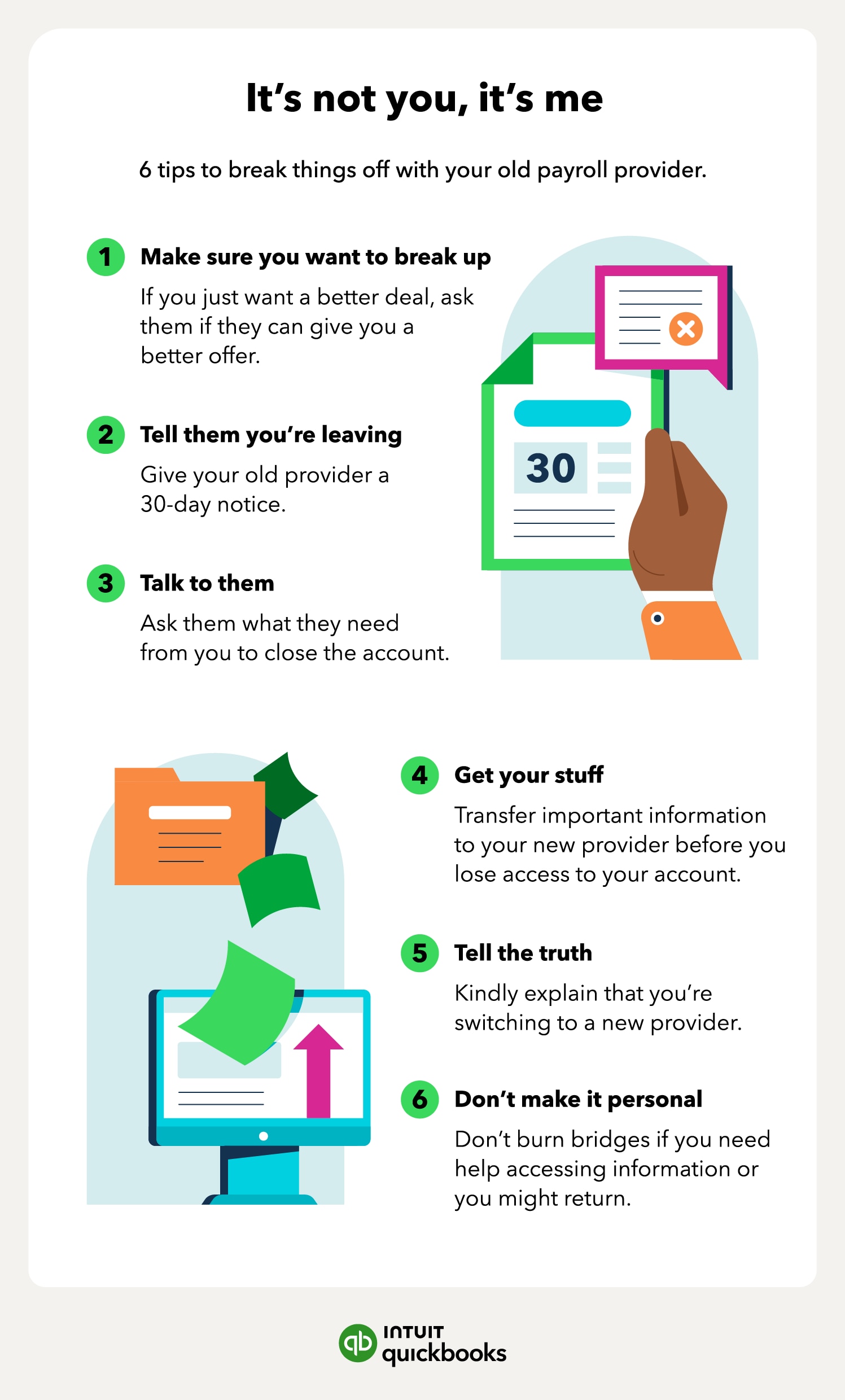
3. Break up with your old provider

A list explaining the steps on how to switch to a new payroll provider.

After you’ve agreed on a start date and developed a transition plan with your new provider, talk to your old one about canceling services. 


Keep in mind that it may take a few business days for your provider to terminate your contract, so be sure to give them plenty of time so you don’t get roped into another month. Generally, you can give written notice to terminate your contract a couple of weeks before your next payment is due, but some companies require a 30-day notice. 


If you’re not sure if you’re under contract, review the sign-on materials they sent you or reach out to your customer support representative for answers and next steps. 


You also need to ask when they will close out your account to ensure you transfer over all of your information before you lose access. 

What To Avoid When Canceling

If you have a good relationship with your current provider and are just leaving because your company outgrew them, you might want to let them down easy—but it’s important not to lie. 


For example, if you tell them you just don’t need to run payroll anymore, they may notify the Internal Revenue Service (IRS) and your state government.


This isn’t vindictive. They may just think they’re responsible for closing out your account if they’re under the impression that you’re going out of business. 

4. Appoint a lead

If you won’t be handling the transition yourself, choose someone within your organization to take charge of finalizing details and ensuring that your new payroll company has the information they need to process the next payroll without a hitch. 


This person should ensure that all of your data is transferred to the new platform before you lose access. 

5. Notify your staff

Your new provider should help ensure a seamless transition, so the switch shouldn’t affect your employees much. However, they will lose access to old paystubs and they need to be on the lookout for errors on their first paycheck in case their personal data is entered incorrectly.


Send out a payroll change announcement so all of your employees are aware and have sufficient time to prepare.


Tip: Encourage employees to print and file at least one year’s worth of their paystubs for tax purposes. 

6. Set up your new account

Upload company and employee information and payroll data to your account yourself or connect with an HR advisor for help starting and maintaining your account.


Before finalizing your account, you will need to schedule the first payroll processing date and verify that the future pay dates align with the schedule you ran last year. 


Then, you should be good to go!


You should also familiarize yourself with the details of your account so you’re aware of fees, cancellation requirements, and how to keep your account active.


Tip: Closely assess all paystubs that go out on the first payroll run to ensure all of the data was transferred correctly. 

4 Factors to consider before switching payroll providers

The features you need from your payroll provider will vary depending on your company, number of employees, tax requirements, and other factors that are specific to your company. 


Before making a final decision, assess the features and cost of the new payroll service plan, timing considerations, and your old contract. 

Payroll system features 

If you choose to work with a full-service payroll provider, they should offer accounting and HR services like:


  • Customer support
  • Payroll processing 
  • Direct deposits
  • Tax return filing
  • New hire reporting
  • W-2 preparation
  • Tax payments
  • Time tracking integrations
  • Direct deposit
  • Expense reporting 
  • Payroll reports
  • Automations and integrations

Payroll software cost 

When you start using a new payroll provider, you may need to pay a one-time fee to create your account, a monthly fee, and fees for any additional bookkeeping services you choose to utilize. 


Some questions you should ask before committing to a new payroll service:


  • How does the price compare to your current provider?
  • If the price is higher, do they offer more or higher quality services than your current payroll provider?
  • If it costs less, do their services still fulfill all of your business needs?

Time of year

The best time to switch to a new payroll service provider is at the start of the calendar year or at the beginning of a new quarter, but you can do it at any time if you aren’t under contract. 


Starting fresh in January is smart because you don’t have to worry about transferring historical payroll data since you will have just filed your tax return(s). Another benefit is that if your new provider runs your first payroll of the new year, they will have everything they need to file quarterly and year-end tax forms for you.  


If you want to start with a new company on the first of January, you’ll need to start preparing in December. Follow along with this calendar to figure out what to do and when so you’re not stuck scrambling to get set up when the holidays roll around. 


Switching payroll providers mid-year can be more complicated, but not impossible. 


As a business owner, you must pay and file reports with several government agencies. If you hire a new payroll company halfway through the year, you will be responsible for importing data from previous pay periods for the year immediately, especially if your deadline to submit your quarterly federal tax return is coming up quickly. 

Current contract terms

Do you have a contract with your current payroll provider? If you’re seriously considering making a switch then it’s time to dust it off and see when you will be free from your agreement.


You generally can end a contract early but you will likely have to pay hefty fees.

6 problems that may arise during the transition

If you’re putting off switching payroll providers because you’re worried the process will be complex or time-consuming, there’s no need. Yes, it may take effort to reduce liabilities and some money for upfront fees, but with help from a solid customer service representative, you can successfully complete the transition with very little hassle. 


Still, it’s good to be aware of potential issues that can arise so you know what to look for and know when to reach out for help. Some common issues that occur after switching to a new payroll service include:


Problem #1: Accounting errors like employee misclassification and incorrect tax withholding rates can lead to more substantial issues when it’s time to do your taxes. 


Solution: Review the information loaded in your accounting software to ensure it is correct. You should also look over the first round of paystubs that go out to catch any mistakes.


Problem #2: Setting the wrong schedule can result in missing a payroll, running it too often, or not enough.


Solution: Make sure that you choose a payment schedule and that the upcoming payment dates align. You can choose to pay your employees on a weekly, bi-weekly, semi-monthly, or monthly basis. 


Problem #3: If your payroll processing system sends paychecks to employees at different times, it can be difficult to stay organized and may anger some of your employees. It’s also illegal to pay employees with the same worker classification at different times.  


Solution: Talk to whoever manages your payroll system to ensure they’re aware of any payment variations for different employment classifications. 


Problem #4: You may end up double paying state and/or federal taxes. This means taxes would be withdrawn twice within one pay period.


Solution: If the IRS double taxes you, you should see it in your bank statement and know you need to resolve an issue. Fortunately, they will automatically initiate a refund if you overpay.  


Problem #5: It might take awhile to figure out payroll integrations which means your time tracking and retirement planning tools may not transmit accurate information. 


Solution: In Quickbooks, you can execute integrations easily under settings. Then, just run a test to make sure everything works correctly.

Secure a seamless switch

Payroll is generally one of the most expensive costs to businesses, you don’t also need the hassle of fixing ongoing errors or dealing with legal complications. 


Don’t let bad payroll hold you back, make the change today. Automate your payroll system with QuickBooks.

Switching payroll providers: FAQs

What should SMBs look for in payroll software?

Small and medium-sized businesses should prioritize ease of use, HR integrations, mobile accessibility, compliance features, and scalability when choosing payroll software. These features ensure efficiency and adaptability as your business grows.

What questions should I ask before buying payroll software?

You should inquire about tax filing services, supported integrations, customer service options, analytics tools, and cancellation policies. These factors help ensure the software aligns with your company’s specific needs and future goals.

How do HR and payroll work together?

HR and payroll integrate to streamline processes like employee compensation, benefits management, compliance with labor laws, and tax form generation. Together, they ensure accuracy, reduce duplicative administrative tasks, and boost employee satisfaction.

How do I get leadership buy-in to switch payroll providers?

Highlight inefficiencies in the current system, present ROI estimates, showcase improved features, and explain how minimal disruption will occur during the transition. Clear communication about cost savings and operational benefits is key.

When is the best time to switch payroll providers?

The ideal time to switch is at the start of a new tax year or fiscal quarter to minimize complexities of transferring historical payroll data and ensure tax compliance. Mid-year switches are possible but may require extra preparation.

What’s the timeline for switching payroll providers?

Plan at least one month ahead by researching providers, notifying employees, collecting data, and canceling old contracts. Conduct reviews and finalize the first payroll run within the first month of transition.

What recent legal changes should I be aware of?

For 2025, federal updates include the Social Security taxable earnings cap rising to $176,100 and stricter IRS electronic filing requirements for businesses submitting 10 or more information returns. Ensure payroll compliance with federal and state minimum wage adjustments.


Recommended for you

Mail icon
Get the latest to your inbox
No Thanks

Get the latest to your inbox

Relevant resources to help start, run, and grow your business.

By clicking “Submit,” you agree to permit Intuit to contact you regarding QuickBooks and have read and acknowledge our Privacy Statement.

Thanks for subscribing.

Fresh business resources are headed your way!

Looking for something else?

QuickBooks

From big jobs to small tasks, we've got your business covered.

Firm of the Future

Topical articles and news from top pros and Intuit product experts.

QuickBooks Support

Get help with QuickBooks. Find articles, video tutorials, and more.