- Start Your BusinessStart Your Business
- Starting a BusinessThe tools and resources you need to get your new business idea off the ground.
- PaymentsEverything you need to start accepting payments for your business.
- Funding & CapitalResources to help you fund your small business.
- Small Business StoriesCelebrating the stories and successes of real small business owners.
- Self-EmployedThe tools and resources you need to run your own business with confidence.
- Run Your BusinessRun Your Business
- Running a BusinessThe tools and resources you need to run your business successfully.
- AccountingAccounting and bookkeeping basics you need to run and grow your business.
- Cash FlowTax and bookkeeping basics you need to run and grow your business.
- PayrollPayroll essentials you need to run your business.
- TaxesTax basics you need to stay compliant and run your business.
- EmployeesEverything you need to know about managing and retaining employees.
- Grow Your BusinessGrow Your Business
- Growing a BusinessThe tools and resources you need to take your business to the next level.
- Sales & MarketingSpread the word: What you need to know about marketing your small business.
- FundingHow to find funding and capital for your new or growing business.
- Midsize BusinessesThe tools and resources you need to manage your mid-sized business.
- Enterprise Suite BlogThe tools and resources you need to grow your own business with confidence.
- E-CommerceHow to start and run a successful e-commerce business.
- TaxesTaxes
- How to fill out a 1099-NEC formLearn how to fill out and file 1099-NEC forms for independent contractors and freelancers.
- How to file small business taxesLearn how to navigate tax season with confidence and minimize your tax liability with this guide.
- Small business 1099: What you need to know for 2025Navigate the complexities of small business 1099 forms and filings with our comprehensive guide.
- 13 documents to give your accountant for small business taxesYour accountant will need these documents to file your small business taxes successfully.
- What's NewWhat's New
- NewsBrowse the latest news, press releases, and reports from QuickBooks.
- AI Resource HubFind the latest on Artificial Intelligence.
- Small Business DataThe latest research and insights for Small Businesses from QuickBooks.
- Small Business StoriesCelebrating the stories and successes of real small business owners.
- Holiday SuccessEverything you need to thrive during your business's busiest seasons.
- AI InnovationsBrowse the latest AI innovations in QuickBooks on the Intuit platform.
- ToolsTools
- All ToolsFree accounting tools and templates to speed up and simplify your workflow.
- AI-Powered Invoice GeneratorTry out this free invoice generator to create an invoice online using Intuit Intelligence.
- Payment Cost CalculatorFind out how much you could save by switching to QuickBooks Payments.
- Paycheck CalculatorAccurately estimate pay for all your employees.











Table of contents
Table of contents
You could save up to 25% on transaction costs².
Speak with us now to see if you qualify.
Talk to sales 1-800-515-8366
Monday - Friday, 6 AM to 4 PM PT
Business Continuity Tips for Small Businesses
- Establish clear team communication channels and check on their physical and emotional well-being before focusing on operations.
- Keep physical and cloud-based copies of your insurance policies, emergency contacts, and recovery procedures.
- Focus the first 24 hours on securing facilities and notifying customers before moving on to deep-dive financial recovery or risk assessments.
- Use quiet times to apply for SBA resources or build a cash reserve.
- Regularly update your risk assessment as your business grows and your service providers change.
According to a recent QuickBooks study, 7 in 10 aspiring entrepreneurs say a lack of financial confidence directly impacts their ability to reach their goals. When an emergency strikes, that uncertainty can turn a manageable setback into a business-ending crisis.
While you can’t predict a disaster, you can control your response by building a foundation of financial and operational resilience. This toolkit is designed to replace panic with a plan, helping you protect your team and your bottom line.
We’ll walk through how to triage your business immediately, fill critical gaps in the following days, and build long-term systems to ensure you're ready for whatever 2026 throws your way.
What is a business continuity plan?
At its core, a business continuity plan (BCP) is a documented strategy that outlines how your business will continue to operate during an unplanned disruption in service.
While an emergency plan focuses on immediate safety (like evacuating a building), a continuity plan focuses on the long-term recovery of your operations. It identifies your most essential functions (*like processing payroll, fulfilling orders, or maintaining your website*) and creates a roadmap to keep them running even if your physical location or primary systems are compromised.
Why your small business needs a business continuity plan
For a small business, a few days of downtime isn't just an inconvenience; it can be a catastrophic financial hit. A formal BCP helps you:
- Minimize downtime: Pre-determined workarounds mean you spend less time "figuring it out" and more time serving customers.
- Protect your reputation: Proactive communication prevents customer churn and maintains professional trust.
- Lower insurance costs: Some providers offer better rates to businesses that demonstrate a commitment to risk management.
- Ensure data integrity: By identifying your "single points of failure," you can back up critical data before it’s lost forever.
Think of it as financial insurance for your workflow. You hope you never have to use it, but having it ensures that when the unexpected happens, you aren't starting from zero.

Personalized insights built for your business
Intuit Intelligence delivers relevant, up-to-date insights that are tailored to your business size and industry.
Remote work and cybersecurity
Your continuity plan must account for a distributed team and the digital threats they face while working from home.
Your continuity plan must account for a distributed team and the digital threats they face while working from home.
To keep your digital operations secure, require multi-factor authentication for all logins and use a centralized password manager to prevent losing access to critical tools. Follow the 3-2-1-1-0 backup rule by keeping three copies of your data on two different media types, with one copy off-site and one copy completely offline. This prevents ransomware from spreading to your backups and ensures you can rebuild your systems even if your primary hardware is destroyed.
Supply chain continuity
A disaster affecting your suppliers can stall your business even if your own facility is safe. Identify your most critical vendors and determine how long you can operate if their deliveries stop.
Map out your entire supply chain to find single points of failure, such as relying on one manufacturer for a custom part. To build resilience, pre-qualify backup vendors in different geographic regions and maintain a safety stock of essential inventory.

Constant communication is key. Share your emergency contact details with your primary suppliers so you can coordinate logistics as soon as a disruption occurs.
6 things you can do immediately for business continuity
The first few hours after an emergency are about triage. Your goal is to ensure safety and keep the core of your business from stalling.
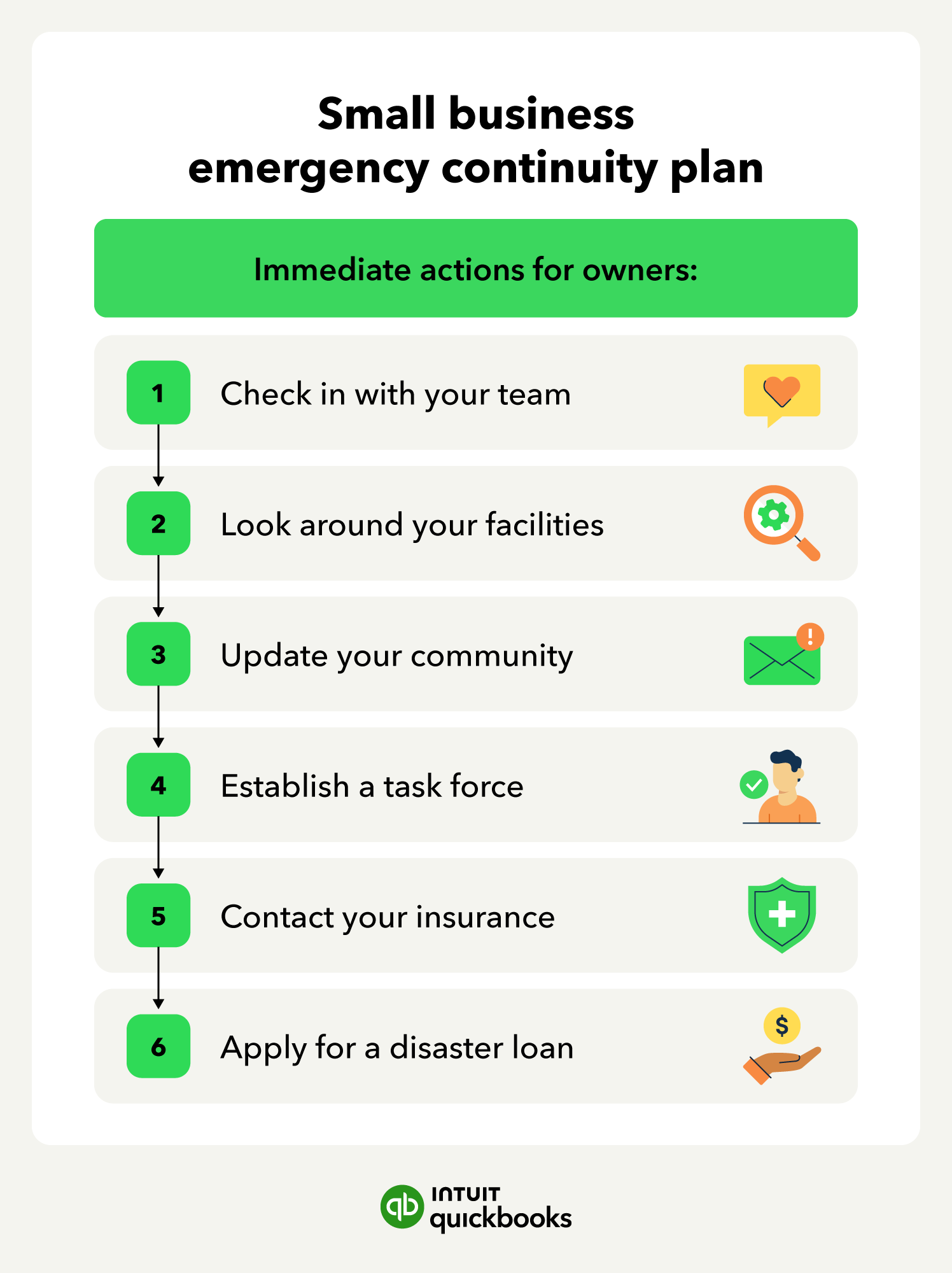
1. Check on your team
Your business is nothing without the people who keep it running. Reach out to your staff and colleagues immediately to ensure they and their loved ones are safe.
 Establish a primary communication channel (like Slack or a text thread) but have backups ready. Distribute an emergency contact list so no one is left isolated.
2. Check on your facilities
Confirm that all of your facilities and systems are secure and that operations can continue. Document all damage in writing and images, as well as any compromised systems, with the date and time.
If needed, the FEMA Disaster Recovery Center Locator can help you find an accessible mobile office, where you can learn more about disaster assistance programs. You can also apply for FEMA assistance online.
3. Check on your community
Keep your customers and stakeholders in the loop. A simple post on social media or an email blast explaining that you’re experiencing a temporary disruption goes a long way in maintaining trust.
If your business sells products and runs into supply chain issues, you might need to create a supply continuity plan.
4. Establish a task force
Even if you’re a solopreneur, you can’t do this alone. Assign specific roles based on your team’s strengths. If someone is great with tech, they handle data recovery. If someone is a people person, they handle client outreach. Set a Recovery Time Objective (RTO), or a realistic deadline for when you need to be back in business to avoid serious financial hits.
5. Contact your insurance
Whether you’re reporting damage or filing a business interruption claim, reach out to your insurance carrier as soon as possible. Not sure how to start? The Insurance Information Institute has created a helpful guide for filing disaster-related business insurance claims.
Have your policy number ready and provide backup contacts so that an adjuster can reach you as soon as possible to move the claims process along.
6. Apply for a disaster loan
Don’t wait until your insurance claim has been processed to apply for a disaster loan through the Small Business Administration (SBA). You are not required to accept the loan if approved, and the window to apply for these funds is often limited.

SBA loans offer low interest rates and can cover physical damage to property and equipment, operating expenses, mitigation assistance (i.e., efforts to prevent future damage), and staffing gaps resulting from employees on active-duty military leave. Check here to see if your business is eligible.
What to do a few days later for business continuity
Now that you’ve got a plan to get your business back on track, take a step back and identify any gaps in what you’ve built so far.
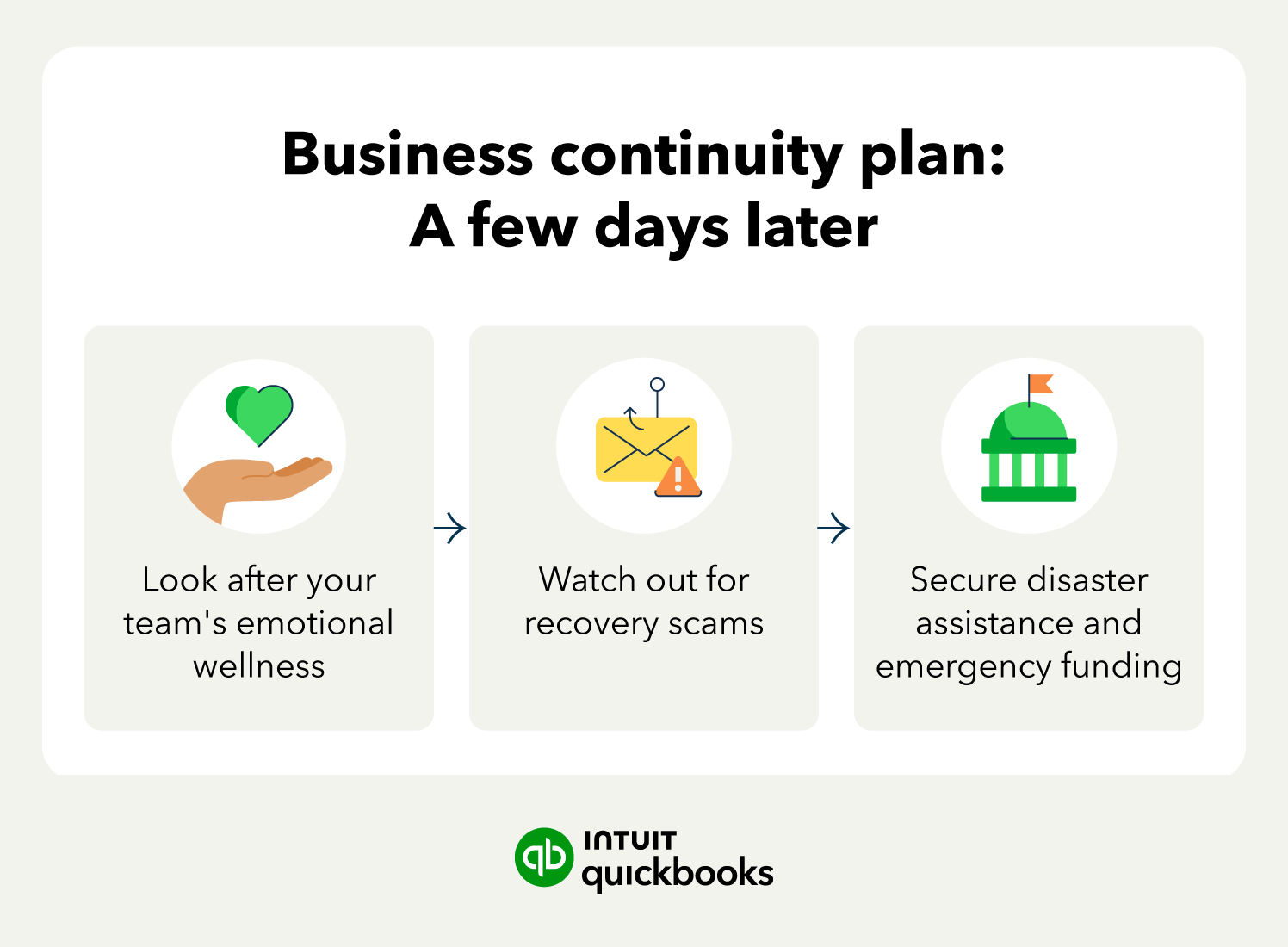
Look after your team’s emotional wellness
Disasters are traumatic events that can stir up complex emotions. Check in with your team to ensure that everyone has the support they need. Look for signs of burnout and try to provide as much flexibility as possible during this transitional period.
Below is a list of resources that can help:
- American Red Cross: “Emotional Recovery After a Disaster” offers further support and includes a free, 24/7 hotline (1-800-985-5990).
- National Center for PTSD offers trauma-informed self-care techniques; “PTSD Coach” website and mobile app; and primers on topics like trauma responses and triggers.
- The 988 Suicide and Crisis Lifeline is available 24/7 for acute emergencies, with a specific extension for veterans.
Further resources for employees with children:
- The National Child Traumatic Stress Network offers a suite of resources to help children and families navigate traumatic disasters and their aftermath.
- Organizations, including the CDC and Ready.gov, provide guidelines to help children cope.
- The National Center for PTSD’s “PTSD Coach” app offers specific resources for families.
- The National Institute of Mental Health: “Helping Children and Adolescents Cope With Traumatic Events” identifies common trauma responses based on age and advises parents on how best to respond.
Watch out for "Recovery Scams"
Fact: Federal workers will never ask for money for inspections or applications.
Action: Always ask for official identification and vet any contractors who show up unannounced.
If you suspect fraudulent activity, report it to the FEMA Disaster Fraud Hotline (866-720-5721) or to the Federal Trade Commission. Consult these FEMA disaster guidelines for more information.
Further resources:
- IRS: “Recognize tax scams and fraud”
- Federal Trade Commission: “What To Know About Identity Theft”
- Federal Communications Commission: “After Storms, Watch Out for Scams”
- FEMA: “Beware of Contractor Fraud: Go Local, Do Your Research”
- Investor.gov: “Investment Scams May Seek to Exploit Natural Disasters – Investor Alert”
- U.S. Department of Justice: “Tips on Avoiding Fraudulent Charitable Contribution Schemes”
Secure further disaster assistance and emergency funding
If you’ve already applied for a disaster loan through the SBA but worry you might need further resources, a number of institutions could help make up the difference.
- The U.S. Chamber of Commerce Foundation’s Disaster Help Desk collaborates with a number of providers, both national and local, and can provide one-on-one expert assistance and help you navigate the relief process.
- DisasterAssistance.gov works with federal, tribal, state, local, and private-sector organizations to help disaster survivors identify and access the information, support, and services they need.
- Benefits.gov can help you navigate the government-assistance process, either through its “Benefit Finder” tool or by searching by category.
- If FEMA has issued a disaster declaration for your locality, you might receive extra time for time-sensitive tasks like filing returns and paying taxes. IRS.gov: “Disaster assistance and emergency relief for individuals and businesses” can help you confirm whether or not your business qualifies.
- For local resources, check with your state’s attorney general’s office.
Conduct a risk assessment
Ask yourself how that event would impact your service providers, your facilities, your technological systems, and your employees’ ability to do their jobs. Assess which of these factors are most critical to your business so that your plans prioritize them accordingly.
If you’re a solopreneur, consult with industry peers to identify strategies or potential issues you might have overlooked. If you run a larger organization, work with team leaders to solidify buy-in and ensure that the plan works well for everyone.
No matter how large or small your organization is, run your plans by all external stakeholders to ensure everyone is on the same page when disaster strikes. Keep these operating procedures documented in a place where all relevant parties can access them.
Further resources:
Support your community
Widespread disasters can leave communities fragile and individuals isolated. If your business has the means, use your time, resources, and available funds to help those who might be struggling.
If you plan to donate money, avoid giving to anyone you don’t know. Sadly, scam artists often post fake donation pleas on crowdfunding sites. Instead, donate to well-known organizations. FEMA offers helpful guidelines for both volunteering and donating during disasters.
If you have funds to spare, reputable organizations include:
You don’t have to rebuild alone
Recovering from an emergency is one of the toughest challenges a small business owner can face. It’s okay to feel overwhelmed, but remember: Resilience is about having the tools to get back up. Tools like AI agents that help your business run smoothly for day to day tasks and during emergencies.
Recommended for you




Explore what you can do with QuickBooks
Explore what you can do with QuickBooks

See profit at a glance


Get expert help
Looking for something else?
Firm of the Future
Topical articles and news from top pros and Intuit product experts.
QuickBooks Support
Get help with QuickBooks. Find articles, video tutorials, and more.
Call Sales: 1-800-285-4854





© 2026 Intuit Inc. All rights reserved.
Intuit, QuickBooks, QB, TurboTax, Credit Karma, and Mailchimp are registered trademarks of Intuit Inc.
Money movement services are provided by Intuit Payments Inc., licensed as a Money Transmitter by the New York State Department of Financial Services. For details about our money transmission licenses, or for Texas customers with complaints about our service, please click here.
By accessing and using this page you agree to the Website Terms of Service.