
You could save up to 25% on transaction costs².
Speak with us now to see if you qualify.
Talk to sales 1-800-515-8366
Monday - Friday, 6 AM to 4 PM PT

Table of contents
Table of contents
In partnership with: Simon Worsfold
Across the U.S., small businesses fuel innovation, create jobs, and strengthen communities. Yet, for years, the data capturing their performance often arrived too late to help them make real-time decisions. Employment figures could lag by months, and revenue data might not appear for years.
To address that delay, Intuit created the Intuit QuickBooks Small Business Index. The Index is our proprietary research-driven resource and tool that delivers a reliable, up-to-date view of how small businesses are performing today.
Read on to learn why the Index was built, how it works, and how businesses across the country are using its insights to make smarter decisions in a fast-changing economy. You’ll also find additional perspective from Simon Worsfold, Head of Data Communications at Intuit QuickBooks, to help highlight the story behind the data.
Developed by a team of economists led by world-renowned macroeconomist Professor Ufuk Akcigit, the Small Business Index measures small business employment and revenue trends in the United States, and small business employment trends in the United Kingdom and Canada.
Three key data sources power the Index:
Each month, the model processes anonymized data and produces aggregated estimates that reflect national, regional, and industry-level trends. Every release goes through a detailed review by 15 experts to ensure accuracy and reliability.
As Worsfold explains, the Index was designed to highlight small businesses’ contributions to the economy, identify challenges, and address the lack of timely data that can inform effective support and decision-making. The goal is to ensure important economic indicators are available in real-time.
According to Worsfold, the Index fills a long-standing knowledge gap: “Official employment data for small businesses is often six to nine months old, and revenue data can be five years behind.” QuickBooks wanted to create something that provides a clearer, more current view of what’s happening right now.
The Index also benefits from:
As a result, the QuickBooks Small Business Index provides an early signal of changes in hiring or revenue before official government reports are released.
Intuit’s data analytics team processes anonymized information from QuickBooks Payroll and QuickBooks Online and benchmark it against official statistics to ensure accuracy and representativeness. This is all done using economic models developed by Professor Akcigit’s team. Each release undergoes a comprehensive multi-step review before publication.
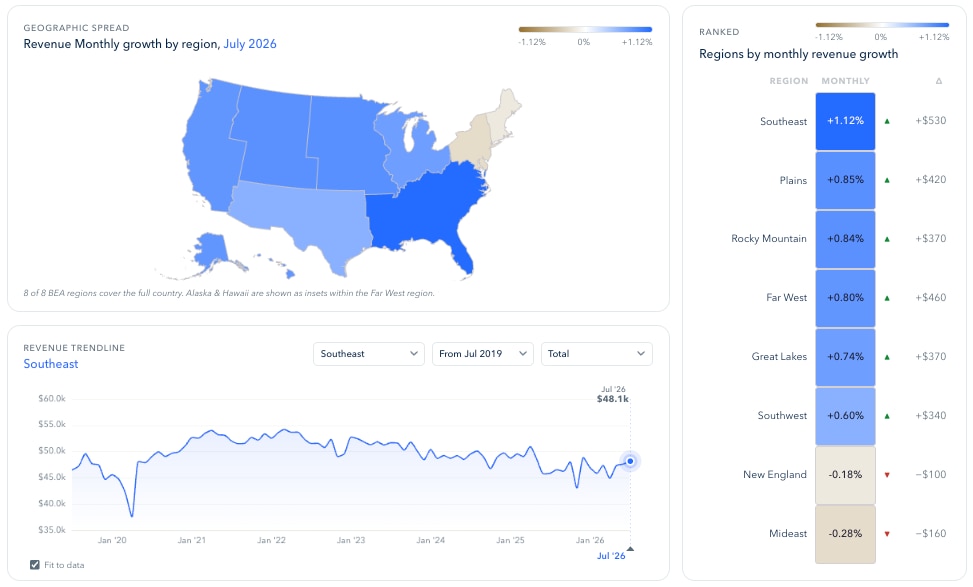
The Index currently tracks monthly small business employment in the U.S., Canada, and the U.K. nationally, regionally, and by sector. In the U.S., the Index also tracks monthly revenue growth. Future plans include expanding the Index to include larger businesses, new metrics, and all 50 U.S. states.

For small business owners, the Index is both a measure of the economy and a tool for comparison and planning. Each update offers context and clarity for business leaders navigating constant change. Here’s how savvy business owners are applying those insights in practical ways:
The Index is designed to be actionable, giving small business owners insights into how their performance stacks up in a changing economy.
Worsfold emphasized that benchmarking is one of the most direct ways the Index helps business owners. It enables them to measure progress, identify trends, and make more informed, data-driven decisions. These insights can also be helpful for accountants with small business clients.
Beyond benchmarking, the data provides additional guidance for business owners, economists, policymakers, and others seeking to understand small business trends.
The Index also helps users:
The Index also supports long-term strategy. By aligning forecasts with fresh data, business leaders can turn learnings into action.
Want to see how it all comes together? Annual reports reveal how small businesses are adapting to economic shifts, new technologies, and policy changess.
The Index has revealed several key trends shaping the small business economy. Among the most notable is how financing behavior and employment patterns have evolved in response to interest rates.
The Small Business Index is continually evolving. The next phase focuses on expanding its reach, refining its insights, and making the experience even more useful for small businesses. The goal is to scale its impact through deeper data, new technology, and a more accessible platform.
## H2 QuickBooks is helping small businesses move forward
The Small Business Index ultimately helps small businesses, policymakers, and economists cut through uncertainty by highlighting what’s changing and where attention is needed most. With the newest measurements drawn from actual business activity, owners get a clearer view of the landscape—one that large corporations have relied on for decades. It’s a tool that helps small businesses stay tuned in, remain agile, and move toward what’s possible.
Stay ahead of small business trends. Explore the latest insights from the Intuit QuickBooks Small Business Index.

Call Sales: 1-800-285-4854