QuickBooks Blog
An image of a restaurant group financial analyst using the 4-5-4 fiscal calendar for restaurant reporting.
What's new

How to use the 4-5-4 fiscal calendar for restaurant reporting & analytics


Key takeaways:

  • Fiscal calendars reduce calendar-based sales volatility. This provides normalized data for precise performance benchmarking across locations.
  • Standardized periods are essential for controlling prime cost and mitigating turnover costs.
  • Implementing a fiscal calendar improves reporting consistency across locations or entities, supporting forecasting and portfolio-level decision-making.


Finance leaders managing restaurant groups require absolute data precision—but traditional calendar months can present unique challenges. When a five-weekend month is compared to a four-weekend month in high-volume locations, the extra days can create an artificial spike in revenue. This inconsistency makes accurate year-over-year analysis across locations and the broader portfolio very difficult.

The foodservice industry is forecast to reach $1.5T in sales in 2025. In an industry operating at this scale, even small reporting inconsistencies can distort performance analysis and complicate decision-making across locations. With so much capital on the table across a restaurant portfolio, that's not a risk worth taking. 

Fortunately, there's a solution. Many financial leaders in the restaurant industry have switched from traditional calendars to the retail fiscal calendar, which uses a 13-week system to standardize accounting weeks. Today, we’ll discuss how a retail fiscal calendar can support more reliable budgeting, enable more consistent evaluation of labor performance, and help finance teams identify margin trends earlier.

Jump to:

Run and grow your business on one platform

Your books are just the beginning. Grow your business, unlock insights, and work like you have a larger team behind you—all in QuickBooks.

What is the retail fiscal calendar (4-4-5 and 4-5-4)

A retail fiscal calendar (often referred to as a 4-4-5 or 4-5-4 calendar) is a standardized reporting structure commonly used in retail and food service to divide the year into consistent weekly periods, reducing calendar-based variance in financial analysis.

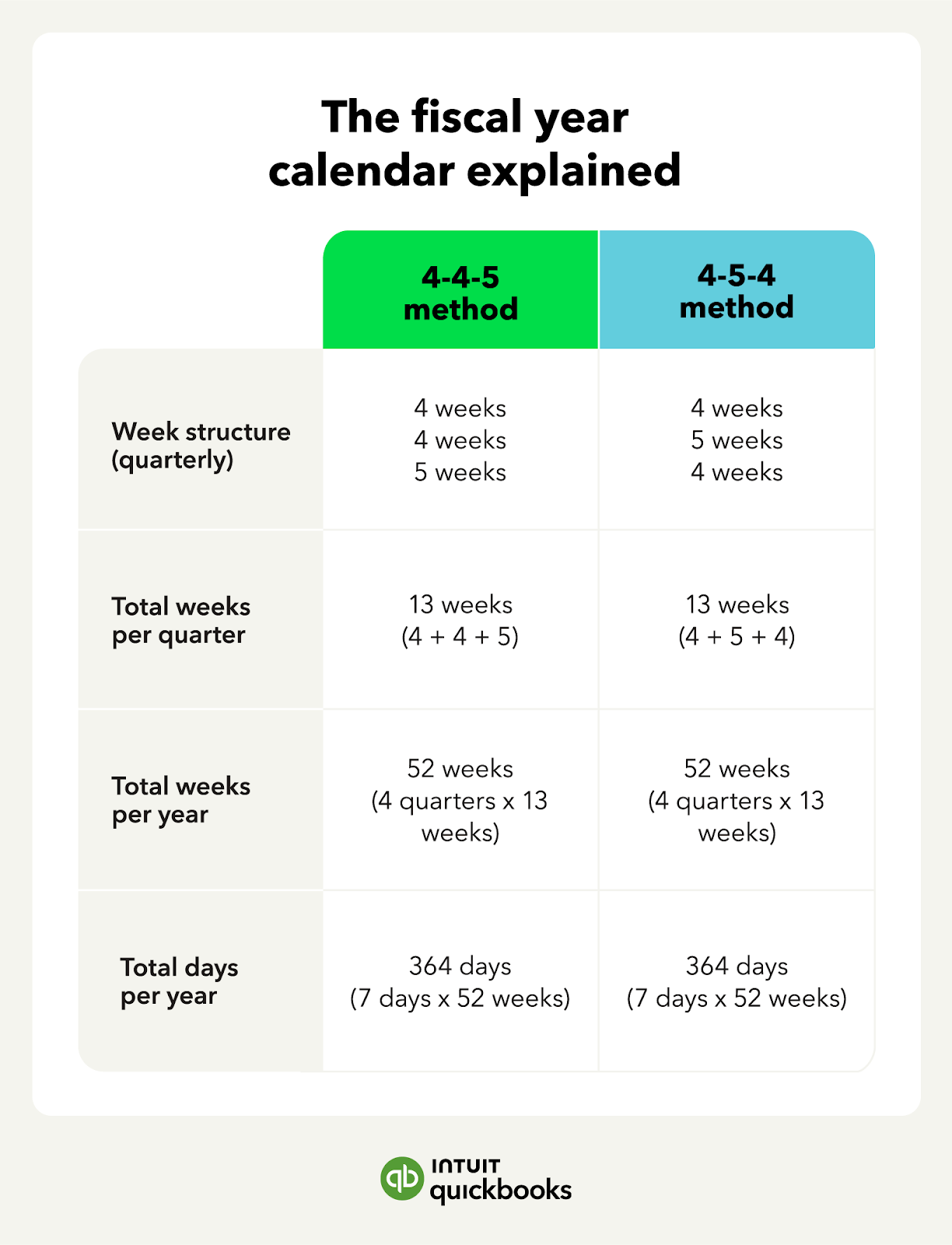
An image showing the fiscal year calendar options with the weeks included in each period.

These calendars use a 13-week system in which the fiscal year consists of four equal quarters, each comprising 13 weeks (totaling 52 weeks). This structure is divided into accounting months following one of two fixed sequences:

  • The 4-4-5 calendar includes two 4-week periods, followed by one 5-week period.
  • The 4-5-4 calendar includes one 4-week period, followed by one 5-week period, then one 4-week period.

The calendars provide several benefits that improve comparability:

  • The calendar lines up holidays.
  • This format ensures that each month has the same number of Saturdays and Sundays, and the accounting weeks are standardized from year to year.

Weekends and holidays can generate spikes in revenue, and these calendars allow you to compare sales with more accuracy.

For a fiscal calendar starting in 2026, many organizations align the start around late January or early February (often beginning on a consistent weekday). The difference is seen in the number of weeks per month:

  • 4-4-5 calendar: February (4), March (4), April (5)
  • 4-5-4 calendar: February (4), March (5), April (4)

Each calendar has 13 weeks in the first three months of the year. To use these calendars, organizations typically adopt a fiscal reporting calendar aligned to weekly periods.


How to adopt a retail fiscal calendar

Adopting a 4-4-5 or 13-period calendar is often an internal operational shift rather than a formal change to your tax year. Many restaurant groups maintain a standard calendar year for the IRS while utilizing a fiscal week system for internal reporting, labor management, and P&L analysis. 

This allows for precise weekly comparisons often without changing the federal tax year.

That said, if you choose to align your official tax year with your new fiscal calendar, you may need to file specific documentation with the IRS:

  • Form 1128: Application To Adopt, Change, or Retain a Tax Year
  • Form 8716: Election To Have a Tax Year Other Than a Required Tax Year

You also need to update your accounting system so that the software generates financial statements for the new fiscal year. For example, a fiscal calendar adopted in 2026 may result in a year-end that falls in late January rather than December 31.

Finance leaders must consult with their tax advisors to confirm the correct form and ensure adherence to all federal, state, and local requirements. This step is critical for maintaining compliance readiness.


Run and grow your business on one platform

Your books are just the beginning. Grow your business, unlock insights, and work like you have a larger team behind you—all in QuickBooks.

How the retail fiscal calendar improves restaurant reporting

Adopting a retail fiscal calendar eliminates the extra-weekend distortion that frequently sabotages monthly P&L accuracy. Because traditional months can vary in length from 28 to 31 days and oscillate between four and five weekends, year-over-year comparisons often reflect calendar shifts rather than genuine business trends. 

Moving to a standardized 52-week structure ensures that every reporting period contains an identical number of high-volume days, allowing finance teams to isolate true performance from calendar variance.

Let's look at how the 4-4-5 structure works in practice using a hypothetical restaurant group: 

Example: Hilltop Restaurant Holding utilizes a 4-4-5 calendar for its multi-location operations. The finance team needs to assess performance across its locations’ fourth quarters.

Under the 4-4-5 structure, every December accounting period contains precisely four high-revenue weekends:

  • Fiscal December 2024: Starts Dec. 1, ends Dec. 28
  • Fiscal December 2025: Starts Nov. 30, ends Dec. 27
  • Fiscal December 2026: Starts Nov. 29, ends Dec. 26

If they were to use a traditional calendar year for the same period, the data would be inconsistent. December 2024 contained five weekends, while December 2025 will contain only four. If Hilltop’s consolidated revenue was 20% higher in December 2024 than in 2025, a portion of the difference may be explained by the extra weekend.

Fiscal calendars reduce calendar noise, making it easier to determine whether differences in December 2026 revenue reflect underlying performance rather than timing effects.

The benefits of using fiscal weeks to budget more effectively

Transitioning to fiscal weeks replaces the unpredictability of the standard calendar with a reliable framework for financial control. By aligning every reporting period into consistent seven-day blocks, finance leaders can focus on the three core drivers of group-level performance: labor efficiency, margin protection, and seasonal forecasting.


Manage employees and performance

The cost of replacing key restaurant staff is high. According to Black Box Intelligence, the average estimated hard cost of turnover stands at:

  • $2,305 for an hourly employee
  • $10,518 for a non-GM manager
  • $16,770 for a General Manager

Standardized fiscal periods provide a consistent, normalized time frame for better managing human capital ROI.

When a fiscal calendar normalizes periods, the finance team can confidently assess accurate productivity metrics, such as sales per labor hour (SPLH), across different locations. This precision allows leaders to track labor management initiatives against a reliable baseline, which can help reduce the financial impact of turnover over time. 


Improve profit margins

Protecting profitability begins with rigorous, consistent control over prime cost—the sum of COGS and total labor cost—which represents the largest expense category. According to the National Restaurant Association, many operators target a prime cost between 55% and 65% of total sales.

Isolating prime cost data within standardized 4-4-5 or 4-5-4 periods helps finance teams quickly detect unfavorable trends and execute corrective action before they significantly impact the bottom line. This reliable, weekly data flow is the foundation for improving margins across the entire restaurant portfolio.


note icon With automated workflows, configurable reporting, and AI-powered insights in QuickBooks Online Advanced, finance teams can surface changes in labor and cost trends earlier in the period—rather than waiting until month-end to identify margin pressure.


Reduce the financial impact of seasonality

Seasonal fluctuations are a constant risk factor in restaurant operations, directly impacting cash flow. Demand typically rises through the first half of the year and softens as operators move from peak summer periods into the winter months.

Fiscal week reporting allows the finance team to quantify the financial impact of these seasonal cycles based on prior periods. Removing calendar variance helps generate more consistent inputs for forecasting revenue and expense patterns across seasons. As a result, finance leaders can plan and manage performance across the portfolio with greater confidence.

Run and grow your business on one platform

Your books are just the beginning. Grow your business, unlock insights, and work like you have a larger team behind you—all in QuickBooks.

Boost productivity and enhance profitability

Standardized fiscal reporting can help improve reporting comparability and decision confidence. As organizations scale across locations or teams, upgrading reporting software and processes becomes increasingly important for accurate forecasting and budget management. 

QuickBooks Online Advanced supports growing restaurant groups by streamlining core finance workflows across locations and teams. With configurable reporting, workflow automation, and forecasting capabilities, finance leaders can gain clearer visibility into performance, manage cash flow and budgets more effectively, and shorten the close.

So, less time is spent correcting for calendar shifts and more time is spent supporting the business.


Recommended for you

Mail icon
Get the latest to your inbox
No Thanks

Get the latest to your inbox

Relevant resources to help start, run, and grow your business.

By clicking “Submit,” you agree to permit Intuit to contact you regarding QuickBooks and have read and acknowledge our Privacy Statement.

Thanks for subscribing.

Fresh business resources are headed your way!

Looking for something else?

QuickBooks

From big jobs to small tasks, we've got your business covered.

Firm of the Future

Topical articles and news from top pros and Intuit product experts.

QuickBooks Support

Get help with QuickBooks. Find articles, video tutorials, and more.