- Start Your BusinessStart Your Business
- Starting a BusinessThe tools and resources you need to get your new business idea off the ground.
- PaymentsEverything you need to start accepting payments for your business.
- Funding & CapitalResources to help you fund your small business.
- Small Business StoriesCelebrating the stories and successes of real small business owners.
- Self-EmployedThe tools and resources you need to run your own business with confidence.
- Run Your BusinessRun Your Business
- Running a BusinessThe tools and resources you need to run your business successfully.
- AccountingAccounting and bookkeeping basics you need to run and grow your business.
- Cash FlowTax and bookkeeping basics you need to run and grow your business.
- PayrollPayroll essentials you need to run your business.
- TaxesTax basics you need to stay compliant and run your business.
- EmployeesEverything you need to know about managing and retaining employees.
- Grow Your BusinessGrow Your Business
- Growing a BusinessThe tools and resources you need to take your business to the next level.
- Sales & MarketingSpread the word: What you need to know about marketing your small business.
- FundingHow to find funding and capital for your new or growing business.
- Midsize BusinessesThe tools and resources you need to manage your mid-sized business.
- Enterprise Suite BlogThe tools and resources you need to grow your own business with confidence.
- E-CommerceHow to start and run a successful e-commerce business.
- TaxesTaxes
- How to fill out a 1099-NEC formLearn how to fill out and file 1099-NEC forms for independent contractors and freelancers.
- How to file small business taxesLearn how to navigate tax season with confidence and minimize your tax liability with this guide.
- Small business 1099: What you need to know for 2025Navigate the complexities of small business 1099 forms and filings with our comprehensive guide.
- 13 documents to give your accountant for small business taxesYour accountant will need these documents to file your small business taxes successfully.
- What's NewWhat's New
- NewsBrowse the latest news, press releases, and reports from QuickBooks.
- AI Resource HubFind the latest on Artificial Intelligence.
- Small Business DataThe latest research and insights for Small Businesses from QuickBooks.
- Small Business StoriesCelebrating the stories and successes of real small business owners.
- Holiday SuccessEverything you need to thrive during your business's busiest seasons.
- AI InnovationsBrowse the latest AI innovations in QuickBooks on the Intuit platform.
- ToolsTools
- All ToolsFree accounting tools and templates to speed up and simplify your workflow.
- AI-Powered Invoice GeneratorTry out this free invoice generator to create an invoice online using Intuit Intelligence.
- Payment Cost CalculatorFind out how much you could save by switching to QuickBooks Payments.
- Paycheck CalculatorAccurately estimate pay for all your employees.











How to come up with a business name: 15 tips and examples
Table of contents
Table of contents
You could save up to 25% on transaction costs².
Speak with us now to see if you qualify.
Talk to sales 1-800-515-8366
Monday - Friday, 6 AM to 4 PM PT
Key takeaways
-
Key things you need to know when naming your business:
- A strong business name should be simple, memorable, and aligned with your brand and audience.
- Start with your core values and keywords, then use techniques like compound names or generators to develop ideas.
- Choose a name that can grow with your business and avoid trends or overly narrow terms that may limit you later.
- Test your business name by checking for clarity, cultural meaning, and feedback from your target audience.
- Always confirm availability across state registrations, trademarks, domains, and social platforms before committing.
When starting your business, coming up with a name is more important than you might think. It's one of the first things potential customers encounter, and it shapes their perception of your brand before they've ever bought a thing.
Choosing the right business name takes more than a brainstorming session. It requires a clear understanding of your brand, your audience, and where you want your business to go. This guide walks you through 15 practical tips to help you find a name that fits, plus what to do once you've made your decision.
What makes a good business name?
A good business name is one that sends a clear message about your brand and value. Before a customer makes a purchase, your business name should already set an expectation.
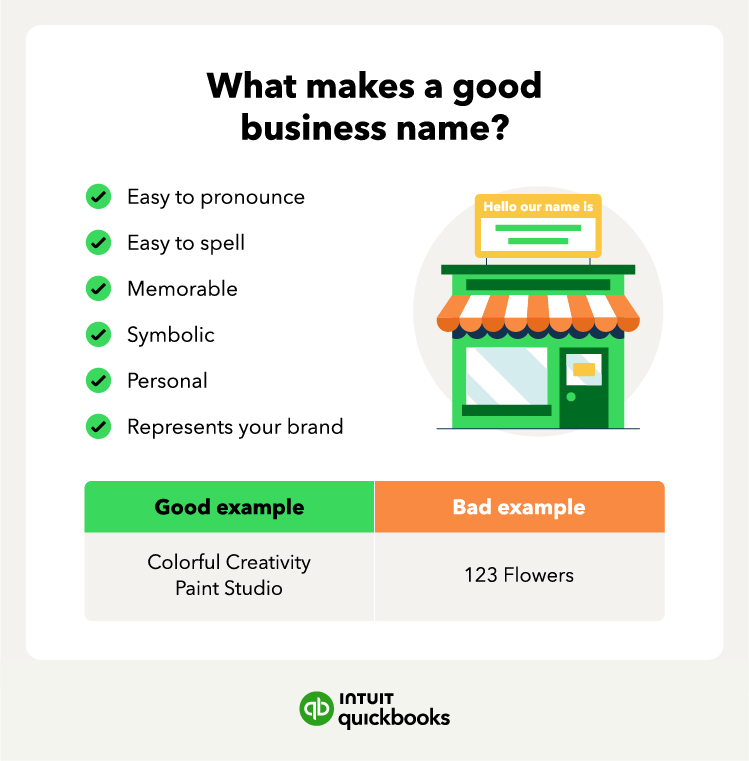
While your personal preference is a factor, the most successful business names meet a few objective criteria to support your growth strategies.
The best business names are:
- Memorable: Sticks in a customer’s mind after just one mention.
- Easy to spell and pronounce: If a customer can’t spell it, they can’t find you on Google or refer you to a friend.
- Scalable: It allows your business to evolve. Avoid naming yourself after a single product or a specific street if you plan to grow.
- Distinct: Stands out from competitors and reduces the risk of marketplace confusion.
- On-brand: Reflects your company’s personality, values, or the specific problem you solve.

Try to avoid overly specific names. If you name your business "Seattle Sourdough," you might find it difficult to pivot if you eventually want to sell cupcakes or move your operations to Portland.
15 tips for coming up with a good business name
Coming up with a business name is a creative process, and what works for one business owner might not work for another. These 15 tips cover everything from brainstorming techniques to practical considerations to help you find a name that fits your business.
1. Define your core values
Before you start looking at words, define your mission. Your business name should reflect your “why.” If your core value is speed, choose a name that feels energetic and short. If you focus on precision or heritage, a more traditional or descriptive name may work better.
Try asking yourself:
- What is the one thing I want customers to think of when they hear my name?
- Does this name reflect the personality of the service I provide?
- Would my ideal customer feel a connection to this word or phrase?

2. Brainstorm keywords
Once you define your core values, generate words that relate to your business. Think about what you do, who you serve, and how you stand out. Focus on quantity, not quality, and capture as many ideas as possible before narrowing them down.
Consider your products or services, the benefits you offer, your industry, and the emotions you want your brand to evoke.
You can also use Google Trends to see which terms people are actively searching for in your industry. A keyword with consistent or growing search interest can give your name built-in discoverability from day one.
From there, mix and match combinations, test different angles, and see what feels natural. These keywords can be the building blocks for your name, either on their own or combined with other words and ideas.

Organize your business finances for free
Track income and expenses in one place. Plans that grow when you're ready.*
3. Use a business name generator
If you feel stuck, use an online business name generator to spark new ideas. Rather than starting from scratch, these tools use your keywords to suggest word combinations, prefixes, and suffixes you might not have considered.
Leaning on digital tools to bypass creative block is incredibly common for modern startups. According to the 2026 QuickBooks AI Impact Report, more than 3 in 4 small and midsize businesses now use AI regularly to run their operations, with marketing, admin, and customer service ranking among the top adoption use cases.
To get the most out of a generator, try inputting a mix of:
- Your industry (e.g., landscaping or bakery)
- A descriptive word (e.g., fast, green, modern)
- A core benefit (e.g., safe, growth, easy)
A few popular ones include:
Most generators can produce hundreds of options instantly. Instead of looking for the "perfect" name here, scan the results for interesting word pairings or naming styles that fit your brand.
4. Look at other business names in your industry
Looking at competitor names before settling on your own can help you identify overused terms and find gaps where your brand can stand out.
Pay attention to how competitors structure their names. Are they short and modern, or more descriptive and traditional? Do they lean on industry keywords or take a more abstract approach? These patterns can give you a clearer sense of what works in your space and where there's room to do something different.
Try looking at businesses that serve the same audience in different industries. If you’re a high-end landscaper, look at the names of luxury home builders or interior designers for inspiration on how to signal "premium quality."
5. Use your own name
Using your own name as your business name is a common approach, particularly for consultants, self-employed individuals, and service providers. A personal name adds credibility and makes clear who is behind the work.
However, think about your long-term goals before going this route. A name tied to you personally can make the business harder to sell down the road or expand beyond your own capacity.
Before going this route, consider the tradeoffs:
6. Keep it simple and easy to say
A simple, memorable name is easier to search for and pass along by word of mouth. If customers can't spell it, they can't find you online. If they can't pronounce it, they won't recommend you to others.
Avoid names that are too long, hard to spell, or rely on unusual capitalization to make sense. Before committing to a name, say it out loud and share it with a few people. If they stumble over it or ask how it's spelled, that's a sign to keep looking.

7. Consider foreign or local words
Foreign and local words can be a useful source of inspiration when English options feel generic or already taken.
A word from another language can give your name a distinct, hard-to-replicate quality—think of brands like Patagonia, Häagen-Dazs, or Zara.
Local words can work just as well, particularly if your business is rooted in a specific community or region. A name that nods to your location or cultural background can make your brand feel more personal and grounded.

8. Choose a compound or mash-up name
If individual keywords feel too generic or are already taken, try combining two terms to create a compound or mash-up name. This strategy allows you to be descriptive while still creating a unique, brandable identity.
There are two main ways to do this:
- Compound names: Join two full words together (e.g., QuickBooks). This works best when the two words clearly signal the value you provide.
- Blended names: Combine parts of two words to create a new one (e.g., Pinterest from "Pin" and "Interest").
Start with your keyword list from tip #2 and experiment with different pairings. You're looking for combinations that are easy to say, easy to spell, and feel natural together.
9. Embrace wordplay and alliteration
Wordplay can make your business name more memorable and give your brand a distinct personality. Puns, alliteration, and double meanings are all fair game as long as the name still feels professional and clearly reflects what you do.
A few approaches to try include:
- Puns and homophones: Play with words that sound similar but have different meanings. A bakery called "Knead to Bake" successfully uses this.
- Double entendres: Choose a word with two meanings—one literal, one clever. "Blooming Marvels" for a landscaping company hints at the service while adding personality.
- Alliteration: Repeating the same starting sound makes a name easier to say and remember. Think "Crafty Creations" or "Rolling Rhinos."
The goal of wordplay is to be clever, not confusing. If a customer has to stop and think for more than a second to understand the play on words, the name might be too obscure.
10. Consider acronyms and abbreviations
Acronyms can be an effective naming strategy, particularly if your full business name is long or complex. Some of the most recognizable brands in the world are better known by their initials than their full name.
IBM (International Business Machines) and MAC (Makeup Art Cosmetics) are two examples.
Your acronym can be based on your full business name, your initials, or even the city where you started. Just make sure to research the acronym before committing to it. What feels neutral to you may already be associated with something else entirely.
11. Base it on your story
Some of the most compelling business names come from the story behind the business, like why it was started, who it was started for, or the problem it set out to solve.
Think about what makes your journey unique. A meaningful detail from your background, a personal milestone, or even the location where it all began can give customers something to connect with beyond the product or service itself.
12. Choose a name that can grow with your business
Pick a name that gives you room to expand. If you tie your business to a single product, location, or narrow niche, you may limit your ability to grow into new markets or offerings. Avoid trends that may feel outdated in a few years.
Before committing, think about where you want your business to be in five or ten years. A name like “Austin Wedding Photography” may work now, but it can become restrictive if you expand to other cities or add new services.
13. Check for hidden meanings and cultural associations
Before finalizing your name, make sure it doesn't carry any unintended associations. A name can look great on paper but land differently once it's out in the world—whether because it spells an unfortunate acronym, shares a name with a controversial figure, or has a slang meaning you weren't aware of.
This is especially important if you're using a foreign or local word, or if you plan to market to a specific cultural group. A word that feels neutral to you may carry a very different meaning for your target audience. When in doubt, ask a native speaker or someone who represents the community you're trying to reach.
14. Get feedback from your target audience
Once you have a shortlist of names, get outside opinions before making a final decision. Fresh eyes can catch pronunciation issues, unintended meanings, or associations you might have missed.
Reach out to a mix of people, ideally, some who represent your target customer. Ask them what feelings the name evokes, whether it's easy to spell, and what kind of business they'd expect it to be. Their answers can be just as revealing as the name itself.
One useful rule of thumb is that if you find yourself explaining the name at length to make it make sense, it's worth revisiting.
15. Check for availability
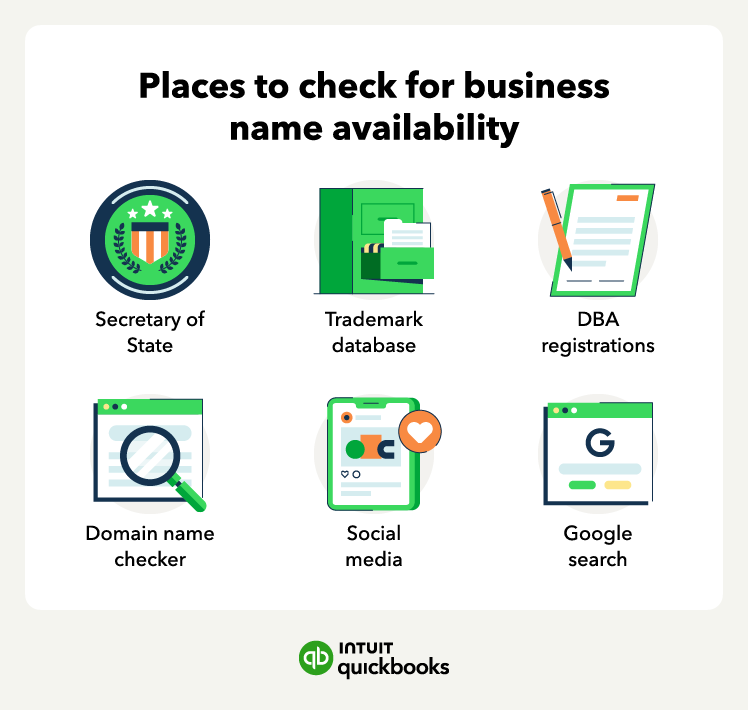
Once you've landed on a name you like, make sure it's actually available before you get attached to it by checking the following:
- Secretary of State: Search your state's business name database to confirm no one else is registered under the same name.
- Trademark database: Search the US Patent and Trademark Office database to avoid potential legal issues down the line.
- Domain registrars: Check that a relevant domain is available through a registrar like GoDaddy or Google Domains.
- Social media: Confirm your preferred handles are available across the platforms your business will use.
- Google: A basic search can reveal whether the name is already associated with another business or anything you'd want to avoid.
What are some business name ideas and examples?
To help spark ideas, here are some sample business names that follow our tips above:
- Wanderlust Travel Agency
- Chen's Culinary Creations
- Peak Performance
- Sunnyside Brunch Cafe
- The Write Touch Advertising
- Whimsical Whiskers Pet Sitting
- Buena Vista Photography
- The Harmony Hub Music School
- Brush & Blush Makeup Studio
- Urban Oasis Day Spa
Keep in mind that this is just a starting point. Don't be afraid to experiment and combine these techniques to find a name that truly embodies your unique business.
How to register your business name
Once you've settled on a name and confirmed it's available, the next step is making it official. How you register your business name depends on your business structure and how you plan to operate.
Here are the most common registration steps:
1. Register with your state: If you're forming an LLC or corporation, your business name gets registered automatically when you file your formation documents with your state's Secretary of State office.
2. File a DBA (Doing Business As): If you're a sole proprietor or partnership operating under a name different from your own, you'll need to file a DBA (sometimes called a fictitious business name) with your state or county.
3. Register a trademark: If you want exclusive rights to your business name nationwide, consider filing a trademark application with the US Patent and Trademark Office. This protects your name from competitors in your industry.
4. Secure your domain: While not a legal requirement, registering your domain name early protects your online presence and ensures customers can find you.
Registration requirements vary by state, so check with your local Secretary of State's office or a business attorney to ensure you're following the correct steps for your location and business structure.
Start your business with confidence
With a strategic approach and a touch of creativity, you've unlocked the secrets of how to come up with a business name. Remember, your company name is the foundation of your brand identity and marketing plan, so choose wisely.
Once you've landed on a name, the next step is building the financial foundation to match. Accounting software like QuickBooks helps you track income and expenses, manage cash flow, and stay on top of your finances from day one.
Recommended for you



Explore what you can do with QuickBooks
Explore what you can do with QuickBooks

See profit at a glance


Manage money
Looking for something else?
Firm of the Future
Topical articles and news from top pros and Intuit product experts.
QuickBooks Support
Get help with QuickBooks. Find articles, video tutorials, and more.
Call Sales: 1-800-285-4854





© 2026 Intuit Inc. All rights reserved.
Intuit, QuickBooks, QB, TurboTax, Credit Karma, and Mailchimp are registered trademarks of Intuit Inc.
Money movement services are provided by Intuit Payments Inc., licensed as a Money Transmitter by the New York State Department of Financial Services. For details about our money transmission licenses, or for Texas customers with complaints about our service, please click here.
By accessing and using this page you agree to the Website Terms of Service.