






QuickBooks Blog
Illustration of person calculating deductions
taxes

What are itemized deductions? Common types and how to claim them


What every taxpayer should know about itemized deductions:

  • Itemized deductions let you claim specific personal expenses to reduce taxable income instead of taking the standard deduction.
  • Common itemized deductions include medical expenses, state and local taxes (SALT), mortgage interest, and charitable contributions.
  • To claim itemized deductions, complete Schedule A (Form 1040).
  • It’s necessary to keep receipts and tax forms to support your deductions in case of an audit.


If you’re dreading your tax bill this season, the small business deductions you choose to claim can make all the difference in how much you’ll owe (or save). And according to a QuickBooks entrepreneurship report, more than three in ten business owners have made tax filing errors, possibly missing out on valuable deductions.

As we head into tax season 2025, all taxpayers must decide whether to take the standard deduction or itemize personal or “individual” expenses to reduce their taxable income. When you’re self-employed or a small business owner, the line between personal and business expenses can sometimes get blurry. Depending on your situation, itemizing your deductions may be the better option.

Let’s dive into everything you need to know about itemized deductions for the 2025 tax year, including the most common ones and the forms you’ll need to file.

Jump to:

What are itemized deductions?

Itemized deductions are specific personal expenses the IRS allows you to subtract from your income to reduce how much of it is subject to tax. Instead of taking a single flat deduction, you claim eligible expenses individually.

The amount you can deduct depends on what you actually paid during the tax year and whether the expense meets IRS requirements. For example, someone with $90,000 in adjusted gross income (AGI) and $22,000 in eligible itemized deductions would have $68,000 of taxable income ($90,000 minus $22,000).

How do itemized deductions work?

To claim your itemized deductions, you’ll use Schedule A (Form 1040) to list and calculate your eligible expenses. You’ll then subtract the total from your gross income. What remains is deemed your taxable income.

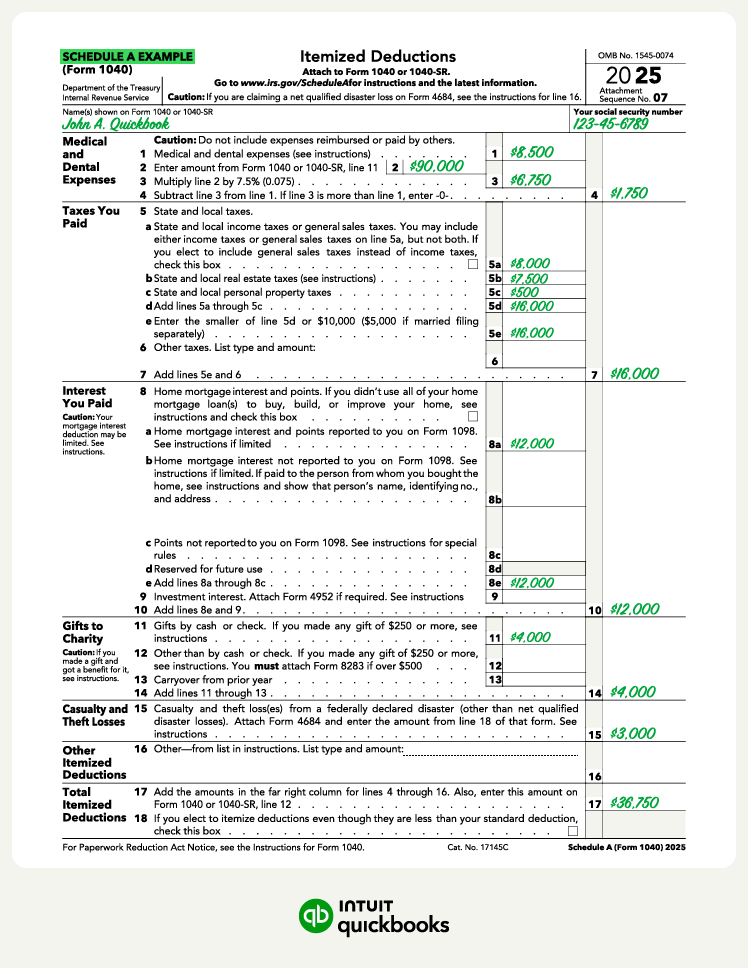
Here is an example of how a Schedule A might look:

Sample Schedule A form with itemized deductions filled out.

Keep in mind that this is only an example. You will need to fill out your own Schedule A with your information. 

You can find detailed instructions for the eligible expenses on the IRS website. Make sure you keep receipts for all of your business-related expenses.

After adding up your eligible expenses, you can compare them to the standard deduction. You’ll only want to itemize deductions if the total amount is greater than the standard deduction. While it generally takes more time and effort to keep up with receipts throughout the year, it’s worth the bigger tax refund or smaller tax bill.


note icon Itemize deductions only if they exceed the standard deduction—though it takes more effort, the payoff could mean a bigger refund or smaller tax bill.

Itemized vs. standard deduction

An itemized deduction lets you claim specific individual expenses, while the standard deduction lowers your taxable income by a preset amount. These set amounts are based on your filing status and are adjusted annually by the IRS.

The standard deduction amounts for the 2025 tax year are:

If you are age 65 or older or legally blind, you are eligible for a higher standard deduction, based on changes from the One Big Beautiful Bill Act. 

For 2025, single or head of household filers can add $2,000 per condition, while married taxpayers (filing jointly or separately) can add $1,600 per condition, per person. For instance, if you are a single filer who is both 65+ and blind, your total standard deduction would increase to $19,750.

Most people are eligible for the standard deduction on their tax return, but it may not always get you the maximum tax deduction. Instead, it might be best to itemize your deductions.


note icon If you're a nonresident alien or married filing separately when your spouse itemizes, you must itemize deductions as well and can't take the standard deduction.


Common types of itemized deductions

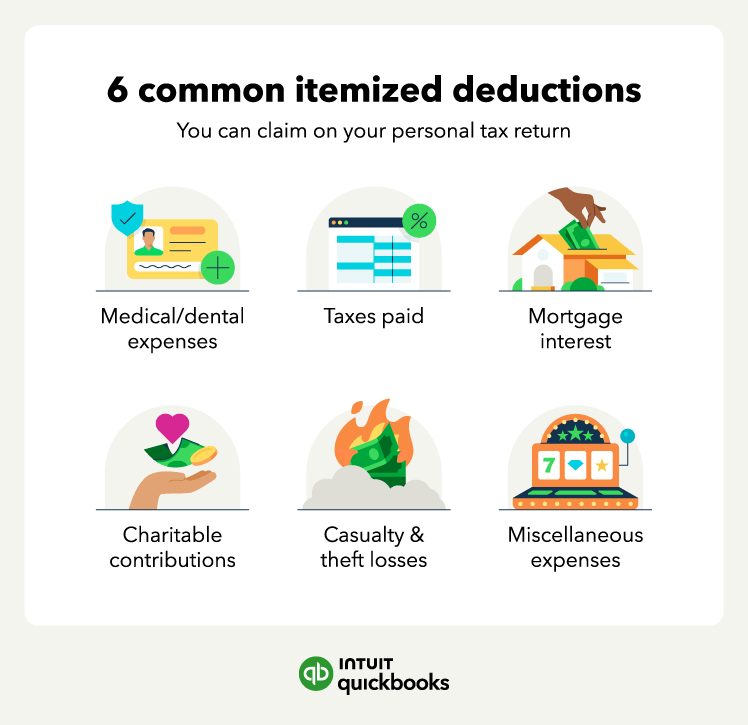
Itemized deductions include a range of expenses from both personal and self-employed business transactions. Below are the most common expenses you can write off:

Image showing 6 common itemized deductions

Medical and dental expenses

Medical and dental expenses can represent a significant portion of your annual budget, especially if you’ve had major health-related costs. 

These expenses offer taxpayers a valuable opportunity to reduce taxable income through deductions, making them a critical consideration during tax season. 

Some common examples of deductible medical and dental expenses:

  • Doctor visits, specialist consultations, and outpatient services
  • Inpatient hospital care, surgeries, and medical procedures
  • Prescription medications and insulin
  • Long-term care insurance premiums
  • Medical equipment like wheelchairs, crutches, and hearing aids
  • Dental care, including cleanings, fillings, and orthodontics
  • Mental health services such as therapy or counseling
  • Travel costs related to medical care, like mileage and lodging for out-of-town appointments

But remember, not all expenses are eligible for deduction. To claim these costs as itemized deductions, the total must exceed 7.5% of your Adjusted Gross Income (AGI)

Additionally, you cannot deduct any costs reimbursed by insurance, employer-sponsored plans, or other sources. Over-the-counter medications, cosmetic procedures, and general wellness expenses (like gym memberships) are also excluded.


note icon Use employee health benefits like a health savings account (HSA) or flexible spending account (FSA) to cover medical expenses with pre-tax dollars, reducing your overall taxable income even further.


State and local taxes (SALT)

You can deduct state and local taxes (SALT) to help reduce your taxable income. These deductions can include real estate, state, and local income or sales taxes you paid during the past year. If you occasionally rent out your home or a portion of it, you can still claim these deductions, provided the rental period does not exceed 14 days per year.

Here are the types of taxes you can deduct:

  • Real estate taxes: Property taxes paid on your primary residence, vacation home, or other real estate.
  • State income taxes or sales taxes: You can deduct either state and local income taxes or the sales taxes you paid during the year (but not both).
  • Personal property taxes: Taxes paid on items like vehicles, boats, or other property assessed based on value.

Keep in mind that these deductions are capped at $40,000 for most taxpayers ($20,000 if married filing separately). This is a significant increase from the previous $10,000 limit.

However, if your modified adjusted gross income (MAGI) is greater than $500,000 ($250,000 if married filing separately), the amount you can deduct is reduced by 30 cents for every dollar you earn above that threshold. This "phase-out" continues until the cap hits a minimum floor of $10,000 (which occurs at $600,000 MAGI).

Additionally, if you itemized these deductions in the previous year and received a tax refund, that refund must be reported as income on your current-year tax return.

Personalized insights built for your business

Intuit Intelligence delivers relevant, up-to-date insights that are tailored to your business size and industry.


note icon Compare your state and local income taxes paid to the IRS sales tax tables to see which deduction is higher. With the SALT cap now at $40,000, choosing the larger deduction can have a much bigger impact on taxable income than in years past.


Mortgage interest

If you own or pay the mortgage on your home, you can and should receive a deduction on your mortgage interest. To do so, your mortgage lender should send you a Form 1098 outlining the deductible interest and points, which are charges associated with getting a home mortgage, that you’ve paid over the past year. 

You may also be able to deduct certain mortgage points that you’ve paid if you’ve:

  • Refinanced or bought your home in the past year
  • Used your home as a rental property
  • Performed renovations/made home improvements

Remember that there are mortgage interest limits, in which the deduction is only for the first $750,000 of mortgage debt for your first or second home (or $375,000 for married couples filing separately).

However, if your home was purchased on or before December 16, 2017, that limit is higher, allowing you to deduct interest on up to $1 million of debt ($500,000 for married couples filing separately).

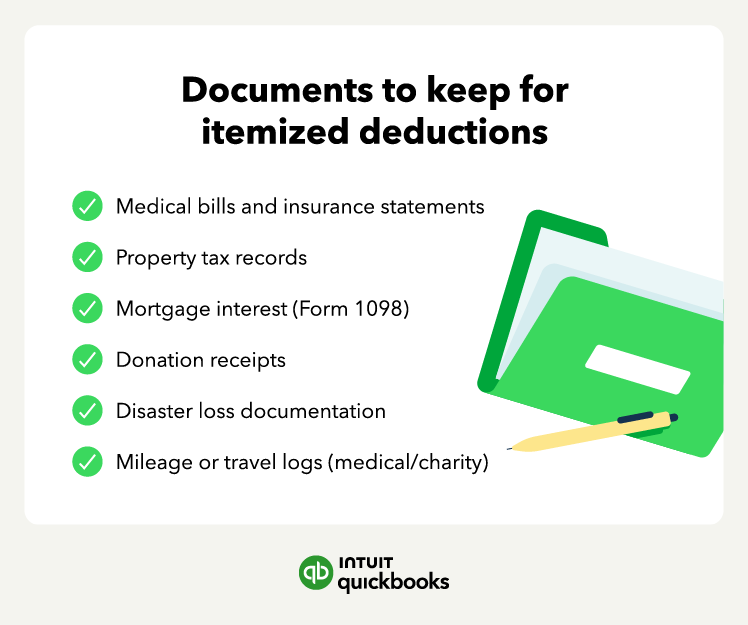
Documents to keep for itemized deductions.

note icon If you refinanced or purchased a home in the past year, check if you paid mortgage points—these could be deductible in addition to your interest.


Charitable contributions

Charitable contributions are a meaningful way to give back to your community and a valuable opportunity to reduce your taxable income. 

Whether you donate as an individual or through your business, these gifts to qualified organizations can be claimed as itemized deductions, often leading to significant tax savings. 

Some common examples of deductible charitable contributions:

  • Monetary donations to nonprofit organizations, including religious, educational, and charitable groups
  • Donations of physical items such as clothing, furniture, or household goods to thrift stores and shelters
  • Stocks, bonds, or other securities gifted to qualified organizations
  • Volunteer-related expenses, such as mileage and transportation costs incurred while performing charity work
  • Sponsorships for nonprofit fundraising events or programs
  • Contributions made through employer-sponsored giving campaigns

If you’re filing as an S corporation or a partnership, your portion of the business’s charitable contributions will be reported on the Schedule K-1 issued to you by the business. You will then report your share of these contributions on Schedule A of your personal tax return. 

For individual taxpayers, cash contributions are generally limited to 60% of your Adjusted Gross Income (AGI), while noncash contributions may have lower limits.


note icon Donating appreciated stocks or assets directly to a charity lets you avoid capital gains taxes while claiming the full market value as a deduction.


Casualty and theft losses

Casualty and theft losses can be claimed as itemized deductions on your tax return only if the loss is attributable to a federally declared disaster. These deductions are limited to unreimbursed losses, meaning you must subtract any insurance payouts you received or expect to receive.

Eligible disaster-related losses may include:

  • Damage caused by natural disasters (floods, hurricanes, tornadoes, earthquakes, etc.)
  • Losses from fire, vandalism, or theft
  • Theft of personal property such as electronics, jewelry, or art
  • Loss of property used for business purposes in a disaster

You can deduct your casualty and theft losses on Schedule A, but keep thorough records of the damage, including receipts, appraisals, and photos. Consider working with a tax professional to maximize your claim and navigate the rules for more complex situations, especially if you are affected by a federally declared disaster.


note icon If you’ve been impacted by a disaster or theft, check if your area is included in a federal disaster declaration. It can significantly broaden the scope of losses that qualify for a tax deduction.


Miscellaneous itemized deductions

There are also less common, miscellaneous personal expenses you can itemize. This includes gambling losses and federal estate tax on income.

Pros and cons of itemized deductions

Of course, there are a few tax rules to consider before itemizing deductions. Depending on your unique situation, one type of deduction may work more in your favor than the other.

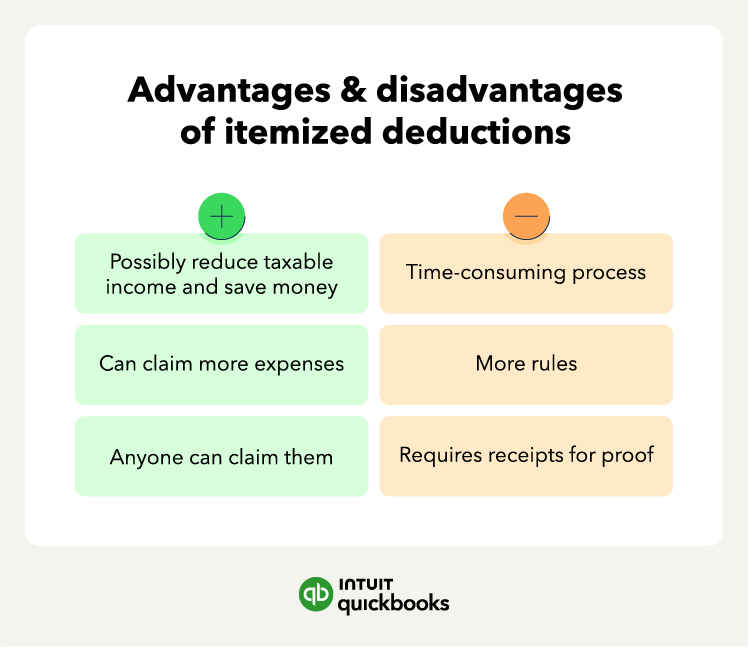
An illustration of the advantages and disadvantages of itemized deductions.

Pros of itemized deductions:

  • Potentially add up to more than the standard deduction, lowering your tax bill
  • Ability to claim more expenses 
  • Option for taxpayers of all tax brackets to claim

Cons of itemized deductions:

  • Adding up and recordkeeping individual claims takes more time and effort than taking a standard deduction.
  • Intricate rules to understand that typically require help from a tax professional
  • Requires sufficient documentation to back up your claims

Although it’s a time-consuming process, the extra steps required for itemized claims may be worth it for the amount of money you’ll save in taxes.

How to claim itemized deductions

Since you can’t claim both standard and itemized deductions, figure out your adjusted gross income first to determine which one gives you the greatest deduction. If your itemized deductions exceed your standard deduction amount, you will claim all of your expenses on Schedule A (Form 1040) with your tax return. 

Here’s how:

  1. List your deductions on their corresponding lines of your Schedule A.
  2. Total them up.
  3. Transfer that total to Line 12 of Form 1040.
  4. Subtract this amount from your income to determine your final taxable income amount.

Make sure you keep thorough records, such as receipts and bank statements, to support your deductions. You'll also need to separate your business expenses from your personal expenses, since self-employed deductions are reported on Schedule C, not Schedule A.

Find peace of mind come tax time

Itemizing deductions can lower your personal tax liability, and posting business deductions will decrease your taxes on business income. Both can be a huge help come tax filing season. If you have questions regarding personal vs. business itemized deductions, it’s best to ask a tax accountant or other tax professional. 

Remember, the most important part of taking deductions is keeping your receipts. Doing so ensures that your deductions are as accurate as possible in the event of an audit. 

Wading through receipts can be a headache. Fortunately, accounting software like QuickBooks Solopreneurs allows you to manage files, taxes, and more all in one place.


Recommended for you

Mail icon
Get the latest to your inbox
No Thanks

Get the latest to your inbox

Relevant resources to help start, run, and grow your business.

By clicking “Submit,” you agree to permit Intuit to contact you regarding QuickBooks and have read and acknowledge our Privacy Statement.

Thanks for subscribing.

Fresh business resources are headed your way!

Looking for something else?

QuickBooks

From big jobs to small tasks, we've got your business covered.

Firm of the Future

Topical articles and news from top pros and Intuit product experts.

QuickBooks Support

Get help with QuickBooks. Find articles, video tutorials, and more.