You could save up to 25% on transaction costs².
Speak with us now to see if you qualify.
Talk to sales 1-800-515-8366
Monday - Friday, 6 AM to 4 PM PT

Table of contents
Table of contents
As an Uber driver, you are considered an independent contractor. Congrats, this makes you a solopreneur, and you’ll need to calculate your tax payments and Uber tax deductions accordingly. This process can be hard to navigate, with as many as 17% of small business owners saying they would hand it off to AI if it worked perfectly.
To help reduce some of your tax-time stress and keep more of your hard-earned money in your pocket, we’ve put together this Uber driver tax deductions list. We’ll also walk you through the steps you need to take to identify and claim all the deductions and credits you are due.
Uber drivers, as well as other types of gig workers, are not classified as employees. Instead, they are classified as independent contractors, which essentially makes them business owners.
If you participate in gig work, this self-employed status means no taxes are withheld from your pay by an employer. It also means you’ll need to complete a different type of tax return, fill out additional forms, and, most importantly, you’ll be able to deduct business expenses to cut down on your tax bill.
At the beginning of the year, Uber and other gig apps like Lyft and DoorDash will send you tax forms that report your earnings. Depending on how much you earned and what type of income it was, you could receive up to two different forms: 1099-K and 1099-NEC.
You may get one tax form, both, or none. Even if you don’t get a tax form this year, you may still need to report earnings if you receive $400 or more in net self-employment income during the year.
As an Uber or Uber Eats driver, one of your biggest expenses is vehicle maintenance. Thankfully, this is an expense you can deduct. There are two methods for deducting vehicle expenses: mileage versus actual costs.
Using the standard mileage rate is usually the quicker, easier method, but you could be leaving money on the table, especially if you have a more expensive vehicle. Let’s take a look at calculating your deduction using each method and explore which option might be best for you.
The quick and easy way to deduct vehicle expenses is to use the standard mileage rate. For the 2025 calendar year, this rate was 70¢ per mile. In 2026, this rate increases to 72.5¢ per mile. So, if you drive 20,000 miles in 2026, your deduction for the year would be $14,250.
Using the standard mileage deduction covers common vehicle expenses, including fuel, insurance, registration, maintenance (like oil changes or new tires), and depreciation. If you paid tolls, parking, or airport fees while driving for Uber, you can still deduct these in addition to standard mileage.
If you have an older vehicle, a fuel-efficient car, want simplicity, or your mileage for the year was higher than your vehicle expenses, then using the standard mileage rate might be the better choice when filing your taxes.

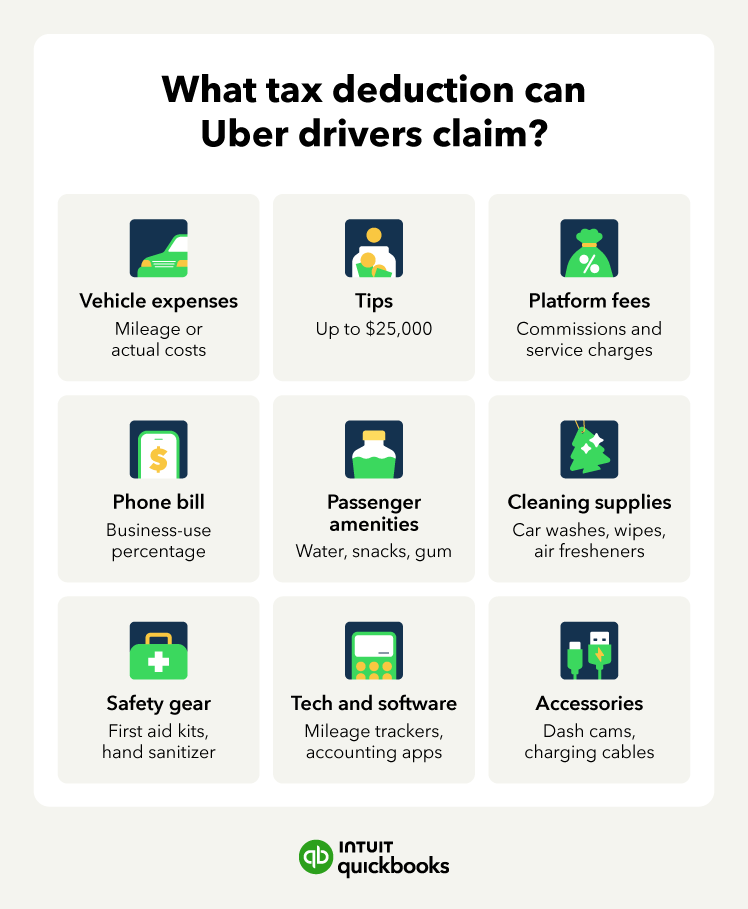
What can you write off on taxes for Uber? In addition to vehicle expenses, you can also write off snacks purchased for riders, phone bills, and the cost for any subscription or software services you use in the course of your work (e.g., mileage trackers).
The other deduction option is to itemize the actual vehicle expenses you incurred during the year. This will require diligent tracking of costs like:
For some of these expenses, you’ll need to separate business use from personal use. For instance, with insurance, you’ll need to determine what percentage of your bill went towards paying for rideshare insurance. Only the business-use portion of the bill is deductible.
This method of calculating your deduction is often the better choice for drivers with newer, high-cost vehicles, those with expensive insurance policies, or those who incurred large repair and maintenance bills for the year. If you use QuickBooks, the software will do the calculations for you, helping you save money when filing.
Note: While you cannot take deductions for both mileage and vehicle expenses, there are several additional driver-related expenses you can deduct, including tolls, fees charged by Uber, and the new-car loan interest deduction.
As a part of determining which deduction method will be best, you need an accurate idea of your mileage for the year. While Uber tracks mileage, it only does so for the duration of a customer's ride.
As a driver, you are likely putting in a lot more mileage than Uber reports. To maximize your deduction, you should also track all the online and offline miles you put in.
Online miles consist of all the mileage you put on your vehicle while operating the Uber Driver app. This generally breaks down into three stages:
All three stages are deductible, but Uber only tracks the mileage for stage 3. Let’s say you drove 20 miles while cruising for a fare, 6 miles to pick up your fare, and 11 miles to drop them off at their destination. This means your total deductible mileage for this trip is 37 miles, not the 11 miles Uber reports.
Is it better to track mileage or gas? Really, you should track both gas and mileage. As you drive more, you’ll gain a better understanding of which number is going to save you more money at tax time.
Offline miles consist of all the driving you do when the app is off. While the miles you drive for personal use are not deductible, there are situations where your mileage might be deductible. For instance, driving to the car wash to clean your car after a night of driving, or going to the store to replenish the bottled water you hand out to passengers.
Any errand or trip you take that relates to your job as an Uber driver is deductible for mileage. The QuickBooks Automatic Mileage Tracker can help you track this mileage, as well as the online miles Uber doesn’t record.
Standard mileage and vehicle expenses are usually the biggest deductions you will have as an Uber driver, but they are far from the only deductions you can take. Many of your nonvehicle business expenses are deductible as well. Let’s take a look at some of the most common nonvehicle Uber tax deductions.
As you’re reviewing your 1099-K, you may notice that your total trip earnings listed are higher than what you were actually paid. This is because the reported total is gross earnings. From this gross, Uber takes a cut in the form of service fees, booking fees, commissions (Uber Eats), sales tax, and instant pay charges.
For a full breakdown of the expenses you were charged, check out your Tax Summary for the year. The total under Expenses, Fees, and Tax is what you can deduct. For example, let’s say your gross earnings were $35,000 and the fees charged by Uber were $13,500. Your net pay would be $21,500, and your deduction amount would be $13,500.
A new law passed in 2026 lets you save tax money on the tips you earn. Part of the One Big Beautiful Bill Act (OBBBA), you can now deduct up to $25,000 of your tips from your income for federal income tax purposes. Social Security, Medicare, and state/local taxes will still be due.
As an example, let’s say your net income from Uber for the year was $20,000 plus $2,000 in tips. Let’s take a look at how the math shakes out if you were in the 12% tax bracket.
As you can see from the above example, this tax break can easily save you hundreds or thousands each year. Even though the tax rate (12%) hasn't changed, the amount being taxed is smaller. By shielding that $2,000 in tips from federal tax, you save $240.
The no tax on tips deduction will phase out for single filers at a MAGI of $150,000 and $300,000 for joint filers. Additionally, as a self-employed individual, you can only deduct tax on tips up to your total net income from the tipped work.
There are numerous other miscellaneous business expenses that you may be able to deduct.
Here’s a quick overview of common deductions for Uber drivers:
To determine if an expense is deductible, it needs to meet three criteria: ordinary (a common expense for Uber drivers, necessary (needed to complete the job), and for business use (not personal use). If an expense meets all three criteria, then you should be able to deduct it on your taxes.
As a self-employed individual, the tax laws you’ll need to adhere to are a bit different, and they are constantly changing. Let’s look at some key changes to Uber and Uber Eats driver tax deductions for 2026.

Taxes aren’t just due to the federal government; state and local governments charge you taxes as well. Even if you live in a state that doesn’t impose income tax, there are still other types of taxes you get hit with, like sales tax and property tax.
As part of itemizing your taxes, you have the option to deduct these costs using the SALT (state and local tax) deduction.
While this deduction has been around for a while, for 2026, the cap increased from $10,000 to $40,000. For Uber drivers who live in high-tax states, or those who recently purchased a new vehicle, this deduction could really cut down your tax bill. You’ll just want to carefully calculate and compare it to the standard deduction to ensure it's worth claiming.
Self-employed taxes are higher than W-2 taxes because you are paying both the employee and employer portions of the Medicare and Social Security taxes. To help reduce this burden for small business owners and sole proprietors, the QBI (Qualified Business Income) deduction was created and made permanent in 2025. This lucrative deduction lets you deduct up to 20% of your qualified business income.
Let’s look at a quick example. After deducting her other expenses, Sarah earned $28,000 net as a gig worker last year. With the QBI deduction, she could reduce her taxable income by $5,600, meaning she would only pay taxes on $22,400 of income.
Navigating tax filing as a self-employed Uber driver comes with unique challenges. There are a lot more forms to fill out and information to gather, and there is always the fear of doing something wrong. Here are some of the most common pitfalls Uber drivers face during tax time:
Use technology to your advantage. Download mileage tracking apps (like QuickBooks), subscribe to accounting software, and pay for tax prep services to ensure you are getting your taxes right.
Now that you know more about what Uber tax deductions are available, it’s time to put that knowledge to work come tax time. To ensure you take advantage of all available deductions, consider using accounting software like QuickBooks. With features for expense tracking, mileage tracking, and tax prep, you’ll be well prepared and less stressed out when filing your taxes next year.

Call Sales: 1-800-285-4854