Types of business taxes in California
As an employer in California, you may be responsible for reporting and paying other business taxes in addition to withholding payroll taxes from your employees' paychecks. From federal to state and local levels, understanding the different tax programs and their impact on your business’s finances is important. And when it comes to onboarding complexities, look over this guide on California hiring requirements.
Federal taxes
You'll be responsible for federal taxes in whatever state you open a business in. Unfortunately, there are dozens of federal tax forms with unique due dates and requirements. Using an accountant or small business accounting software can be helpful in avoiding mistakes that can lead to overpayment or penalties.
As a business owner, you have both personal and business tax filing obligations. Here’s what you need to know:
Personal tax filing
Federal income tax returns:
Every individual is required to file and pay federal personal income tax. This forms the foundation of your overall tax responsibility.
Business tax filing
Business owners have additional filing requirements, depending on the business structure:
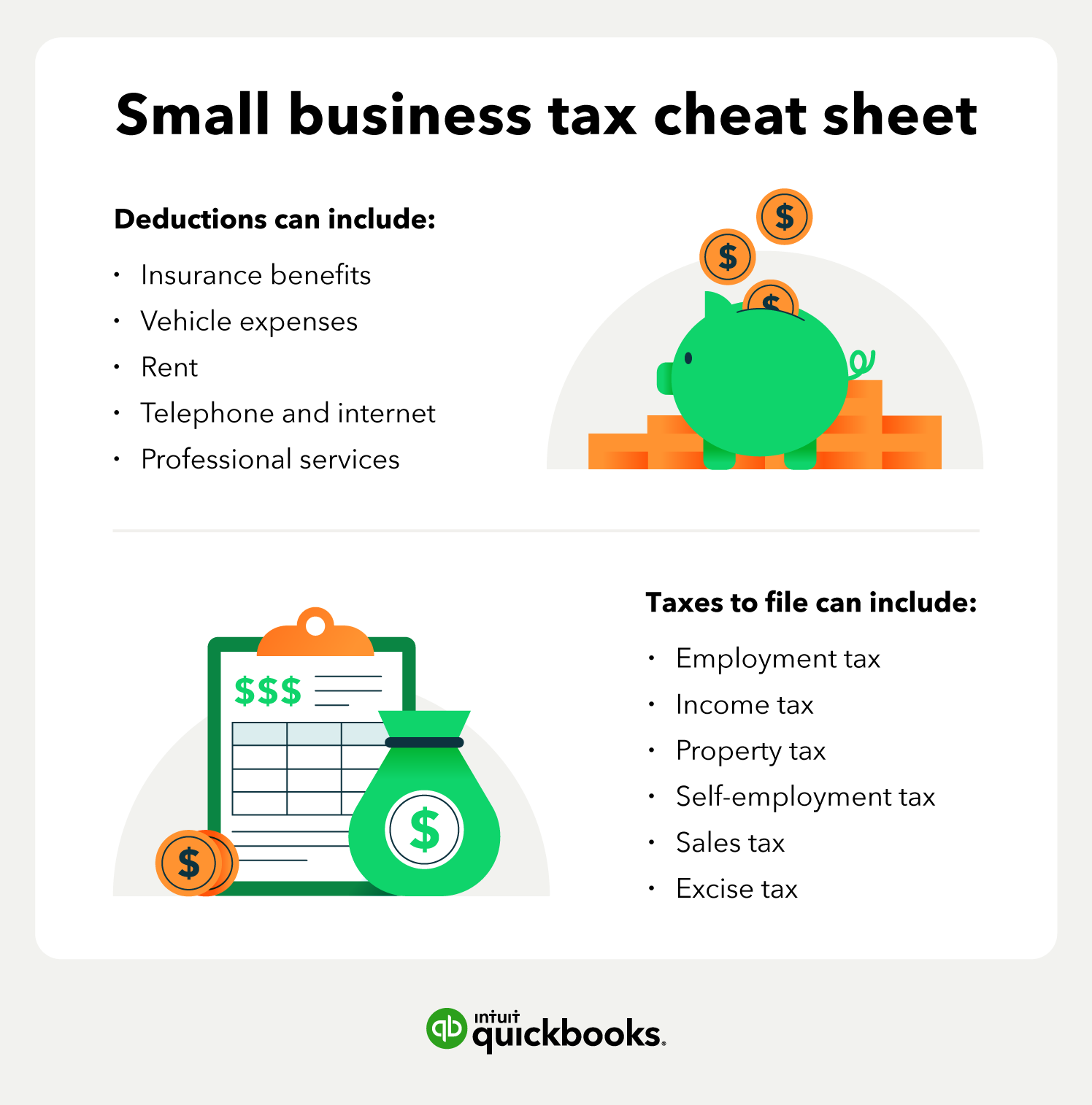
- Sole proprietorship: Income and expenses are reported on your personal tax return using Schedule C (Form 1040).
- Partnership: A partnership must file an information return (Form 1065) to report income, deductions, and other relevant details, while each partner reports their share of income on their personal return.
- Corporation: A corporation files a corporate tax return (Form 1120), paying taxes on its profits.
- S Corporation: An S corporation files an informational return (Form 1120S). Its income, losses, and deductions pass through to shareholders, who report them on their personal returns.
- Limited Liability Companies (LLCs): LLCs are not classified separately for federal tax purposes and are taxed based on their ownership structure. Single-member LLCs default to sole proprietorship taxation or may elect corporate taxation, while multi-member LLCs default to partnership taxation or may elect corporate taxation.
Self-employment tax
If you work for yourself and earn more than $400 a year, you pay toward Social Security and Medicare programs through a self-employment tax. The Social Security system provides retirement benefits, disability benefits, survivor benefits, and hospital insurance (Medicare) benefits.
Employment taxes
As an employer, you are responsible for withholding and depositing federal income tax and the employee contribution to Social Security and Medicare taxes. You must also pay the employer portion of Medicare and Social Security and pay federal unemployment tax (FUTA).
State taxes
California has a variety of state taxes, including three types of business income taxes. It’s important to know which kinds of taxes your business may be liable for based on your structure and business activities.
California corporate income taxes
California has a flat corporate income tax of 8.84%. This tax applies to C corporations and LLCs (other than banks and financials) that elect to be treated as corporations if they report a profit (taxable income).
Banks and financials are taxed at a flat rate of 10.84%.
How is the corporate income tax calculated in California?
In California, the corporate income tax rate for C corporations, excluding banks and financial institutions, is 8.84%. To determine the portion of income subject to this tax, California employs an apportionment formula.
Most corporations are required to use a single-sales factor apportionment, which calculates the taxable income based solely on the percentage of the corporation's total sales made to customers within California. However, corporations deriving more than 50% of their gross receipts from qualified business activities may use a three-factor formula that considers property, payroll, and sales.
Who is liable for the corporate income tax in California?
Every corporation that is incorporated, registered, or doing business in California is subject to the state's corporate income tax. Nexus plays a key role in determining liability. A corporation establishes nexus—and is therefore liable for corporate income tax—if it has a sufficient connection to the state. This includes corporations that are:
- Incorporated in California
- Conducting business operations within the state
- Registered with the California Secretary of State
- Generating income from California sources
Corporations with nexus are also required to pay a minimum franchise tax of $800 annually, unless they are newly incorporated or qualified, in which case the minimum tax is waived for their first taxable year.
Alternative Minimum Tax (AMT)
California has an Alternative Minimum Tax rate of 6.65% (8.65% for financial corporations). An alternative minimum tax sets a lower limit for the amount businesses can pay in taxes, regardless of their level of expenses and deductions.
What is the Alternative Minimum Tax?
The Alternative Minimum Tax (AMT) is a parallel tax system designed to ensure taxpayers, particularly corporations, pay a minimum level of tax by limiting certain deductions and tax preferences.
How is the AMT calculated?
AMT is calculated by applying adjustments and preference items to regular income, subtracting an exemption, and taxing the result at 6.65% for general corporations or 8.65% for financial corporations. If the AMT exceeds regular tax, the difference is owed. AMT applies to corporations with adjusted income over $40,000 and may generate future tax credits.
Who is liable for the AMT?
The AMT applies to profitable C corporations and LLCs that elect to be treated as corporations for tax purposes.
California franchise tax and annual tax
California imposes a franchise tax on corporations and an annual tax on certain other business entities for the privilege of doing business in the state.
What are the franchise and annual tax rates?
The franchise tax rate and how it is calculated depends on your business structure and industry:
Franchise tax:
- Applies to C corporations and S corporations
- C corporations: 8.84% of net income or $800 minimum, whichever is greater
- S corporations: 1.5% of net income or $800 minimum, whichever is greater
- S corporations in banking and finance: 3.5% of net income or $800 minimum
Annual tax:
- Applies to LLCs, LPs, and LLPs
- Flat rate of $800 per year
Additional LLC fee:
- LLCs pay an additional fee based on total California income:
- $250,000 - $499,999: $900
- $500,000 - $999,999: $2,500
- $1,000,000 - $4,999,999: $6,000
- $5,000,000 or more: $11,790
The annual tax applies to LLCs, LPs, and LLPs and is distinct from the franchise tax applied to corporations. Sole proprietorships and general partnerships are not subject to either the annual tax or franchise tax.
Who is liable for the franchise or annual tax in California?
If you do business in California, you are subject to its tax laws. Doing business includes the following entities:
- Corporations incorporated in California
- Corporations registered to do business in California
- Corporations doing business in California
- Limited Liability Companies (LLCs) doing business or organized in California
The minimum franchise tax is $800 for most entities. Newly incorporated or qualified corporations are exempt from the minimum franchise tax in their first taxable year. Corporations are also exempt if they did not conduct any business in California during the tax year and their tax year was 15 days or fewer.
Even inactive corporations must pay the minimum franchise tax unless they meet specific exemption criteria.
Visit the State of California Franchise Tax Board website for the latest information on franchise taxes and your responsibilities.
Excise taxes
The California Department of Tax and Fee Administration's Business Tax and Fee Division administers over 30 special tax and fee programs that encompass a broad range of activities and transactions.
Some products and activities that trigger special taxes include alcoholic beverages, cigarettes and e-cigarettes, cannabis, lithium extraction, timber yield, and vehicle fuel. It’s important to review what may apply to your business and understand your tax responsibilities. Here are some examples:
- Cannabis: The cannabis excise tax is 15% of gross receipts from retail sales of cannabis and cannabis products, with the rate subject to change on July 1, 2025.
- Wine: Wine excise tax is $.20/gallon for wine and $.30/gallon for sparkling wine.
- Cigarettes: Cigarettes are currently taxed at $0.1435/cigarette ($2.87/pack of 20)
See the California Department of Tax and Fee Administration for details on special taxes and fee programs.
Unemployment taxes
If your business has employees, you will need to pay employment or payroll taxes. While some are federal, others are payable to the state of California. Contributions may be employee-only, employer-only, or shared.
- California personal income tax withholding for each employee is set at marginal rates of 1.0% to 14.4%.
- California State Disability Insurance (SDI) is funded solely through employee contributions and is withheld at a rate of 1.2% for 2025. Effective January 1, 2024, all wages are subject to SDI contributions, with no taxable wage limit.
- California state Unemployment Insurance (UI) and Employment Training Tax (ETT) are funded solely by employers. The UI rate ranges from 1.5% to 6.2%. The new Employer UI rate is 3.4%. The ETT rate is 0.1%. Both UI and ETT have a taxable wage limit of $7,000 per employee per calendar year.
All employers are required to electronically submit employment tax returns, wage reports, and payroll tax deposits to California’s Employment Development Department.
California Sales and Use Tax
California has a statewide sales and use tax rate of 7.25%. (Most local jurisdictions also charge sales tax, known as district taxes.)
All retailers engaged in business in California have to register with the California Department of Tax and Fee Administration (CDTFA) and pay the state's sales tax on all non-exempt retail sales of goods and merchandise. The use tax generally applies to the storage, use, or other consumption in California of goods purchased from retailers in transactions that weren’t subject to the sales tax. Use taxes can also apply to purchases shipped to a California consumer from another state, including purchases made by mail order, telephone, or Internet.
Remote seller tax considerations
Remote sellers are out-of-state sellers whose only activity in California is the remote solicitation of sales (through internet, mail, phone, etc). In 2019, California enacted legislation requiring remote sellers to collect and remit sales tax if they have an economic presence in the state, even without physical presence. Remote sellers must register with the CDTFA and collect California sales and use taxes if their total sales of tangible personal property for delivery in California exceed $500,000 during the current or prior calendar year.
Local taxes
Some cities, counties, and other jurisdictions in California levy additional local taxes to fund essential services and infrastructure such as schools, roads, and public safety.
Local and district taxes
Most local jurisdictions charge their own sales tax, which is added to the state’s rate. These are also known as district taxes. These local rates currently range from 0.10% to 1.50%. You can locate your local rate on the state tax and fee department’s list of effective sales and use tax rates. Keep in mind that rates can change over time and certain areas may have multiple district taxes in effect.
As of April 25, 2019, all retailers, whether located inside or outside of California, are required to collect district use taxes on sales made for delivery in any district that imposes such taxes if their total combined sales of tangible personal property in California or for delivery in California exceed $500,000 in the preceding or current calendar year. This $500,000 threshold applies to both taxable and nontaxable sales, including sales for resale. Once a retailer meets this threshold, they are considered engaged in business in every district in California, regardless of physical presence, and must immediately begin collecting and remitting district use taxes.
Property taxes
Although there are no statewide property taxes, property taxes are the primary source of revenue for local governments in California. The California property tax rate is determined by each county assessor and varies widely depending on the location of the property. Unlike business and income taxes, California’s property taxes tend to be relatively low compared to other states.