QuickBooks Blog
An illustration of someone following up on a past due invoice
payments

How to follow up on a past due invoice in 7 steps [+ email templates]


Tips for handling past due invoices:

  • Implement a 7-step follow-up strategy starting with verifying invoice details, setting clear payment terms, and escalating communication gradually.
  • Automate reminders using invoicing software like QuickBooks to send notices before, on, and after the due date, reducing manual effort.
  • Use a professional, escalating email schedule (e.g., Day 1, Day 15, Day 30) to encourage payment while maintaining a positive client relationship.
  • Clearly define and communicate late fees and interest (typically 1.5% to 3% per month) in your contract before applying them to an overdue invoice.
  • The goal is collection, not confrontation; for unresponsive or large debts, collections or legal action should always be a last resort.


On average, US small businesses with outstanding invoices are currently owed a staggering $17,500 each. That’s cash flow you could be using to grow your business or serve existing customers.

A past-due invoice, or overdue invoice, is simply a bill that hasn't been paid by the stated due date. While this situation can be frustrating, adopting a clear, professional strategy will dramatically increase your chances of getting paid without damaging client relationships.

Our guide equips you with a seven-step process (including effective email templates) to chase down past-due invoices, minimize friction, and ensure you secure the cash flow your business needs.

1. Review past due invoices

2. Set clear payment expectations upfront

3. Send an overdue invoice notice via email

4. Escalate the follow-up if necessary

5. Personalize the final communication

6. Create a follow-up schedule

7. Take legal action (last resort)

Best practices for effective overdue invoice follow-up

Past due invoice email templates: copy and paste

Unpaid invoice email escalation

Choose the best payment setup for your business

Follow along as Morgan Law guides you through all you need to know about following up on past-due invoices as a small business.

1. Review past due invoices

An invoice becomes past due the moment the payment deadline passes. Before diving into collection efforts, take a moment to ensure you're working with accurate information.

Double-check these key details:

  • The invoice number, amount, and original due date
  • The agreed-upon payment terms
  • Any previous communication attempts you’ve made regarding the invoice

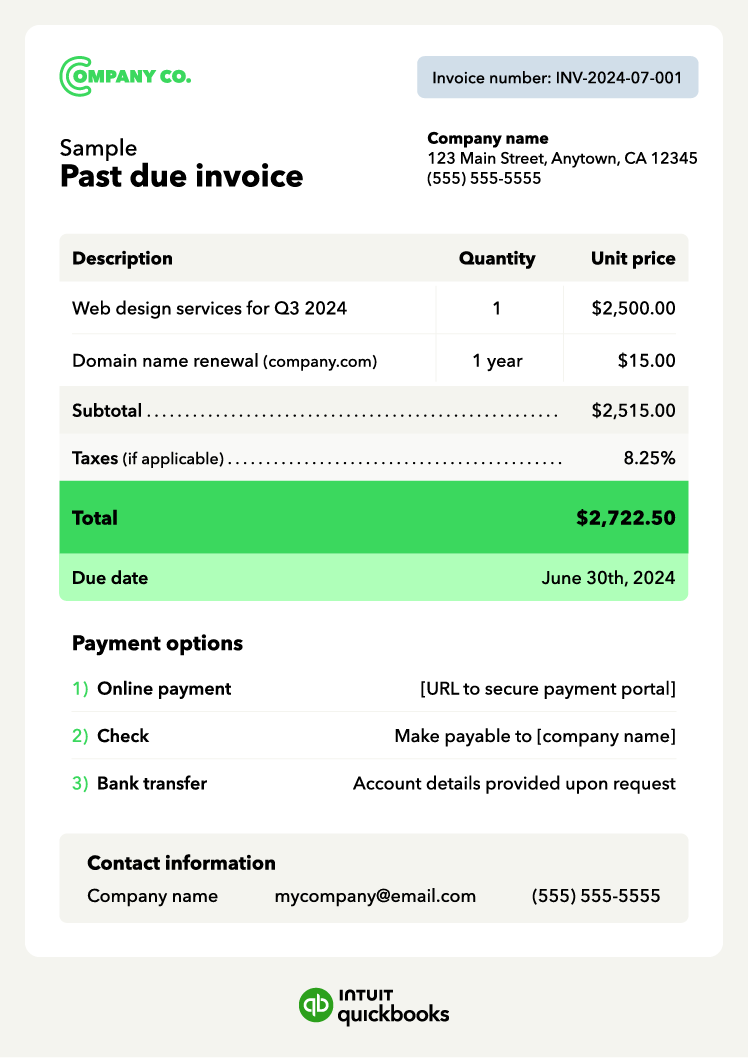
Here is a sample past due invoice for reference:

An example of a past due invoice.

Knowing why a client might be late can help you tailor your approach. Common reasons include:

  • Administrative oversight: The invoice was lost in a crowded inbox or sent to the wrong person/department.
  • Cash flow issues: Your client is delaying payments to manage their own temporary money problems.
  • Disputed charges: The client believes the bill amount is incorrect or unexpected.
  • Banking or processing delays: A check or bank transfer is taking longer than expected to clear.
  • Intentional delays: Some companies delay payments as an internal cash flow strategy.
@quickbooks Reminding your customers about late payments doesn’t have to be awkward. Here are some #SmallBusinessTips on getting clients to pay their bills and invoices faster. #BusinessOwner #MediumBusiness #SmallBusinessTikTok #SmallBusinessOwner ♬ original sound - QuickBooks

2. Set clear payment expectations upfront

The best way to avoid chasing late payments is to set clear expectations from the start. When clients know exactly when and how they need to pay, there’s less room for confusion.

Be upfront about terms:

  • Clearly outline payment deadlines, late fees, and any interest charges in your contract or service agreement.
  • Specify accepted payment methods, such as bank transfers, credit cards, or online payment portals.
  • Consider offering small discounts or perks as incentives for early payments.

For larger projects, splitting payments into smaller chunks is highly effective. This structure keeps cash flowing and makes payments easier for clients to manage:

  • Upfront deposit: A percentage of the total that's due before work begins.
  • Milestone payments: Payments due at specific, pre-defined project stages.
  • Final payment: The remaining balance due upon completion.

3. Send an overdue invoice notice via email

Once you've confirmed the invoice details, it's time for a gentle nudge. Craft a polite email (or phone call) reminding your client about the outstanding invoice.

Email is the best first step because:

  • It's a respectful, nonconfrontational way to request payment.
  • A well-crafted email keeps the conversation professional without damaging the client relationship.
  • It creates a crucial written record of your communication, which is useful if you ever need to escalate things later.

note iconMake it easy to pay: Always include clear details like the invoice number, the amount due, and a direct link to your online payment portal or a list of available payment methods (mail-in checks, credit card payments, etc).


4. Escalate the follow-up if necessary

If your initial attempt doesn't get a response, it's time to take a firmer approach. Send a follow-up that clearly reiterates the outstanding invoice and the urgency for payment. 

Using a professional and understanding tone, outline potential consequences of continued nonpayment, like:

  • Late fees: These are typically a flat rate or a percentage of the amount owed (e.g., $25 to $50 flat fee, or a 1.5% monthly late charge).
  • Accruing interest: If an invoice stays unpaid for too long, you can charge interest on the overdue balance. A standard rate is 1.5% to 3% per month.
  • Service interruption: Politely inform the client that current and future work will cease until the outstanding balance is settled.
  • Collection agency involvement: This is a last resort, as agencies typically take 25% to 50% of the recovered amount, but mentioning it emphasizes your seriousness.

Continue to foster a solution-oriented approach. The goal is to collect payment while preserving the opportunity for future business.

5. Personalize the final communication

Understanding your audience is key to effective communication. When crafting your follow-up, personalize the message based on your relationship with the client.

Remind the client how your services benefit their business. This subtly reinforces the value they receive and incentivizes them to pay and continue the relationship.

For example, you could say: "Once this payment is processed, we can immediately resume work on the Q4 marketing plan, ensuring your business stays on track to hit those crucial year-end sales goals we discussed."

6. Create a follow-up schedule

Follow up consistently without overwhelming the client. A structured email schedule helps you escalate the situation gradually while giving the client multiple chances to pay.

Introducing the AI Payments Agent

Get paid 5 days faster on average when you send invoice reminders with your Payments Agent, an AI-powered assistant right in QuickBooks.

7. Take legal action (last resort)

While legal action should always be a last resort, understanding when and how to involve collections agencies or legal counsel is crucial. Here's what you need to know:

  • Consider the amount owed: For smaller amounts, the cost of legal action might outweigh the potential recovery.
  • Gather documentation: Throughout the collection process, keep meticulous records of all communication attempts (emails, phone logs) and invoice copies. This strengthens your case if legal action becomes necessary.
  • Consult a lawyer: Seek professional legal advice if the amount owed is significant or the client is unresponsive. They can guide you through the legal process and maximize your chances of recovering the full amount.
  • Remember, thorough documentation is key throughout the collection process. It serves as evidence of your efforts and strengthens your position if legal action becomes unavoidable.
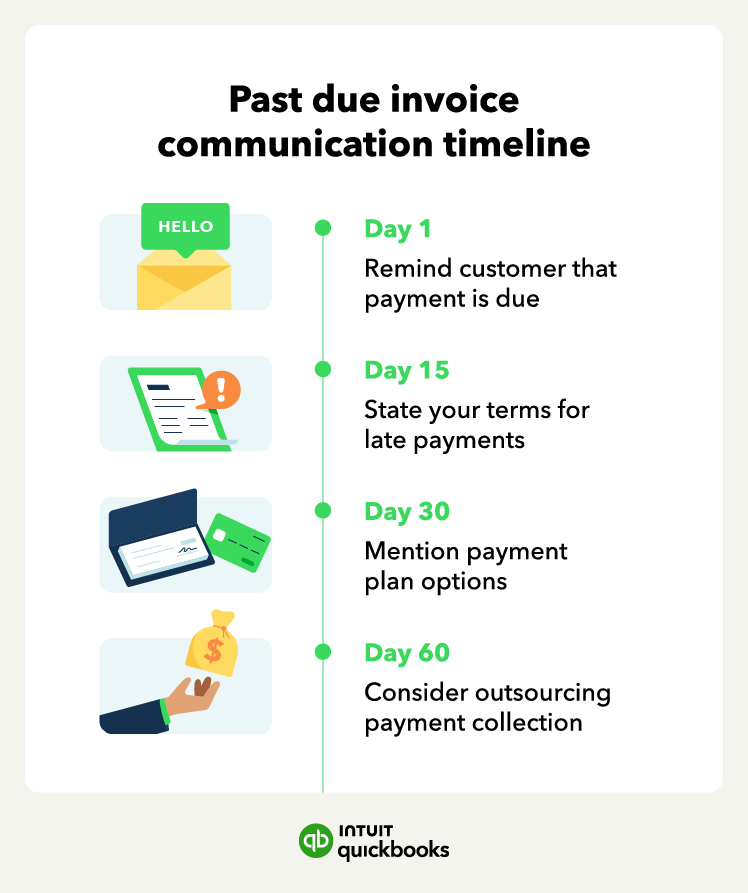
A 60 day past due invoice communication timeline.

Best practices for effective overdue invoice follow-up

Late client payments can wreak havoc on your small business’s cash flow. The past due invoice email templates can help you collect payments on invoices that are already overdue. There are steps you can take with other current customers and those you work with in the future to increase the likelihood of on-time payments.

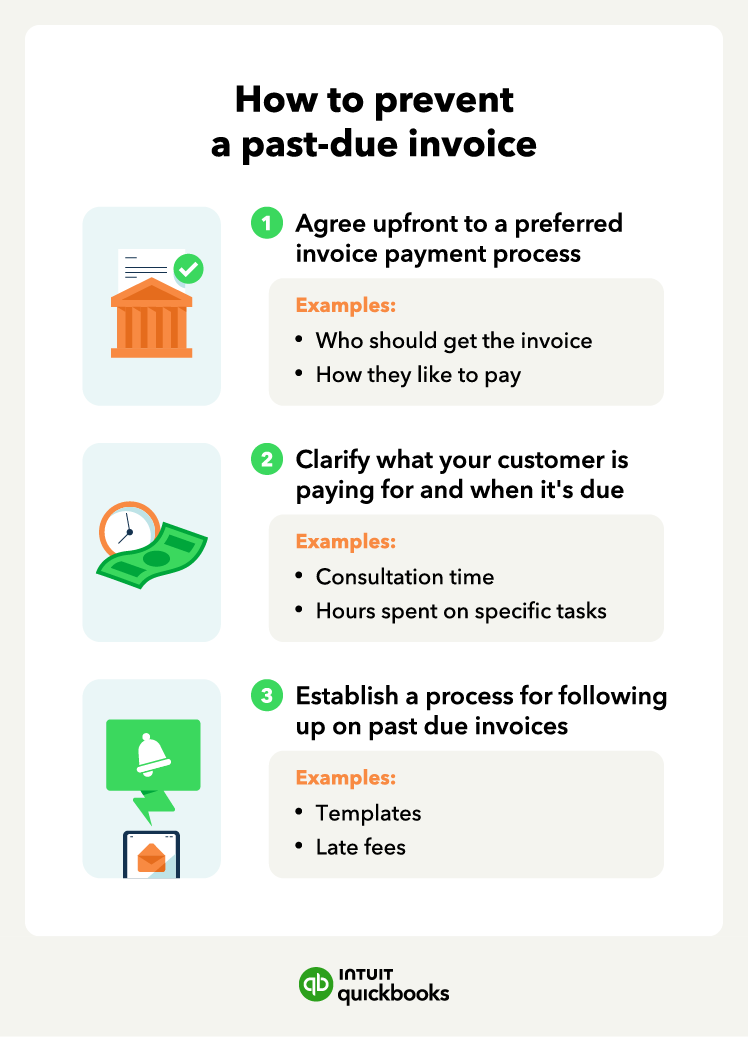
A guide on how to prevent a past-due invoice from occurring.

1. Agree upfront to a preferred invoice payment process

For faster payments, hold the invoice conversation right at the start before you do the work. If it’s too late for that, don’t beat yourself up. There’s always next time.

It can be easier to get payment if you’ve determined these two specific logistics of what your client wants and needs in an invoice:

  • Who should get the invoice: Sometimes it’s the client, sometimes it’s the accounting department, and sometimes it’s both. Make sure you know the procedure to expedite smoother, faster payment.
  • How they like to pay: Offering your customers more payment options, such as credit card, eCheck, or direct ACH bank transfer, ensures that there’s no holdup for an easily avoidable reason.

It’s an extremely common situation: A client becomes accustomed to paying for almost everything one way, only to become inconvenienced when that payment method isn’t available. 

If they pay for everything by credit card, and you’re asking for a check, they may not ever find the time to locate their checkbook, get a stamp, and put the check in the mail. With QuickBooks, Payments AI helps you identify payment methods that will likely get you paid faster.

2. Clarify what your customer is paying for and when it's due

Clients are more likely to pay on time when the invoice clarifies what they’re paying for. That’s why you want to make sure you’ve included all the information a client needs.

This could include:

  • Consultation time
  • Hours spent on specific tasks
  • Research time
  • Distinct project numbers for pre-defined deliverables
  • Cost of materials

If you haven’t yet cataloged your products or services, it’s a worthwhile exercise that can make everything from marketing your business to sending invoices more efficient in the future.


note icon Be proactive and remind customers of their outstanding payments. Sending a reminder that their payment is due next week gives them a heads-up. It might get the money you’re owed in your hands more quickly.


3. Establish a process for following up on past due invoices

Having “the conversation” about past-due payments is enough to have you chewing your nails and wiping your sweaty palms on your pants. When your nerves are already high, you don’t want to feel lost about what to do next. 

Having a system for following up on late payments can help you keep calm. The specifics of each system will differ from entrepreneur to entrepreneur, but a few things to consider include:

  • Templates: Use pre-written email templates for payment reminders and overdue invoices to streamline communication.
  • Late fees: Use pre-written email templates for payment reminders and overdue invoices to streamline communication.
  • Reinforcements: For unresponsive clients, consider involving a lawyer or collections agency. Have this information readily available, just in case.

No two late payment situations are exactly the same, and you’ll need to respond accordingly. But having a system in place can help you determine your next steps with a little less panic and dread.

Past due invoice email templates: copy and paste

If you’re not automating reminders, starting with a payment reminder template can help you write a professional and friendly past due invoice letter. 

Customize these templates to your specific business and match the tone of your customer relationship to them. Below are guides to help you start.

Day 1: The payment due date

If you haven’t received the payment by the due date, check to see if your customer even received the bill. If you use invoicing software like QuickBooks, you can see whether a customer has viewed their invoice, which can tip you off that they might have overlooked the email.

Either way, send a polite email reminder mentioning that the invoice may have gotten lost in the shuffle. That might be enough to spur them into action. 

Invoice due email template:

Hi [Customer’s Name],

I hope this email finds you well.

This email is to notify you that payment on invoice #XXXXX for the amount of [invoice amount], which was sent on [sent date], is due today.

We have not yet received payment on this invoice and ask that you kindly confirm an ETA for the payment. If payment is not received by [late fee penalty date], a late fee will be charged.

We hope to avoid a late fee penalty, so if you have any questions about this invoice, please let us know; we will be happy to clarify.

Thank you,

[Your Name]

[Your Company Name]

Day 15: Two weeks late

If you haven’t received payment after your first reminder, it's a good time to reach out with a polite phone call. Reconfirm that your customer has the invoice, and see if they have any questions. 

You might also begin assessing late payment fees, but—this is important—only if you've already made the terms clear in your contract or onboarding process. Hitting a customer with an unexpected late fee could cause more animosity than it’s worth. However, it’s perfectly fine to state your terms for late payments upfront and then itemize them on the invoice.

15-day past due invoice email template:

Hi [Customer’s Name],

I hope this email finds you well.

This email is to notify you that payment on invoice #XXXXX for the amount of [invoice amount] was due 15 days ago, on [due date].

We have not yet received payment on this invoice. [Optional, if applicable] As your invoice is now past its due date and grace period, a late fee of [amount] has been assessed.

The outstanding invoice amount is [invoice amount plus late fees, if applicable]. Attached is a copy of the invoice. You may make a payment here: [link to online payment or other payment methods].

Please update me with the status of your payment. Don't hesitate to reach out if you have any questions.

Thank you,

[Your Name]

[Your Company Name]


note icon Provide clients with options for responding, like email and phone calls, to make it easier for them to address the issue.


Day 30: One month late

At this point, you might want to dial up your persistence. Be clear that you need to be paid, and make sure you’re talking to the right person. If you are dealing with an accounting department, it might be time to get your client involved again, as they have a vested interest in seeing you get paid in a timely fashion so the work can go on.

That’s because this is an ideal time frame to cease all current and future work. Politely let your client know via email that you will have to stop working on projects or products until the bills are current.

30-day past due invoice email template:

Hi [Customer’s Name],

I am seeking your immediate attention to your invoice, which is now 30 days past due.

Our records show that we have not yet received payment for invoice #XXXXX in the amount of [invoice amount], which was due on [due date].

[Optional, if applicable] As your invoice is past due, a late fee of [amount] has been assessed.

The outstanding invoice amount is [invoice amount plus late fees, if applicable] and is [number of days] past due. Attached is a copy of the invoice. You may make a payment here: [link to online payment or other payment methods].

Please let me know the status of your payment.

If your payment has already been sent, please disregard this notice. If you have any questions or concerns or would like to discuss payment plan options, please contact me at [contact number].

I appreciate you addressing this at your earliest convenience.

Thank you,

[Your Name]

[Your Company Name]

Day 60: Two months late

Depending on how large of a payment you're pursuing and how determined you are to collect the full amount, you may want to consider:

  • Using an invoice factoring agency
  • Sending the bill to a collections agency
  • Writing the invoice off as bad debt and moving on

Using an agency comes with its own costs, but they might be more successful in collecting your past due payment. Or it might be time to deem the payment a bad debt expense or an uncollectible payment that becomes a business expense if you don't get a payment from this final email.


note icon Instead of just demanding payment, acknowledge there might be a reason for the delay and offer to work with them to find a solution, such as a payment plan.


Unpaid invoice email escalation

The traditional Net 15, 30, and 60-day overdue invoice reminders may not be conducive to your business plan. These alternative templates offer a flexible structure for crafting overdue invoice emails.

The reminder

For the first contact, send a polite reminder to the individual with a busy schedule. Dispatch this email one week before the payment is due to ensure they have sufficient time to make the payment.

Gentle reminder email template:

Hi [Client Name],

Just a friendly heads-up that your payment for account number [Account Number] is due next week on [New Due Date]. The outstanding balance is [Amount].

We understand that busy schedules can sometimes lead to overlooked deadlines. If you've already submitted payment, please disregard this email. Otherwise, we've made it easy for you to settle the invoice online through this link: [Link to secure payment portal] (if applicable).

The invoice is attached for your reference. Please don't hesitate to reach out if you have any questions about the invoice or need any assistance with the payment process.

Thanks,

[Your Name]

The nudge

This is the first request for action. You are now directly requesting payment. Send this email on the due date and keep it concise.

Nudging reminder email template:

Dear [Client Name],

This is a friendly reminder that your invoice # [Invoice Number] is due today, totaling [amount]. We've attached the invoice for your reference.

Your prompt payment is appreciated. For your convenience, we offer several easy payment options: [list payment options].

Please don't hesitate to contact us if you have any questions about the invoice or encounter any difficulties with the payment process. We're happy to assist you.

Thank you for your business.

Sincerely,

[Your Name]

Official notice

This is the first overdue invoice email, notifying the customer that their account is in default and immediate payment is required. Clearly outline any applicable late fees. Send this email one month after the payment due date.

Official notice email template:

Dear [Client Name],

This is a friendly reminder that your invoice # [Invoice Number] is past due. The total amount due is [amount]. We've attached the invoice for your reference.

We understand that things can sometimes slip through the cracks. If you've already submitted payment, please disregard this email.

To help us keep our records current, we encourage you to settle this invoice as soon as possible.

Should you have any questions or require assistance with the payment process, please don't hesitate to reach out. We're happy to help!

Thank you for your business.

Sincerely,

[Your Name]


note icon Maintain a clear record of all communication regarding the invoice, including dates, emails, and phone calls.


The direct ask

At this stage, the tone needs to be more pressing. Inform the customer that late fees have been added and mention the possibility of their account being sent to collections to ensure they take notice. Dispatch this email two months after the payment due date.

Direct notice email template:

Dear [Client Name],

This email is to bring your immediate attention to invoice # [Invoice Number], which remains outstanding. The original due date was [original due date], making it significantly past due. The outstanding balance is [amount due], and a late fee of [late fee amount] has been applied, bringing the total due to [total amount due].

We understand unexpected situations can happen. However, to maintain a healthy business relationship, prompt payment is crucial.

Unfortunately, if this invoice remains unsettled within the next [number] business days, we will be forced to take further action. This may involve involving a collection agency, which could negatively affect your credit score and potentially incur additional fees.

To prevent these consequences, we strongly encourage you to prioritize settling this invoice immediately. The updated invoice with payment options is attached for your convenience: [list payment options].

If you've already submitted payment, please disregard this email and accept our apologies.

Sincerely,

[Your Name]

The final notice

At this stage, you may need to involve a collections agency to recover the amount owed. All late fees will be applied, the account will be closed, and the customer relationship will be terminated. Send this email three months after the payment due date.

Final notice email template:

Dear [Client Name],

This serves as your final notice regarding outstanding invoice # [Invoice Number] for [amount due]. This includes late fees totaling [late fee amount]. A final copy of the invoice is attached for your reference.

Unless payment is received in full within the next seven (7) business days, we will be forced to take further action. This may include:

  • Closure of your account
  • Referral to a collections agency, which could negatively impact your credit score and incur additional fees.

To avoid these consequences, we urge you to prioritize settling this invoice immediately. We offer several convenient payment options: [list payment options].

If you have already submitted payment, please disregard this email and accept our apologies for any inconvenience. Should you require assistance or have any questions about the invoice, please don't hesitate to contact us.

Sincerely,

[Your Name]

Run your business with confidence

Get help and guidance when you need it from real QuickBooks experts.*

Choose the best payment setup for your business

Choosing the right billing system can significantly reduce the time and effort you spend chasing a past-due invoice. When you get ahead of past due invoices, you can ensure a smoother cash flow and maintain positive relationships with your clients.

QuickBooks Payments can help you move, manage, and grow your money, making it easier to manage your business finances.

Disclaimers:

QuickBooks Payments account subject to eligibility criteria, credit, and application approval. Subscription to QuickBooks Online required. Money movement services are provided by Intuit Payments Inc., licensed as a Money Transmitter by the New York State Department of Financial Services. For more information about Intuit Payments' money transmission licenses, please visit https://www.intuit.com/legal/licenses/payment-licenses/.

QuickBooks Money: QuickBooks Money is a standalone Intuit offering that includes QuickBooks Payments and QuickBooks Checking. Intuit accounts are subject to eligibility criteria, credit, and application approval. Banking services provided by and the QuickBooks Visa® Debit Card is issued by Green Dot Bank, Member FDIC, pursuant to license from Visa U.S.A., Inc. Visa is a registered trademark of Visa International Service Association. QuickBooks Checking Deposit Account Agreement applies. Banking services and debit card opening are subject to identity verification and approval by Green Dot Bank. Money movement services are provided by Intuit Payments Inc., licensed as a Money Transmitter by the New York State Department of Financial Services. For more information about Intuit Payments' money transmission licenses, please visit

https://www.intuit.com/legal/licenses/payment-licenses/. No subscription cost or monthly fees. Other fees and limits, including transaction-based fees, apply.

Competitive APY: Competitive rate information based on publicly available data for small business checking accounts provided by the largest national and online banks as of September 18, 2023. APYs are subject to change at any time.

QuickBooks Payments: QuickBooks Payments account subject to eligibility criteria, credit, and application approval. Subscription to QuickBooks Online required. Money movement services are provided by Intuit Payments Inc., licensed as a Money Transmitter by the New York State Department of Financial Services. For more information about Intuit Payments' money transmission licenses, please visit https://www.intuit.com/legal/licenses/payment-licenses/.

Features

Apple Pay: Apple Pay is a registered trademark of Apple Inc.

Claims

“Get paid 4x faster”: 'Four times faster’ is an average, based on time to receive payment from the date invoice was sent, for U.S. customers using QuickBooks Online invoice tracking and payment features, compared to customers not using these features, from Aug 2023 to Jul 2024.

Based on U.S. Intuit Assist Beta customers using outstanding invoice notifications and AI-drafted invoice reminder features, compared to customers sending standard invoice reminders to the same customers, from January 2024 to August 2024. Not available in QuickBooks Online Advanced.


Recommended for you

Ask about discounts

You could save up to 25% on transaction costs².

Speak with us now to see if you qualify.

Talk to sales 1-800-515-8366

Monday - Friday, 6 AM to 4 PM PT

More about payments
Mail icon
Get the latest to your inbox
No Thanks

Get the latest to your inbox

Relevant resources to help start, run, and grow your business.

By clicking “Submit,” you agree to permit Intuit to contact you regarding QuickBooks and have read and acknowledge our Privacy Statement.

Thanks for subscribing.

Fresh business resources are headed your way!

Looking for something else?

QuickBooks

From big jobs to small tasks, we've got your business covered.

Firm of the Future

Topical articles and news from top pros and Intuit product experts.

QuickBooks Support

Get help with QuickBooks. Find articles, video tutorials, and more.