QuickBooks Blog
Illustration showing images of various stages in the process of calculating FUTA tax
taxes

What is FUTA tax? Rates, who pays, and how to calculate in 2026


A quick overview of FUTA tax:

  • FUTA definition: The Federal Unemployment Tax Act (FUTA) establishes a payroll tax, known as the FUTA tax, that employers must pay.
  • 2026 tax rate: The standard FUTA tax rate remains 6.0% on the first $7,000 of wages for each employee.
  • Tax credit: Most employers qualify for a credit of up to 5.4% for timely state unemployment (SUTA) tax payments, bringing the effective FUTA rate down to 0.6%.
  • Filing deadline: The last day to file Form 940 for the 2025 tax year is February 2, 2026.


According to QuickBooks’ Entrepreneurship in 2025 report, 54% of people said they're thinking of starting a business. But with the excitement comes the responsibility of understanding tax obligations and important dates, including the Federal Unemployment Tax Act (FUTA).

When you lose your job, you might rely on unemployment benefits to provide temporary income support while you search for a new job or explore new opportunities. These benefits are funded by a payroll tax called the Federal Unemployment Tax, which is paid by employers.

Below, we'll cover what FUTA is, why it's important, and how to calculate it. We'll even give you some tips on how to effectively manage FUTA taxes as a small business owner.

Jump to:

What is FUTA?

The Federal Unemployment Tax Act (FUTA) is a federal law that plays a crucial role in supporting the US workforce. It establishes a system of unemployment insurance that provides temporary financial assistance to workers who lose their jobs through no fault of their own. This helps them stay afloat while they search for new employment.

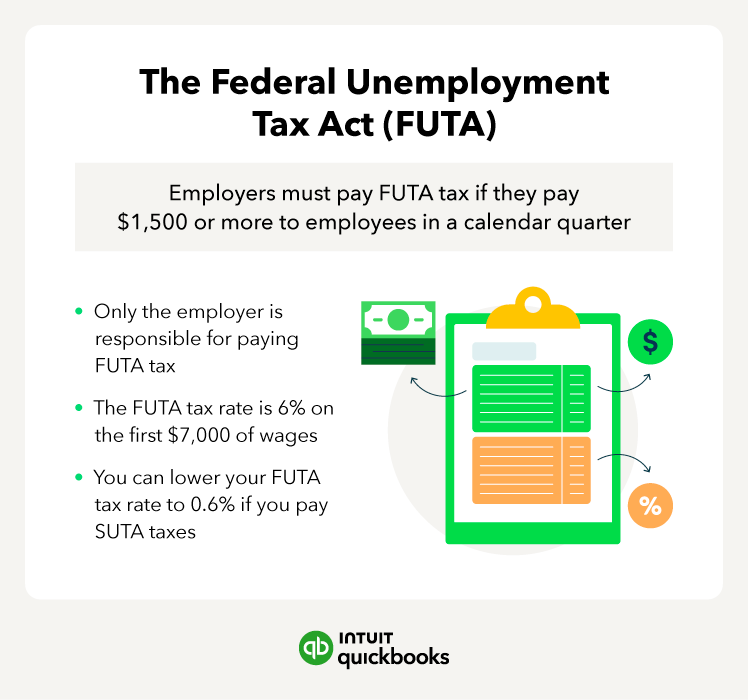
An illustration of the Federal Unemployment Tax Act (FUTA) and who has to pay it.

How does FUTA work?

FUTA works through a collaborative effort between the federal government and individual states. Employers pay a FUTA tax, and the funds are then distributed to states to administer their own unemployment insurance programs. Each state sets its own eligibility requirements and benefit levels, ensuring that the system is tailored to the specific needs of its workforce.

One of the key distinctions of FUTA is that it is paid solely by employers. Unlike other payroll taxes, such as Social Security and Medicare, which are split between employers and employees, the full burden of FUTA falls on the employer.

What is the FUTA tax rate for 2026?

The FUTA tax rate is 6% on the first $7,000 of an employee’s wages—and if you pay state unemployment taxes, your business is eligible for a tax credit of up to 5.4% to lower your FUTA tax rate to 0.6%.

FUTA vs. SUTA taxes

The State Unemployment Tax Act (SUTA) is essentially FUTA on the state level. It’s a payroll tax that many states impose on employers to fund state unemployment insurance and other employment programs.

The SUTA tax rate ranges from 0% to 12% of each employee’s salary, depending on your state. State wage bases for 2026 have increased in many jurisdictions:


note icon

If your business operates in multiple states, you'll likely need to comply with the SUTA requirements in each state.


FUTA vs. FICA

Similar to FUTA, the Federal Insurance Contributions Act (FICA) is another payroll tax for businesses. The main difference between FUTA and FICA lies in the rates and who pays them, for example:

  • The FUTA tax rate is 6% on up to $7,000 of an employee’s wages. However, this rate can be as low as 0.6% if you pay state unemployment taxes. Only the employer pays FUTA taxes.
  • The FICA tax rate is 7.65% since you withhold 6.2% of your employee’s wages for Social Security and 1.45% for Medicare. Both the employee and employer must pay FICA taxes since you match the employee’s 7.65% in FICA taxes when paying the federal government.

FUTA and FICA fund different programs. While money for FUTA taxes goes toward unemployment insurance, revenue from FICA goes toward Social Security and Medicare benefits.


note icon

Remember that FUTA and FICA have different wage bases. You'll stop paying FUTA tax on an employee's wages once they hit $7,000, but you'll continue paying FICA taxes on their wages up to the Social Security wage base.


Who has to pay FUTA tax?

Most employers in the United States are required to pay FUTA tax. This tax helps fund unemployment insurance programs that provide financial assistance to workers who have lost their jobs.

Here's a breakdown of who is generally liable for FUTA tax:

  • Businesses with employees: If your business employs at least one person for some portion of a day in each of 20 different calendar weeks, you are liable for FUTA tax.
  • Businesses with significant payroll: If your business pays wages of $1,500 or more in any calendar quarter, you are also liable for FUTA tax.

This means that businesses of all sizes, from small startups with a few employees to large corporations with thousands of workers, are typically required to pay FUTA tax.

Your accounting, your taxes. All in one place.

Save time by seamlessly moving from books to taxes in QuickBooks, then file your return with unlimited expert help and your maximum refund.*

There are also specific rules for certain types of employers:

  • Agricultural employers: These employers are liable for FUTA tax if they pay $20,000 or more in cash wages to farmworkers in any calendar quarter or employ 10 or more farmworkers during some portion of a day in each of 20 different calendar weeks.
  • Household employers: These employers are liable if they pay $1,000 or more in cash wages in any calendar quarter.

The purpose of FUTA is to provide a safety net for employees who lose their jobs. By requiring most employers to contribute to the unemployment insurance fund, the government ensures that funds are available to support those who are temporarily out of work. This helps to stabilize the economy and prevent widespread hardship during periods of high unemployment.

A series of photos showing the contents of a plant.

Who is exempt from paying FUTA tax?

While most employers are required to pay FUTA tax, there are some exceptions. Certain types of organizations and businesses are exempt from this tax, including:

  • Federal and state governments: Government agencies are typically exempt from paying FUTA tax as they have their own unemployment insurance programs.
  • Nonprofit organizations: Certain nonprofit organizations that are exempt from income tax under section 501(c)(3) of the Internal Revenue Code may also be exempt from FUTA tax.
  • Religious organizations: Churches and other religious organizations are generally exempt from FUTA tax.
  • Educational institutions: Schools and other educational institutions operated by a church or nonprofit organization may be exempt.

It's crucial to consult the IRS guidelines or a tax professional to determine if your organization qualifies for exemption from FUTA tax.

How to calculate FUTA taxes

Calculating FUTA taxes is a straightforward process. If everyone at your company earns more than $7,000 per year, the basic equation for determining FUTA tax is as follows:

$7,000 x 0.06 x Number of employees = FUTA tax liability

For example, let’s say you run a company with 20 employees, each of whom earns $50,000 per year.

Since everyone makes over $7,000 per year—and FUTA tax only applies to the first $7,000—we can calculate your company’s FUTA payroll liability with the following formula:

$7,000 x 0.06 x 20 = $8,400

Your company’s FUTA tax liability is $8,400. Depending on the state your business is in, you may also owe state unemployment taxes and get a credit to lower your FUTA tax rate.

Your equation will differ if you have one or more employees who make less than $7,000.

Let’s say you run a company with 10 employees—eight employees earn $40,000, one earns $6,500, and one earns $4,000.

Here’s how to calculate your FUTA taxes if you have a mixture of employees making above and $7,000 a year:

1. Calculate your liability for eight employees making over $7,000, which is $7,000 x 0.06 x 8 = $3,360.

2. Calculate your liability for your employee making $6,500, which is $6,500 x 0.06 = $390.

3. Calculate your liability for your employee making $4,000, which is $4,000 x 0.06 = $240.

4. Add up each to get your total liability of $3,990.

Depending on the state your business or employees are in, you may also owe state unemployment taxes.


note icon

Use payroll software to ensure accurate FUTA tax calculations, especially if you have employees with varying wages.


How do you file and pay FUTA taxes?

You’ll make your FUTA tax filings via Form 940 annually, but will likely need to make quarterly payments via the IRS’ Electronic Federal Tax Payment System (EFTPS).

You need to file a Form 940 if you meet either of these conditions:

  • You pay wages of $1,500 or more in any given quarter during the current or previous calendar year.
  • You pay wages to at least one employee for 20 weeks or more during the current or previous year.

Form 940 is used to report and calculate your Federal Unemployment Tax Act (FUTA) tax liability.


note icon

Electronic Mandate: Under Executive Order 14247, the IRS has moved toward a full transition to electronic payments. As of 2026, balance due payments on Form 940 should be made electronically via EFTPS, and refunds are now issued via direct deposit.


Here's a simplified guide to help you complete it:

Part 1: Fill out your information

Provide your basic business information in the header of the form, including:

  • Your Employer Identification Number (EIN)
  • Your business name and address
  • Any trade name your business uses

Part 2: Tell us about your return

Answer a few questions about your business and its state unemployment tax obligations:

  • Did you have to pay state unemployment tax? If so, in how many states?
  • Did you pay wages in a state subject to credit reduction?

Part 3: Determine your FUTA tax before adjustments

Calculate your initial FUTA tax liability based on your total payroll and any exempt payments:

  • Enter the total payments you made to all employees during the year.
  • Report any payments that are exempt from FUTA tax (e.g., fringe benefits, retirement contributions).
  • Calculate the total taxable FUTA wages.
  • Multiply your total taxable wages by 0.006 to determine your initial FUTA tax.

Part 4: Determine your adjustments

Factor in any adjustments that may affect your FUTA tax liability:

  • If all your taxable wages were excluded from state unemployment tax, multiply your total taxable wages by 0.054.
  • If some of your wages were excluded or you paid state unemployment tax late, complete the worksheet in the instructions.
  • If a credit reduction applies, enter the total from Schedule A (Form 940).

Part 5: Determine your FUTA tax and balance due or overpayment

Calculate your final FUTA tax liability and determine if you have a balance due or an overpayment:

  • Add up your initial FUTA tax and any adjustments to find your total FUTA tax.
  • Enter the amount of FUTA tax you deposited during the year.
  • Calculate the difference between your total FUTA tax and your deposits to find your balance due or overpayment.

Part 6: Report your FUTA tax liability by quarter

If your total FUTA tax liability is more than $500, report the amount for each quarter.

Part 7: Third-party designee

Indicate whether you want to allow someone else (like an accountant or tax preparer) to discuss this return with the IRS.

Part 8: Sign here

Sign and date the form, providing your printed name, title, and phone number. If someone else prepared the form for you, they must also sign and provide their information.

FUTA tax deadlines for 2026

It's crucial to meet FUTA tax deadlines to avoid penalties. Here are the key dates for 2026:


Remember that these deadlines apply even if you file Form 940 electronically.


note icon

Mark these deadlines in your calendar and set reminders to ensure timely filing and payment of your FUTA taxes.


Best practices for meeting your FUTA obligations

If you run a small business, it’s important to stay on top of your FUTA taxes. Missing deadlines or making mistakes can result in costly fees.

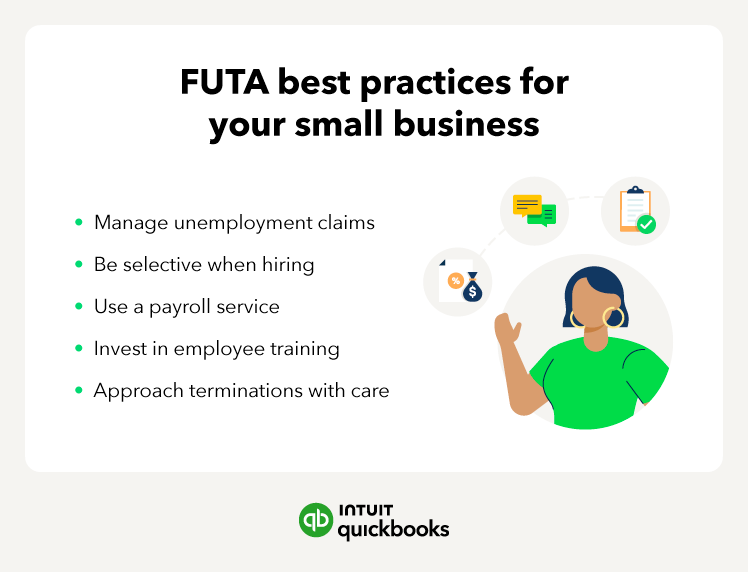
FUTA best practices for your small business

To help you stay in compliance, here are some best practices for handling your FUTA taxes:

  • Manage unemployment claims: Make an effort to respond to unemployment claims promptly and confirm claimant information for legitimate claims.
  • Be selective with hiring: Conduct a thorough interview and screening process to ensure you hire capable employees committed to your company.
  • Use a payroll service: A payroll service can help you file payroll taxes on time—automatically calculating SUTA and FUTA taxes in just a few clicks.
  • Invest in employee training: Improve employee retention by investing in training and professional development programs for your employees.
  • Approach terminations with care: Consider offering a severance package or outplacement services to help lower your potential unemployment tax liability.
  • Monitor credit reduction states: In 2026, employers in states like California and the US Virgin Islands may face higher effective FUTA rates due to outstanding federal loans.

Your company can potentially earn a 5.4% tax credit if you submit SUTA taxes on time. This is a 90% reduction in the FUTA tax and a huge incentive to meet all tax filing deadlines during the year. If you fail to meet due dates, you may face penalties from the IRS.

Find peace of mind come tax time
If you’re a small business owner, figuring out what FUTA is and calculating payroll obligations are likely the last things you want to deal with. In some cases, determining your tax liability can be confusing.

Payroll software like QuickBooks Payroll keeps your payroll information in one place, so you can easily organize and manage it. Plus, it allows you to calculate and file SUTA and FUTA taxes, helping you stay in compliance and avoid penalties.

*QuickBooks Online Payroll & Contractor Payments: Money movement services are provided by Intuit Payments Inc., licensed as a Money Transmitter by the New York State Department of Financial Services, subject to eligibility criteria, credit, and application approval. For more information about Intuit Payments Inc.’s money transmission licenses, please visit https://www.intuit.com/legal/licenses/payment-licenses/*


Recommended for you

Mail icon
Get the latest to your inbox
No Thanks

Get the latest to your inbox

Relevant resources to help start, run, and grow your business.

By clicking “Submit,” you agree to permit Intuit to contact you regarding QuickBooks and have read and acknowledge our Privacy Statement.

Thanks for subscribing.

Fresh business resources are headed your way!

Looking for something else?

QuickBooks

From big jobs to small tasks, we've got your business covered.

Firm of the Future

Topical articles and news from top pros and Intuit product experts.

QuickBooks Support

Get help with QuickBooks. Find articles, video tutorials, and more.